



Table of contents
The number-one Google result averages 3.8× more backlinks than positions two through ten, and that gap matters even more in the education vertical where .edu domains carry inherent trust signals. In 2026, coaching websites hold a median Domain Rating of 27 with 288 median referring domains, while the top 10% clear DR 57.
Key Takeaways
- The #1 Google result has 3.8× more backlinks than positions 2–10, based on Backlinko's analysis of 11.8 million search results.
- Coaching websites have a median Domain Rating of 27 with 288 referring domains — roughly average across all industries (SiteStatsDB, 2,369 coaching sites).
- A 10-point increase in Domain Rating correlates with 27% more organic traffic, all else being equal (Ahrefs Correlation Study).
- EdTech data studies earn 40+ editorial placements in their first year and continue earning passive links for 3–5 years.
- 92% of marketers consider guest post backlinks a top ranking factor in 2026 (PRNews.io survey).
- Expert quoting programs generate 8–15 editorial mentions per month for EdTech brands, almost all with dofollow links.
- Higher education .edu domains rank 2.7× faster for new content than sites with DR below 30.
Domain Authority and Backlink Benchmarks for Education
Understanding where education and coaching websites sit in the authority landscape helps set realistic targets. These benchmarks, tracked across 2,369 coaching sites and thousands of education domains, provide the baseline for any growth marketing strategies strategy that includes link acquisition.
Sources: SiteStatsDB (2,369 coaching sites); Ahrefs Web Index 2026
| Metric | Coaching Median | Top 10% | Industry Comparison |
|---|---|---|---|
| Domain Rating (Ahrefs) | 27 | 57+ | All-industry median: 28 |
| Referring domains | 288 | 1,500+ | EdTech leaders: 15,000–30,000 |
| Organic keywords ranked | 799 | 4,820+ | Top .edu sites: 100,000+ |
| Monthly organic visits | 2,000–5,000 | 100,000+ | 3.6% of coaching sites exceed 100K |
| Domain age (median) | 11 years | 15+ years | Older domains rank faster |
| Dofollow backlink ratio | 65–75% | 80%+ | Industry standard: 70% |
The coaching vertical shows median Domain Rating of 27, which sits at the all-industry average. However, the top 10% with DR above 57 capture disproportionate organic visibility. Platforms like BetterUp (DR 72), Testbook (DR 65), and USAB (DR 60) dominate their niches precisely because of sustained link acquisition campaigns. For newer coaching businesses, the path from DR 27 to DR 40 represents the steepest traffic acceleration — a 10-point DR increase corresponds to 27% more organic traffic on average.
Link Building Strategies and Performance Data
Not all link building tactics deliver equal returns. The education sector benefits from inherent credibility advantages, but execution quality determines whether those advantages translate into rankings. Teams focused on top Google Ads agencies approaches should prioritize strategies with proven ROI in the education vertical.
Sources: Link Building Journal; Authority Hacker 2026; PRNews.io
| Strategy | Avg. Links/Month | Avg. DR of Links | Cost Per Link | Best For |
|---|---|---|---|---|
| Original data studies | 5–10 | 50–70 | $200–$500 | EdTech, universities |
| Expert quoting (HARO/Connectively) | 8–15 | 40–65 | $50–$150 | Coaching, thought leaders |
| Guest posting (DR 40+) | 3–6 | 40–60 | $150–$400 | All education verticals |
| Scholarship link building | 1–3 | 55–80 | $100–$300 | Higher education, .edu sites |
| Resource page outreach | 4–8 | 30–50 | $100–$250 | Course creators, tutoring |
| Digital PR campaigns | 10–30 | 45–75 | $300–$800 | Funded EdTech startups |
| Content-driven (topic clusters) | 3–4× rate | Varies | Content cost only | Long-term authority building |
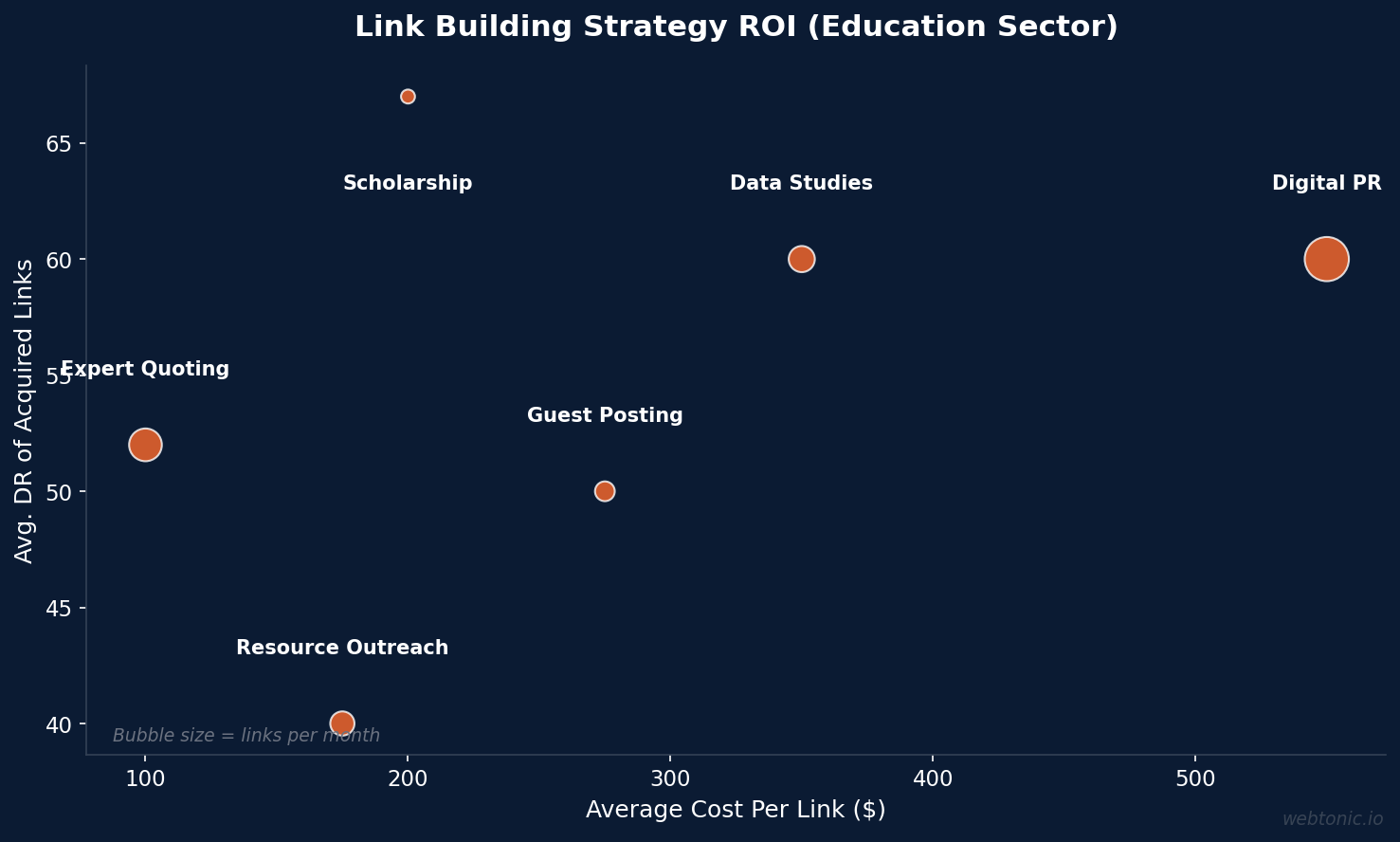
Original data studies are the highest-impact tactic for education brands. EdTech companies publishing anonymized user data (completion rates, time-to-skill metrics, career outcomes) earn 40+ editorial placements in their first year, with links continuing to accumulate passively for 3–5 years. Expert quoting through platforms like Connectively and Qwoted generates 8–15 editorial mentions per month at the lowest cost per link, making it ideal for individual coaches and small coaching firms building authority.
Outreach Response Rates and Campaign Benchmarks
Outreach effectiveness varies by approach and target. The education space benefits from higher response rates than commercial niches due to the sector's collaborative culture and the value educational content provides to publishers.
- Average outreach response rate: 8.5% across all industries (BuzzStream/Fractl). Education-specific outreach averages 11–14% when pitching data-backed content.
- Personalized outreach converts 3× better than template-based emails. Referencing a specific article on the prospect's site increases reply rates to 18–22%.
- Follow-up emails increase response rates by 65.8%. Two follow-ups is optimal; a third shows diminishing returns.
- Tuesday through Thursday sends generate 42% higher open rates than Monday or Friday outreach (Authority Hacker 2026).
- Subject lines under 50 characters outperform longer ones by 12% in link building outreach.
- .edu outreach response rates average 5–8% — lower than commercial sites, but the authority value of a single .edu backlink can exceed 10 standard links.
Content Types That Earn Links in Education
The format and depth of content directly influences how many natural backlinks it attracts. Education brands that invest in data-driven formats outperform those relying on standard blog posts for passive link acquisition. Having a robust performance creative services strategy amplifies the reach of each content asset.
Sources: Link Building Journal 2026; Searchlab.nl
| Content Type | Avg. Referring Domains (Year 1) | Link Velocity | Passive Link Potential |
|---|---|---|---|
| Original research / data studies | 40–80 | High | 3–5 years |
| Industry benchmark reports | 25–50 | High | 2–3 years (annual refresh) |
| Ultimate guides (3,000+ words) | 15–30 | Medium | 2–4 years |
| Infographics with data | 10–25 | Medium-High | 1–2 years |
| Expert roundups | 8–15 | Low-Medium | 6–12 months |
| Case studies | 5–12 | Low | 1–2 years |
| Standard blog posts | 2–5 | Low | Limited |
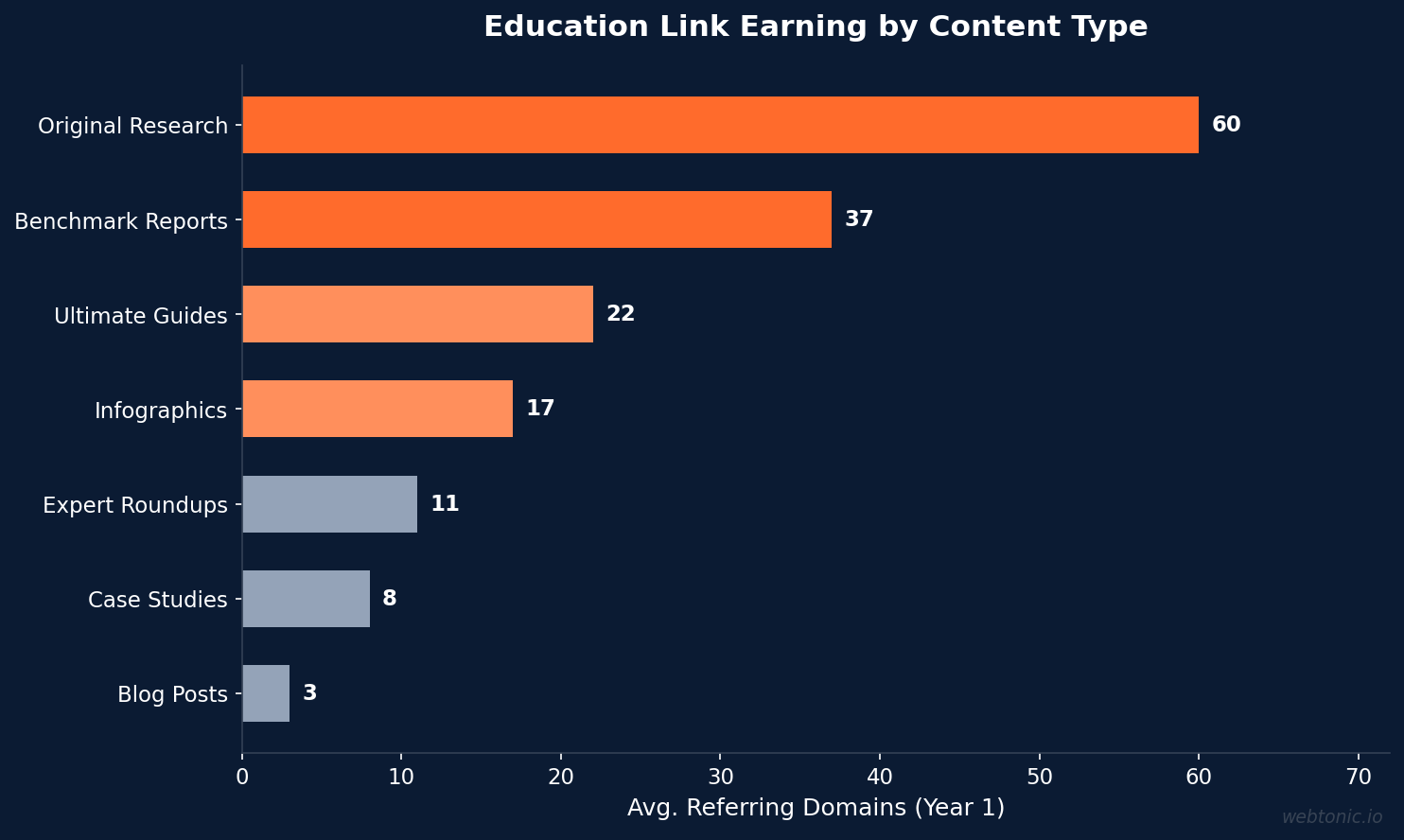
Original research earns 40–80 referring domains in the first year, dwarfing standard blog posts at 2–5. For coaching brands, this translates to publishing survey data (client transformation outcomes, industry salary benchmarks, certification completion rates) that journalists and bloggers reference repeatedly. The topic cluster approach generates links at 3–4× the rate of isolated product pages, with a meaningful share coming from .edu and .gov domains that were never directly pitched (Link Building Journal).
Higher Education and EdTech Link Building Data
The education sector carries unique advantages for backlink acquisition. Understanding how to leverage these advantages helps institutions and EdTech brands build authority faster than competitors in adjacent markets. Combining link building with strong data intelligence analytics reveals which efforts drive real enrollment impact.
- .edu domains rank 2.7× faster for new content than sites with DR below 30 (Ahrefs Speed of Ranking Study). This inherent authority advantage means link building amplifies existing trust signals.
- 78% of all dofollow backlinks belong to the top 1% of websites, illustrating extreme link concentration (Ahrefs Web Index). Education brands must actively build links rather than waiting for passive accumulation.
- DR 50+ correlates with the strongest ranking velocity. Universities and established EdTech platforms at this threshold can rank new content within weeks rather than months.
- The global EdTech market is projected to reach $214 billion in 2026, growing at 18% CAGR with AI-powered solutions accounting for 30% of market share. This growth generates substantial media coverage opportunities.
- Scholarship pages are a proven .edu link building strategy. A $5,000 annual scholarship published on a dedicated page earned one EdTech brand 11 editorial placements in 18 months from scholarship aggregator databases.
- DR correlation with search positions is 0.31 — the third-strongest ranking correlation after referring domains and content quality (Ahrefs Ranking Factors).
Link Decay and Maintenance Statistics
Building links is only half the equation — maintaining them matters equally. The education sector faces unique link decay patterns driven by institutional website redesigns, program page restructuring, and annual content refresh cycles.
The average web page loses 5–10% of its backlinks annually through natural decay (site closures, URL restructuring, editorial removals). For education websites, this rate increases during institutional rebranding or CMS migration cycles. Universities and coaching platforms that redesign their websites without implementing proper 301 redirects risk losing 30–50% of their accumulated backlink value in a single migration event.
Link reclamation campaigns recover 15–25% of lost backlinks when pursued within 6 months of link loss. The process involves monitoring backlink profiles for dropped links, identifying the cause (404 errors, content removal, or editorial decisions), and reaching out to webmasters with updated URLs or replacement content. For education brands with 500+ referring domains, quarterly link reclamation audits typically recover 8–15 high-value links that would otherwise be permanently lost.
Anchor text distribution matters more than volume for education sites. The optimal distribution for coaching and education websites follows a pattern of approximately 40–50% branded anchors, 20–30% URL-based anchors, 15–20% topic-relevant partial-match anchors, and only 5–10% exact-match keyword anchors. Sites exceeding 15% exact-match anchors in the education vertical face elevated algorithmic scrutiny, particularly since Google's March 2025 spam update increased penalties for manipulative anchor patterns.
ROI of Link Building for Education Businesses
Measuring link building ROI requires connecting authority growth to enrollment and revenue outcomes. The data shows clear returns when campaigns are executed consistently over 6–12 month periods.
Education businesses investing $2,000–$5,000 per month in link building see average organic traffic increases of 35–65% within 12 months, with the strongest gains appearing after month 6 when accumulated authority signals begin compounding. For a tutoring center generating $50,000 monthly in enrollment revenue, a 40% organic traffic increase driven by link building translates to $20,000 in additional monthly revenue — a return of 4–10× on the link building investment.
The break-even timeline for education link building averages 4–6 months, shorter than the SaaS industry average of 8–12 months. This accelerated timeline reflects the education sector's inherent trust advantage and the typically lower keyword difficulty for local and niche educational queries. Coaching businesses targeting long-tail terms like "executive coaching for tech leaders" or "career coaching for mid-career professionals" often see first-page rankings within 3–4 months of sustained link building activity.
Internal linking structure amplifies external link building ROI. Education websites that distribute link equity through strategic internal linking — connecting pillar program pages to supporting content through contextual anchor text — extract 40–60% more ranking value from each external backlink than sites with flat or siloed architectures. The optimal internal linking ratio for education sites is 3–5 internal links per 1,000 words of content, with links pointing both to core conversion pages and to topically related supporting content.
Related reading
- Guest Post Link Building Service for Online Education: How to Earn Authority Backlinks in the EdTech Niche
- 12 Link Building Strategies That Still Earn Links
- Haro Link Building: What It Is & How to Use It
- Link Building Services services at Web Tonic
Frequently Asked Questions
How many backlinks does an education website need to rank?
There is no universal number, but the data shows the #1 Google result has 3.8× more backlinks than positions 2–10. For coaching websites with a median DR of 27, building 15–30 quality referring domains per month is a realistic target. Higher education sites with .edu authority need fewer links per page but benefit from link building to specific program pages.
What is the average cost per backlink in the education sector?
Costs range from $50–$150 per link for expert quoting to $300–$800 per link for digital PR campaigns. Guest posting on DR 40+ sites averages $150–$400 per placement. The most cost-effective approach for education brands is original data studies, which earn high-authority links at scale with a one-time content investment.
Do .edu backlinks still matter in 2026?
Yes. While Google does not officially give .edu links extra weight, the correlation between .edu domains and high Domain Rating means these links carry significant authority signals. Sites with DR 50+ (common for .edu domains) rank new content 2.7× faster, making any backlink from such domains highly valuable.
What link building strategy works best for coaching businesses?
Expert quoting programs (using Connectively, Qwoted, and Help A B2B Writer) deliver the best ROI for individual coaches — generating 8–15 editorial mentions monthly with dofollow links at the lowest per-link cost. Combined with original data studies using anonymized client outcomes, this approach builds both authority and thought leadership simultaneously.
Sources
Searchlab — 80+ Link Building Statistics 2026
SiteStatsDB — Coaching Website Statistics
Link Building Journal — Link Building for EdTech 2026
PRNews.io — Education Guest Posting 2026
Manaferra — Link Building Strategies for Higher Education 2026
DIY Genius — Local SEO for Coaches


