Table of contents
If you searched "HARO link building" and found a confusing mess of shutdown notices, rebrand announcements, and outdated screenshots, that reaction makes complete sense. The platform went through three different names in under two years. The good news: the underlying tactic never actually stopped working, and HARO itself is back, free, and very much active in 2026.
HARO (Help A Reporter Out) link building is the practice of responding to journalist queries with expert pitches in exchange for a mention and, often, a backlink from the publication that uses your quote. It remains one of the few ways an unknown website can earn a link from a genuinely high-authority domain like Forbes without an existing media relationship, without paying for placement, and without competing purely on domain rating.
Key Takeaways
- HARO shut down as "Connectively" on December 9, 2024, after Cision introduced paid tiers the community largely rejected; Featured.com relaunched it under the original HARO name and free model on April 22, 2025.
- HARO is entirely free in 2026 for both journalists and sources; Featured.com monetizes the platform through newsletter sponsorships rather than subscription fees.
- Typical pitch success rates run 5-15%, and sending 10-15 relevant pitches per week tends to produce 1-3 actual placements per month.
- Response speed matters more than almost anything else: popular queries can draw hundreds of pitches within the first hour, so pitching quickly after a digest lands is often the single biggest lever a source controls.
- Link quality varies by publication: some outlets give dofollow links, some nofollow, and some just a text mention, so a HARO strategy shouldn't assume every placement passes the same SEO value or drives the same referral traffic.
- Alternatives like Qwoted, SourceBottle, and Source of Sources are worth running alongside HARO rather than relying on a single platform for editorial backlinks.
What happened to HARO? A quick history
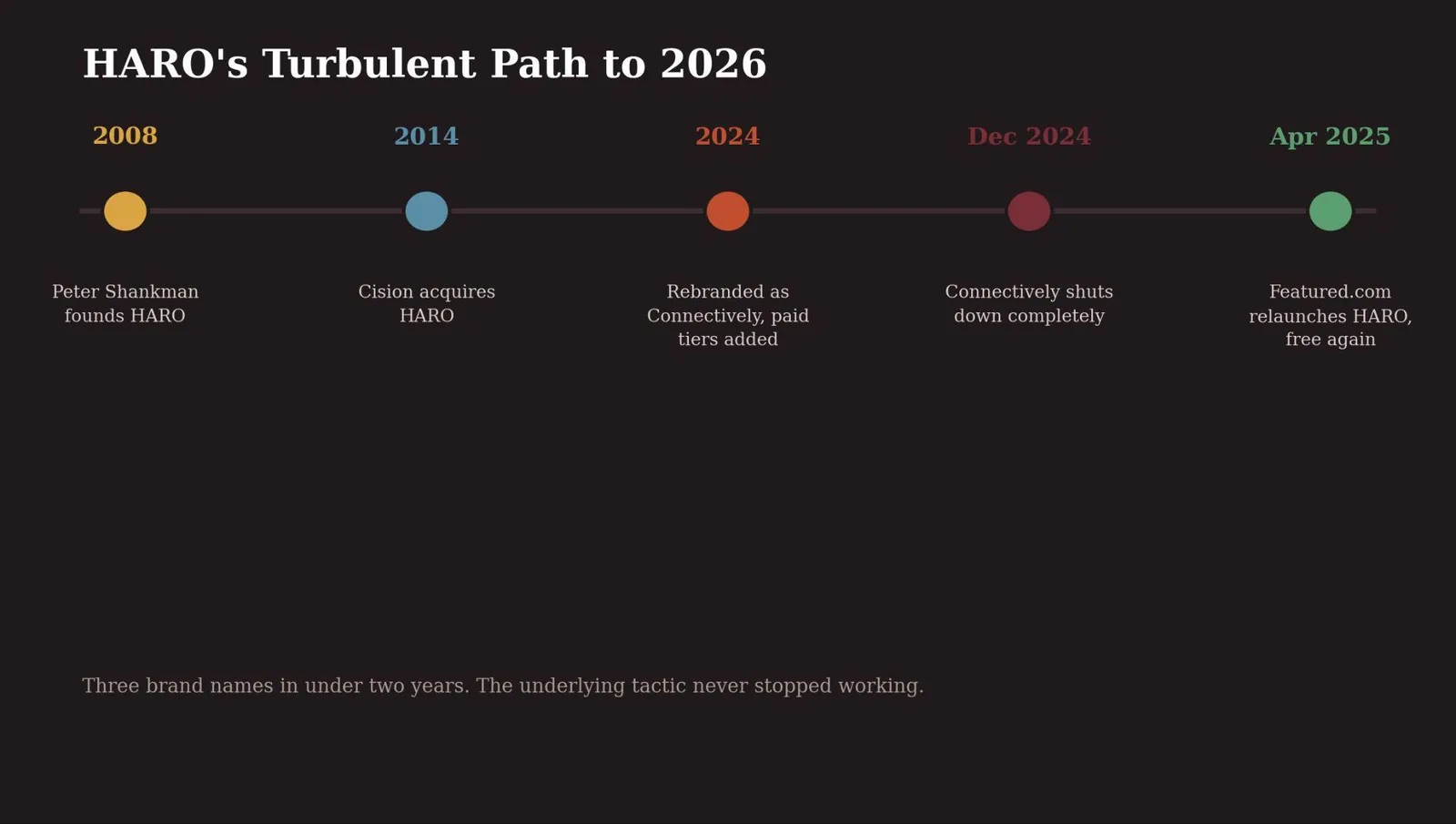
Understanding the current platform requires understanding what it survived. Per GavelGrow's 2026 breakdown of HARO's history, Peter Shankman founded HARO in 2008, and Cision acquired it in 2014, running it largely unchanged for close to a decade. In 2024, Cision rebranded the service as Connectively and introduced paid tiers ranging up to $149 per month, a change the PR community broadly resisted. According to Prezly's 2026 roundup of Connectively alternatives, response quality dropped as the transition frustrated long-time users, and Connectively shut down completely on December 9, 2024.
The story doesn't end there. MentionAgent's 2026 HARO review confirms that Featured.com, led by CEO Brett Farmiloe, acquired the HARO brand and relaunched it on April 22, 2025, restoring the classic three-times-daily email digest format and removing the paid tiers entirely. As of 2026, per MentionAgent's pricing breakdown, HARO operates free for both journalists and sources, funded by newsletter sponsorships rather than subscription fees. Some more recent brand consolidation has moved parts of the service back toward the Connectively name, though the core mechanics, free digests, direct email pitching, no login required to respond, have stayed consistent since the April 2025 relaunch.
How HARO link building actually works
Journalists, editors, and content teams post queries describing exactly what kind of source they need for a story already in progress, a marketing CMO who can speak to attribution modeling, or a personal injury attorney who can explain how courts evaluate a specific claim. Sources sign up for free at HARO's site, receive three daily email digests, and reply directly to queries that match their expertise. If a journalist uses the response, the source typically gets named in the piece along with a link back to their website, though link type varies by publication.
That mechanism is exactly why it works for SEO: a journalist selecting a source for an article is an independent editorial decision, not a paid placement, which makes the resulting backlink carry a kind of trust signal that's difficult to manufacture through guest posting or other more transactional link building tactics. Google's own public guidance has long discouraged manufactured link schemes in favor of links earned through genuine editorial merit, which is the exact mechanism HARO placements rely on.
HARO and its alternatives compared
| Platform | Cost | Best for | Notes |
|---|---|---|---|
| HARO (Featured.com) | Free | Volume of daily queries across broad topics | Classic 3x daily email digest; high competition per query |
| Qwoted | Free tier available | Curated matching, less noise per query | Profile-based; journalists can find sources proactively |
| SourceBottle | Free tier available | International queries, including podcasts | Strong outside the U.S.; interface feels dated |
| Source of Sources (SOS) | Invite/waitlist | Higher dofollow rate, curated format | Founded by Peter Shankman post-shutdown; smaller volume |
Why journalist links carry outsized SEO value
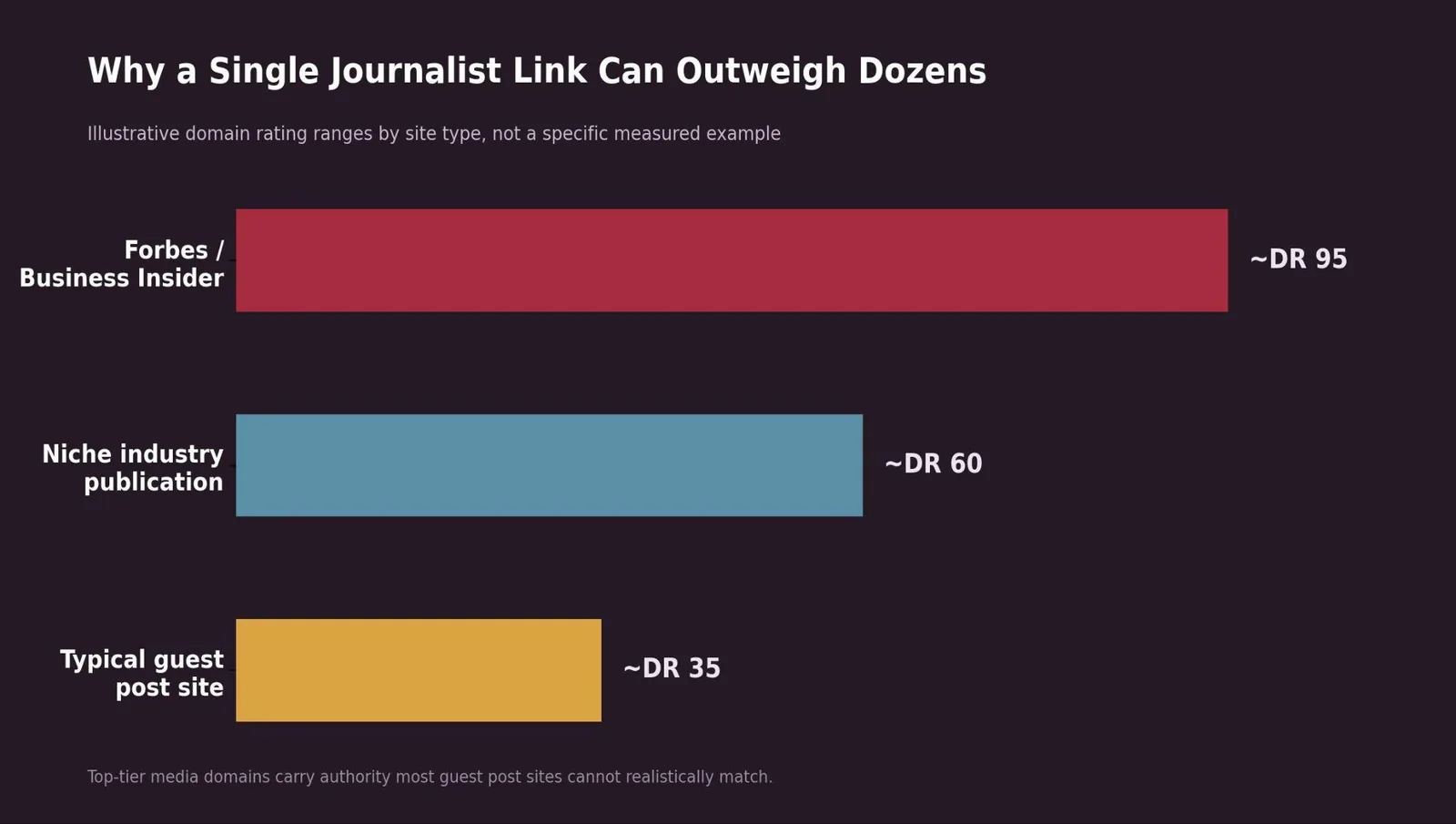
Not every backlink is created equal, and this is where HARO's value lives. A single quote placed in a publication like Forbes or Business Insider can carry more authority, and a higher domain rating, than dozens of typical guest post links combined, simply because of the domain strength those top tier media outlets have built over years of their own editorial output. That's also increasingly relevant beyond traditional rankings: research from Mentiohunt's 2026 guide, citing BuzzStream found that 75% of digital PR professionals have already been asked by clients about the connection between editorial placements and AI citation visibility, though only 11% report having a reliable process for it, a gap that HARO placements on reputable sites can help close simply by existing.
Building a realistic HARO pitching system
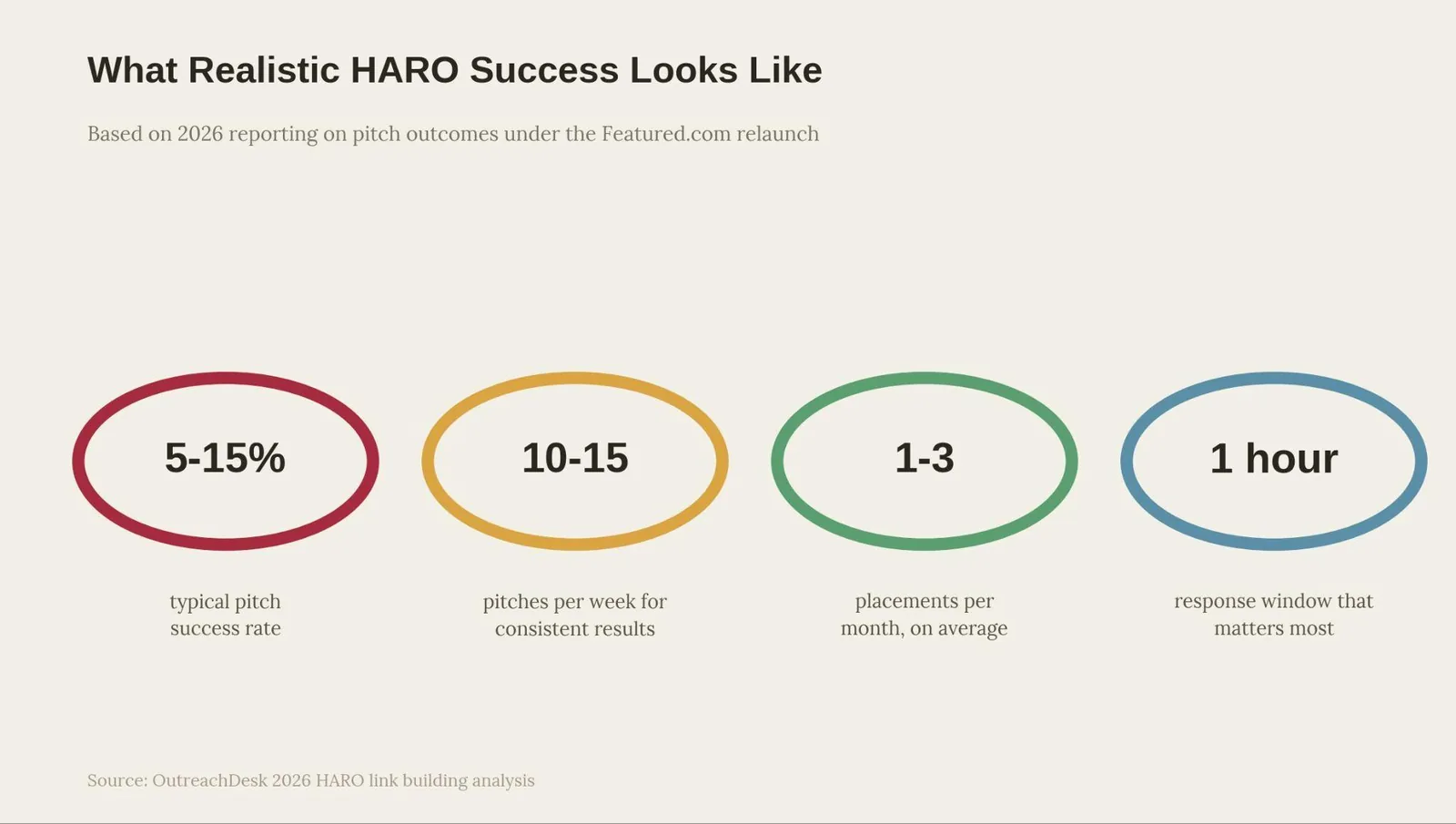
Treat this as a numbers game with a hard floor built in. Per OutreachDesk's 2026 analysis, a 5-15% typical success rate means most individual pitches won't land, and that's normal, not a sign of a bad pitch. Consistency compounds: 10-15 relevant pitches per week realistically produces somewhere around 1-3 placements per month, enough to build a steady stream of high-authority links over a quarter.
Speed is the single most controllable variable. Popular queries can draw hundreds of responses within the first hour a digest goes out, so checking the digest promptly and replying fast matters more than almost any other tactic. Beyond speed, Prezly's step-by-step pitching guide recommends keeping pitches short (well under 150 words), leading with a specific credential or title rather than a generic introduction, answering the actual question asked rather than pitching a call or interview, and skipping anything that reads like it was generated rather than written by a genuine subject matter expert, since editors and Featured.com's own AI-detection filters are both increasingly good at spotting generic responses. A pitch needs an actual voice and specifics tied to real experience to survive that filter.
Check a draft pitch below before sending it, against the patterns that tend to separate a placement from an ignored email.
Pitch quality tool
Check your pitch before you hit send
Paste a draft pitch below to check it against the patterns that tend to get selected.
For teams without the internal bandwidth to monitor three daily digests, hiring a freelance PR or content specialist through a platform like Upwork to manage pitch monitoring and drafting is a common, cost-effective middle ground between doing it entirely in-house and hiring a full digital PR agency.
Common HARO link building mistakes
Pitching generic, obviously AI-written responses is the most damaging mistake in 2026 specifically, since both journalists and Featured.com's own filters are actively screening for it.
Asking for a call or interview when the query asked for a direct quote is a close second. Journalists on tight deadlines want the answer in the pitch itself, not a scheduling back-and-forth.
Treating every HARO placement as an equal SEO win is a subtler mistake. Link type, dofollow, nofollow, or text-only mention, varies by publication, so a HARO strategy built entirely around backlink assumptions will overestimate its own SEO impact and the actual traffic it drives.
And relying on HARO as the sole link building channel is a bigger strategic mistake. It works best as one source of unpredictable, high-authority placements alongside a broader link building strategy that includes more controllable tactics, case studies, original research, and proactive outreach among them.
Frequently asked questions
Is HARO still around in 2026?
Yes. After Cision's "Connectively" rebrand shut down completely in December 2024, Featured.com acquired and relaunched HARO in April 2025 under its original free, email-digest format, and it remains active today.
Is HARO free to use?
Yes, for both journalists and sources. Featured.com monetizes the platform through newsletter sponsorships rather than charging subscription fees or per-pitch costs.
Do HARO placements always include a backlink?
Not always. Link policy depends on the individual publication; some give dofollow links, some nofollow, and some provide only a text credit without a link at all.
What's a realistic success rate for HARO pitches?
Most sources see a 5-15% success rate. Sending 10-15 relevant, well-targeted pitches per week typically produces about 1-3 actual placements per month.
Should I use HARO alongside other link building tactics?
Yes. HARO works best as one channel among several, since it produces unpredictable, high-authority placements rather than guaranteed links to specific target pages. Pairing it with more controllable digital PR and outreach tactics builds a more diversified, resilient backlink profile.
Where HARO fits in a 2026 link building strategy
HARO link building survived a shutdown, a rebrand, and a return, and the tactic itself remains genuinely valuable: a free, direct path to backlinks from publications no cold outreach email could realistically reach. It isn't a volume play, and it isn't predictable, but a consistent, fast, well-written pitching habit run over several months adds up to a meaningful run of high-authority placements that most other link building tactics can't replicate.
Check whichever email digest arrives next against the pitch checklist above before responding. The habit of pitching quickly and specifically, more than any single trick, is what separates sources who get placements from sources who get ignored.
Building a link profile that goes beyond HARO alone
Journalist pitching earns unpredictable, high-authority links, but it can't be the entire strategy. Web Tonic's off-site SEO and digital PR team combines HARO-style pitching with more controllable link building and content work, so a backlink profile keeps growing even in the weeks a digest doesn't produce a placement.
More from Web Tonic: growth marketing services, data & analytics.
Sources: gavelgrow.com · prezly.com · mentionagent.ai · mentiohunt.com · outreachdesk.com