Table of contents
Key Takeaways
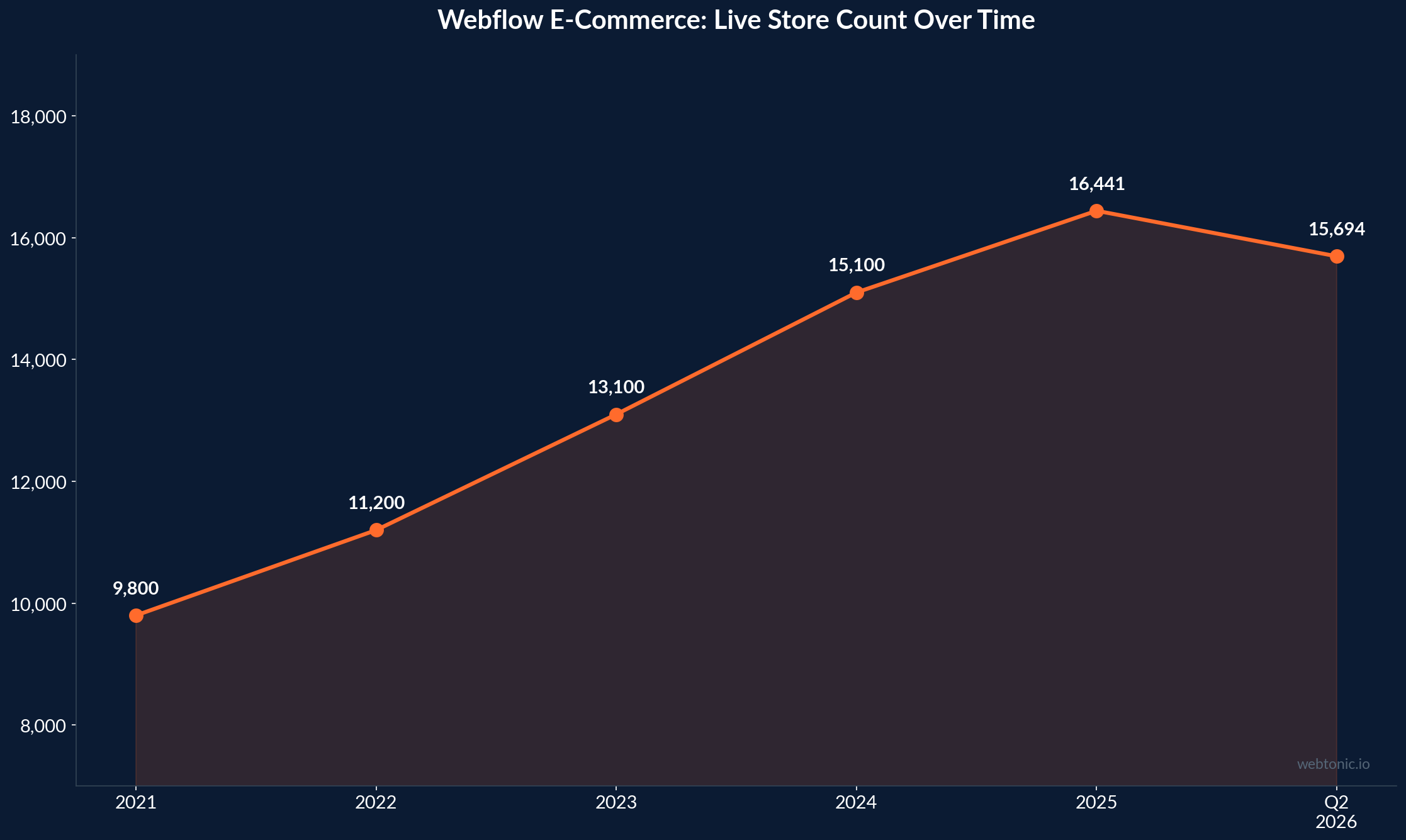
- Webflow powers approximately 15,694 live e-commerce stores as of Q2 2026, a 4% year-over-year increase despite a slight quarterly dip of −1.2%.
- Webflow e-commerce holds a 0.55% market share among e-commerce platforms, ranking #8 in the category — far behind Shopify's 46.9% but growing faster in the design-first DTC segment.
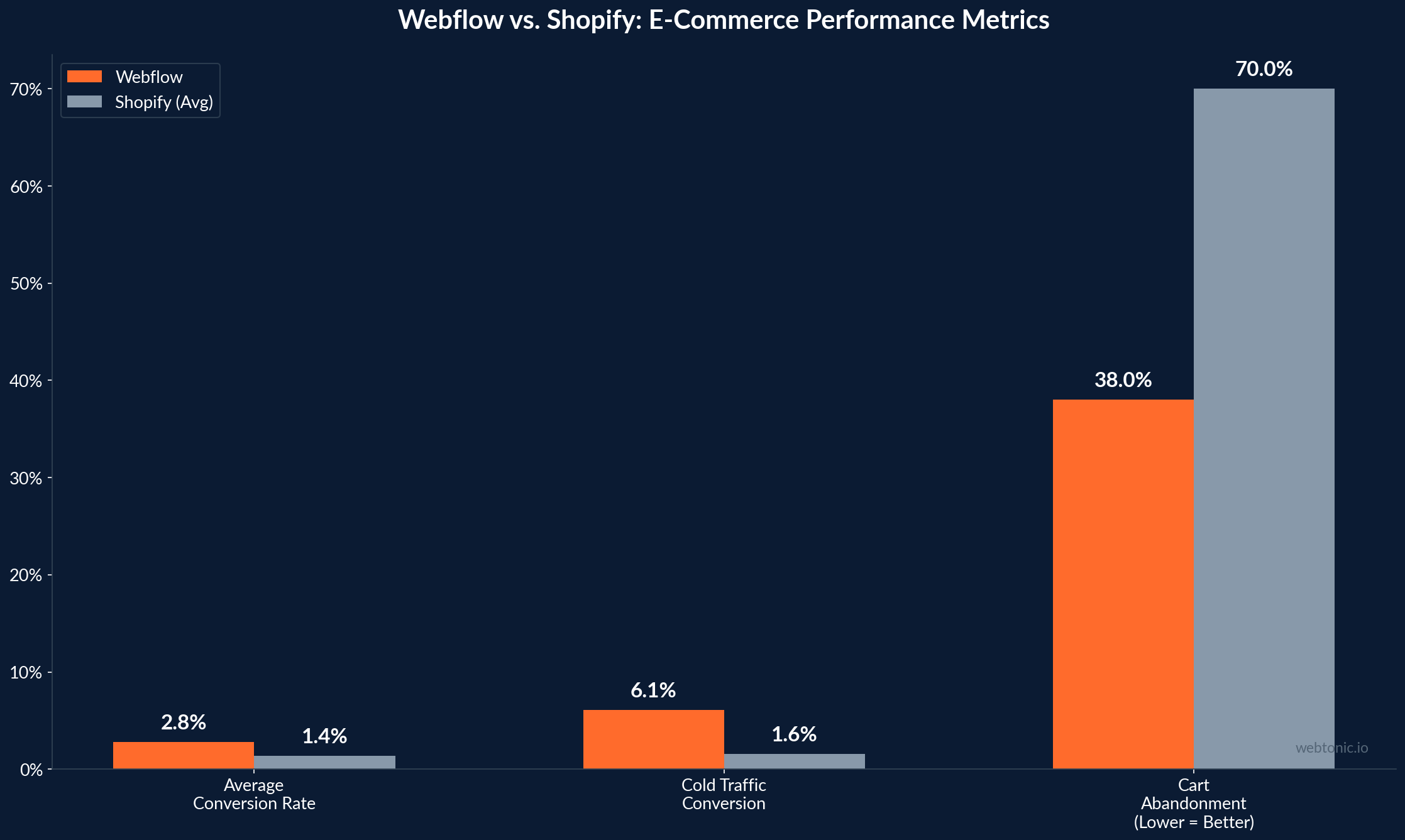
- Webflow e-commerce clients average 2.8% conversion rates versus Shopify's 1.4% store average, attributed to design flexibility and page speed advantages.
- Cold traffic conversion on Webflow funnels reaches 6.1%, with 14–21% better conversion than typical Shopify setups due to faster load times.
- Cart abandonment on optimized Webflow checkouts sits at 38% versus the industry average of 70%+, driven by streamlined single-page checkout flows.
- Webflow added approximately 10,000 net new e-commerce domains in 2024, making it one of the fastest-growing design-first e-commerce platforms by adoption rate.
Webflow E-Commerce Benchmarks at a Glance
| Metric | Webflow E-Commerce | Industry / Shopify Avg. |
|---|---|---|
| Live Stores (Q2 2026) | ~15,694 | Shopify: 4.8M+ |
| Market Share | 0.55% | Shopify: 46.9% |
| YoY Store Growth | +4% | Shopify: +18% |
| Avg. Conversion Rate | 2.8% | Shopify avg: 1.4% |
| Cold Traffic CVR | 6.1% | Shopify avg: 1.4–1.8% |
| Cart Abandonment | 38% (optimized) | ~70% (industry avg) |
| Checkout CVR Lift | 10–20% over default themes | — |
Webflow's e-commerce layer is positioned as a design-first platform for brands that prioritize conversion and experience over raw SKU scale. The numbers tell a clear story: fewer stores, but significantly higher conversion rates for brands that leverage the platform's design freedom to optimize every element of the shopping experience.
Webflow E-Commerce Market Share and Growth Trajectory
Webflow e-commerce holds a 0.55% share of the global e-commerce platforms market, ranking #8 overall. That looks tiny next to Shopify's 46.9%, but growth rate tells a different story. Webflow added roughly 10,000 net new active e-commerce domains in 2024 alone, faster than many established mid-tier platforms and indicating strong momentum in the design-first e-commerce segment.
As of Q2 2026, there are 15,694 live Webflow e-commerce stores, reflecting a 4% year-over-year increase but a slight −1.2% quarter-over-quarter dip. The United States accounts for 10,376 Webflow e-commerce sites, making it the dominant market by a wide margin. Sales-Hacking reports approximately 15,500 active stores with about 5% annual growth — consistent with a platform carving a niche in the premium DTC and branded commerce segments rather than competing for mass-market volume.
The Aguko tracking platform counts 5,915 Webflow e-commerce sites using a stricter methodology, representing a 0.07% share of the broader e-commerce ecosystem. This discrepancy between sources reflects different counting methods — some include sites with commerce features enabled but not actively selling, while others count only stores processing live transactions.
Conversion Rate and Speed Advantages
The strongest argument for Webflow e-commerce is its conversion performance. Michael Zang's agency reports that Webflow e-commerce clients average 2.8% conversion rates — double Shopify's 1.4% store average. This gap is not accidental: Webflow's design freedom allows optimization of every element without the constraints of template systems or app bloat.
DTC Funnels' data is even more striking: cold traffic conversion on Webflow funnels reaches 6.1%, with cart abandonment at just 38% on optimized checkouts. The speed advantage alone accounts for a 14–21% conversion improvement over typical Shopify setups loaded with multiple third-party apps that bloat page weight and slow load times.
LoudFace confirms that Webflow's focus on the checkout flow can deliver 10–20% conversion rate improvements over default Shopify themes, particularly for limited-edition launches and campaign-driven commerce where the marketing page experience matters as much as the product page itself.
For context, the top 20% of Shopify stores convert at above 3.2%, and the top 10% exceed 4.7%. Webflow's 2.8% average sits between the general Shopify average and the top performer tier — but importantly, this average applies to all Webflow commerce stores, not just optimized ones, suggesting significant headroom for conversion rate optimization work on the platform.
Webflow vs. Shopify: E-Commerce Platform Comparison
| Factor | Webflow E-Commerce | Shopify |
|---|---|---|
| Starting Price | $29/mo (Standard) | $29/mo (Basic) |
| Product Limit | 500 (Standard) | Unlimited |
| Transaction Fee | 2% (Standard), 0% (Plus/Adv) | 0.5–2% (non-Shopify Payments) |
| Annual Sales Cap | $50K (Standard), Unlimited (Adv) | None |
| Design Freedom | Full visual control | Theme-based with Liquid |
| App Ecosystem | Limited (~100+) | 8,000+ apps |
| Payment Processors | Stripe, PayPal + Apple/Google Pay | Shopify Payments + 100+ gateways |
| Best For | Design-led DTC, under 500 SKUs | Scale, marketplace, 500+ SKUs |
For a $1M-per-year brand, 24-month total cost of ownership runs within 15% of each other on Webflow Ecommerce Plus vs. Shopify Advanced, according to Digital Heroes. The subscription fee is small — payment processing, the app stack, and developer hours dominate total costs. Both platforms charge $29/month at the entry level, but the cost trajectories diverge significantly as transaction volume and feature requirements grow. Webflow's Standard plan caps annual sales at $50K with a 2% transaction fee, while Shopify Basic allows unlimited revenue volume with lower Shopify Payments processing rates. This makes Webflow more cost-effective for low-volume, high-margin DTC brands but more expensive per transaction for volume-driven businesses that process hundreds of orders daily.
Webflow E-Commerce for DTC Brands: When It Works
Webflow's e-commerce layer works best in specific scenarios where design drives revenue directly:
- Limited-edition launches and one-off campaigns — when marketing drives the conversion, not product breadth. Webflow's design flexibility creates campaign-specific shopping experiences impossible on template-constrained platforms.
- Design-led DTC brands with fewer than 500 SKUs — the sweet spot where Webflow's Standard plan ($29/mo) covers the product catalog without sales caps immediately limiting growth trajectory.
- Acquisition funnels that feed into a separate commerce backend — smart brands split acquisition (Webflow) from commerce (Shopify), capturing the conversion advantages of both platforms.
- Content-driven commerce where editorial and product pages blend seamlessly — Webflow's CMS custom fields enable storytelling-first product experiences that template platforms struggle to replicate.
Where it breaks down: structural constraints become visible once operators move past modest SKU counts and transaction volumes. E-commerce Times' 2026 review notes that native tools like abandoned cart recovery and email automation remain basic compared to Shopify's mature ecosystem, and Stripe and PayPal are the only primary payment processors — a meaningful limitation for international sellers needing regional payment methods.
Webflow E-Commerce Limitations and Scaling Constraints
While the conversion data favors Webflow, the platform has structural limitations that become apparent at scale. E-commerce Times' 2026 analysis identifies several constraints that mid-market brands should evaluate carefully before committing to Webflow as their primary commerce platform.
The product limit of 500 on the Standard plan ($29/mo) is the first ceiling most growing stores hit. The Plus plan at $74/month raises this to 1,000 products with a $200K annual sales cap, while the Advanced plan at $212/month supports 3,000 products with no revenue ceiling. For brands with extensive catalogs, these caps force plan upgrades earlier than equivalent Shopify tiers would require.
Payment processing is notably restricted: Stripe and PayPal are the only primary payment processors, supplemented by Apple Pay and Google Pay through Stripe. This limits Webflow's viability for international sellers who need regional payment methods like Klarna, Afterpay, or local bank transfers. Shopify, by contrast, integrates with over 100 payment gateways globally.
Native marketing tools also lag behind: abandoned cart recovery and email automation remain basic compared to Shopify's mature ecosystem. Webflow stores that need advanced post-purchase flows, loyalty programs, or subscription management typically must integrate third-party tools — which can negate the speed advantage that drives Webflow's superior conversion rates. The app ecosystem gap (approximately 100 Webflow integrations versus 8,000+ Shopify apps) represents the most significant functional difference between the two platforms for commerce-focused operations.
Best Practices for Webflow E-Commerce Optimization
- Keep SKU counts under 500 on the Standard plan. The $50K annual sales cap means high-AOV brands hit the ceiling fast — upgrade to Plus ($74/mo) for a $200K cap and 0% transaction fees before transaction costs eat into margins.
- Design single-page checkout flows. Optimized Webflow checkouts achieve 38% cart abandonment vs. 70%+ industry average — every unnecessary step or field costs conversions.
- Use Webflow for acquisition, Shopify for fulfillment. The hybrid approach captures Webflow's 6.1% cold traffic conversion while leveraging Shopify's app ecosystem for post-purchase operations.
- Optimize page speed religiously. Webflow's speed advantage accounts for 14–21% better conversion than Shopify setups with multiple apps — don't add heavy third-party scripts that negate the core advantage.
- Leverage native Apple Pay and Google Pay. Webflow supports both through Stripe integration — express checkout reduces friction on mobile, where the majority of DTC traffic originates.
- Build custom product pages with CMS collections. Use Webflow's CMS custom fields to create rich, data-driven product pages that template-based platforms cannot match in visual quality or performance.
Frequently Asked Questions
How many stores use Webflow e-commerce in 2026?
Approximately 15,694 live stores run on Webflow's e-commerce platform as of Q2 2026, with about 10,376 based in the United States. The platform grew 4% year-over-year and added roughly 10,000 net new domains in 2024, though quarterly growth has slowed slightly to −1.2% in Q2 2026. Different tracking methodologies produce varying counts, with stricter definitions showing approximately 5,900 active commerce sites.
What is Webflow's e-commerce market share?
Webflow holds 0.55% of the e-commerce platforms market, ranking #8 in the category. For context, Shopify commands 46.9%. Webflow's share is small by volume but significant in the design-first DTC segment where brands prioritize conversion rate and brand experience over SKU scale and marketplace features.
Is Webflow better than Shopify for e-commerce?
Webflow outperforms Shopify on conversion rate (2.8% vs. 1.4% average) and page speed, but Shopify wins on scalability, app ecosystem (8,000+ vs. approximately 100), and unlimited product catalogs. Webflow is better for design-led DTC brands with fewer than 500 SKUs; Shopify is better for high-volume commerce with complex fulfillment and international payment needs.
What are Webflow e-commerce pricing limitations?
Webflow's Standard plan ($29/mo) caps at 500 products and $50K annual sales with a 2% transaction fee. The Plus plan ($74/mo) raises limits to 1,000 products and $200K with 0% fees. The Advanced plan ($212/mo) supports 3,000 products with unlimited sales volume. These caps make Webflow unsuitable for high-SKU catalog businesses but competitive for focused DTC brands.
What conversion rates do Webflow e-commerce stores achieve?
Webflow e-commerce clients average 2.8% conversion rates, with optimized cold-traffic funnels reaching 6.1%. Cart abandonment on streamlined checkouts sits at 38%, well below the 70%+ industry average. These numbers reflect Webflow's design freedom and speed advantages rather than platform-inherent features — meaning results depend heavily on implementation quality.
Sources
technologychecker.io — Companies Using Webflow Ecommerce 2026
michaelzang.com — Webflow for E-Commerce: Building High-Converting Stores
dtcfunnels.com — Webflow vs Shopify for DTC Funnels
ecommerce-times.com — Webflow's Ecommerce Layer in 2026
mycodelesswebsite.com — Webflow Statistics 2026
sales-hacking.com — Webflow Key Figures 2026
loudface.co — Webflow for E-commerce 2026
digitalheroesco.com — Webflow vs Shopify 2026
match-vs.com — Shopify vs Webflow 2026
aguko.com — Websites Using Webflow Ecommerce