



Table of contents

Shopify powers 2.9 million live stores in 175+ countries and processed $378 billion in GMV during 2025 — making it the dominant hosted e-commerce platform worldwide. Below are the most important Shopify statistics every online retailer should know in 2026.
Key Takeaways
- 2,898,351 live Shopify stores are active globally as of Q2 2026, up 11% year-over-year (Store Leads).
- $378.4 billion in GMV was processed through Shopify in 2025, a 29% increase from the prior year (Ecommercetrix).
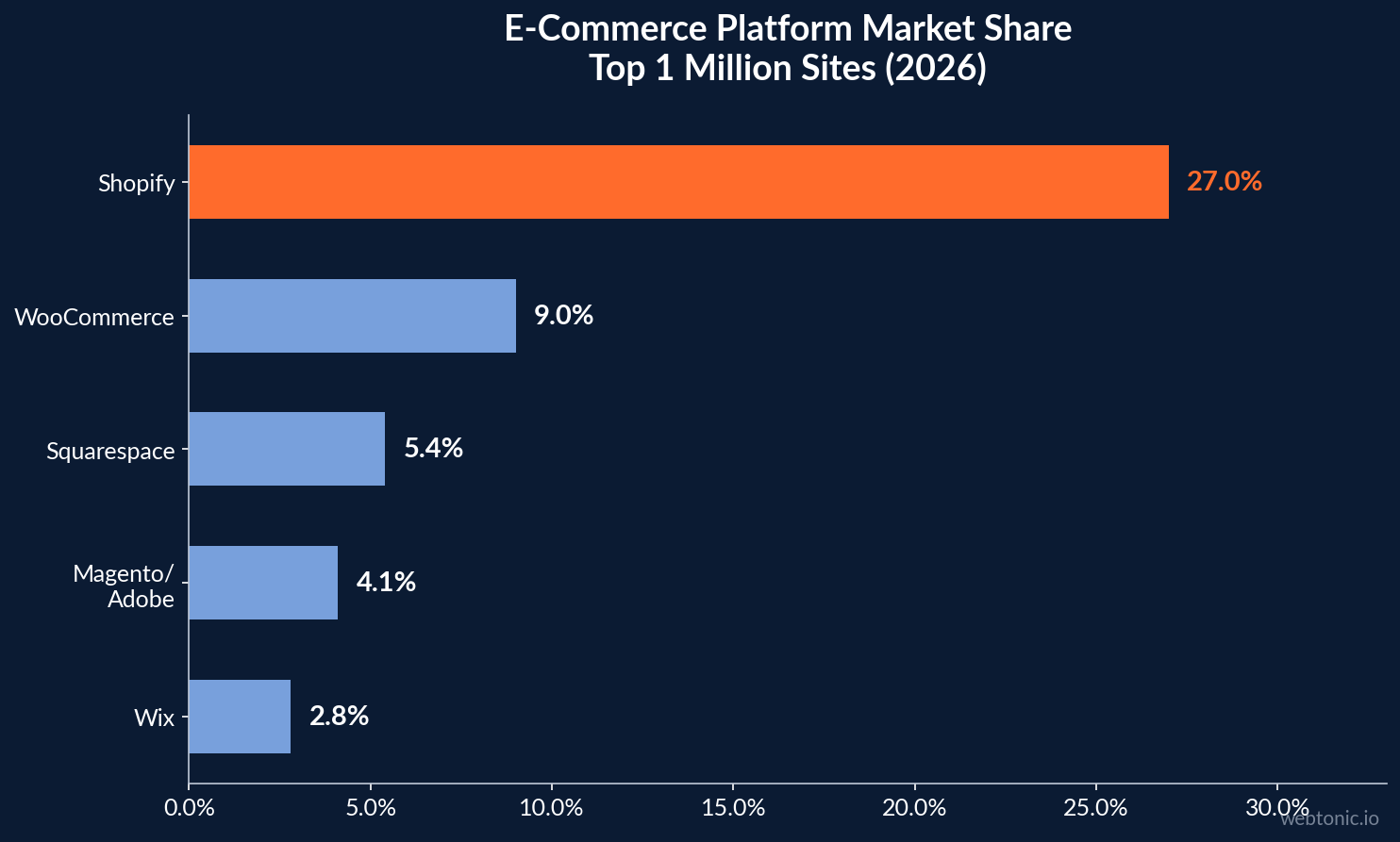
- 27% of the top one million e-commerce sites run on Shopify, making it the #1 platform in that segment (Ecommercetrix).
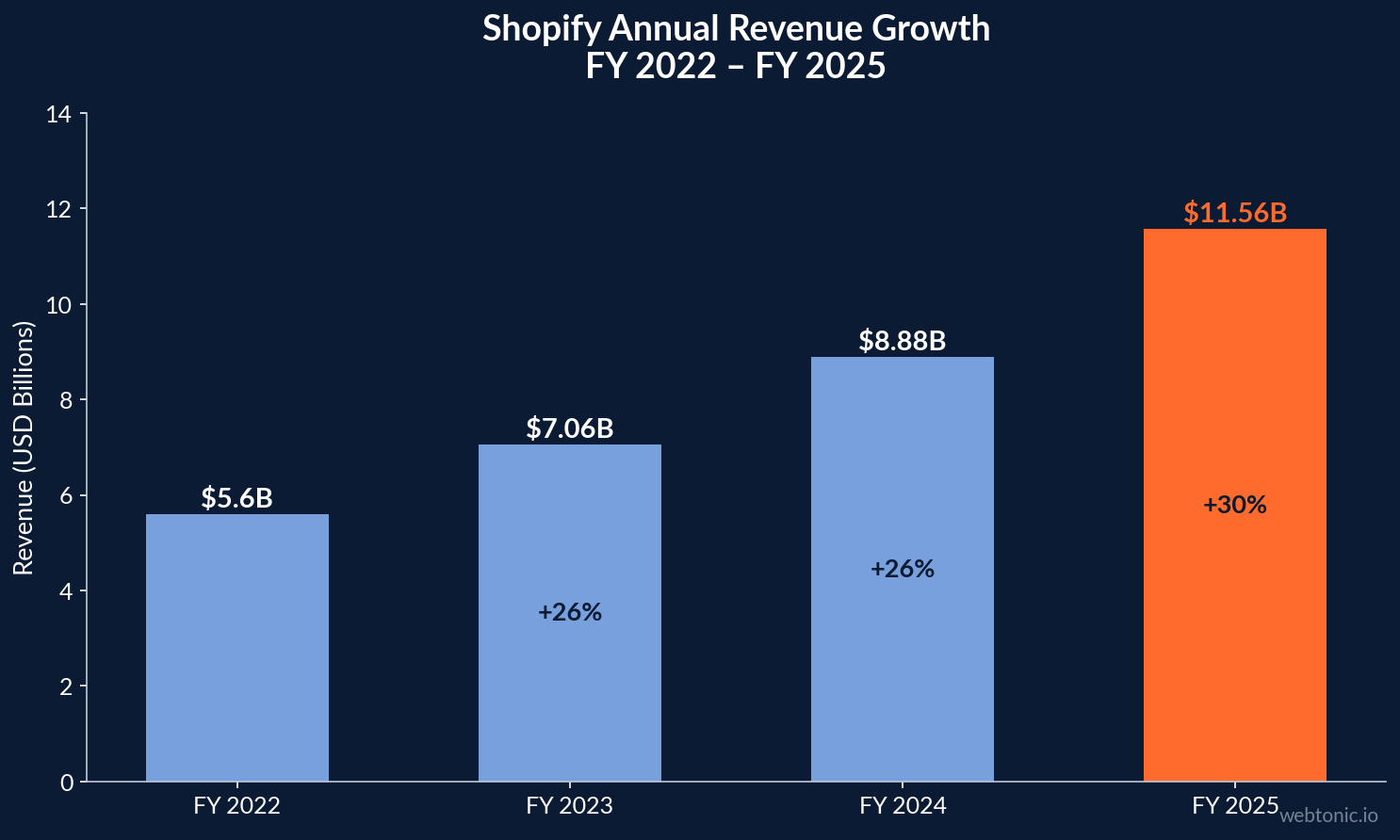
- $11.56 billion in annual revenue was reported by Shopify for fiscal 2025, up 30% year-over-year (Ecommercetrix).
- 17,891 apps are listed in the Shopify App Store from 11,352 partners, with 387 new apps launched monthly (AppJubilee).
- 57% of Shopify stores are based in the United States, followed by Germany (4.9%) and Australia (4.9%) (StoreInspect).
Shopify Store Count and Platform Growth
Shopify's footprint continues to expand across every measurable dimension. The platform grew from roughly 2.6 million stores in early 2025 to 2,898,351 live stores by mid-2026 — an 11% year-over-year increase (Store Leads). BuiltWith's broader detection methodology, which includes inactive storefronts and code remnants, places the figure at 6.84 million Shopify-detected websites (StoreInspect).
Third-party estimates from Backlinko put the total merchant-account universe at 5.5 million+, though Shopify itself now only discloses "millions of businesses in 175+ countries" in its public filings. Quarterly growth has moderated to 1.1% quarter-over-quarter in Q2 2026, signaling a maturing install base that is shifting from land-grab expansion to revenue-per-merchant optimization.
| Period | Live Shopify Stores | QoQ Change |
|---|---|---|
| 2025 Q1 | 2,605,774 | — |
| 2025 Q2 | 2,614,938 | +0.4% |
| 2025 Q3 | 2,690,291 | +2.9% |
| 2025 Q4 | 2,753,498 | +2.3% |
| 2026 Q1 | 2,804,211 | +1.8% |
| 2026 Q2 | 2,898,351 | +3.4% |
Shopify Market Share and Competitive Landscape
Shopify commands 27% of the top one million e-commerce sites — the largest share of any single platform — split between standard Shopify stores (20.4%) and Shopify Plus (6.74%) (Ecommercetrix). When measured across the entire web, WooCommerce leads in raw store count at 4.15 million, but Shopify's average merchant generates substantially higher GMV.
TechnologyChecker's February 2026 crawl gives Shopify a 45.99% e-commerce-platform market share — 2.6× WooCommerce's 17.79% (TechnologyChecker). Inbound migration reinforces this dominance: 31,946 stores moved to Shopify versus 10,271 that left, yielding a 3.1:1 inbound migration ratio. In the US hosted-platform segment specifically, 28% of sites run Shopify — 11 percentage points ahead of WooCommerce's 23% (Ecommercetrix).
| Platform | Top 1M Sites Share | All Sites Share | Key Strength |
|---|---|---|---|
| Shopify | 27.0% | 10.3% | Hosted, high GMV merchants |
| WooCommerce | 9.0% | 38.7% | Open-source, WordPress integration |
| Squarespace | 5.4% | 14.0% | Design-first small business |
| Magento/Adobe | 4.1% | 1.0% | Enterprise customization |
| Wix | 2.8% | 5.9% | Ease of use, small stores |
Revenue, GMV, and Financial Performance
Shopify's financial trajectory underscores its scale. Full-year 2025 revenue reached $11.56 billion, a 30% increase over the prior year. Merchant solutions — payments processing, capital, and shipping — accounted for $8.8 billion of that total, with subscription solutions adding $2.75 billion (Ecommercetrix).
In Q1 2026, the momentum continued: revenue grew 34.3% year-over-year to exceed $100 million in quarterly GMV for the second consecutive quarter (Digital Commerce 360). The Shop app is emerging as a standalone commerce destination — GMV up 70% YoY, monthly active users up 40%, and unique buyers growing 50% compared to Q1 2025.
Key profitability milestones include gross profit of $5.56 billion for 2025 (48% margin) and 11 consecutive quarters of 25%+ revenue growth (excluding logistics). Shopify now claims over 14% of all US e-commerce by dollar volume — up from single digits just five years ago (Ecommercetrix).
| Metric | FY 2024 | FY 2025 | YoY Change |
|---|---|---|---|
| Total Revenue | $8.88B | $11.56B | +30% |
| GMV Processed | $292.3B | $378.4B | +29% |
| Merchant Solutions | $6.53B | $8.80B | +35% |
| Subscription Solutions | $2.35B | $2.75B | +17% |
| Gross Profit | $4.47B | $5.56B | +24% |
| US E-commerce Share | ~12% | >14% | +2pp |
Shopify Stores by Country and Region
The United States dominates Shopify's install base with 57% of all stores (StoreInspect). From a revenue perspective, US-based Shopify stores account for $10.6 billion in tracked revenue and 84% of total marketplace traffic (EcomScout).
International expansion is accelerating. Q1 2026 earnings showed Europe growing at 42% year-over-year and Asia-Pacific at 30% (Digital Commerce 360). BFCM 2025 global sales hit $14.6 billion, a record that highlighted Shopify's growing cross-border capability. Countries like India, France, and Colombia are seeing rapid adoption — Colombia alone has 7,400 stores generating $108.6 million in revenue.
| Country | Store Count | Market Share | Avg Revenue/Store |
|---|---|---|---|
| United States | 220,000+ | 57.0% | $15,700 |
| Germany | 19,100 | 4.9% | $5,000 |
| Australia | 18,900 | 4.9% | $7,900 |
| France | 13,800 | 3.6% | $3,900 |
| Canada | 11,100 | 2.9% | $5,000 |
| United Kingdom | 9,400 | 2.4% | $9,600 |
| Italy | 7,900 | 2.0% | $3,900 |
| Colombia | 7,400 | 1.9% | $6,900 |
App Store and Theme Ecosystem
Shopify's partner ecosystem is a key competitive moat. The Shopify App Store now lists 17,891 active apps from 11,352 partners, with 7,003 new apps launched in the past 12 months — an average of 584 per month (AppJubilee). There are 1,443 Built for Shopify-certified apps, and the average app rating across 807,113 reviews stands at 4.70 stars.
Store Leads tracks 11.76 million app installs across 7,395 detectable apps. The most popular app is Judge.me Product Reviews (20.4% install rate), followed by Klaviyo Email Marketing & SMS (14.3%) and Shopify Inbox (12.4%) (Store Leads). For themes, Shopify merchants can choose from 1,000+ tracked themes: the Trademark theme leads at 16.3%, followed by Dawn (9.3%) and Horizon (6.2%).
App Store ranking is driven by review velocity over total review count, Built for Shopify certification, and listing freshness — stores that update descriptions every 30–60 days consistently rank higher in search (AppJubilee). For e-commerce operators evaluating their technology stack, these ecosystem stats underscore Shopify's extensibility advantage.
B2B Commerce, Payments, and Emerging Growth
Shopify's expansion into B2B and payments is reshaping its revenue mix. B2B commerce grew 96% year-over-year, though it remains a small share of total GMV (TechnologyChecker). Shop Pay now serves 200 million+ users, making it one of the largest accelerated-checkout networks in global e-commerce. Offline revenue from Shopify POS — point-of-sale hardware, POS Pro plans, and retail subscriptions — is growing as the platform bridges digital and physical retail.
The AI-first strategy is another differentiator. Shopify's Q1 2026 results highlighted growing AI-driven traffic and purchase activity for merchants, including integration with ChatGPT for product discovery. The company's "Renaissance Edition" roadmap prioritizes agentic commerce — AI agents that can browse, compare, and purchase on behalf of consumers.
Category and Product Distribution
Shopify's merchant base spans virtually every product vertical. The largest categories by store count are Apparel & Fashion (17.2%), Home & Garden (11.8%), and Health & Beauty (9.4%) (Store Leads). Niche segments — pet supplies, automotive parts, specialty foods — are growing fastest in percentage terms, reflecting the long-tail expansion that Shopify enables through its low barrier to entry.
From a product-count perspective, 48% of stores list fewer than 25 products, indicating a market heavily weighted toward curated DTC brands and dropshipping operations. The top 5% of stores by product count carry 500+ SKUs and disproportionately run Shopify Plus plans with advanced catalog management and custom checkout capabilities (StoreInspect). Social media adoption among these merchants is strong: 74% maintain an active Instagram presence and 68% use Facebook, while TikTok adoption has surged to 22% in 2026 — up from 11% two years earlier.
For online retailers evaluating platform choices, these numbers highlight Shopify's sweet spot: brands with focused product catalogs that rely heavily on paid social acquisition and visual storytelling to convert traffic into sales.
How Shopify Compares to Other E-commerce Platforms
Choosing between Shopify, WooCommerce, and other platforms remains one of the highest-stakes decisions for online retailers. The table below benchmarks Shopify against its closest competitors across the metrics that matter most for e-commerce advertisers and store operators. While WooCommerce still leads in raw store count, its -3.2% year-over-year decline contrasts with Shopify's +11% growth — driven by net merchant migration and increasing enterprise adoption through Shopify Plus. BigCommerce occupies a mid-market niche with ~44,000 stores, offering headless commerce capabilities that appeal to brands seeking API-first architecture.
| Metric | Shopify | WooCommerce | BigCommerce |
|---|---|---|---|
| Live Stores (2026) | 2.9M | 4.15M | ~44K |
| Hosting Model | Fully hosted SaaS | Self-hosted (WordPress) | Hosted SaaS |
| Top 1M Site Share | 27.0% | 9.0% | 2.1% |
| App/Extension Count | 17,891 | 6,800+ (WP plugins) | 1,200+ |
| Avg Revenue/Store | Higher (GMV-weighted) | $63K median | Mid-market focus |
| Migration Trend | 3.1:1 net inflow | Net outflow (-3.2% YoY) | Stable |
Best Practices for E-commerce Brands on Shopify
- Leverage the app ecosystem strategically. The average top-performing store installs 8–12 apps across reviews (Judge.me), email (Klaviyo), and analytics categories. Avoid bloat — each app adds load time.
- Prioritize mobile speed. With mobile accounting for 72%+ of e-commerce sessions, Shopify stores using optimized themes like Dawn or Horizon consistently outperform custom builds in page-speed benchmarks.
- Adopt Shop Pay for checkout. With 200M+ users, Shop Pay's one-tap checkout reduces friction and improves conversion rates versus standard payment flows.
- Explore B2B capabilities. At 96% YoY growth, Shopify's B2B features (custom pricing, net terms, wholesale catalogs) are increasingly competitive with standalone B2B platforms.
- Use multi-channel sales. Merchants selling on Shopify + marketplace channels (Amazon, TikTok Shop) see higher overall GMV growth than single-channel sellers, according to platform migration data.
- Monitor the BFCM benchmark. Shopify's BFCM 2025 total of $14.6 billion sets the bar — use last year's peak as your growth target for seasonal promotional creative.
- Invest in theme performance. Stores running modern themes like Dawn, Horizon, or Trademark benefit from Shopify's Online Store 2.0 architecture, which supports app blocks and sections everywhere — reducing reliance on code edits and third-party page builders.
- Track migration trends. Shopify's 3.1:1 inbound-to-outbound migration ratio signals growing ecosystem lock-in. Merchants considering a switch should evaluate not just the platform but the broader app ecosystem and payment infrastructure before committing.
Related reading
- E-Commerce Webflow Statistics: Market Share, Speed & Conversion Data (2026)
- WordPress E-Commerce Statistics: WooCommerce Store Count, Market Share & Performance (2026)
- E-Commerce Landing Page Statistics: 80+ Conversion Benchmarks (2026)
- Custom Web Development services at Web Tonic
FAQ
How many Shopify stores are there in 2026?
There are approximately 2,898,351 live Shopify stores as of Q2 2026, according to Store Leads' weekly DNS verification. BuiltWith detects a broader figure of 6.84 million Shopify-linked websites, which includes inactive storefronts and code-remnant sites. Third-party estimates from Backlinko put the total merchant-account universe at 5.5 million+. Shopify itself reports "millions of businesses in 175+ countries" in its public filings without disclosing an exact active merchant count.
What is Shopify's market share in e-commerce?
Shopify holds 27% of the top one million e-commerce sites and an estimated 45.99% of the overall e-commerce platform market based on TechnologyChecker's 2026 crawl. In the US specifically, Shopify powers 28% of hosted e-commerce sites and accounts for over 14% of all US online sales by dollar volume.
How much revenue does Shopify generate?
Shopify's fiscal 2025 total revenue was $11.56 billion, up 30% year-over-year. Of that, $8.80 billion came from merchant solutions (payments, shipping, capital) and $2.75 billion from subscription solutions. Q1 2026 revenue grew an additional 34.3% YoY.
What are the most popular Shopify apps?
The top three apps by install rate are Judge.me Product Reviews (20.4%), Klaviyo Email Marketing & SMS (14.3%), and Shopify Inbox (12.4%). Other high-adoption apps include Klarna On-Site Messaging, PageFly Landing Page Builder, and Mailchimp Email SMS. The App Store contains 17,891 active apps from 11,352 development partners, with an average rating of 4.70 stars across 807,113 reviews. Roughly 1,443 apps carry Built for Shopify certification, which has become a prerequisite for ranking in top search positions.
Which countries have the most Shopify stores?
The United States leads with 57% of all Shopify stores (220,000+), followed by Germany (4.9%), Australia (4.9%), France (3.6%), and Canada (2.9%). US stores also generate 84% of total tracked Shopify marketplace traffic.
Sources
storeleads.app/reports/shopify
storeinspect.com/blog/how-many-shopify-stores-are-there
ecommercetrix.com/ecommerce-statistics/shopify-statistics
technologychecker.io/blog/shopify-analytics-trends-insights
appjubilee.io/shopify-app-store-report-2026
digitalcommerce360.com/article/shopify-revenue-gmv
3plinsider.com/research/how-many-shopify-stores
ecomscout.com/reports/country


