



Table of contents
Video now accounts for 82% of all internet traffic and delivers the highest ROI of any content format — with 91% of businesses using it as a core marketing tool in 2026. For e-commerce brands, these video marketing statistics translate directly into higher conversions, better engagement, and measurable revenue lift.
Key Takeaways
- 91% of businesses use video as a marketing tool in 2026, up 11 points since 2024 (HubSpot).
- 82% of consumers have purchased a product after watching a video about it (GoDAM).
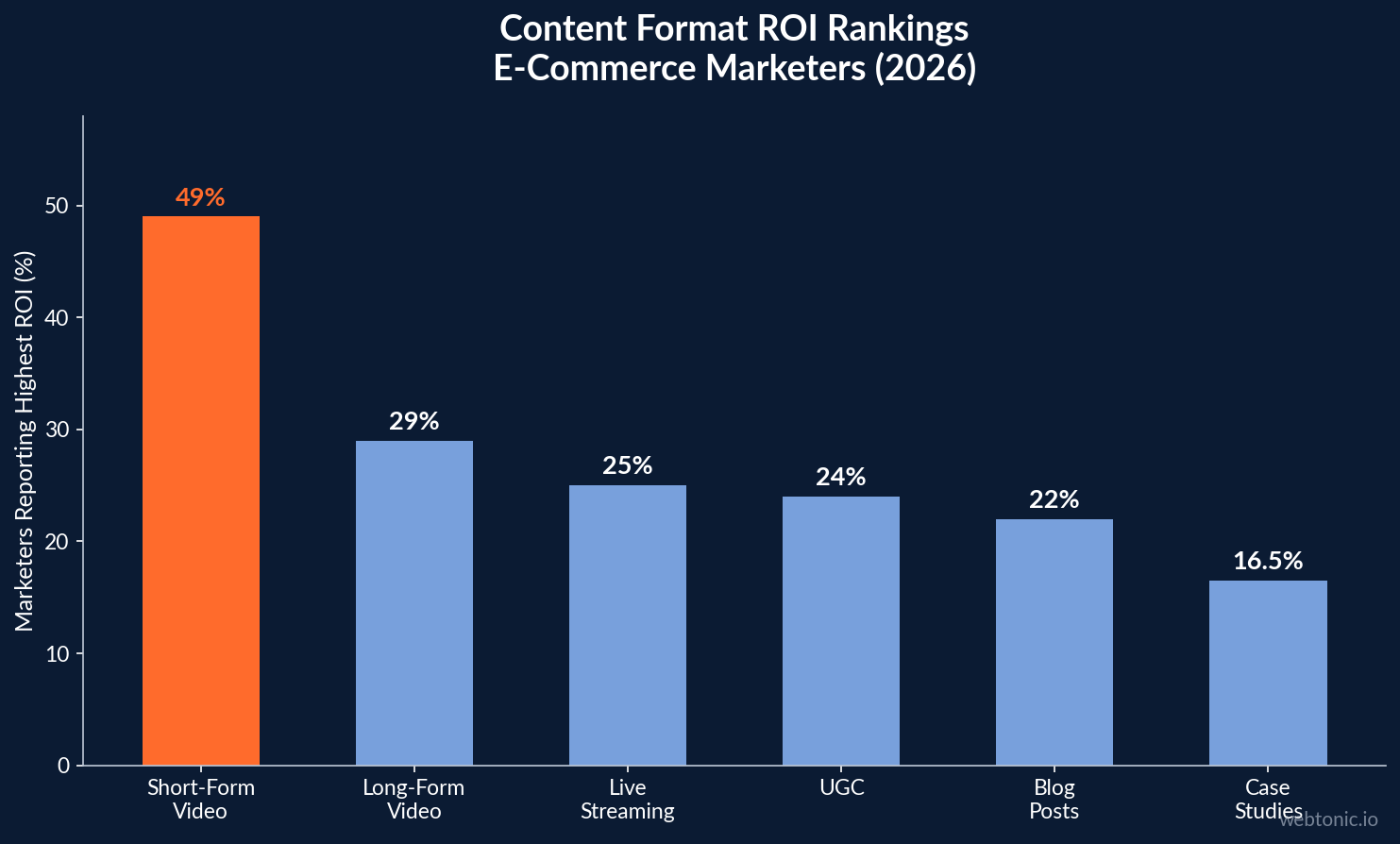
- Short-form video delivers 49% ROI — the highest of any content format, ahead of long-form video (29%) and live streaming (25%) (HubSpot).
- Pages with video convert at 4.8% versus 2.9% without — a 65% conversion lift (GoDAM).
- Shoppable video lifts site-wide conversion by 17–33%, with engaged viewers converting at +125% median uplift (Whatmore).
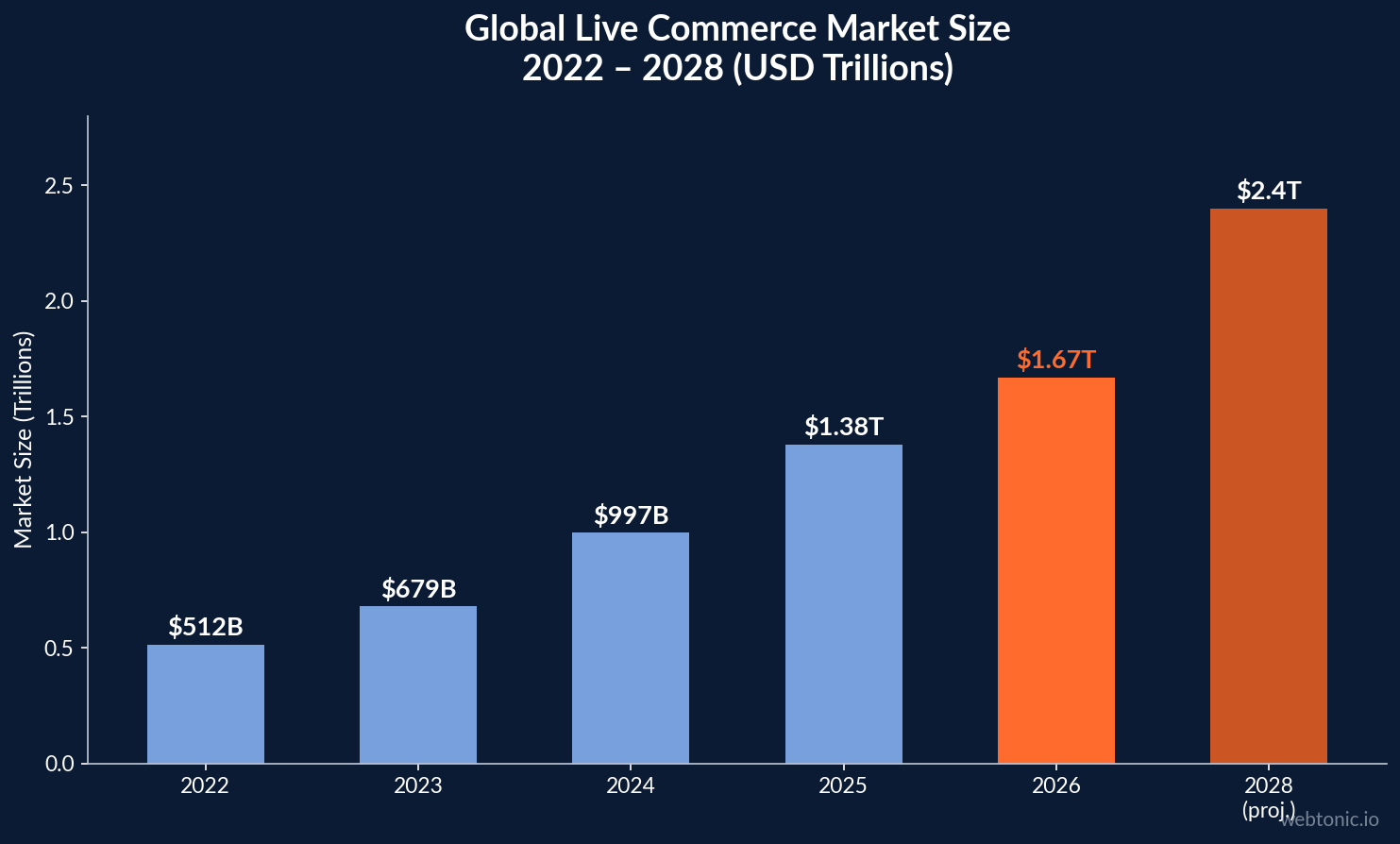
- Live commerce reached $1.67 trillion globally in 2026, growing at 11.28% CAGR toward $4.37 trillion by 2035 (LiveShopFront).
Video Marketing Adoption and ROI
Video is no longer an emerging channel — it is the dominant content format in digital marketing. HubSpot's 2026 State of Marketing report surveyed 1,500+ marketers globally and found that 93% view video as an important part of their strategy, with 86.4% now using AI tools to accelerate production (HubSpot).
The ROI data is definitive. When marketers were asked which media formats earned the biggest return in 2026, the top three were all video-based: short-form video (49%), long-form video (29%), and live-streaming video (25%). Blog posts, user-generated content, and static images all trailed significantly. For e-commerce brands managing creative performance, this means video production should be the primary content investment.
Wyzowl's annual survey reinforces these findings: 82% of video marketers report a positive ROI, and 87% say video has directly increased sales. The optimal video length, per consumer preference research, is 30–60 seconds — with 91% of viewers preferring content under two minutes (Shopify).
| Metric | 2024 | 2026 | Trend |
|---|---|---|---|
| Businesses using video | 80% | 91% | ↑ +11pp |
| Short-form video ROI (top format) | 44% | 49% | ↑ +5pp |
| Video marketers reporting positive ROI | 78% | 82% | ↑ +4pp |
| Consumers who purchased after video | 78% | 82% | ↑ +4pp |
| Optimal video length (30–60s preference) | 47% | 51% | ↑ +4pp |
E-Commerce Video Conversion Benchmarks
The conversion case for video in e-commerce is backed by substantial sample sizes. Product pages with embedded video convert at 4.8% on average versus 2.9% without — a 65% lift that holds across categories (GoDAM). Consumer behavior data is equally compelling: 75% prefer video over text or images when learning about a product, 90% say video helps them decide, and 85% say video influenced a purchase.
Shoppable video takes these numbers further. Whatmore's controlled A/B tests across 200,000+ sessions and seven DTC brands found that shoppable video widgets lift site-wide conversion by 17–33%. Among visitors who actively engaged with a video, conversion jumped +50% to +500%, with a median uplift of +125% (Whatmore).
Engagement rates for shoppable formats ranged from 10–25%, with floating video cards outperforming traditional carousels by 19.3% in conversion rate. Revenue attributed to video reached 5–25% of total store sales in the top-performing quartile — proving that video is not just a branding play but a direct-response channel for growth-focused retailers.
| Format | Engagement Rate | CVR Lift | Revenue Impact |
|---|---|---|---|
| Floating video card | 15.1% | +32.5% | +24.1% revenue |
| Floating video widget | 10.2–25.5% | +17–33% | +54% revenue (top) |
| Stories format | 10.0% | +2.9% | Moderate |
| Carousel (control) | 1.3–2.9% | Baseline | Baseline |
Short-Form Video and Platform Trends
Short-form video is the fastest-growing format in digital advertising, commanding ~$111 billion of the ~$236 billion global video ad spend in 2026 (ReelFlood). YouTube Shorts now generates 200 billion daily views — nearly triple its figure from two years ago. TikTok users spend 95 minutes per day in-app, while Instagram Reels account for 50% of all time spent on Instagram (Kapwing).
For e-commerce specifically, 63% of Gen Z shoppers name TikTok and Instagram as their top channels for product discovery (Shopify). Retail brands using Reels and creators see 71% higher brand intent lift and 19% lower acquisition costs compared to static formats. The paradox of 2026: platforms keep raising length caps (TikTok allows up to 60-minute uploads) while audiences continue to reward videos under 60 seconds with the highest completion and share rates.
77% of marketers say sub-60-second videos deliver the highest ROI of any format, and 57% of marketing budgets now include a dedicated short-form video line item (ReelFlood). For brands running paid social campaigns, short-form creative is no longer optional — it is the primary conversion driver.
Live Commerce and Video Shopping
The global live commerce market reached $1.67 trillion in 2026, growing at an 11.28% CAGR toward a projected $4.37 trillion by 2035 (LiveShopFront). Live shopping events convert at 9.5% to 15.2% — 6 to 10× higher than standard e-commerce conversion rates of 1.8–2.5%.
The US market is catching up to Asia-Pacific, which holds 66.8% of global live commerce revenue. US live commerce now represents 5.2% of total e-commerce (up from 3.1% in 2024), with a 36% CAGR expected to reach $55 billion by 2028. TikTok Shop hit $66 billion in global GMV in 2025, accelerating the adoption of integrated social commerce advertising.
| Year | Global Live Commerce | US Market | YoY Growth |
|---|---|---|---|
| 2022 | $512B | $17B | — |
| 2023 | $679B | $25B | +32.6% |
| 2024 | $997B | $32B | +46.8% |
| 2025 | $1.38T | $41B | +38.4% |
| 2026 | $1.67T | $50B | +21.0% |
| 2028 (proj.) | $2.4T | $55B | — |
Video Marketing Channels and Production
YouTube remains the most widely used video marketing platform at 82% adoption among video marketers, followed by Instagram, TikTok, and Facebook (Shopify). On company websites, product videos and webinars are the two formats teams say have the biggest impact on business success, with homepages, video galleries, and product pages generating the highest play rates. Video ad spend reflects this dominance: the global video advertising market reached approximately $236 billion in 2026, with short-form capturing roughly half of that total.
Production economics are shifting dramatically. Most marketers (46%) allocate a third of their budget or less to video content, yet 67% track views as their primary KPI, followed by engagement (63%) and leads/clicks (52%). AI tools are collapsing production timelines — 86.4% of marketers now use AI for content creation, with media creation being the second-most popular AI application in marketing. Tools like Content Remix can automatically convert blog content into video scripts, social posts, and audio content in minutes rather than hours.
Content repurposing is also accelerating. More than half of companies repurpose video content into social clips, and 60% use those clips to drive traffic back to their website (Shopify). Shopify Posts now allows merchants to publish shoppable videos up to two minutes long and tag up to 10 products or an entire collection — bridging the gap between social content and product catalogs.
Video Marketing vs. Other E-Commerce Formats
The data clearly positions video above all other content formats for e-commerce. When compared head-to-head, video outperforms static images, blog posts, and interactive content across every ROI metric tracked by HubSpot in 2026. The conversion advantage compounds across the funnel: video captures attention at the top (discovery), builds confidence in the middle (consideration), and drives action at the bottom (purchase). Notably, 95% of consumers watch short-form video regularly, and 71% do so daily — making it the most consumed content format worldwide. E-commerce brands that have not yet invested in video infrastructure face a widening performance gap against competitors who have.
| Content Format | ROI Rank (2026) | E-Commerce Impact | Adoption Rate |
|---|---|---|---|
| Short-form video | 1st (49%) | Highest conversion lift | 77% of marketers |
| Long-form video | 2nd (29%) | Product education | 62% of marketers |
| Live-streaming video | 3rd (25%) | 9.5–15.2% CVR | 41% of marketers |
| User-generated content | 4th (24%) | Social proof | 38% of marketers |
| Blog posts / articles | 5th (22%) | SEO traffic | 55% of marketers |
| Case studies | 6th (16.5%) | B2B conversion | 29% of marketers |
Best Practices for E-Commerce Video Marketing
- Start with product videos. 61% of shoppers say product images and videos are the most important page element when completing a purchase — make them the first video investment.
- Prioritize short-form content. Sub-60-second videos deliver the highest ROI across all platforms. Focus on hooks within the first 3 seconds to maximize completion rates.
- Add shoppable overlays. Floating video widgets outperform carousels by 19.3% in conversion rate and drive 5–25% of total store revenue in the top quartile.
- Test live shopping events. Live commerce converts at 9.5–15.2% — up to 10× standard e-commerce rates. Start with TikTok Shop or Instagram Live for the lowest barrier to entry.
- Repurpose across channels. Over 50% of companies turn long-form videos into social clips. Use AI tools to automate this workflow and maximize content distribution efficiency.
- Track the right KPIs. Move beyond view counts — measure engagement rate, click-through to product pages, and attributed conversion revenue to prove video ROI.
- Invest in AI-assisted production. With 86.4% of marketers already using AI tools, brands that lag behind face a growing cost disadvantage. Use AI for scripting, editing, and automated social clip generation to maintain consistent output volume.
Related reading
- The State of Branding & Logo Design in E-commerce: 2026 Stats & Trends
- E-commerce Ad Creative Statistics: Benchmarks & Trends
- What Dumpster Rental Marketers Should Budget for Video Ads
- Branding services at Web Tonic
FAQ
What percentage of businesses use video marketing in 2026?
91% of businesses use video as a marketing tool in 2026, according to HubSpot's State of Marketing report surveying 1,500+ global marketers. This is up 11 percentage points from 2024 and signals that video has moved from experimental to essential. Additionally, 93% of marketers consider video an important part of their overall strategy, and 86.4% are now using AI tools to streamline video production workflows. The adoption curve is flattening near saturation, which means competitive advantage now comes from execution quality rather than simply having video.
How much does video increase e-commerce conversion rates?
Product pages with video convert at 4.8% on average, compared to 2.9% without video — a 65% increase. Shoppable video formats lift site-wide conversion by 17–33%, and engaged viewers convert at +125% median uplift compared to non-viewers across controlled A/B tests.
What is the ROI of short-form video for e-commerce?
Short-form video delivers the highest ROI of any content format at 49%, ahead of long-form video (29%) and live streaming (25%), according to HubSpot's 2026 data. For e-commerce brands, short-form content on TikTok, Instagram Reels, and YouTube Shorts drives both organic discovery and paid conversion at lower acquisition costs than static formats.
How big is the live commerce market?
The global live commerce market reached $1.67 trillion in 2026, with the US segment at approximately $50 billion (5.2% of total US e-commerce). Live shopping events convert at 9.5–15.2%, which is 6–10× higher than standard e-commerce conversion rates. The market is projected to reach $4.37 trillion by 2035.
Which video platforms are most effective for e-commerce?
YouTube leads with 82% adoption among video marketers and remains the dominant platform for long-form product education and brand storytelling. For e-commerce product discovery among younger demographics, 63% of Gen Z shoppers use TikTok and Instagram as their primary channels. Retail brands using Instagram Reels and creators see 71% higher brand intent lift and 19% lower acquisition costs compared to non-video formats. TikTok holds roughly 40% of the short-form market, with Instagram Reels and YouTube Shorts each holding about 20%. The best strategy for most e-commerce brands is a multi-platform approach that creates once and distributes across all three, adapting format and hooks to each platform's audience behavior.
Sources
blog.hubspot.com — 2026 State of Marketing
godam.io/blog/video-commerce-statistics
shopify.com/blog/video-marketing-statistics
whatmore.ai — Shoppable Video Benchmarks 2026
kapwing.com — Short-Form Video Statistics 2026
reelflood.com — Short-Form Video Marketing Stats 2026
liveshopfront.com — Live Commerce Statistics 2026


