Table of contents
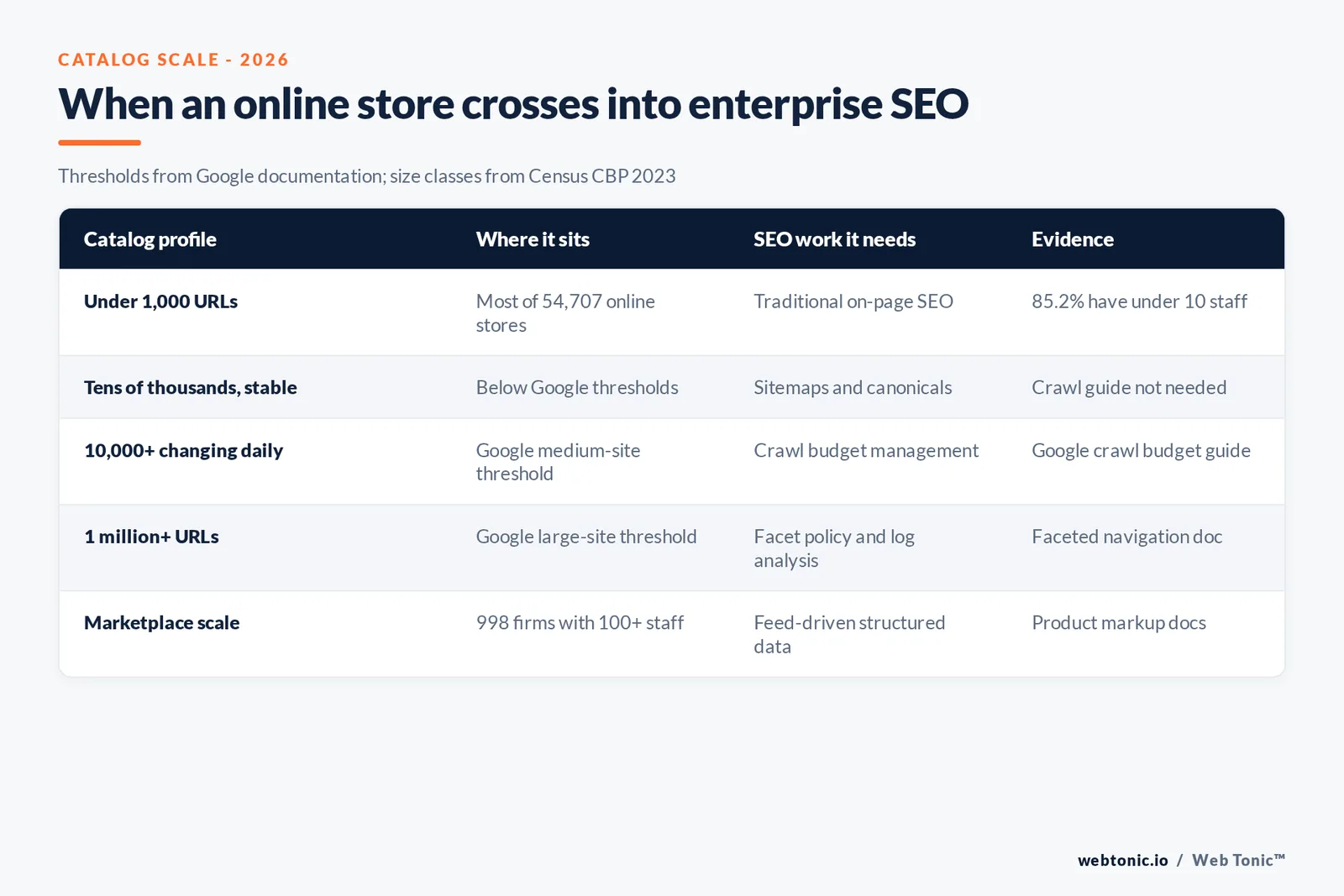
Enterprise e-commerce SEO starts where Google's crawl budget guide starts: at 1 million or more unique pages, or 10,000 or more pages changing daily. Below that line, traditional SEO works; above it, the job becomes deciding which of your millions of URLs deserve to be crawled at all.
Key Takeaways
- US e-commerce reached USD 340.2 billion in Q2 2026, seasonally adjusted (Census).
- That was 17.1% of total retail sales, up 12.2% year on year.
- Census CBP 2023 lists 54,707 electronic shopping and mail-order establishments.
- 85.2% of them had fewer than 10 employees; only 998 had 100 or more.
- Google's crawl budget guide targets sites with 1 million+ pages, or 10,000+ changing daily.
- Ahrefs found 96.55% of pages in its index get no Google traffic (2023 study).
- 58.5% of US Google searches ended with zero clicks in 2024 (SparkToro and Datos).
- AI Overviews correlated with a 34.5% lower top-result CTR in April 2025 and 58% lower on December 2025 data (Ahrefs).
- Google held 86.1% of US search engine share in August 2026 (Statcounter).
- Conductor reports organic search produced 33% of website traffic across seven industries in 2024.
The market: large sales, few large sellers
The Census Bureau's quarterly e-commerce report puts Q2 2026 US retail e-commerce at USD 340.2 billion, seasonally adjusted, or 17.1% of total retail sales, up 12.2% from Q2 2025 while total retail grew 6.7%.
The seller base is far less concentrated than the sales. In the Census County Business Patterns 2023 file, the electronic shopping and mail-order industry has 54,707 establishments: 39,307 with fewer than five employees, and just 998 with 100 or more, of which 124 had 1,000 or more. Enterprise SEO, in this industry, means that thin top layer plus marketplace sellers and large omnichannel retailers.
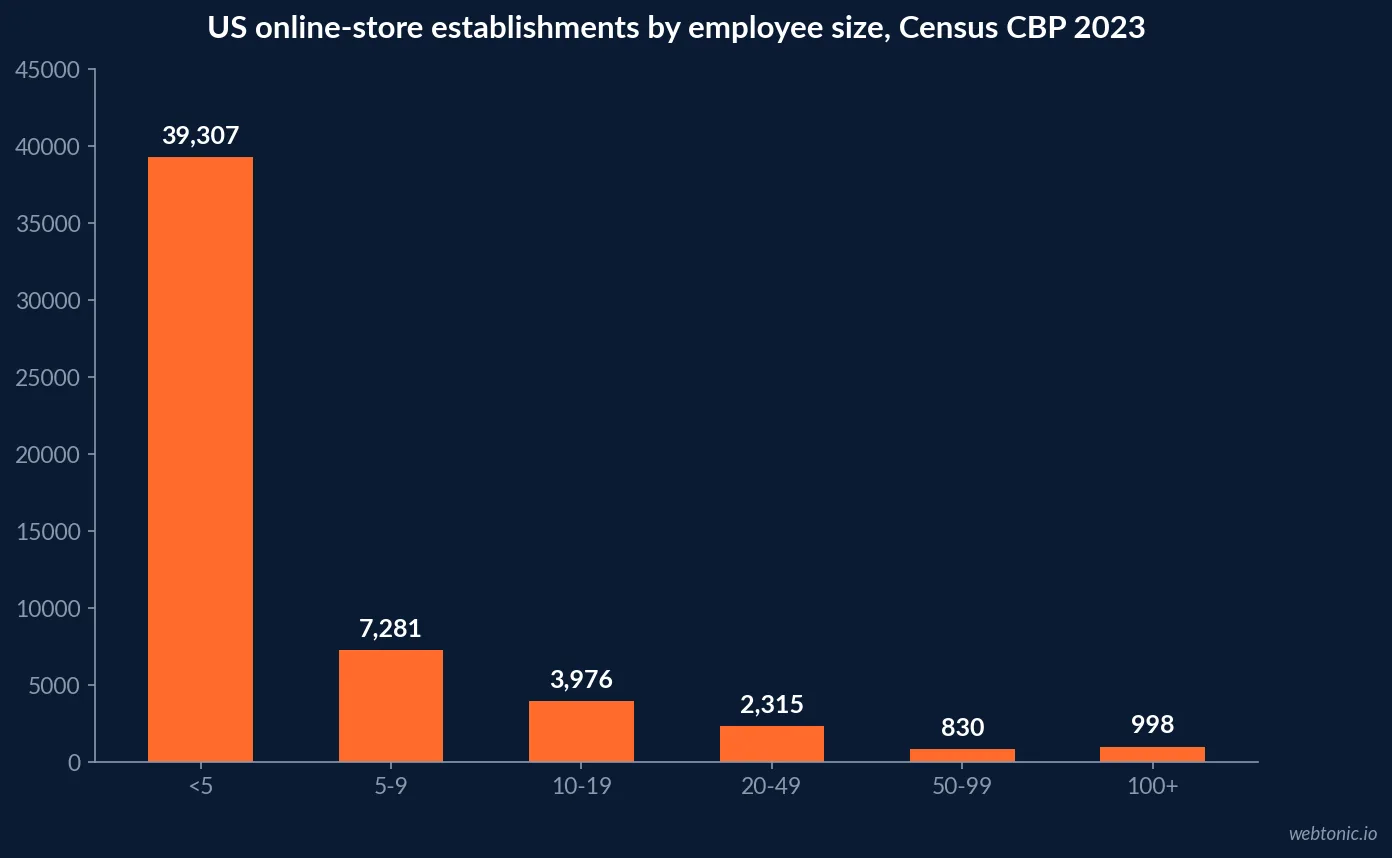
| Employee size class (CBP 2023) | Establishments | Share of 54,707 | Typical SEO model |
|---|---|---|---|
| Under 5 | 39,307 | 71.9% | Platform defaults, owner-run |
| 5 to 9 | 7,281 | 13.3% | Traditional SEO, a few hundred products |
| 10 to 19 | 3,976 | 7.3% | Traditional SEO with a freelancer or agency |
| 20 to 49 | 2,315 | 4.2% | Growing catalog, first facet issues |
| 50 to 99 | 830 | 1.5% | Mid-market, technical SEO needed |
| 100 or more | 998 | 1.8% | Enterprise: crawl and index governance |
Why online sales growth raises the stakes
The Census release gives the growth detail. Q2 2026 e-commerce rose 3.8% from Q1 2026, while total retail sales of USD 1,986.5 billion rose 2.9% quarter on quarter. On an unadjusted basis the quarter came to USD 329.5 billion, up 12.4% year on year. Online is taking share from a growing total, not just riding it.
For a large retailer that shift moves more of the demand that used to arrive through stores and catalogues into search results, where a crawl or indexing problem on a category page is now a revenue problem. It also means more competitors publishing more product pages into the same index, which is the setting in which crawl priority and page consolidation start to matter. The Census data does not say how much of that demand starts in organic search; it only shows the size of the pool.
| Census e-commerce measure | Q2 2026 value | Change | Basis |
|---|---|---|---|
| Retail e-commerce sales | USD 340.2 billion | +12.2% year on year | Seasonally adjusted |
| Retail e-commerce sales | USD 340.2 billion | +3.8% vs Q1 2026 | Seasonally adjusted |
| Total retail sales | USD 1,986.5 billion | +6.7% year on year | Seasonally adjusted |
| E-commerce share of retail | 17.1% | Quarterly share | Seasonally adjusted |
| Retail e-commerce sales | USD 329.5 billion | +12.4% year on year | Not seasonally adjusted |
Enterprise SEO vs traditional SEO: where the line sits
Google draws the line itself. Its crawl budget guide is "intended primarily" for large sites with 1 million+ unique pages whose content changes about once a week, medium or larger sites with 10,000+ unique pages changing daily, and sites with a large portion of URLs classified in Search Console as Discovered - currently not indexed. Google notes the thresholds are rough estimates.
A store with 3,000 products and clean filters sits well below that. A marketplace with 400,000 SKUs, colour and size variants and ten filter dimensions can cross it without anyone noticing, because every filter combination is a URL.
| Dimension | Traditional store SEO | Enterprise catalog SEO | Evidence |
|---|---|---|---|
| Primary constraint | Relevance and links | Crawl and index capacity | Google crawl budget guide |
| URL count | Thousands | 1 million+ or 10,000+ changing daily | Google thresholds |
| Faceted filters | A handful, often indexable | Governed, most blocked or canonicalised | Google faceted navigation doc |
| Structured data | Product snippet basics | Merchant listing markup at feed scale | Google product structured data docs |
| Content risk | Thin category copy | Most pages never earn traffic | Ahrefs, 96.55% zero-traffic pages |
Faceted navigation is the biggest crawl sink
Google's faceted navigation guidance describes filters as popular and useful, then warns that the most common implementation, based on URL parameters, can generate infinite URL spaces that lead to overcrawling. Its two options are to prevent crawling of faceted URLs you do not need in search, using robots.txt or URL fragments, or to make the ones you keep follow a consistent, crawlable structure and return a 404 when a combination has no results.
For an enterprise catalog the practical output is a facet policy: a short list of filter values with real search demand that get indexable, linked landing pages, and everything else kept out of the crawl path.
Most pages will never earn search traffic
Scale produces waste. Ahrefs' 2023 study of about 14 billion pages in its Content Explorer index found 96.55% get zero traffic from Google and 1.94% get between one and ten monthly visits. That is a whole-web figure, not a retail one, but a catalog with thousands of near-duplicate variant and filter pages is exactly the kind of site that feeds it.
The enterprise response is pruning and consolidation: merge variants onto one canonical product URL, retire empty categories, and give Googlebot fewer, stronger pages.
Search share: one engine still decides
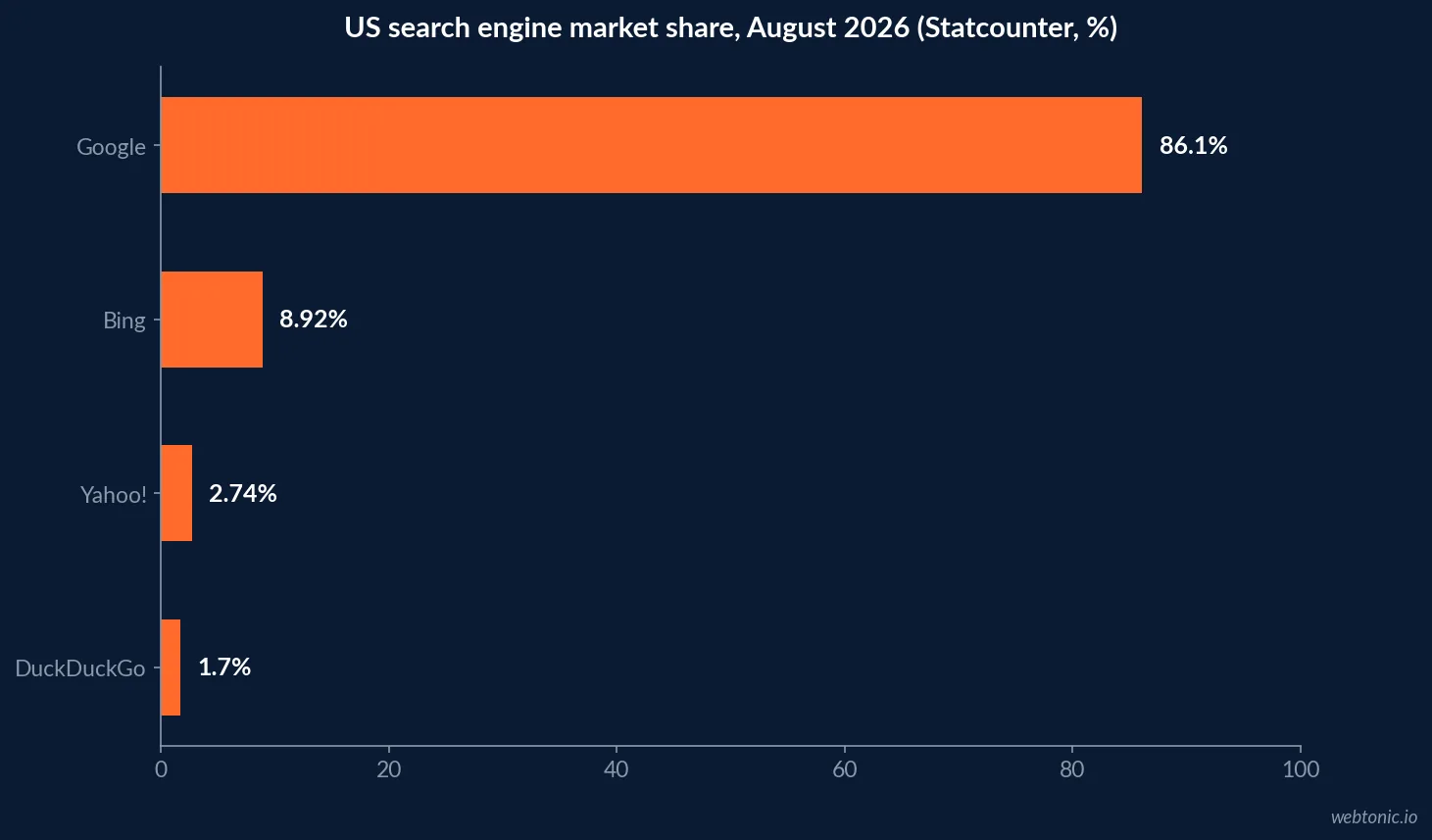
Statcounter puts Google at 86.1% of US search engine share in August 2026, Bing at 8.92%, Yahoo at 2.74% and DuckDuckGo at 1.7%. Crawl governance, structured data and faceted navigation are therefore still written first for Googlebot.
Zero-click and AI Overviews on the results page
SparkToro's 2024 zero-click study, built on Datos clickstream panels, found 58.5% of US Google searches ended without a click, and that only 360 of every 1,000 US searches produced a click to the open web. Ahrefs' April 2025 study of 300,000 keywords found an AI Overview correlated with a 34.5% lower click-through rate for the top-ranking page; its re-run on December 2025 data found 58% lower.
Pew Research Center tracked 900 US adults in March 2025: 18% of searches produced an AI summary, and users clicked a traditional result on 8% of those visits versus 15% without one. All three studies centre on informational queries; none isolates product searches.
| Zero-click measure | Figure | Source and period | Scope |
|---|---|---|---|
| US Google searches with zero clicks | 58.5% | SparkToro and Datos, 2024 | All query types |
| Clicks to the open web per 1,000 US searches | 360 | SparkToro and Datos, 2024 | All query types |
| Top-result CTR change with an AI Overview | -34.5% | Ahrefs, April 2025 | Informational keywords |
| Top-result CTR change with an AI Overview | -58% | Ahrefs, December 2025 data | Informational keywords |
| Result clicks with vs without AI summary | 8% vs 15% | Pew Research Center, March 2025 | 900 US adults |
Organic search's share of traffic
Two issuer figures are often quoted and they are not the same measure. BrightEdge's 2019 research found organic search drove 53% of trackable website traffic, up from 51% in its 2014 analysis, with organic social flat at 5%. Conductor reports organic search produced 33% of overall website traffic across seven key industries in 2024, and that 91% of respondents to its 2025 State of SEO survey said SEO had a positive impact in 2024.
The gap reflects different samples and years, not a collapse from 53% to 33%. Neither figure is e-commerce-only.
| Traffic-share figure | Value | Issuer and year | Caveat |
|---|---|---|---|
| Organic search share of trackable traffic | 53% | BrightEdge, 2019 | Dated, cross-industry |
| Same measure, first edition | 51% | BrightEdge, 2014 | Baseline |
| Organic social share | 5% | BrightEdge, 2019 | Flat since 2014 |
| Organic search share of website traffic | 33% | Conductor, 2024 data | Seven industries |
| Respondents reporting positive SEO impact | 91% | Conductor 2025 survey | Self-reported |
Structured data at feed scale
Google's product structured data documentation separates product snippets from merchant listing markup, with additional types for variants, loyalty programs, return policies and shipping policies. On a small store this is a theme setting. On an enterprise catalog it is a data pipeline: markup has to be generated from the same product source as the feed and kept in sync as prices and stock change, or the page and the markup disagree.
An enterprise e-commerce SEO checklist
- Count URLs, not products: compare crawled URLs in logs with the canonical product and category set.
- Write a facet policy and enforce it in robots.txt, canonicals and internal links.
- Watch the Discovered - currently not indexed report as the early warning of crawl strain.
- Consolidate variants onto one canonical product URL.
- Generate product and merchant listing markup from the feed source.
- Report branded and non-branded clicks separately, since zero-click behaviour hits them differently.
For the cross-industry baseline, see our enterprise SEO statistics, and for the paid side of product search our e-commerce Google Shopping and feed management statistics. Our data and analytics team builds the log and index reporting large catalogs need, or contact us.
What the data does not show
No source we opened publishes an e-commerce organic click-through rate by position, an industry visibility share or a cost per organic order, and we do not estimate one. The studies above are cross-industry or whole-web; use them to size risks, and your own Search Console and log data to size results.
Frequently Asked Questions
What is the difference between enterprise SEO and traditional SEO for an online store?
Scale changes the problem. Traditional SEO for a small shop is mostly keyword targeting and content. At catalog scale the constraints are crawling and indexing: Google's own crawl budget guide is written for sites with 1 million or more unique pages changing weekly, or 10,000 or more changing daily. Faceted filters, variants and pagination generate URLs faster than Googlebot will fetch them, so governance of which URLs exist becomes the core job.
How many online retailers are enterprise-sized?
Few. Census County Business Patterns 2023 lists 54,707 electronic shopping and mail-order establishments; 85.2% had fewer than 10 employees and 998 had 100 or more. Enterprise SEO in e-commerce is therefore a practice for a small group of large catalogs and marketplace sellers, not the typical store.
Does crawl budget matter for a Shopify store with 2,000 products?
Usually not. Google says sites below its thresholds generally do not need the crawl budget guide, and that keeping a sitemap current is usually enough. It becomes relevant when filters create millions of URL combinations or when a large share of URLs sit in Search Console as Discovered - currently not indexed.
How are AI Overviews changing organic traffic for retailers?
No retail-specific study we opened measures it. Ahrefs found the presence of an AI Overview correlated with a 34.5% lower click-through rate for the top-ranking page in its April 2025 study, and 58% lower in a re-run on December 2025 data, both on informational keywords. Pew Research Center found users clicked a traditional result on 8% of visits with an AI summary versus 15% without. Transactional product queries may behave differently.
How much traffic does organic search deliver to stores?
Published cross-industry figures vary with method and year. BrightEdge's 2019 channel research put organic search at 53% of trackable website traffic. Conductor reports organic search produced 33% of overall website traffic across seven industries in 2024. Neither is an e-commerce-only figure, so measure your own channel mix before modelling.
Sources
US Census Bureau - Quarterly e-commerce report
US Census Bureau - County Business Patterns datasets
Google Search Central - Crawl budget for large sites
Google - Managing crawling of faceted navigation URLs
Google - Product structured data
Ahrefs - 96.55% of content gets no traffic from Google
Ahrefs - AI Overviews reduce clicks by 34.5%
Ahrefs - Update: AI Overviews reduce clicks by 58%
SparkToro - 2024 zero-click search study
Pew Research Center - AI summaries and clicks
Statcounter - US search engine market share
BrightEdge - Organic share of traffic 53%
Conductor - State of organic marketing