



Table of contents
Video testimonials improve restoration landing page conversions by 32%, and 62% of restoration marketers say video is their best-performing content format. With 91% of businesses now using video as a marketing tool, restoration companies that document their work on camera consistently outperform those relying on text and photos alone. Here are the numbers driving video marketing for disaster restoration in 2026.
Key Takeaways
- Video testimonials improve restoration landing page conversions by 32% (Marketing LTB).
- 62% of restoration marketers say video is their best-performing content format (Marketing LTB).
- 91% of businesses use video as a marketing tool — a joint all-time high (Wyzowl).
- Restoration video ads have a 10–13% winner rate in batch testing — the highest of any home service vertical (Prestyj).
- Video on landing pages boosts conversion rates up to 80% (Cambridge Filmworks).
- Video CTAs generate 380% more clicks than static buttons (Cube Creative Design).
- Video testimonials carry 89% more credibility than written reviews for restoration services (The Restoration Marketers).
Video Marketing Adoption and ROI
| Metric | 2026 Data | Source |
|---|---|---|
| Businesses using video | 91% | Wyzowl (12-year survey) |
| Marketers reporting good ROI | 82% | Wyzowl |
| Video directly helped generate leads | 85% | Wyzowl |
| Plan to spend same/more on video | 92% | Wyzowl |
| Video important to strategy | 93% | Wyzowl |
| Marketers who spent on video ads | 41% (up from 36%) | Wyzowl |
| Proposals with video acceptance rate | +41% higher | Storimatic Studio |
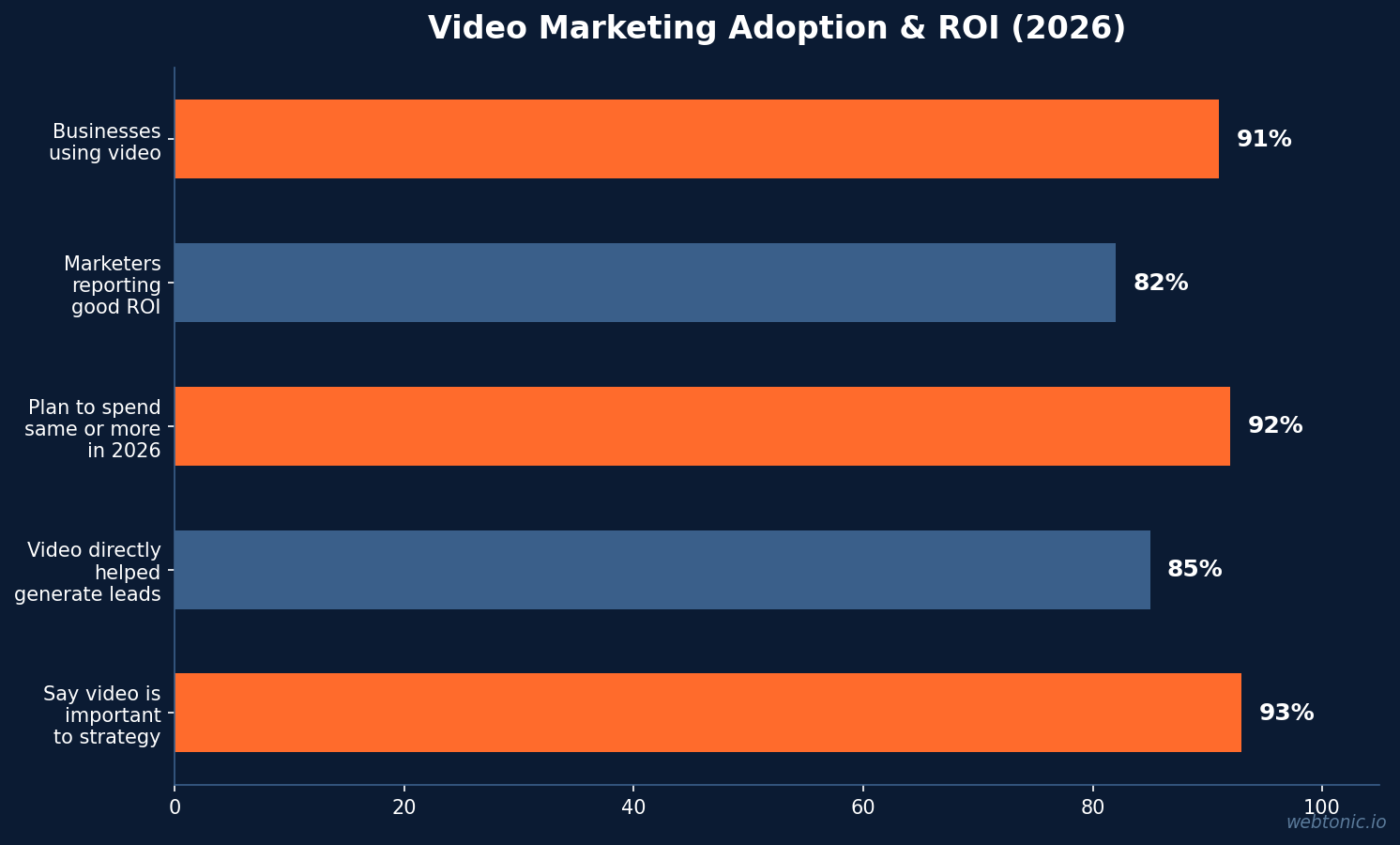
Wyzowl's 12 consecutive years of survey data show that video marketing continues to climb as a business tool. The slight dip in reported ROI from 93% to 82% reflects rising production costs and increased competition for attention rather than a decline in video effectiveness. For restoration companies, where visual proof of work is inherently compelling, the ROI case remains exceptionally strong.
Restoration-Specific Video Performance
Restoration companies sit in a unique position for video marketing: every project is a potential case study with built-in dramatic tension. A flooded basement transformed into a clean, dry living space tells a story that static photos cannot match.
| Restoration Video Metric | Data Point | Source |
|---|---|---|
| Video testimonial conversion lift | +32% | Marketing LTB |
| Video as best-performing format | 62% of marketers agree | Marketing LTB |
| Video testimonial credibility vs. text | 89% more credible | The Restoration Marketers |
| Emergency leads lost without visuals | 73% potential leads lost | The Restoration Marketers |
| Batch video ad winner rate | 10%–13% (top vertical) | Prestyj |
| Branded video intro viewer retention | Higher than unbranded | Marketing LTB |
Restoration companies lose 73% of potential emergency leads because property owners cannot visualize the repair process. Video bridges this trust gap by showing real before-and-after transformations, equipment in action, and certified technicians explaining each step of the remediation process.
Platform Performance and Video Format Benchmarks
| Platform | Avg. Engagement | Avg. CPC (Paid) | Best Video Length |
|---|---|---|---|
| TikTok | 3.85%–4.90% | $1.00 | 15–30 seconds |
| Instagram Reels | 2.7% | $1.83–$3.35 | 15–60 seconds |
| YouTube Shorts | 60% higher completion | Varies | 15–35 seconds |
| Facebook Video | N/A (organic near zero) | Meta CPM: $14.91 | 60+ seconds |
| YouTube (Long-form) | Ranks for years in search | Varies | 5–15 minutes |
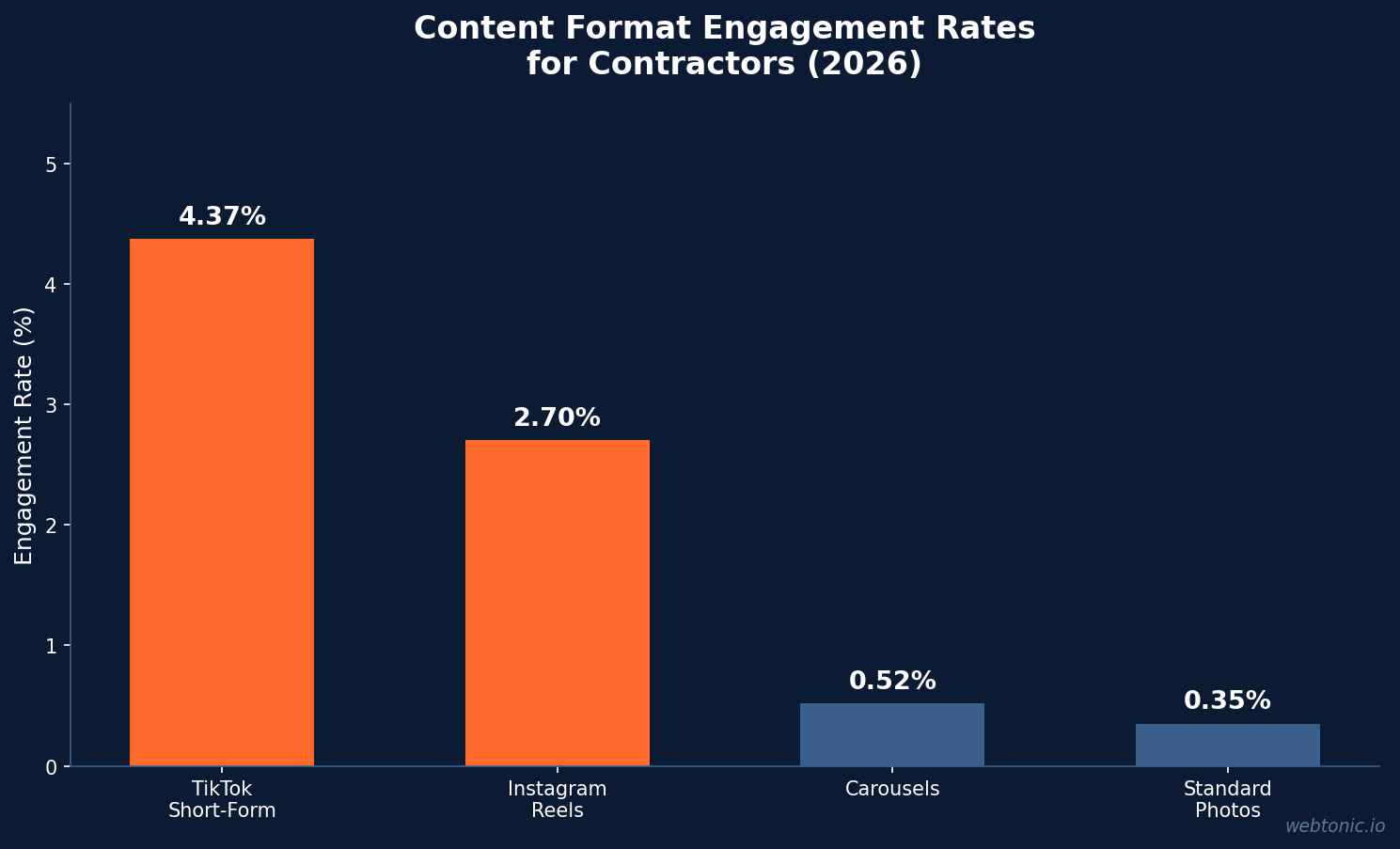
TikTok delivers $1.00 CPC compared to $12.18 for electrician search ads and $10.70 for roofing search campaigns (PipelineOn). The CPM gap between TikTok ($9.16) and Meta ($14.91) means restoration companies get more eyeballs per dollar on TikTok, though Facebook remains stronger for direct emergency lead generation.
Video Content Types for Restoration Companies
The Cleanfax 2025 Benchmarking Survey found restoration companies increasingly shifting toward short-form video and social media content. Every restoration project creates opportunities for multiple content types:
- Time-lapse restoration videos — Show complete projects from damage to completion in 60–90 seconds. These consistently produce the highest engagement.
- Equipment demonstration videos — Display specialized tools like thermal imaging cameras, industrial dehumidifiers, and air scrubbers in action. Builds technical authority.
- Emergency response documentation — Capture your team arriving on-site within promised timeframes. Creates urgency and proves reliability.
- Customer testimonial videos — Feature satisfied clients describing your service quality. Carry 89% more credibility than text reviews.
- Process explanation videos — Break down complex procedures like mold containment, structural drying, or insurance claim documentation.
- Drone footage — Aerial views of storm damage, roof assessments, and large-scale property documentation for insurance purposes.
A single restoration project can produce weeks or even months of marketing material. Short clips work for TikTok, Instagram, and Facebook; longer educational pieces anchor YouTube channels and embed in paid campaign landing pages.
Conversion and Landing Page Impact
The financial case for video on restoration websites and landing pages is compelling:
- Adding video to a landing page boosts conversion rates up to 80% (Cambridge Filmworks). For a restoration page converting at the home services average of 7%, reaching even 10–12% significantly cuts effective CPL without increasing ad spend.
- Video CTAs generate 380% more clicks than static CTA buttons (Cube Creative Design).
- Property owners who watch 75%+ of a project video show serious buying intent and convert at higher rates than casual viewers (The Restoration Marketers).
- Google prioritizes recent video content in local map rankings, meaning restoration companies posting video to Google Business Profile appear higher in emergency searches.
One authentic customer video near your call button can lift conversion rates by double digits. It answers "Can I trust these people?" in the seconds that matter for a homeowner with standing water in their basement (The Restoration Marketers).
Case Studies and Real-World Results
| Company | Result | Details |
|---|---|---|
| Fera Form (construction) | $1.7M job in 5 months | Zero to $1.7M parking structure job through video documentation alone. No paid ads. |
| Texas plumber | 21 jobs in 14 days | Repeatable "how we fixed this" Reels format on Instagram. |
| Flooring contractor | $32K from 1 Reel | 280K views, 1,400 followers, 9 DMs from local homeowners. |
| Minutemen Restoration | 47 calls in 90 days | $198 cost per call. Projected $76K–$171K in revenue. |
The Fera Form case study illustrates the compounding value of consistent video documentation. Starting from zero online presence, the construction company filmed real job site work monthly. By month 4–5, builders recognized them in bid meetings before any introduction. They landed a $1.7 million job based on trust built entirely through video (Storimatic Studio). Proposals that include video have a 41% higher acceptance rate than text-only proposals.
Video Documentation and Field Service Integration
Beyond marketing, video serves a critical operational role in restoration. Photo documentation and video evidence are now standard requirements for insurance claim processing, OSHA compliance, and quality control across the restoration industry. Field service management (FSM) platforms like ServiceTitan Enterprise, Jobber, and HousecallPro increasingly integrate video capture into their mobile apps, allowing technicians to document fire damage, water intrusion, and mold conditions directly within the job workflow.
Restoration-specific software solutions like QuoteIQ combine pricing estimation with visual documentation, enabling technicians to record damage assessments on-site and share them with adjusters in real time. This dual-purpose approach — where documentation recorded for insurance purposes also becomes marketing content — eliminates the need for separate production efforts. The scheduling and dispatch features in these platforms also enable restoration companies to tag completed jobs for content follow-up, creating a systematic pipeline from job completion to published video.
In the U.S. market, commercial restoration firms are leading adoption of integrated video workflows. Property managers and facility directors expect video-based progress reports during multi-day remediation projects, and restoration companies using structured video updates report faster payment cycles and fewer disputed invoices. G2 reviews of restoration and field service software consistently rank video integration as a top-requested feature among businesses in the damage restoration sector.
Measuring Video Marketing Performance
Most restoration companies track the wrong video metrics. Views and likes are vanity signals that do not correlate with booked jobs. The metrics that predict whether video marketing actually drives revenue for restoration businesses include:
- Watch time percentage — Property owners who watch 75%+ show serious buying intent and convert at significantly higher rates
- Video-to-call conversions — Track using unique phone numbers in video descriptions to isolate which content drives immediate emergency response
- Cost per video view from paid promotion — Determines budget allocation across platforms; TikTok's $9.16 CPM versus Meta's $14.91 makes it the more efficient awareness channel
- Geographic distribution of viewers — Identifies which service areas generate the most video engagement, informing both content strategy and ad targeting
- Branded search volume lift — Track whether video publishing correlates with increases in direct company name searches, a key indicator of brand awareness impact
Home services businesses that review marketing performance weekly see an average 6x ROI, compared with 4.8x for those reviewing quarterly — a 25% difference attributed solely to review cadence (Scorpion). For video-heavy restoration marketing programs, weekly performance reviews enable faster creative rotation and prevent the 60–90 day fatigue threshold from silently eroding campaign returns.
Video Marketing Best Practices for Restoration
- Document every job — Each project is a content asset. Record before, during, and after footage with a smartphone.
- Keep before/after clips to 15–35 seconds for YouTube Shorts, 15–30 seconds for TikTok, and 15–45 seconds for Instagram Reels.
- Add voiceover to project videos — Construction videos with voiceover have a 50% higher engagement rate than silent clips (Zipdo).
- Use owner-on-camera content — Outperforms agency-produced video by 25–40% on contractor accounts.
- Post to Google Business Profile first — Google prioritizes recent video in local emergency searches.
- Track watch time, not views — Viewers who watch 75%+ of restoration videos show serious buying intent.
- Include video on landing pages — Up to 80% conversion rate lift by adding a single video testimonial above the fold.
- Plan for 50+ ad variations quarterly — With a 10–13% winner rate, you need volume to find performing creative.
Related reading
- Disaster Restoration Branding Statistics (2026)
- Disaster Restoration Ad Creative Statistics: 2026 Market Data & Benchmarks
- WDR Video Marketing Statistics (2026)
- Branding services at Web Tonic
Frequently Asked Questions
Does video marketing work for restoration companies?
Yes. 62% of restoration marketers say video is their best-performing content format, and video testimonials improve landing page conversions by 32%. Restoration video ads have the highest winner rate (10–13%) of any home service vertical in batch testing.
What type of video content works best for restoration marketing?
Time-lapse before-and-after transformation videos consistently produce the highest engagement. Customer testimonials carry 89% more credibility than written reviews. Equipment demonstration videos and emergency response documentation also perform strongly, building technical authority and trust.
How long should restoration marketing videos be?
For short-form platforms: 15–35 seconds for YouTube Shorts, 15–30 seconds for TikTok, and 15–45 seconds for Instagram Reels. YouTube long-form educational content (5–15 minutes) ranks in Google search results for years. Construction videos with voiceover achieve 50% higher engagement than silent clips.
What ROI should restoration companies expect from video?
82% of marketers report good ROI from video marketing. One construction company went from zero online presence to a $1.7 million job in five months through video alone. Landing page video lifts conversions up to 80%, and video CTAs generate 380% more clicks than static buttons.
Which platform is best for restoration video marketing?
YouTube remains the most effective long-term platform, with videos ranking in Google search results for years. TikTok offers the lowest ad costs at $1.00 CPC. Instagram Reels deliver 2.7% engagement versus 0.43% for standard posts. Google Business Profile video posts directly improve local search visibility for emergency queries.
Sources
marketingltb.com – restoration marketing statistics 2026
wyzowl.com – video marketing statistics 2026
prestyj.com – batch video ad testing benchmarks
pipelineon.com – video marketing for home services
pipelineon.com – short-form video for contractors
pushleads.com – video marketing for restoration
storimaticstudio.com – construction video ROI case study
thedailyindustry.com – video content during every job
zipdo.co – building industry marketing statistics


