Table of contents
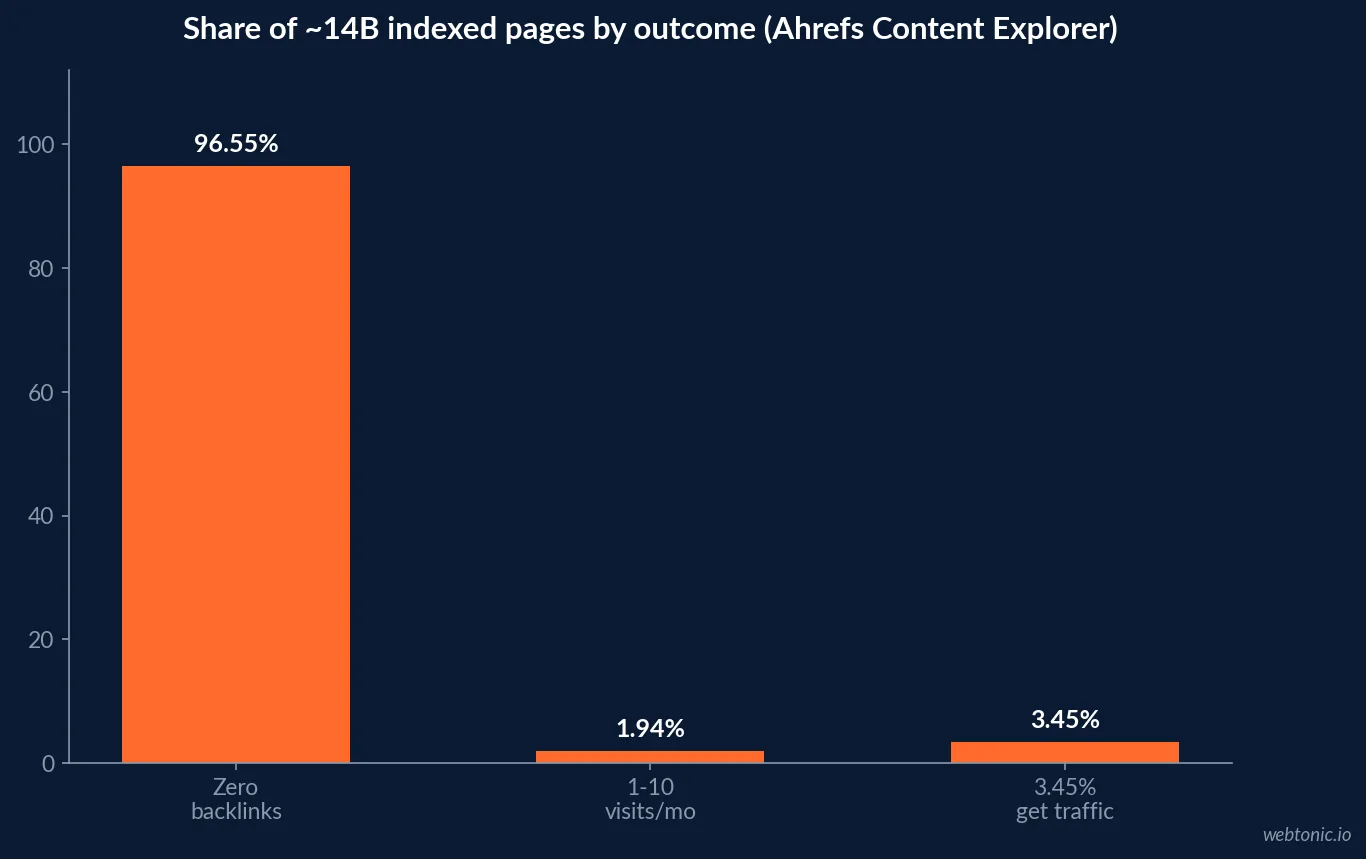
Inbound and outbound links are not the same statistic, and treating them as one number hides where the actual work should go. Ahrefs' Content Explorer study of roughly 14 billion pages found 96.55% get zero organic search traffic, largely for lack of inbound links, while Orbit Media's 2026 blogger survey found top performers add a median of 113 outbound links per post as a trust signal, not a ranking hack. This page keeps the two apart.
Key Takeaways
- 96.55% of indexed pages get zero organic search traffic (Ahrefs, ~14B pages).
- 1.94% get only 1 to 10 monthly visits.
- Roughly two-thirds of pages have zero external backlinks (Ahrefs).
- #1-ranking pages keep gaining new referring domains at 5-14.5% a month (Ahrefs).
- Referring domain count was the strongest correlate of Google position tested (Backlinko/Ahrefs).
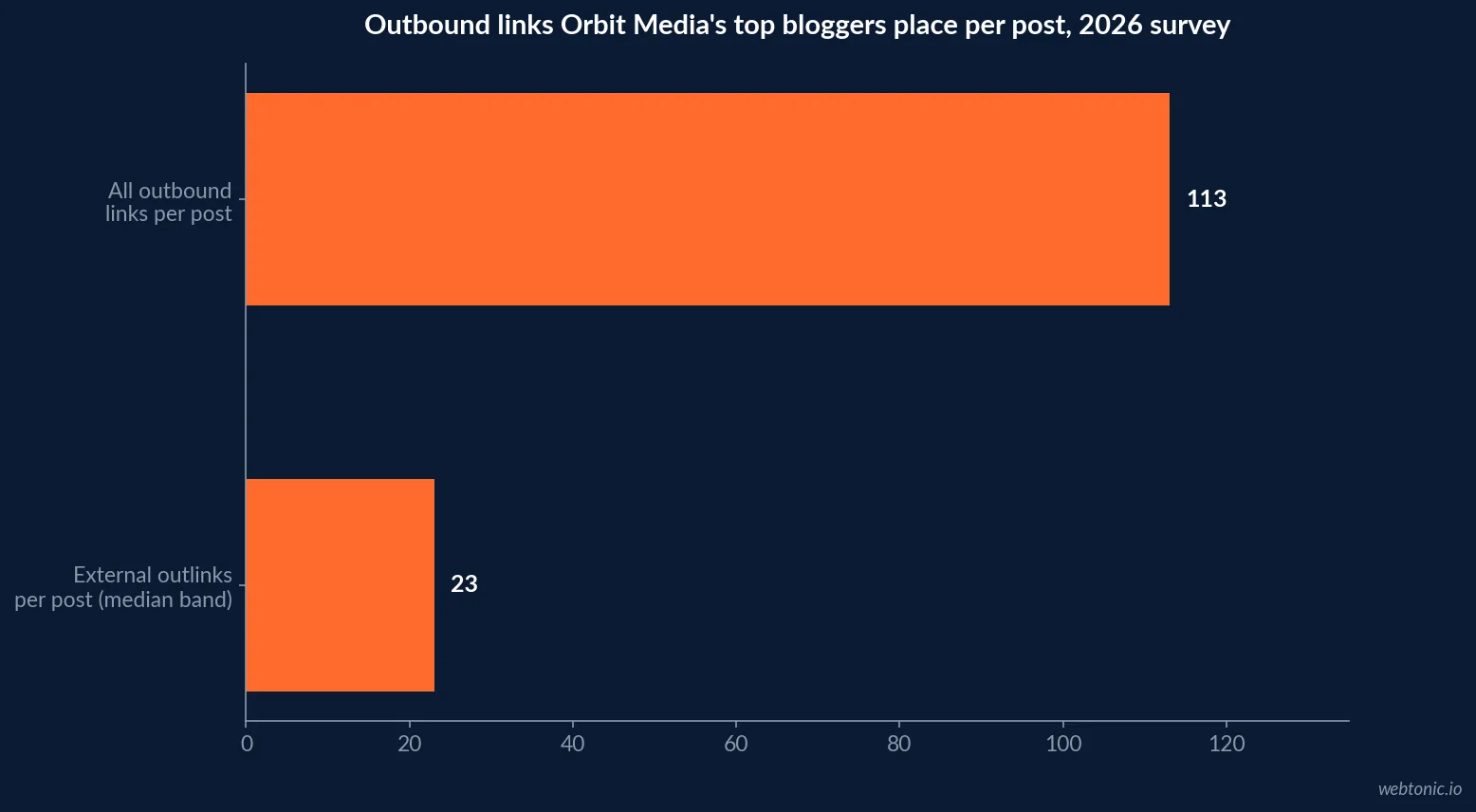
- Top bloggers place a median of 113 outbound links per post (Orbit Media, 1,042 marketers).
- All outbound links per page range 56 to 171 across surveyed blogs (Orbit Media).
- External outlinks alone range roughly 5 to 42 per post (Orbit Media).
- 92.4% of content marketers now use AI in their workflow (Orbit Media 2026).
- Only 13.9% call their blog results "strong" despite that adoption.
- Guest-post and roundup outreach beat the cold-outreach average for replies (Backlinko, 12M emails).
- Cold email reply rates run in the low single digits industry-wide (Mailshake 2026).
- The first follow-up step lifts B2B email replies materially (Belkins outreach data).
- Roughly half of all backlink links get lost within seven years (Ahrefs link-decay data).
Two different problems wearing one name
"Link building" usually means earning inbound links, but every page also makes decisions about outbound links - who it cites, how often, and why. Ahrefs' search-traffic study, built from roughly 14 billion pages in its Content Explorer database, found 96.55% earn zero organic traffic and only 1.94% pick up between one and ten visits a month. Backlinks are one of the three reasons Ahrefs names for that gap, alongside no search demand and poor on-page targeting.
Outbound linking runs on a different logic entirely - it is about who you cite, not who cites you - which is exactly why this page separates the two instead of folding them into one "backlink count."
Inbound links: the scarcity is the story
The inbound-link picture is one of concentration. Ahrefs' backlink research finds roughly two-thirds of all pages carry zero external backlinks, meaning any working backlink already puts a page ahead of most of the web. Among pages that do rank, the advantage keeps compounding: Ahrefs' backlink growth study, tracking 200,000 top-ranking pages, found #1-ranking pages continue gaining followed backlinks from new referring domains at 5% to 14.5% a month even after reaching the top spot.
The Backlinko and Ahrefs joint ranking correlation study tested a wide set of proposed Google ranking factors and found the number of referring domains - not raw backlink count - was the strongest on-page correlate of position among the factors it measured.
| Inbound-link fact (Ahrefs) | Figure | What it measures | Takeaway |
|---|---|---|---|
| Pages with zero backlinks | ~66% | Content Explorer sample | A single working backlink is already rare |
| Pages earning zero search traffic | 96.55% | ~14B pages | Backlinks are one of three named causes |
| Pages earning 1-10 visits/mo | 1.94% | ~14B pages | The gap between zero and meaningful traffic is thin |
| #1-page monthly new-domain growth | 5%-14.5% | 200,000 top pages tracked | Ranking and backlink growth reinforce each other |
| Strongest tested ranking correlate | Referring domains | Backlinko/Ahrefs joint study | Domain diversity beats raw link count |
Outbound links: the trust signal, not the ranking hack
Orbit Media's 2026 Blogger Survey, its twelfth annual edition covering 1,042 content marketers, is one of the longest-running datasets on how content actually gets built. A companion analysis on the same dataset, outbound links per post, found the highest-performing posts carried a wide range - all outbound links per page spanning 56 to 171, with the external-only subset running roughly 5 to 42 depending on post length and niche.
The 2026 edition also reports 92.4% of surveyed content marketers now use AI in their workflow, yet only 13.9% describe their blog's results as strong - a gap that suggests citation quality and outbound linking discipline matter more than production volume.
Where outreach for inbound links actually converts
Not all outreach performs the same. Backlinko's analysis of 12 million outreach emails found messages specifically about guest posting, roundups and link building carried an above-average response rate compared with cold outreach as a whole - link-focused asks apparently read as more legitimate to recipients than generic pitches.
That has to be read against baseline cold-email performance: Mailshake's 2026 Cold Email Benchmarks put the average reply rate across industries at 3.43%, with a separate 1.37-million-email analysis finding 2.09%. Belkins' follow-up data shows the first follow-up step alone lifts reply rates meaningfully, which is as true for a link-outreach sequence as for a sales one.
| Outreach fact (2026) | Figure | Source | What it means for link outreach |
|---|---|---|---|
| Guest-post/roundup pitch replies | Above cold-outreach average | Backlinko, 12M emails | Frame the ask as content, not a favor |
| Average cold email reply rate | 3.43% | Mailshake 2026 Benchmark | Budget for volume, not one perfect email |
| Reply rate, 1.37M-email sample | 2.09% | Mailshake 2026 | Confirms the low single digits industry-wide |
| Reply lift from a follow-up step | Meaningful, first-step largest | Belkins | A single-email outreach plan underperforms |
| Content marketers using AI in 2026 | 92.4% | Orbit Media | Volume is not the bottleneck anymore |
| Marketers calling results strong | 13.9% | Orbit Media | Citation and outreach quality still separate winners |
What link buyers are actually paying and choosing in 2026
Reporter Outreach's 2026 State of Link Building survey of 500 SEO professionals found 58% increased their link building budget year over year, against just 14% who cut back, and 75% expect costs to keep rising over the next two years. On price, 76% of buyers now pay USD 300 or more per link, with 31% already in the USD 500-1,000 range. On tactics, digital PR was named the single best-performing approach by 34% of respondents, nearly double guest posting's 18% and ahead of HARO/journalist sourcing at 21%.
The same survey found 74% of practitioners believe backlinks influence AI search visibility, but only 24% are actually tracking that impact and just 19% have changed their process because of it - a measurement gap worth closing before betting a 2026 budget on an AI-visibility justification for link spend.
| Link building budget signal (2026) | Figure | Source |
|---|---|---|
| Buyers increasing link-building budget YoY | 58% | Reporter Outreach, 500 SEOs |
| Buyers cutting back | 14% | Reporter Outreach |
| Buyers paying USD 300+ per link | 76% | Reporter Outreach |
| Buyers paying USD 500-1,000 per link | 31% | Reporter Outreach |
| Naming digital PR the best tactic | 34% | Reporter Outreach |
| Naming guest posts the best tactic | 18% | Reporter Outreach |
Link decay: why inbound link counts need maintenance
Backlink profiles are not static assets. Ahrefs' link-decay analysis, covering more than two million sites, found roughly half of all links are lost within seven years, with the heaviest losses concentrated early in a link's life. A page that earned strong inbound links two years ago is not guaranteed to hold them today, which is a maintenance argument for periodic backlink audits rather than a one-time acquisition push.
Our data and analytics practice treats backlink monitoring the same way it treats any other decaying asset - measured on a schedule, not assumed to be permanent.
What SEO experts rank backlinks against everything else
The 2026 Google Ranking Factors Expert Survey from Cyrus and Dawn Shepard, drawing on 13,665 ranking-factor data points from 131 practitioners, found backlinks named as a top-three ranking factor by 54.8% of respondents - second only to relevance at 57.1%, and ahead of content quality at 47.6%. Internal links, by contrast, were named by just 11.1%. Experts quoted in the survey were explicit that exact-match anchor text "cuts both ways" - it drives gains up to a point, then suppresses performance once it dominates too much of the anchor profile.
A separate, older but still-cited data point: Moz's Search Ranking Factors survey has run the same exercise with over 150 search marketers scoring more than 90 ranking factors, and its methodology - expert consensus rather than a single correlation dataset - is the direct model the 2026 Zyppy survey extends.
| Top ranking factors named 2026 (Zyppy/Shepard survey) | Share naming it top-3 | Rank |
|---|---|---|
| Relevance / search intent match | 57.1% | 1 |
| Backlinks | 54.8% | 2 |
| Content quality | 47.6% | 3 |
| Authority and trust | 36.5% | 4 |
| Behaviour / click signals | 29.4% | 5 |
| Internal links | 11.1% | 10 |
Where SEO still sits inside the broader marketing mix
Link building only pays off if the channel it supports is still worth investing in, and that remains true by a wide margin. HubSpot's 2026 State of Marketing data reports that website/blog/SEO remains marketers' number one ROI-generating channel, ahead of paid social media at 26%. That is the return link building is ultimately built to protect and grow - organic visibility earned through content that other sites find worth citing.
What this means for a 2026 link strategy
Spend inbound-link effort on referring-domain diversity, not raw backlink count, because that is the correlate the Backlinko/Ahrefs study actually found strongest. Spend outbound-link effort on citing real, checkable sources at the density Orbit Media's top performers use, because that is a trust signal search engines and readers both reward. And treat outreach as a numbers game inside a sequence, not a single perfect email, because every dataset above - Backlinko, Mailshake, Belkins - shows the same low-single-digit baseline improved mainly by follow-up and framing.
If you want this audited against your own domain, talk to us, or see how our performance creative team pairs content built to earn citations with the outreach process that gets them placed.
| Decision | Inbound-link answer | Outbound-link answer |
|---|---|---|
| What to optimize for | Referring domain diversity, not raw link count | Citation density that matches Orbit Media's top-performer range |
| What outreach should target | Sites with real, checkable traffic and topical fit | Sources worth linking to in the piece itself |
| What to measure monthly | New vs. lost referring domains | Number and freshness of cited sources |
| Where the budget goes first | Digital PR and personalized pitches over volume | Editorial time to find and vet citations |
Frequently Asked Questions
What is the real difference between inbound and outbound link statistics?
Inbound links (backlinks) are what other sites point at you; outbound links are what you point at other sites. Ahrefs' Content Explorer study of roughly 14 billion pages found 96.55% earn zero organic search traffic, and a lack of inbound links is one of the leading reasons why. Outbound links behave differently - Orbit Media's 2026 survey of 1,042 content marketers found its highest-performing bloggers place a median of 113 outbound links per post, using citations to build trust rather than to earn rankings directly.
Do outbound links actually help a page rank?
The evidence is directional, not definitive. Backlinko and Ahrefs' joint ranking correlation study found number of referring domains was the single strongest on-page correlate of Google position among the factors tested. Independent third-party outbound-link tests report ranking gains specifically for lower-authority sites when they cite established sources, which fits the trust signal explanation better than a direct ranking-factor claim.
How much of the guest-post outreach that link builders send actually gets replies?
A minority, and it depends on the pitch. Backlinko's 12-million-email outreach study found messages framed around guest posting, roundups and link building had an above-average response rate compared with cold outreach generally, while unrelated cold-email benchmarks from Mailshake and Belkins put typical B2B reply rates in the low single digits. Personalization and topical fit move that number more than volume does.
Is it true that most pages have no backlinks at all?
Yes, by a wide margin. Ahrefs' Content Explorer analysis found roughly two-thirds of the pages it indexes have zero external backlinks, and its separate search-traffic study found 96.55% of pages get no organic Google traffic at all. The overlap between the two groups is large - a page with zero backlinks is a page with almost no chance of ranking for anything competitive.
How fast do new backlinks accumulate for pages that already rank well?
Ahrefs' backlink-growth study, tracking 200,000 top-ranking pages, found #1-ranking pages continued gaining followed backlinks from new referring domains at a pace of roughly 5% to 14.5% a month after they reached the top spot. Rankings and backlink growth reinforce each other rather than backlinks being a one-time unlock.
Sources
Ahrefs - 96.55% of content gets no traffic from Google
Ahrefs - How many new backlinks do top-ranking pages get over time
Backlinko - 11.8 million Google search results ranking correlation study
Backlinko - 12 million outreach emails analyzed
Orbit Media - 2026 Blogger Survey, 1,042 content marketers
Orbit Media - Outbound links per post
Mailshake - 2026 Cold Email Benchmarks
Belkins - Sales follow-up statistics
Zyppy (Cyrus & Dawn Shepard) - 2026 Google Ranking Factors Expert Survey
Moz - Search Ranking Factors survey
HubSpot - 2026 Marketing Statistics, Trends & Data
Reporter Outreach - State of Link Building 2026, 500 SEO pros surveyed