



Table of contents
Key Takeaways
- Design services encompass branding, graphic design, visual design, and creative services, each serving distinct strategic functions within a cohesive visual communication ecosystem.
- Research consistently demonstrates substantial returns on design investment, with studies indicating that improvements in user experience design can increase conversion rates by up to 400% and that consistent branding can boost revenue by approximately 23%.
- The graphic design market represents over $50 billion globally, with web and app design leading market share followed by brand identity design, reflecting the shift toward digital-first business operations.
- Common misconceptions about design undervalue its strategic contribution; professional design services solve business problems through visual communication rather than merely creating aesthetic outputs.
- Organizations considering design investment should evaluate providers based on strategic process, portfolio relevance, client retention, and demonstrated ability to connect design decisions to business outcomes.
- For businesses where visual communication significantly influences customer decisions, partnering with qualified design professionals typically delivers returns that exceed investment costs.
What Are Design Services?
Design services cover the creation of visual communications that help businesses establish identity, connect with audiences, and drive measurable results. These services range from foundational brand identity work to sophisticated digital experiences, advertising materials, and user interface design. They turn business objectives into visual assets that speak to specific audiences.
According to the U.S. Bureau of Labour Statistics, graphic designers held approximately 265,900 jobs in 2024, with the median annual wage reaching $61,300. The specialized design services market extends far beyond traditional graphic design, with the global graphic design market valued at approximately $52 billion in 2024 and projected to grow at a compound annual growth rate of 4.6% through 2030, according to NextMSC market research.
For mid-market and enterprise businesses, professional design services are a strategic investment. The gap between companies that leverage design effectively and those that treat it as an afterthought widens as markets mature. Competition intensifies. And organizations across industries now recognize that visual communication directly influences customer perception, purchasing decisions, and long-term brand value.
Types of Design Services and What They Deliver
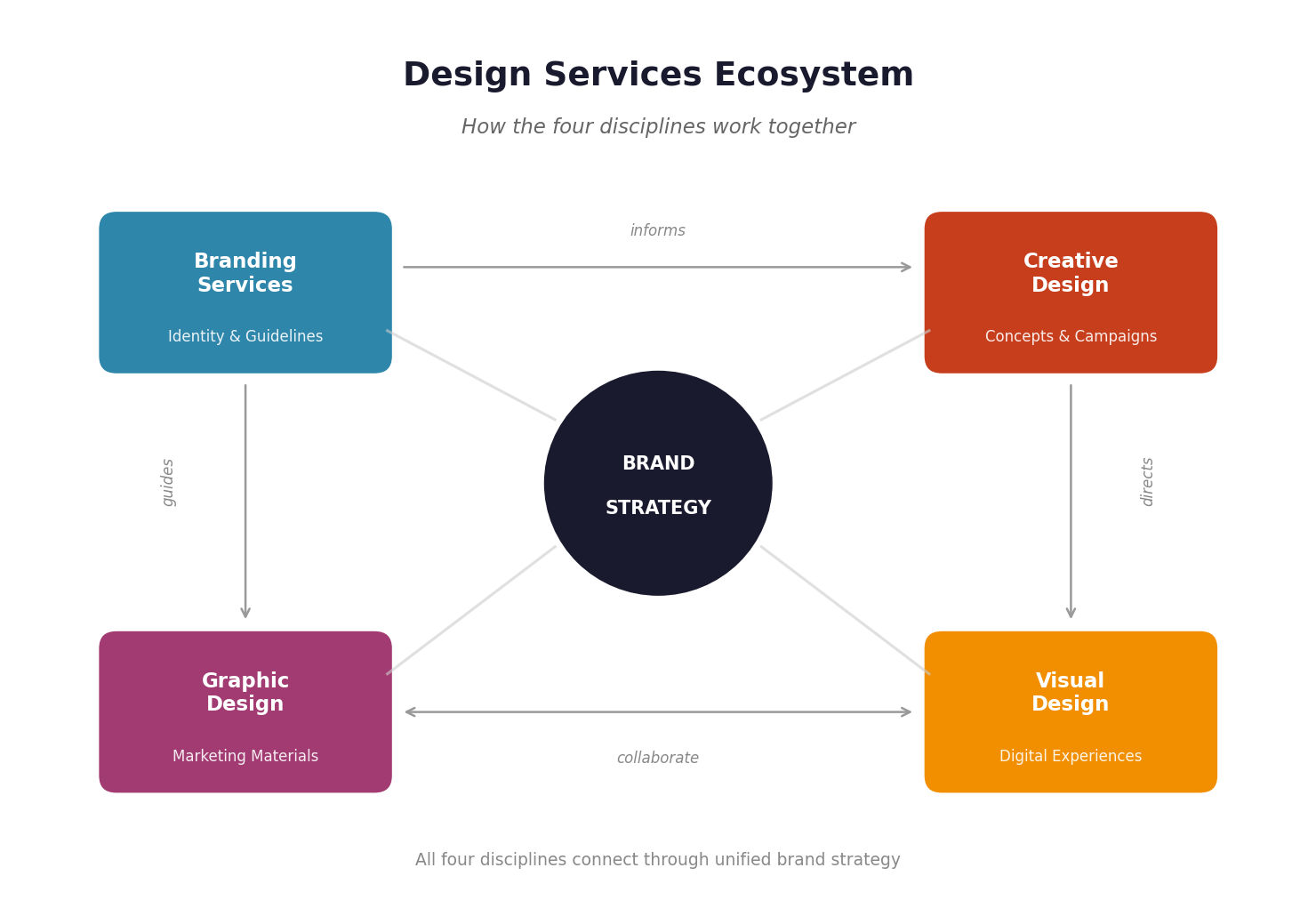
Understanding the landscape of professional design services helps businesses identify which capabilities align with their goals. Each discipline serves distinct purposes while contributing to a unified brand experience.
Core Design Service Categories
| Service Type | Primary Function | Typical Deliverables | Best For |
|---|---|---|---|
| Branding Services | Establish visual identity | Logos, brand guidelines, color systems | New businesses, rebrands, mergers |
| Graphic Design Services | Create visual communications | Marketing materials, advertisements, presentations | Ongoing marketing needs |
| Visual Design Services | Craft digital experiences | Website layouts, app interfaces, digital campaigns | Digital-first companies |
| Creative Design | Develop conceptual campaigns | Campaign concepts, art direction, storytelling | Brand differentiation |
Branding Services Deep Dive
Branding services create the visual and verbal identity that sets an organization apart. This includes logo development, typography selection, color palette creation, and brand guidelines that ensure consistency across all touchpoints. According to McKinsey research cited in industry analyses, strong brands on average achieved triple the sales volume of weaker brands and commanded a 13% price premium.
Branding services typically include brand strategy and positioning development, logo design and identity systems, brand guidelines and style documentation, verbal identity covering tone and messaging frameworks, and brand architecture for multi-product organizations.
Graphic Design Services Explained
Graphic design services translate brand identity into marketing assets you can actually use. This discipline creates the visual materials businesses need daily for customer communication—business cards, brochures, social media graphics, trade show displays. The North American graphic design market alone represents over $19.6 billion annually, reflecting substantial demand for professional visual communication.
Professional graphic design services offer consistent brand application across all materials, higher quality outputs compared to template-based solutions, visual hierarchy that guides viewer attention, and scalable asset libraries that reduce long-term costs. On the other hand, they require higher initial investment than DIY approaches, clear communication of business objectives, and revision cycles that may extend project timelines.
Visual Design Services for Digital Platforms
Visual design services focus specifically on digital environments where user interaction, accessibility, and technical constraints shape creative decisions. This includes website design, mobile application interfaces, interactive presentations, and digital advertising. According to market analysis, web and app design holds the largest share of the graphic design market at 22%, followed by logo and brand identity design at 21.3%.
What separates visual design from traditional graphic design? Speed and iteration. Digital assets get tested, measured, and revised based on user behaviour data. A landing page might go through dozens of variations in a single quarter. Print collateral gets one shot.
Common Misconceptions
Misconception 1: Design is just making things look pretty
Design is strategic. Effective design services begin with understanding business objectives, target audience psychology, market position, and measurable outcomes. According to Forrester research, companies investing in user experience design report conversion rate improvements of 200-400% and reduced customer support costs. Design thinking integrates user research, prototyping, and testing to solve complex business problems through visual and experiential solutions.
Misconception 2: AI tools eliminate the need for professional designers
Artificial intelligence has introduced powerful capabilities for automating certain design tasks, but these tools work best as efficiency multipliers for skilled professionals. AI can generate variations, automate repetitive processes, and accelerate ideation phases. But strategic thinking, cultural sensitivity, brand consistency judgment, and translating complex business requirements into unified visual systems? Those remain human work. The Bureau of Labour Statistics projects approximately 20,000 openings annually for graphic designers through 2034, though the nature of work continues evolving.
Misconception 3: Brand consistency limits creativity
Organizations sometimes resist detailed brand guidelines, believing they constrain creative expression. The opposite tends to be true. According to research compiled from multiple industry sources, consistent branding across platforms can increase revenue by up to 23%. Working within established parameters focuses creative problem-solving and ensures outputs reinforce brand value rather than dilute it.
Why Digital-First Companies Invest More in Design
Design investment and business performance have grown more connected since 2020, when digital channels became the primary customer touchpoint for most businesses. Companies that operate mainly through screens don't have physical presence to compensate for poor visual communication. Every interaction counts.
According to McKinsey research, branding was cited as the number one priority for 2026 by marketing leaders surveyed across major European markets, with 72% of CMOs planning to increase their budgets relative to sales. Brand distinctiveness and clear value proposition now drive competitive differentiation in markets saturated with similar offerings.
Research backs this up with hard numbers. According to analysis of Forrester research, improvements in website UX design can lead to conversion rate increases of up to 400% for businesses. Digital-native companies allocate 15-25% of product budgets to design capabilities, compared to 5-10% at traditional enterprises.
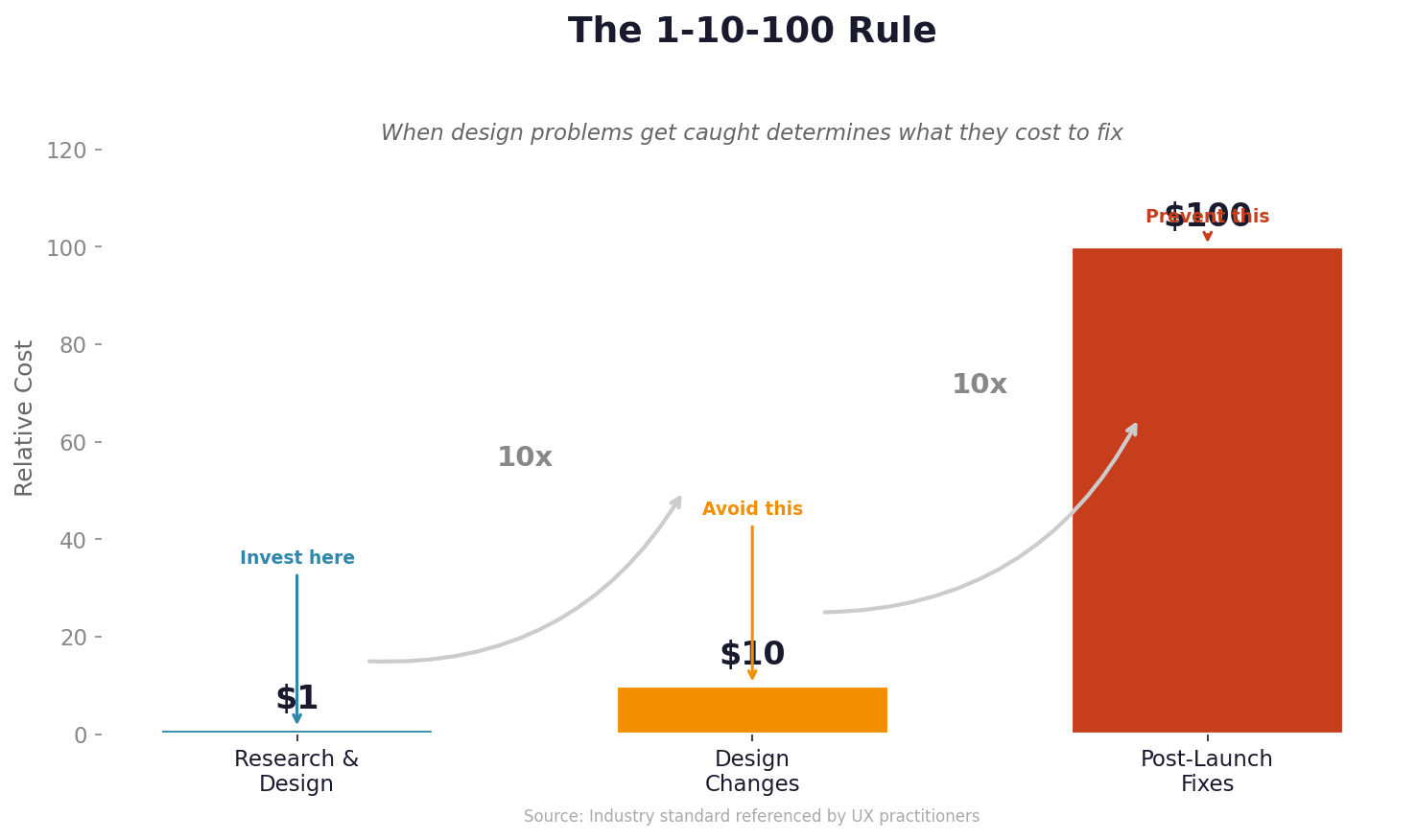
Front-end design investment pays off. Industry practitioners reference the 1-10-100 rule: spending $1 on research and design upfront prevents $10 in design changes and $100 in development-phase corrections. Companies that discover usability issues after launch face higher remediation costs and lost revenue from suboptimal customer experiences.
The Hidden Costs of Inconsistent Visuals
Beyond customer perception, inconsistent design execution creates organizational inefficiencies. Teams without established brand systems waste 5-10 hours weekly recreating assets, debating visual decisions, and producing materials that work against each other.
According to McKinsey analysis, companies implementing data-driven approaches to branding report marketing efficiency gains of up to 30% and incremental top-line growth of up to 10% without increasing marketing budgets. The reason? Eliminating redundant creative development and ensuring marketing investments build upon previous efforts rather than starting from scratch each time.
The proliferation of channels makes this worse. A business might interact with customers through website, mobile app, social media platforms, email, physical locations, packaging, and advertising across multiple formats. That's potentially dozens of teams making independent visual decisions on their own. Without systematic design services maintaining coherence, brand identity fragments and audiences get confused.
Deloitte's marketing trends analysis confirms that today's consumers expect seamless experiences across all channels. Brands successfully integrating physical and digital touchpoints see measurably higher engagement and conversion rates.
Real-World Examples and Case Studies
Airbnb: Design-Led Transformation
When Airbnb undertook its comprehensive 2014 rebrand, the company treated design as fundamental business strategy. Not a nice-to-have. According to DesignStudio, the agency behind the rebrand, the project began with extensive research: visits to 13 cities, stays with 18 Airbnb hosts, and interviews with 120 employees. They invested in understanding what the brand meant before creating visual assets.
The resulting "Bélo" logo and "Belong Anywhere" positioning unified the company's identity around emotional connection. On its first day of trading in 2020, Airbnb's share price more than doubled its IPO price, giving it a market capitalization of approximately $86.5 billion. Many factors contributed to this success. But the design-led approach gave Airbnb a clear way to communicate what made it different across every touchpoint.
Mailchimp: Evolution Without Losing Identity
Mailchimp's 2018 rebrand shows how to mature a brand while preserving what built customer loyalty. As the company expanded from email marketing into a comprehensive marketing platform, its visuals needed to signal this broader capability without abandoning the playful personality that set it apart.
According to case study analysis, Mailchimp refined its chimp mascot Freddie into a more versatile icon usable across diverse applications while introducing a bold color palette centered on "Cavendish Yellow." The company retained its distinctive Cooper Light typeface rather than following industry trends toward minimalist sans-serif typography. Mailchimp emerged as a professional marketing platform while keeping the character that customers loved.
The lesson? Evolution beats revolution when you've already built something strong. Mailchimp didn't abandon what worked. They refined it.
Frequently Asked Questions
What's the difference between branding services and graphic design services?
Branding services create the visual and verbal identity elements that define how a company presents itself: logos, color systems, typography, and brand guidelines. Graphic design services apply this identity to create specific marketing materials. Branding creates the DNA; graphic design produces the tangible expressions in advertisements, collateral, and digital assets.
How much should businesses budget for professional design services?
It depends on scope, industry, and stage. Brand identity development for mid-market companies typically ranges from $15,000 to $75,000, while comprehensive rebrands for larger organizations can exceed $200,000. Ongoing graphic design services often operate on retainer arrangements ranging from $3,000 to $15,000 monthly depending on volume and complexity. Focus on return on investment rather than absolute cost.
How do I evaluate the quality of design service providers?
Look at portfolio relevance to your industry, client retention rates, and their extensive process for understanding business goals before creating visuals, and their ability to connect design decisions to measurable outcomes. Request case studies that include business results rather than only visual samples. A good sign: they ask more questions than they answer in the first meeting.
What makes creative design different from standard graphic design?
Creative design involves higher-level conceptual development, campaign ideation, and art direction that establishes the strategic and aesthetic framework. It determines what a campaign should say and feel. Graphic design then produces the specific assets. Many agencies combine both, while some organizations maintain internal creative direction with external graphic design production.
When should a company rebrand versus refresh?
Rebrand when you're facing fundamental business model changes, mergers requiring identity consolidation, significant negative associations, or evolved market positioning that existing visuals can't communicate. Refresh when core brand strategy remains sound but execution has become dated or inconsistent. Refresh typically costs 30-50% less. Most companies need a refresh every 5-7 years; full rebrands are rarer.


