Table of contents
Key Takeaways
- A complete brand identity package includes strategic elements (positioning, messaging, voice) plus visual elements (logo, colours, typography, imagery) plus implementation guidelines—not just a logo
- Most businesses invest $5,000–$50,000 in professional branding packages, with pricing driven by scope, research depth, team seniority, and timeline
- Consistent brand presentation can increase revenue by 23-33%, making enforcement and implementation as important as initial creation
- Speed-to-market often matters more than perfection—deploy a strong foundation quickly, then refine based on market response
- For significant brand investments or complex requirements, partnering with experienced brand strategy professionals reduces risk and accelerates results
What Is a Branding Package?
A branding package is a collection of strategic and visual assets that define how a business presents itself to the world. It encompasses the complete system of elements that create recognition, build trust, and differentiate a company from competitors.
According to research published in the International Journal of Academic Research in Business and Social Sciences, brand visual identity is a critical component of brand image that impacts consumers' perceptions, attitudes, and purchase intentions. The systematic review analyzed 34 peer-reviewed studies and found that visual identity elements directly influence brand quality perception, brand personality, customer satisfaction, and loyalty.
The concept of brand identity gained prominence during the Industrial Revolution when mass production created indistinguishable products, forcing manufacturers to develop unique identities to differentiate themselves. In today's crowded marketplace, that differentiation has become even more critical.
A brand identity isn't simply what a company says about itself. It's shaped jointly by the organization and its audience through every interaction and touchpoint. For mid-market and enterprise-level businesses, a branding package anchors all marketing communications, customer interactions, and internal culture. Research from Lucidpress found that consistent brand presentation can increase revenue by up to 33%.
McKinsey research indicates that B2B companies with strong brands outperform weak-branded competitors by 20%. Strong brands reduce customer acquisition costs, command premium pricing, and build competitive moats that are difficult to replicate.
What's Included in a Complete Branding Package
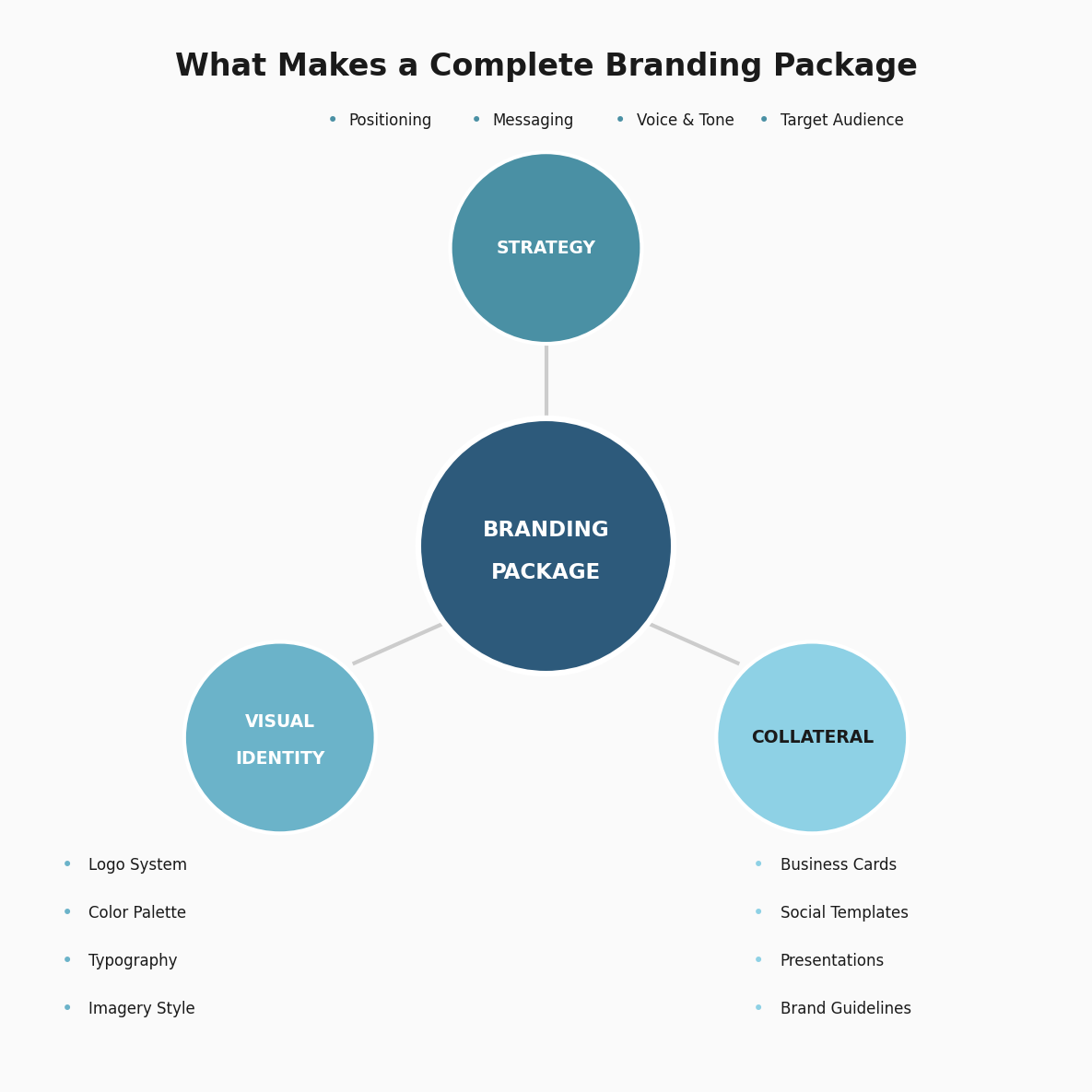
A brand design package typically includes multiple interconnected components that work together to create a cohesive identity. Understanding what you're paying for helps you evaluate proposals and ensure you're getting the deliverables your business actually needs.
Core Visual Identity Elements
| Component | Description | Purpose |
|---|---|---|
| Primary Logo | The main brand mark used across all applications | Recognition and identification |
| Secondary Logos | Variations for different contexts (horizontal, stacked, icon-only) | Flexibility across platforms |
| Color Palette | Primary, secondary, and accent colours with exact specifications | Visual consistency |
| Typography System | Primary and secondary fonts with usage guidelines | Readable, consistent communications |
| Imagery Style | Photography direction, illustration style, iconography | Visual storytelling |
Strategic Brand Elements
| Component | Description | Purpose |
|---|---|---|
| Brand Strategy | Positioning, values, mission, target audience definition | Strategic foundation |
| Messaging Framework | Taglines, value propositions, key messages | Consistent communication |
| Voice & Tone Guidelines | Communication style across contexts | Personality consistency |
| Brand Guidelines Document | Usage rules for all elements | Implementation and enforcement |
Extended Collateral Assets
Depending on the scope and investment level, branding packages may include business stationery such as business cards, letterhead, envelopes, and presentation folders. Digital assets cover social media templates, email signatures, presentation templates, and website design specifications.
Marketing materials like brochure templates, one-pagers, and sales deck frameworks give marketing teams on-brand starting points. Environmental applications include signage specs, vehicle wraps, and trade show booth guidelines.
For product-based businesses, packaging design and unboxing experience guidelines transform every customer touchpoint into a brand moment.
Pros:
- All elements designed to work together cohesively from day one
- Single point of accountability for brand consistency
- Cost efficiency compared to piecemeal development
- Faster time-to-market with complete assets ready for deployment
Cons:
- Higher upfront investment than minimal approaches
- May include elements not immediately needed
- Requires clear strategic direction before execution begins
How Much Does a Branding Package Cost in 2026?
Branding services pricing varies dramatically based on scope, provider experience, and business complexity. Most businesses invest between $2,000 and $90,000 in branding packages.
Cost Breakdown by Investment Level
| Investment Level | Price Range | Typical Deliverables | Best For |
|---|---|---|---|
| Entry-Level | $1,000–$5,000 | Basic logo, color palette, minimal guidelines | Startups, solopreneurs, MVP launches |
| Small Business | $5,000–$20,000 | Full visual identity, messaging, brand guidelines, core collateral | Established small businesses, Series A startups |
| Mid-Market | $20,000–$50,000 | Strategy, identity system, extensive collateral, website direction | Growing companies, competitive markets |
| Enterprise | $50,000–$90,000+ | In-depth research, positioning workshops, full identity system, brand architecture | Multi-brand portfolios, global expansion |
| Global Agency | $90,000–$250,000+ | World-class strategy, naming, visual identity, advertising campaigns, brand activation | Fortune 500, late-stage startups with significant funding |

What Drives Branding Package Pricing
Several factors influence branding costs.
Scope of deliverables is the biggest cost driver. A logo-only project costs a fraction of a full brand identity package including strategy, visual system, messaging framework, and guidelines.
Research depth adds value and cost. Projects involving competitive analysis, customer interviews, market research, and user testing require more time and expertise but yield more strategic results.
Team seniority affects pricing. Principal-led projects with senior strategists and designers command premium rates compared to junior team execution. Revision and collaboration intensity impacts final costs too. Projects requiring extensive stakeholder alignment, multiple presentation rounds, and iterative refinement add hours that increase the investment.
Timeline compression carries premiums. Rush projects typically cost 25-50% more than standard timelines. And brand architecture complexity matters: organizations with multiple sub-brands or need for trademark research face higher costs than single-brand projects.
Budget Allocation Guidance
For businesses planning branding investment, industry benchmarks provide useful starting points.
Startups and new businesses should allocate 15-30% of initial marketing budget to branding. For a $30,000 marketing budget, that means $4,500-$9,000 for foundational brand identity work.
Established businesses rebranding should budget 5-10% of annual revenue. A company earning $500,000 annually should consider $25,000-$50,000 for complete brand transformation. Early-stage ventures should avoid overspending before product-market fit is established. A functional brand identity under $10,000 allows iteration as the business model evolves.
Common Misconceptions
Misconception 1: A Logo Is the Same as a Brand Identity
Many businesses conflate logo design with complete branding, leading to inadequate investment. A logo is just one component of a brand identity package. Research from EBSCO confirms that brand identity encompasses both abstract qualities like personality and values, plus tangible elements including visual symbols, colours, shapes, and typography that work together to create recognition. A logo without supporting elements, consistent application guidelines, and strategic foundation delivers minimal value.
Misconception 2: Branding Is a One-Time Expense
Businesses often treat branding as a fixed cost. But brand activation, updating marketing materials, refreshing digital assets, and evolving brand guidelines require ongoing budget allocation. According to Frontify, most brands require evolution every 3-5 years to remain relevant, and budgeting for updates keeps companies competitive in changing markets.
Misconception 3: Cheaper Always Means Better Value
Budget constraints are real. But research demonstrates the hidden costs of underinvestment. Studies indicate that inconsistent branding requires up to 1.75 times more media spend to achieve equivalent results, effectively negating any upfront savings. The lowest-cost option frequently results in rework, confusion, and lost opportunities that exceed the original savings.
Why Speed-to-Market Often Trumps Perfection
Here's something most branding articles won't tell you: waiting for the perfect brand often costs more than launching with a good one.
According to McKinsey research on marketing return on investment, brand messaging effectiveness is one of the most important determinants of success, more important than a precisely optimized marketing mix.
For early-stage companies and those in fast-moving markets, the cost of delayed launch often exceeds the benefit of additional refinement. A functional brand identity deployed quickly allows businesses to begin building market presence, gathering customer feedback, and generating revenue while competitors deliberate.
This doesn't mean rushing or accepting poor quality. An 80% solution delivered in weeks outperforms a perfect solution delivered in months. Consider phased approaches that establish core identity elements first, then expand and refine based on market response.
Research from the McKinsey Consumer Marketing Analytics Center supports this approach, noting that marketing investment decisions should factor in both short-term and long-term impact, with spend biased toward future growth.
The Hidden Cost of Brand Inconsistency
While businesses focus on upfront branding investment, they often overlook the ongoing costs of inconsistency. According to Demand Metric research, organizations with brand consistency issues could see an average 23% lift in revenue from consistent brand presentation.
Here's the gap that costs real money: 95% of organizations have brand guidelines, but only 25% enforce them consistently.
Inconsistent branding creates market confusion, damages professional credibility, increases customer acquisition costs, and requires more resources to achieve the same marketing impact. For organizations investing in branding services, enforcement and implementation matter as much as initial design quality.
When formal guidelines exist and are enforced, organizations are more than twice as likely to see consistent brand presentation across all touchpoints. Budget allocation should include not just creation but also governance, training, and brand management infrastructure.
Real-World Examples and Case Studies
Airbnb: From Startup to Global Icon
Airbnb's 2014 rebrand is one of the most studied transformations in brand identity history. Working with DesignStudio, the company conducted extensive immersion research. Four team members traveled to 13 cities, stayed with 18 hosts, and interviewed 120 employees over three months.
The research revealed that being part of a global community was what customers cherished most about Airbnb. This insight drove the new positioning around "belonging" rather than accommodation. The resulting visual identity, centered on the "Bélo" symbol, was designed to represent people, places, love, and Airbnb. Simple enough for anyone to draw. Transcending language barriers.
Customer research during the process uncovered something surprising: many people had mistakenly associated the old logo with a mattress company. This disconnect between brand perception and business reality underscored the need for identity work beyond visual refinement.
The rebrand trended on Twitter, won numerous design awards, and helped position Airbnb for its eventual IPO at a valuation exceeding $100 billion.
Deep customer research reveals insights that pure design thinking cannot. The most successful brand transformations invest in understanding how audiences actually perceive the brand before redesigning it.
Mailchimp: Growing Up Without Losing Personality
When email marketing platform Mailchimp evolved into an all-in-one marketing platform, their brand needed to reflect expanded capabilities without losing the quirky personality that customers loved. In 2018, working with Collins, Mailchimp undertook a complete rebrand.
The challenge was significant. The company had 35 solutions that needed to be rationalized into a coherent portfolio. Collins helped sort these into five categories, improving cross-selling, informing the product roadmap, and allowing easy integration of new products without customer confusion.
But here's what made this rebrand different: instead of following the tech industry trend toward minimal, generic design, Mailchimp doubled down on distinctive character. The redesign included a refined mascot (Freddie), a bold new typeface (Cooper Light), an expanded color palette anchored by "Cavendish yellow," and a complete logo system. The brand system maintained playfulness while projecting greater authority for enterprise customers.
What happened next surprised the industry. Intuit acquired Mailchimp for $12 billion, representing 10% of Intuit's market capitalization at the time. The rebrand attracted enterprise customers while preserving appeal to small business owners.
Growing up doesn't mean erasing distinctive qualities. The most memorable rebrands amplify authentic personality rather than conforming to industry conventions.
Frequently Asked Questions
How long does a professional branding package take to develop?
The timeline depends on scope and complexity. A basic brand identity package typically requires 4-8 weeks. Full projects involving strategy, research, identity development, graphic elements, and extensive collateral may take 3-6 months. Enterprise rebrands with global rollout requirements can extend to 12+ months. Rush timelines? Possible, but typically add 25-50% to costs.
Should we hire a freelancer or an agency for our brand design package?
Freelancers offer cost efficiency for straightforward projects and work well when you have clear direction. Design agencies provide broader expertise, backup resources, and structured processes that reduce risk on complex projects. For businesses spending over $20,000 or requiring strategy beyond visual design, agencies typically deliver better outcomes.
When is the right time to invest in rebranding versus creating a new brand?
New brands need foundational identity, but full packages aren't always necessary for early-stage ventures. Rebrand when your current identity no longer represents who you are, confuses customers about your offerings, or fails to differentiate in an increasingly competitive market, leaving you without a competitive edge. Warning signs? Consistent customer confusion, difficulty commanding premium pricing, visual identity that looks dated compared to competitors.
What should we prepare before engaging in branding services?
Gather business fundamentals: mission, values, target audience definition, competitive landscape analysis, and growth objectives. Collect existing branding elements, brand assets, and any research on customer perceptions. Define decision-making authority and approval processes. The clearer your inputs, the more efficient the branding process becomes.
How do we measure ROI on branding investment?
Track customer acquisition cost, conversion rates, sales cycle length, pricing power, customer retention, and hiring effectiveness. Establish baselines before brand investment and monitor trends after implementation. Strong brands can deliver 20% performance advantage over weak-branded competitors. But attribution requires tracking multiple metrics over time rather than expecting immediate returns.