Table of contents
ABM in dentistry means targeting DSOs and referral networks as named accounts, not running personalized ads at patients. This page evaluates whether that account-based approach is worth the spend, using ADA/Private Practice Research's own DSO market data, an AAE referral-pattern survey and ITSMA's cross-industry ROI benchmarks. The goal is an honest ROI evaluation a dental group can defend internally, not a marketing pitch for running ABM regardless of the numbers.
Key Takeaways
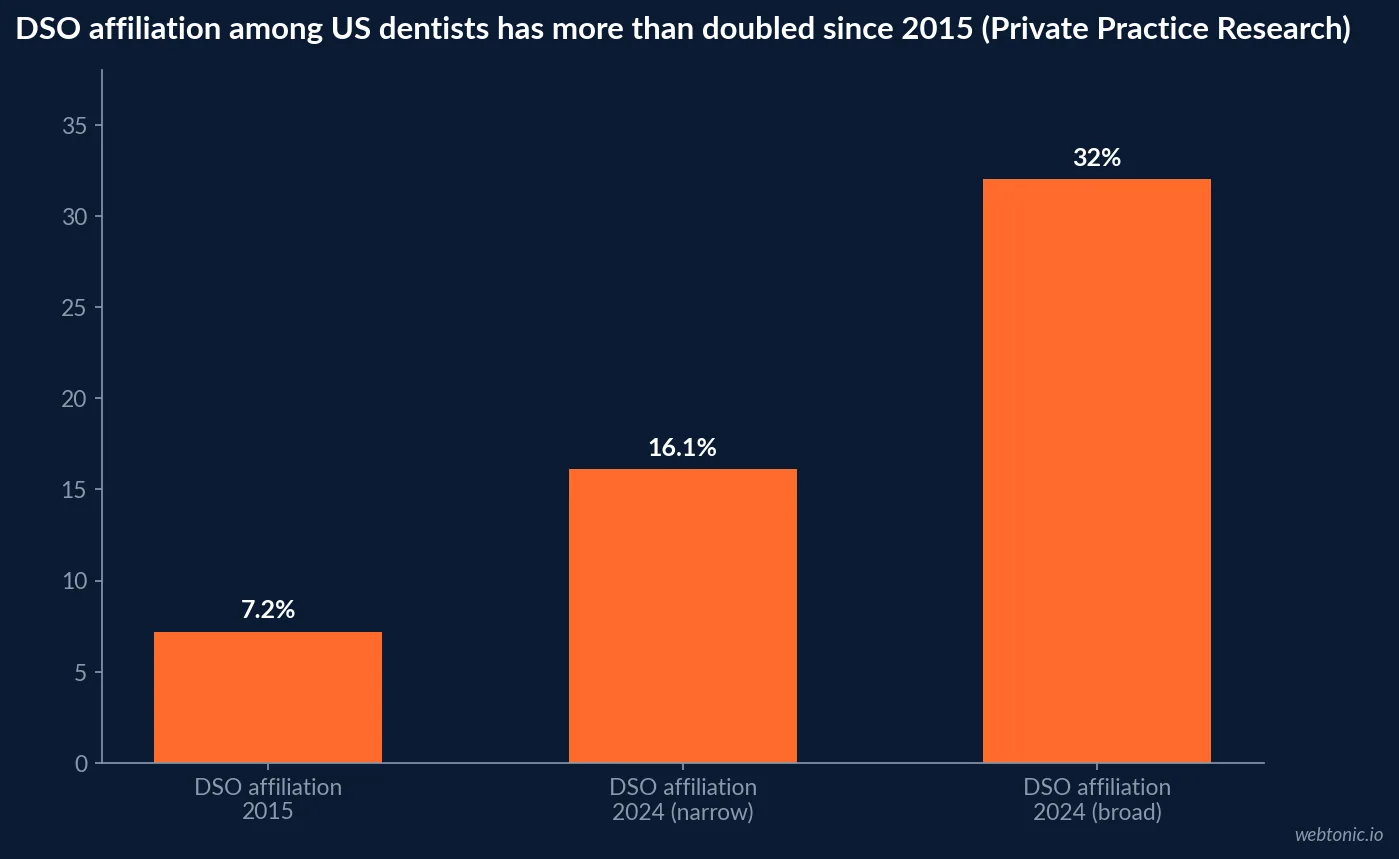
- DSO affiliation reached 16.1% of dentists in 2024, up from 7.2% in 2015.
- Under broader industry definitions, DSO-affiliated dentists exceed 30%.
- The DSO market is projected to grow 18% annually to $200 billion by 2034.
- The total US dental market is valued at $164 billion today, headed toward $270 billion by 2034.
- About 90% of endodontic root canal referrals originate from general-dentist referrals, per the AAE's 2026 survey.
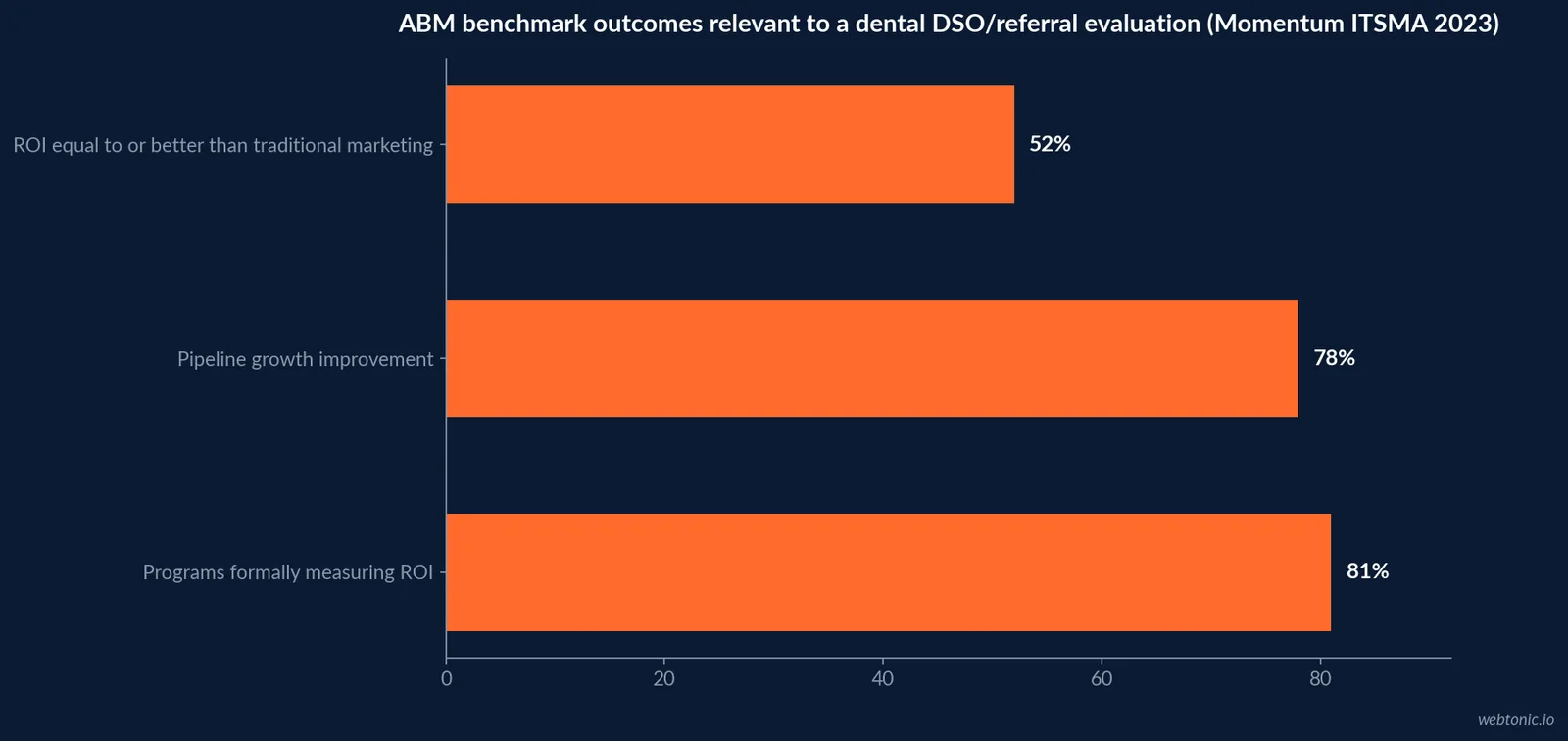
- 81% of ABM programs report ROI equal to or better than traditional marketing.
- Only 52% of those programs formally measure that ROI.
- 78% of ABM programs report improved pipeline growth.
- Mature ABM programs dedicate 30% of the marketing budget to the practice.
- "Hidden buyers" carry 49% of decision weight versus 51% for target buyers, per LinkedIn's B2B Institute.
- 94% of B2B organizations sell to buying groups of three or more.
- The average dentist ownership rate fell from 84.7% in 2005 to 72.5% in 2023, a structural driver behind DSO growth.
- The average enterprise B2B buying group spans 5 to 11 stakeholders across 5 distinct functions, per Gartner's own buying research.
| DSO/dental market metric | Figure | Source |
|---|---|---|
| DSO affiliation, 2015 | 7.2% of dentists | Private Practice Research, 2026 Baseline Report |
| DSO affiliation, 2024 (narrow definition) | 16.1% of dentists | Private Practice Research / ADA HPI |
| DSO affiliation, 2024 (broad definition) | 30%+ of dentists | Private Practice Research, 2026 Baseline Report |
| DSO market projected annual growth | ~18% | Private Practice Research, 2026 Baseline Report |
| DSO market size by 2034 (projected) | $200 billion | Private Practice Research, 2026 Baseline Report |
| Total US dental market, today vs 2034 | $164B -> $270B | Private Practice Research, 2026 Baseline Report |
Why DSOs and referral sources are the actual "accounts"
ABM has no target if the unit of analysis is a patient - patients are not named accounts a sales team can build a plan around. The two groups that are: dental support organizations a practice might affiliate with, sell equipment or services to, or compete against for acquisition; and referral sources - the general dentists and physicians who send patients to a specialist. Private Practice Research's 2026 baseline report puts DSO affiliation at 16.1% of dentists under the ADA's narrow employment definition - up from 7.2% in 2015 - or over 30% under broader industry definitions, with the underlying dentist-ownership rate falling from 84.7% in 2005 to 72.5% in 2023. That consolidation is precisely why a DSO-facing ABM list is worth building now.
Referral networks are already account-based
The referral side proves the ABM logic even without a formal program. The American Association of Endodontists' 2026 Endodontist-General Dentist Referral Patterns Survey found approximately 90% of root canal treatments performed by endodontists originate from general-dentist referrals. That means a specialist's real top-of-funnel account list is a short, nameable set of referring practices - and treating each one with an account-specific plan (co-branded patient education, direct scheduling lines, case-outcome reporting back to the referrer) is ABM by definition, whether or not the term is used internally.
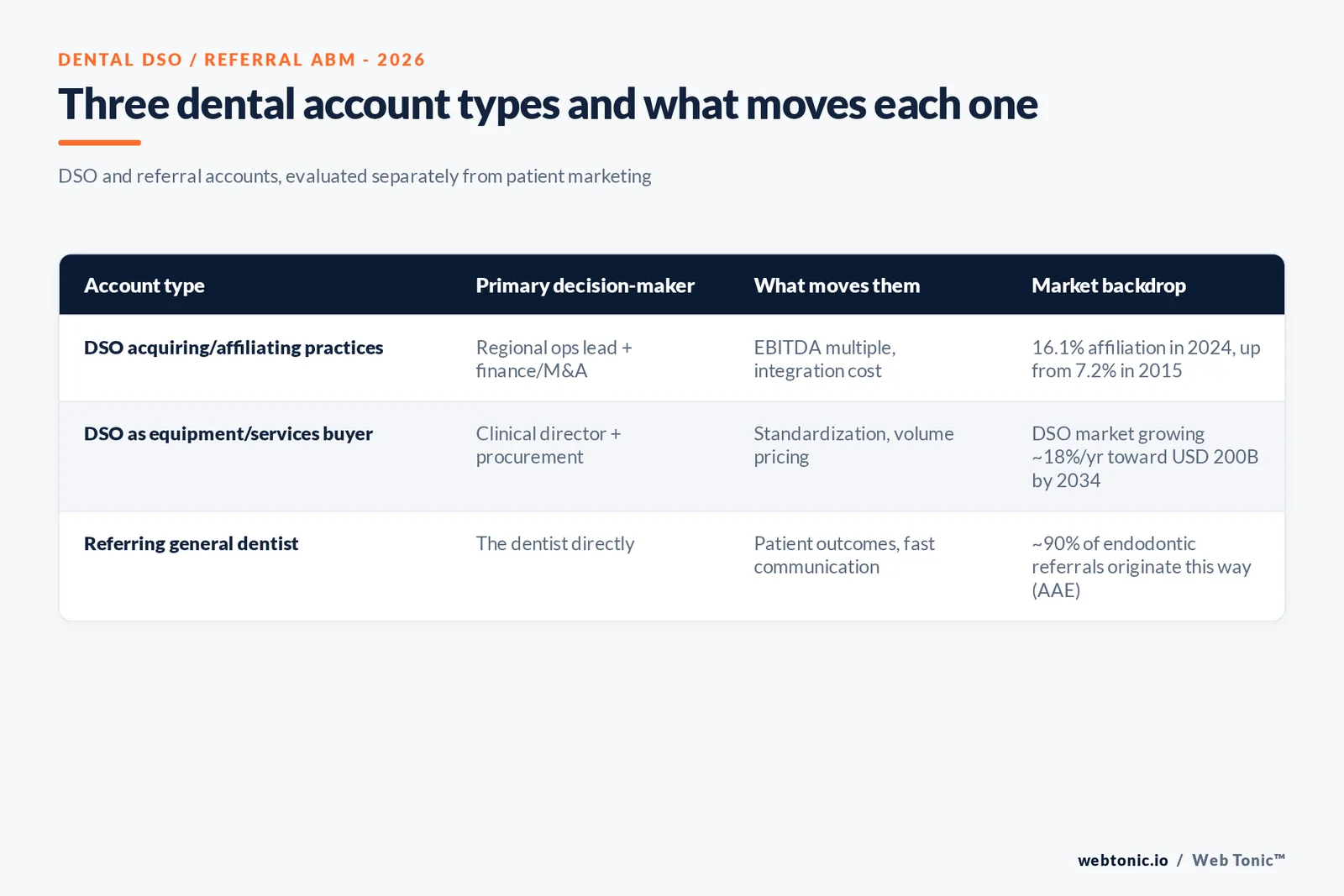
| Dental account type | Who is the buyer/decision-maker | What moves them |
|---|---|---|
| DSO acquiring or affiliating practices | Regional operations lead + finance/M&A contact | EBITDA multiple, integration cost, clinical quality data |
| DSO as an equipment/services buyer | Clinical director + procurement | Standardization across locations, volume pricing |
| Referring general dentist | The referring dentist directly | Patient outcomes, communication speed, ease of scheduling |
Who actually decides on the DSO/referral side
LinkedIn's B2B Institute research on buyer groups, conducted with Bain & Company and NewtonX, found that "hidden buyers" - those without an obvious product-decision title - carry almost equal weight to product-focused "target buyers": 49% versus 51% of decision-making influence. On the DSO side, that hidden buyer is often the regional operations lead or a finance contact evaluating integration cost, not the clinical director who takes the first meeting. Forrester's broader research backs the group-not-person framing generally: 94% of B2B organizations report selling to groups of three or more.
Does the ROI evidence hold up?
The Momentum ITSMA and ABM Leadership Alliance benchmark study, from 111 companies already running ABM across industries, found 81% rate ABM's ROI as the same as or better than traditional marketing, and 78% report improved pipeline growth. The honest caveat: only 52% formally measure that ROI, and mature programs run at roughly 30% of the marketing budget with 66% planning to increase spend - none of that is dental-specific, and a dental group should build its own tracked pipeline against a named DSO/referral list before assuming the 81% figure transfers.
| ABM benchmark (cross-industry, N=111-208) | Figure | Source |
|---|---|---|
| ROI equal to or better than traditional marketing | 81% | Momentum ITSMA / ABM Leadership Alliance |
| Programs formally measuring ROI | 52% | Momentum ITSMA / ABM Leadership Alliance |
| Pipeline growth improvement | 78% | Momentum ITSMA / ABM Leadership Alliance |
| Marketing budget share, mature programs | 30% | Momentum ITSMA / ABM Leadership Alliance |
| Buying groups of three or more | 94% | Forrester |
What the ADA's own economic data adds
The ADA Health Policy Institute's quarterly State of the US Dental Economy series is the underlying source behind the affiliation figures above, and its Q2 2026 update adds a second signal worth tracking on the DSO side specifically: a small but growing share of dentists report using AI for non-clinical tasks like insurance verification and business analytics, which is exactly the kind of operational standardization that makes a practice a more attractive DSO acquisition or affiliation target in the first place.
Who is actually in the room on a DSO deal
Gartner's own B2B buying research puts the average enterprise buying group at 5 to 11 stakeholders across 5 distinct business functions - on a DSO acquisition or major equipment purchase, that typically maps to a clinical lead, a regional operations director, a finance/M&A analyst, a compliance contact and an executive sponsor. Treating the "practice" as a single buyer, the way solo-practice patient marketing often does, undercounts the committee by a factor of four or five.
| DSO buying-committee role | What they decide | Content they need |
|---|---|---|
| Clinical lead | Standard of care, clinical workflow fit | Case outcomes, clinical protocols |
| Regional operations director | Rollout logistics, staffing | Implementation timeline, staffing model |
| Finance / M&A analyst | EBITDA multiple, deal structure | Financial performance, valuation comps |
| Compliance contact | Regulatory and HIPAA fit | Compliance documentation, audit history |
What ABM tooling costs a dental group
No ABM platform in this category publishes a rate card, which matters for a dental group budgeting a DSO/referral pilot. Demandbase's own pricing page states the model - a platform fee plus a flat fee per user - without listing numbers, and 6sense follows the same custom-quote pattern on its own site. Expect a scoping call built around the size of the named DSO/referral list, not a published price, before any number appears.
Building an ROI evaluation, in order
- Separate the DSO/referral account list from patient marketing entirely - the buyer, budget and content are different for each.
- Name the referring practices first - the AAE's 90% figure means a small set of general dentists likely accounts for most specialist referrals already.
- Plan for a hidden buyer on any DSO account, per the 49%/51% split - a clinical-only pitch misses roughly half the real decision weight, which usually sits with a finance or M&A analyst rather than the clinical lead who takes the first meeting.
- Map the full 5-to-11-person committee, not just the practice owner, before building outreach content for a DSO acquisition or affiliation conversation.
- Track pipeline against the named list directly rather than importing ITSMA's 81% ROI figure as a given.
- Size the DSO opportunity against the market data - 16.1% affiliation today, growing toward 30%+ under broader definitions, is the backdrop for why this list is worth building now.
Frequently Asked Questions
Does ABM apply to a solo dental practice marketing to patients?
No - ABM targets named commercial accounts, and a patient is not an account. In dentistry, ABM applies to dental support organizations (DSOs) a practice might sell into or affiliate with, and to referral sources - the general dentists, physicians and specialists who send patients. A solo practice's patient-acquisition marketing is a different budget line entirely; this page evaluates ROI for the DSO/referral-account side only.
How big is the DSO opportunity actually worth targeting?
DSO affiliation grew from 7.2% of dentists in 2015 to 16.1% in 2024 under the ADA's narrow employment definition, or over 30% under broader industry definitions that count dentists operating inside DSO-affiliated practices, per Private Practice Research's 2026 baseline report. The same report projects the DSO market growing at roughly 18% annually to $200 billion by 2034, against a $164 billion total US dental market today headed toward $270 billion by the same year.
What does the referral side of a dental ABM program look like?
Referral relationships are already account-based in practice, even before a formal program exists. The American Association of Endodontists' 2026 survey of endodontists and general dentists found approximately 90% of root canal treatments performed by endodontists originate from referrals - meaning the general-dentist relationship is effectively the whole top of that specialist's funnel, and a handful of named referring practices can be worth more than any patient-facing ad spend.
Is ABM's reported ROI trustworthy for a dental account-based program?
Treat it as directional, not guaranteed. ITSMA's benchmark data, from 111 companies already running ABM across industries, found 81% rate ABM's ROI as equal to or better than traditional marketing, with 78% reporting improved pipeline growth. But only 52% of those programs formally measure ROI, and the sample is companies that chose to keep the program running - a dental group evaluating its own DSO/referral ABM pilot should set up its own tracked pipeline rather than assume the 81% figure transfers directly.
Who is actually involved in a DSO's purchase decision?
More than one person, and the roles differ by influence, not just title. LinkedIn's B2B Institute research on buyer groups found that hidden buyers carry almost equal decision-making weight to product-focused target buyers - 49% versus 51% - meaning a DSO pitch aimed only at the clinical or operations lead misses roughly half the real influence in the room, which typically includes a finance or M&A contact and a regional operations lead alongside the clinical decision-maker.
Sources
Private Practice Research, The State of Dental Practice Values: 2026 Baseline Report
American Association of Endodontists, 2026 Referral Patterns Survey
Momentum ITSMA / ABM Leadership Alliance, Rethinking ABM 2023 Benchmark Study
Forrester, Your Buyer Is A Group, Not A Person
LinkedIn B2B Institute, The Hidden Buyer Gap
See the cross-industry ABM statistics hub for the platform-wide benchmarks referenced above, or explore Dental Demand Generation Statistics for the patient-side channel, and get in touch to scope a DSO/referral ABM plan.