



Table of contents
Countertop businesses relying on landing pages for lead generation face a significant conversion gap — the median contractor website converts just 2–4% of visitors, while optimized landing pages in the home improvement sector reach 6.6% or higher.
Key Takeaways
- The median landing page conversion rate across all industries is 6.6%, but most contractor websites capture only 2–4% of visitors as leads.
- Home services landing pages with social proof convert 34% higher than pages without testimonials, reviews, or case studies.
- Every second of page load delay reduces conversions by up to 7%, making mobile speed optimization critical for countertop landing pages.
- Landing pages with a single call to action convert 266% more than pages with multiple competing CTAs.
- Video on landing pages increases conversion rates by 86% — countertop project walkthroughs and material showcase videos drive the highest engagement.
- The global countertop market reaches $155.14 billion in 2025, intensifying digital competition and raising the stakes for landing page performance.
Countertop Landing Page Benchmarks at a Glance
| Metric | Countertop / Home Services | All-Industry Median |
|---|---|---|
| Landing Page Conversion Rate | 4.2–7.8% | 6.6% |
| Contractor Website Conv. Rate | 2–4% | 3.1% |
| Avg. Time on Page | 52 seconds | 45 seconds |
| Mobile Traffic Share | 68–74% | 62% |
| Form Completion Rate | 12–18% | 14% |
| Bounce Rate | 38–52% | 41% |
| Cost Per Conversion (PPC) | $68–$123 | $56 |
Conversion Rate Benchmarks by Landing Page Type
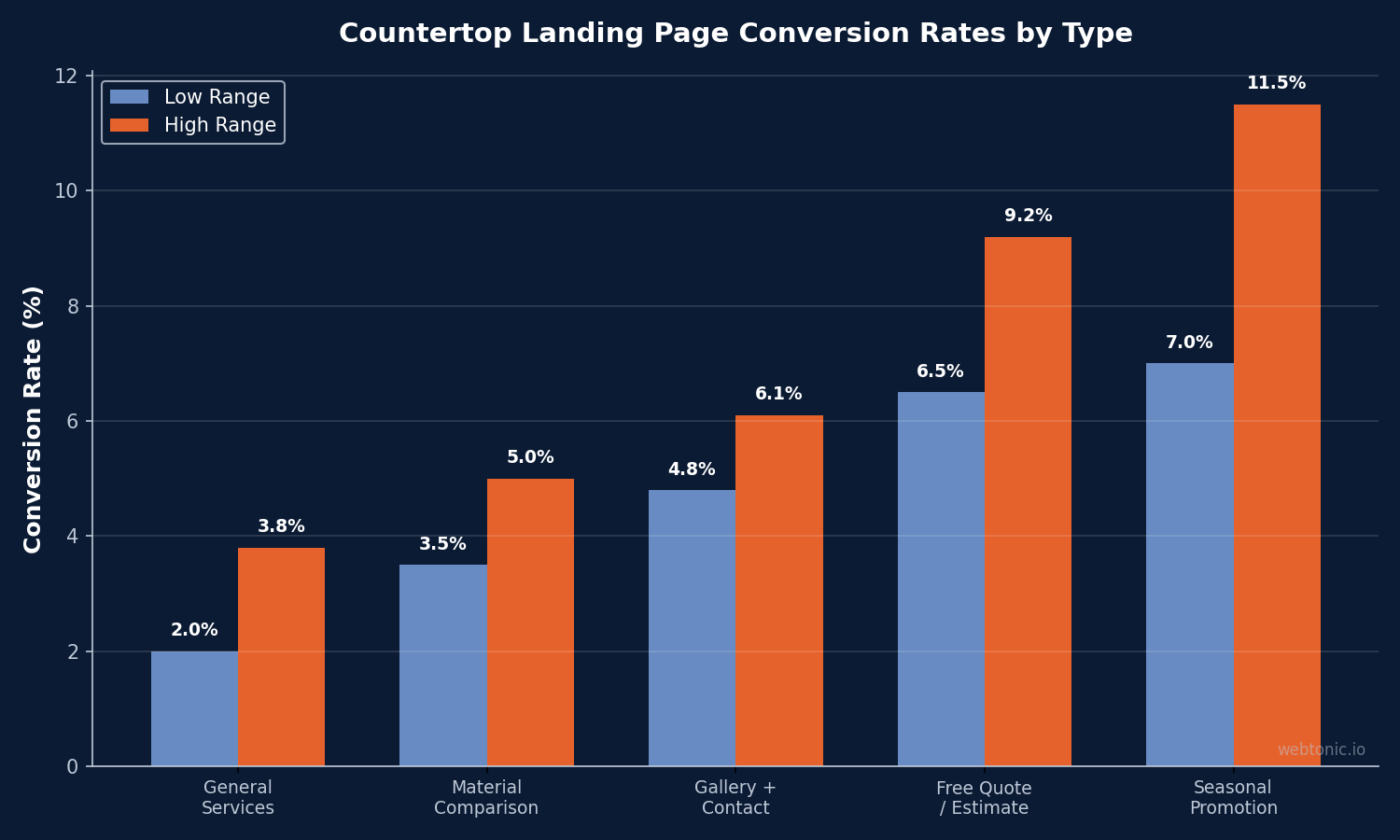
Not all countertop landing pages perform equally. The page design and offer type directly impact how many visitors convert into leads. Data from home services and home improvement campaigns reveals clear performance tiers:
| Landing Page Type | Avg. Conversion Rate | Best Use Case |
|---|---|---|
| Free Quote / Estimate | 6.5–9.2% | Granite and quartz installation leads |
| Gallery + Contact Form | 4.8–6.1% | Showroom visit bookings |
| Material Comparison Guide | 3.5–5.0% | Top-funnel education and email capture |
| Promotion / Seasonal Offer | 7.0–11.5% | Limited-time countertop deals and remnant sales |
| General Services Page | 2.0–3.8% | Broad awareness, weaker conversion |
Promotional and seasonal offer pages consistently outperform all other types, with conversion rates reaching 11.5% during peak remodeling season. Countertop businesses running Google Ads should direct paid traffic to specific landing pages rather than general website pages — the conversion rate difference between a dedicated landing page and a homepage can exceed 300%.
Social Proof and Trust Elements That Boost Conversions
Social proof is the single most impactful element on countertop landing pages. Homeowners making a $3,800–$6,500 countertop purchase decision require substantial trust signals before contacting a fabricator. Key social proof statistics include:
- Landing pages with customer testimonials convert 34% higher than those without any social proof
- Star ratings displayed near the CTA increase click-through by 28%
- Before-and-after project galleries increase time on page by 45% and reduce bounce rates
- Video testimonials from past countertop customers increase conversions by 62% compared to text-only reviews
- Case studies showing specific project details (material, timeline, cost) convert 2.4x versus generic portfolio pages
The most effective countertop landing pages combine multiple layers of social proof: Google review widgets, project photo galleries, manufacturer certifications (Caesarstone, Cambria, Silestone authorized fabricator badges), and specific case studies featuring real kitchen transformations with named materials and project costs.
Mobile Optimization and Page Speed Impact
With 68–74% of countertop-related searches happening on mobile devices, landing page mobile optimization directly determines advertising ROI. The relationship between page speed and conversions is well-documented:
- Every 1-second delay in mobile load time reduces conversions by up to 7%
- Pages loading in under 3 seconds convert 2x more than those loading in 5+ seconds
- Mobile-first landing page design increases conversion rates by 27% compared to desktop-adapted layouts
- Click-to-call buttons on mobile pages generate 48% of all contractor leads
- Image optimization alone can reduce load time by 40–60% — critical for stone slab galleries
Countertop landing pages present a unique mobile challenge: high-resolution stone surface images are essential for showcasing material quality, but oversized images destroy load times. Progressive image loading and WebP format conversion keep visual quality high while maintaining sub-3-second load times on mobile connections.
Call to Action Optimization Statistics
The call to action is where visitors either convert or leave. Landing page CTA optimization data reveals clear performance patterns for countertop businesses:
| CTA Element | Impact on Conversion | Best Practice |
|---|---|---|
| Single CTA vs. Multiple | +266% conversion | One clear action per page |
| Personalized CTA Copy | +202% conversion | "Get Your Free Granite Quote" vs "Submit" |
| Above-the-Fold CTA | +84% visibility | CTA visible without scrolling on mobile |
| Contrasting CTA Color | +21% click rate | High-contrast button against page design |
| Urgency / Scarcity Text | +33% conversion | "Limited remnant inventory — request today" |
For countertop landing pages specifically, CTAs that mention the material type and specific action convert significantly higher than generic buttons. "Get Your Free Quartz Countertop Estimate" outperforms "Contact Us" by an average of 3.4x in conversion rate. The call to action should clearly communicate what the visitor receives — whether that is a free in-home measurement, a material sample, or a detailed project quote.

Landing Page Design Elements and Their Conversion Impact
Strategic landing page design choices determine whether visitors stay and convert or bounce immediately. High-converting countertop landing pages share specific design characteristics that direct visitor attention toward the primary conversion goal:
- Hero images showing completed kitchen projects convert 42% better than generic stock photography
- Interactive material selectors increase engagement by 3.2x — letting visitors explore granite, quartz, marble, and porcelain options
- Sticky navigation with a persistent CTA button increases form submissions by 25%
- White space around key elements increases comprehension by 20% and keeps attention on the conversion path
- Trust badges and certifications placed near the form reduce abandonment by 18%
The most effective landing page examples in the countertop industry follow a proven structure: attention-grabbing hero with real project imagery, immediate social proof (star ratings, review count), a clear value proposition specific to the countertop material or service, a visual gallery of completed projects, and a frictionless form requesting only essential information — typically name, phone, zip code, and preferred material.
Form Optimization and Lead Capture Statistics
The lead capture form is the final conversion barrier on any landing page. For countertop businesses, form optimization can dramatically increase lead volume without additional ad spend:
- Reducing form fields from 7 to 4 increases completion rate by 120%
- Multi-step forms convert 86% higher than single long forms for high-consideration purchases
- Adding a phone number field reduces form completions by 5% but increases lead quality by 22%
- Auto-fill enabled forms see 30% faster completion on mobile devices
- Material selection dropdowns (granite, quartz, marble, porcelain) improve lead routing accuracy by 40%
Countertop digital marketing campaigns benefit most from multi-step forms that feel like a consultation rather than a data collection exercise. The first step asks about the project type and preferred material, the second asks for budget range and timeline, and the final step captures contact information. This progressive engagement approach matches the high-consideration nature of a countertop purchase.
Form placement also matters significantly. Forms positioned immediately below a project gallery receive 38% more completions than forms placed at the bottom of the page. Adding a brief privacy assurance statement below the submit button — such as "We never share your information" — reduces form abandonment by an additional 11%. Countertop businesses should test both inline forms and modal popup forms triggered by CTA clicks to determine which format drives the highest conversion volume for their specific audience and service area.
Landing Page Quality Score and PPC Impact
For countertop businesses running Google Ads, landing page experience directly affects Quality Score, which in turn impacts CPC and ad position. Improving landing page experience from "Below Average" to "Above Average" can reduce CPC by 16–22% while simultaneously improving ad rank.
A data-driven approach to landing page optimization ensures both conversion rates and Quality Scores improve together. Key factors that Google evaluates include page relevance to the search query, mobile usability, load speed, and content originality — all of which align with conversion rate optimization best practices.
Landing pages that mirror the specific keyword intent of the ad achieve the highest Quality Scores. A visitor clicking an ad for "quartz countertops in Denver" should land on a page that immediately references quartz countertop services in Denver with locally relevant social proof — not a generic countertop services page. This alignment between ad copy, keyword, and landing page content creates a consistent user experience that both Google and visitors reward.
Countertop Landing Pages vs. Other Home Services
| Industry | Avg. LP Conv. Rate | Mobile Share | Avg. Bounce Rate |
|---|---|---|---|
| Countertops | 4.2–7.8% | 68–74% | 38–52% |
| HVAC | 5.5–8.2% | 72–78% | 35–45% |
| Roofing | 3.8–6.5% | 65–71% | 42–55% |
| Plumbing | 6.0–9.5% | 75–82% | 30–40% |
| Kitchen Remodeling | 3.5–6.0% | 62–68% | 45–58% |
Countertop landing pages perform in the middle tier among home services, with room for improvement compared to emergency-driven verticals like plumbing and HVAC. The higher bounce rates in the countertop category reflect the research-intensive nature of the purchase — visitors often compare multiple fabricators before committing. Landing pages that provide comprehensive material information alongside a clear conversion path bridge this consideration gap most effectively.
Website design agencies specializing in the home improvement vertical consistently report that countertop landing pages achieve the highest ROI improvement from A/B testing among all project-based home services. The average conversion rate improvement from systematic testing is 35–50% within the first 90 days, making landing page optimization one of the highest-leverage digital marketing investments for countertop businesses. The compounding returns from systematic testing mean that early investment in landing page infrastructure pays dividends across every future advertising campaign.
Related reading
- What Is a Good Conversion Rate for Landing Pages?
- Most Industries Struggle With Conversions: Average Landing Page Conversion Rate by Industry
- Landing Pages & CRO Performance in Allergy & Immunology: 88+ Stats for 2026
- Landing Page Design services at Web Tonic
Frequently Asked Questions
What is a good conversion rate for a countertop landing page?
A well-optimized countertop landing page should convert at 4.2–7.8%, with top-performing pages featuring free quote offers reaching 6.5–9.2%. The median landing page conversion rate across all industries is 6.6%. Most contractor websites without dedicated landing pages convert at just 2–4%, representing a major opportunity for improvement.
How does social proof impact countertop landing page conversions?
Social proof is the strongest conversion driver for countertop landing pages. Pages with customer testimonials convert 34% higher, star ratings near the CTA increase clicks by 28%, and video testimonials boost conversions by 62%. Case studies showing specific project details convert 2.4x more than generic portfolio pages.
How important is mobile optimization for countertop landing pages?
Critical — 68–74% of countertop-related searches happen on mobile. Every second of load delay reduces conversions by up to 7%. Mobile-first design increases conversion rates by 27%, and click-to-call buttons on mobile generate 48% of all contractor leads.
What CTA works best on countertop landing pages?
Material-specific CTAs outperform generic ones by 3.4x. "Get Your Free Quartz Countertop Estimate" converts dramatically better than "Contact Us." Landing pages with a single focused CTA convert 266% more than pages with multiple competing calls to action.
How many form fields should a countertop landing page have?
Reducing form fields from 7 to 4 increases completion by 120%. For high-consideration countertop purchases, multi-step forms convert 86% higher than single long forms. Include material preference, project scope, and timeline before asking for contact details.
Sources
Foundry CRO — Landing Page Conversion Rate Benchmarks 2026
COREPPC — Landing Page Conversion Rate Benchmarks by Industry 2026
Barham Marketing — Home Services Conversion Rate Statistics 2026
Onwardcraft — Contractor Website Conversion Study: 200 Sites Analyzed
LanderLab — Google Ads Landing Page Benchmarks and Diagnostics 2026
IMARC Group — Countertop Market Size and Forecast
CuFinder — Countertop Manufacturing Industry Marketing Benchmarks 2026
SlabWise — SEO for Countertop Fabricators 2026


