Table of contents
A conversational tone is writing that sounds like one person talking to another: second person, short sentences, plain words, contractions allowed. It is a set of mechanical choices, not a personality you either have or lack.
Key Takeaways
- 79% of users scan a new page and only 16% read word by word, so conversational writing is mostly about making sentences survivable at a glance (Nielsen Norman Group).
- Tone can be measured on 4 documented dimensions — formality, humour, respectfulness and enthusiasm — and casual is not the same as conversational.
- Aim for a Flesch Reading Ease of 60–70 (plain English, roughly grade 8–9); scores of 80–90 read as conversational consumer English.
- Four levers do 80% of the work: second person, active voice, average sentence length near 15 words, and one idea per sentence.
- Conversational is not sloppy: US federal writing law requires plain, clear language in public-facing documents, and the same discipline raises conversion copy.
This piece covers the mechanics and gives before-and-after rewrites you can copy. If you need the wider brief structure around it, our blog post framework and SEO content writing process cover where tone sits in a production workflow.
What a conversational tone is — and what it is not
The confusion is worth clearing early, because most bad conversational writing is really one of the three imitations below.
| Style | Signature move | Reader effect | Use when |
|---|---|---|---|
| Conversational | Second person, short sentences, plain words | Feels addressed and respected | Almost all marketing and product copy |
| Casual | Slang, filler, in-jokes | Fun for insiders, alienating for the rest | Community channels with a known audience |
| Formal | Third person, nominalisations, passive voice | Authoritative but slow | Legal, regulatory, clinical documents |
| Corporate-neutral | Abstract nouns, no agent | Trust-neutral at best, evasive at worst | Rarely — usually a failure state |
NN/g's tone-of-voice research frames each dimension as a spectrum rather than a switch, which is why "be conversational" as a brief instruction fails. Give writers a position on each axis instead.
The 6 mechanical levers
Every lever below is checkable in a draft without any judgement call.
| Lever | Target | How to check | Effect on the reader |
|---|---|---|---|
| Lever 1 — Person | Second person ("you") in the first 2 sentences | Search the draft for "you" | Turns a broadcast into an address |
| Lever 2 — Voice | Under 10% passive constructions | Search for "was", "were", "is being" | Restores the actor and the accountability |
| Lever 3 — Sentence length | Average 15 words, none over 30 | Word count per sentence | Survives scanning |
| Lever 4 — Word choice | Prefer 1–2 syllable verbs over noun phrases | Flag words ending in -tion, -ment, -ance | Faster comprehension |
| Lever 5 — Contractions | Use them where you would speak them | "do not" vs "don't" pass | Removes stiffness instantly |
| Lever 6 — Rhythm | Mix 5-word and 20-word sentences | Read one paragraph aloud | Prevents a monotone drone |
Microsoft's public style guidance states the goal plainly — write like a person, not an institution — and its word-choice rules are effectively lever 4 in list form.

Before and after: 8 rewrites
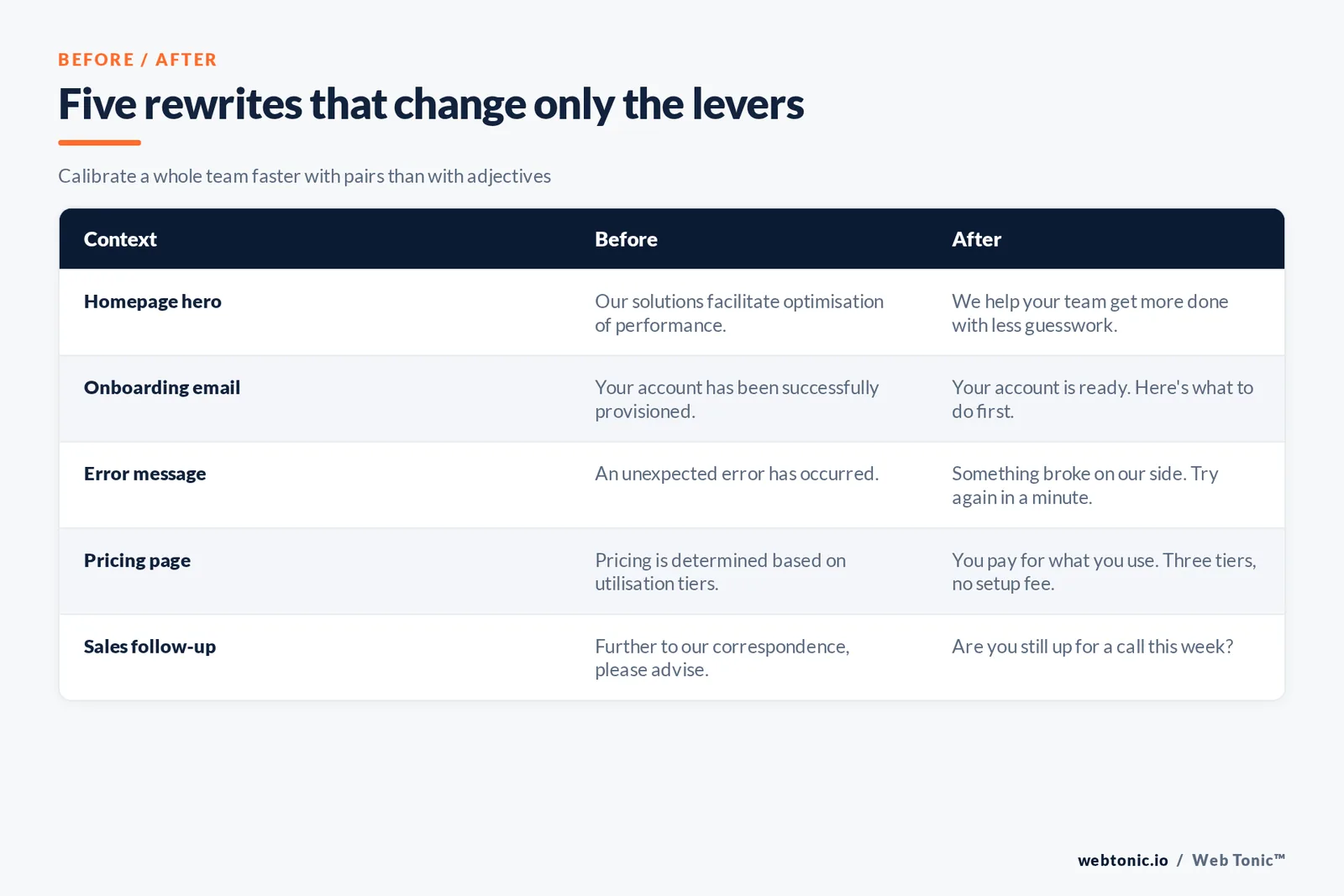
These pairs are the fastest way to calibrate a team. Each one changes only the levers named in the last column.
| Context | Before | After | Levers applied |
|---|---|---|---|
| Homepage hero | Our solutions facilitate the optimisation of organisational performance. | We help your team get more done with less guesswork. | 1, 4 |
| Onboarding email | Your account has been successfully provisioned. | Your account is ready. Here's what to do first. | 2, 3 |
| Error message | An unexpected error has occurred. | Something broke on our side. Try again in a minute. | 2, 5 |
| Pricing page | Pricing is determined based on utilisation tiers. | You pay for what you use. Three tiers, no setup fee. | 1, 2, 3 |
| Blog intro | In today's ever-evolving digital landscape, brands must consider... | Most brands get this wrong in the same three places. | 3, 4 |
| Support article | It is recommended that users verify their configuration. | Check your settings first — it fixes this 90% of the time. | 1, 2 |
| Sales follow-up | Further to our correspondence, please advise on next steps. | Are you still up for a call this week? | 1, 3, 5 |
| Social caption | We are pleased to announce the launch of our new product. | It's live. Here's what it does in 15 seconds. | 3, 5, 6 |
Readability targets by channel
The Flesch scale gives you a shared number to argue about. The published bands put 90–80 at "conversational English for consumers" and 70–60 at plain English understood by 13- to 15-year-olds.
| Channel | Flesch target | Avg sentence | Notes |
|---|---|---|---|
| Landing page hero | 80–90 | 8–12 words | Read in under 3 seconds or lost |
| Blog article | 60–75 | 14–18 words | Subheads every 200 words |
| 70–85 | 10–15 words | One ask per message | |
| Product UI | 80+ | 6–10 words | Verbs first on buttons |
| Technical docs | 50–60 | 15–20 words | Precision outranks warmth |
| Regulated finance or health | 45–60 | 15–22 words | Plain wrapper around exact terms |
Scores are a smoke alarm, not a grade. Free tools such as Hemingway flag long sentences and passive voice in seconds, and Yoast has argued for years that readability serves users first and rankings only indirectly.

Tone by audience and situation
The same brand should not sound identical in a welcome email and a service outage notice. Map it once.
| Situation | Formality | Warmth | Humour | Example opener |
|---|---|---|---|---|
| Welcome / onboarding | Low | High | Light | "Glad you're here. Two minutes and you're set up." |
| Sales outreach | Medium | Medium | None | "Saw you're hiring three reps — worth a quick call?" |
| Outage or incident | Medium | High | None | "Checkout is down. Here's what we know and when." |
| Billing or dunning | Medium | Medium | None | "Your card didn't go through. You have 7 days." |
| Sensitive topics | High | High | None | "This part is hard. Read it once, then call us." |
| Community / social | Low | High | High | "Okay, this one surprised us too." |
Mailchimp's public voice-and-tone guide is the reference implementation of this idea: one voice, many tones, each mapped to a reader's emotional state. Sprout Social's brand voice framework pushes the same mapping into social channels.
7 traps that make conversational writing worse
| Trap | Symptom | Fix |
|---|---|---|
| Trap 1 — Fake chumminess | "Hey friend!" to a stranger | Warm, not familiar: earn informality |
| Trap 2 — Filler questions | Three rhetorical questions before the point | Max 1 per page, and answer it |
| Trap 3 — Slang decay | Last year's meme in evergreen copy | Keep trend language in social only |
| Trap 4 — Vagueness | Friendly sentences with no facts | Every 2 paragraphs carries a number or specific |
| Trap 5 — Jargon in a hoodie | "Let's unpack synergistic enablement" | Name the thing the customer would name |
| Trap 6 — Tone whiplash | Jokes inside a refund notice | Map tone per situation before writing |
| Trap 7 — Exclamation inflation | 5+ exclamation marks per email | Cap at 1; let the verb carry energy |
Where plain language is a requirement, not a preference
Some writing is legally obliged to be understandable. The US Plain Writing Act requires federal agencies to communicate clearly, and the resulting federal guidelines read like a conversational-writing manual: address the reader, use "you", use active voice, keep sentences short. The statutory basis is public.
| Rule | Plain-language requirement | Marketing equivalent |
|---|---|---|
| Rule 1 | Write for your reader, name them | Second person throughout |
| Rule 2 | Use active voice and everyday words | Verbs over noun phrases |
| Rule 3 | Put the main message first | Answer-first intros of 2 sentences |
| Rule 4 | Break content with useful headings | Descriptive H2s, no cleverness |
| Rule 5 | Test with real readers | Five-second tests and reply rates |
The GOV.UK style guide is the most battle-tested public example: contractions allowed, jargon banned, one preferred word per concept. Copy that discipline and your tone problem becomes a style-guide problem, which is solvable.
A 5-step editing pass for any draft
| Step | Action | Time | What it catches |
|---|---|---|---|
| Step 1 | Read aloud, mark every stumble | 5 min | Rhythm and length problems |
| Step 2 | Cut the first 2 sentences of the intro | 1 min | Warm-up padding |
| Step 3 | Convert passive constructions | 10 min | Missing actors |
| Step 4 | Replace nominalisations with verbs | 10 min | Corporate fog |
| Step 5 | Add 1 concrete number per section | 10 min | Friendly emptiness |
Roughly 35 minutes turns most stiff drafts into readable ones, and the pass is teachable to junior writers in a single session. Where tone has to hold across dozens of pages, our growth marketing team documents it as rules with examples, not adjectives. Reviewing an existing site? Start with the highest-traffic pages and the forms people abandon.
Measuring whether it worked
| Signal | Where | What improvement looks like |
|---|---|---|
| Scroll depth | Analytics | More sessions past 50% of the article |
| Reply rate | Email and outreach | Replies rise even when opens hold flat |
| Form completion | Funnel reports | Fewer abandons on the field with the rewritten label |
| Support volume | Helpdesk tags | Fewer "what does this mean" tickets |
| Comprehension test | 5 users, 5 questions | 4 of 5 answer correctly unaided |
Tone is a conversion variable, so test it like one. A/B the label, the intro or the subject line rather than the whole page, and keep the winner in the style guide.
Conversational tone by content type
Different formats break in different ways, so the lever you pull first changes with the format.
| Content type | First lever to pull | Typical failure | Word budget |
|---|---|---|---|
| Long-form article | Sentence length and subheads | A 60-word opening sentence | 1,500–2,500 |
| Product page | Second person on every benefit line | Feature nouns with no reader in them | 300–600 |
| Cold email | Cut to one ask | Three paragraphs before the point | 60–120 |
| Video script | Read-aloud rhythm | Written for the eye, not the ear | 140 words per minute |
| UI microcopy | Verb-first buttons | "Submit" everywhere | 1–5 words |
| Case study | Quote the customer verbatim | Paraphrase that flattens the voice | 700–1,200 |
| Social caption | Open mid-thought | Press-release phrasing | 20–80 |
Notice the pattern: the shorter the format, the more the first sentence has to do. In a caption or a button, tone is the copy.
Fixing the tone of an AI-assisted draft
Generated first drafts fail in predictable ways, which makes them cheap to repair once you know the tells. Each row below is a find-and-replace habit, not a rewrite.
| Tell | Example phrase | Replacement habit | Frequency in raw drafts |
|---|---|---|---|
| Scene-setting opener | "In today's fast-paced world..." | Delete the first sentence entirely | Nearly every draft |
| Triadic padding | "efficient, effective and engaging" | Keep the 1 adjective that is true | Several per page |
| Hedge stacking | "it is generally considered that" | State it or cite it | Common |
| Symmetrical paragraphs | Every block exactly 3 sentences | Break one to 1 sentence, extend another | Structural |
| No agent | "Improvements can be observed" | Name who did what | Common |
| Zero specifics | "significantly increased results" | Insert a real figure or delete the claim | Common |
Human editing is where the voice arrives. Budget 30 to 45 minutes of editing per 1,000 generated words and the difference is obvious to readers; skip it and the draft reads like every competitor's.
Writing the tone-of-voice guideline your writers will actually use
Most tone documents fail because they list adjectives. A usable guideline gives writers a position on each dimension, a sentence-level example, and a banned-phrase list they can search a draft for.
| Section of the guideline | What it must contain | Length | Why writers ignore weak versions |
|---|---|---|---|
| Voice statement | 1 sentence naming who the brand sounds like | 25 words | Adjective lists give no direction |
| Dimension positions | Where you sit on formality, humour, respect and enthusiasm | 4 lines | "Friendly but professional" means nothing |
| Before-and-after pairs | Real sentences from your own website, rewritten | 8–10 pairs | Examples travel between writers; theory does not |
| Banned phrases | Words your audience never uses about themselves | 15–30 entries | Searchable rules survive deadlines |
| Situation map | Tone per scenario: welcome, outage, billing, bad news | 6 rows | Prevents jokes in refund emails |
| Checklist | The mechanical levers as a pre-publish list | 6 checks | Turns taste into a repeatable pass |
Keep the whole thing to two pages. A conversational writing style guide that reads like a policy document has already lost the argument it is making.
Formal or conversational? A decision table
When a team argues about tone, the disagreement is usually about audience risk rather than style. Answer these four questions and the choice makes itself.
| Question | If yes | If no | Weight |
|---|---|---|---|
| Is a legal or clinical claim being made? | Formal wording, plain wrapper around exact terms | Conversational throughout | Decisive |
| Is the reader in a stressful moment? | Warm, direct, no humour | Humour allowed in small doses | High |
| Will the text be read on a phone? | Shorter sentences, 2-line paragraphs | Up to 4-line paragraphs | High |
| Is the audience expert in the subject? | Keep precise terms, drop the explaining | Define each term once, in plain words | Medium |
Notice that none of the answers produce corporate-neutral copy. Formal writing still has a person behind it; the reader should always be able to tell who is speaking and what they want the reader to do next.
FAQ
Is a conversational tone unprofessional?
No. Federal plain-language guidance and Microsoft's own style manual both prescribe it. Unprofessional comes from slang, vagueness and misplaced humour — not from short sentences and the word "you".
Can I use contractions in B2B writing?
Yes, and enterprise style guides increasingly require them. Contractions cut syllables and remove stiffness at zero cost to precision.
What Flesch score should I aim for?
60–70 for articles, 80+ for hero copy and interface text. Regulated content can sit at 45–60 as long as exact terms stay intact.
Does conversational writing hurt SEO?
No. Scannable, question-answering prose matches how people search and how assistants summarise. Keep the target phrase in the title and opening, then write for a human.
How do I keep a consistent tone across many writers?
Publish positions on the 4 tone dimensions, add 8–10 before-and-after pairs, and list banned words. Examples travel; adjectives do not.
Sources: Nielsen Norman Group (how users read on the web; tone-of-voice dimensions) · plainlanguage.gov guidelines and Plain Writing Act · GOV.UK style guide · Microsoft Writing Style Guide (brand voice, word choice) · Mailchimp Content Style Guide · Sprout Social · Yoast · Hemingway App · Flesch–Kincaid reading-ease bands. Verified August 2026.