Table of contents
Google does not use one ranking system for local search - it runs two, scored by different signal groups. Whitespark's 2026 Local Search Ranking Factors survey, 47 local search experts scoring 187 factors, shows the Maps/local-pack result and the organic result below it respond to different fixes, and a cleaning business that only optimizes one half is leaving the other half of local visibility untouched.
Key Takeaways
- Primary GBP Category is the single highest-scoring local pack factor, at 227 of 187 factors evaluated.
- Proximity of address to the point of search scores 225 for the Maps pack.
- Keywords in the GBP business title score 223 for the local pack.
- Business Is Open at Time of Search scores 189, a pack-only signal with no organic equivalent.
- Dedicated Page for Each Service is the top organic-ranking factor, scoring 210.
- Geographic keyword relevance of content scores 190 for organic rankings.
- Quality and authority of inbound links to the domain scores 187 organically.
- Native Google reviews with text score 170 for the Maps pack, inside the top 10 factors.
- 97% of consumers still read reviews before choosing a local business (BrightLocal 2026).
- "Near me" searches grew more than 130% year over year per Google's own research.
- Just 35% of small businesses have a Google Business Profile, per BrightLocal's most recent tracking.
- The FTC's fake-review ban has been enforceable since October 21, 2024, ruling out bought reviews as a shortcut.
- The US janitorial services market is worth USD 112.4 billion in 2026, meaning most local competition is unclaimed opportunity.
Two rankings, two survey lists, one Google result page
The Whitespark Local Search Ranking Factors report - developed by David Mihm in 2008 and run by Darren Shaw since 2017 - asks 47 of the best-known local search experts to score 187 individual factors on a 0-to-5 scale across four dimensions: local pack/Maps impact, local organic impact, conversion impact, and (new for 2026) AI Search visibility. The scores below are the summed, ranked totals for 2026.
What matters for a cleaning business is that the top of each list looks nothing alike. The Maps pack rewards profile configuration and proximity; organic rewards site structure and content. A single "local SEO" checklist that doesn't separate the two will inevitably underweight one.
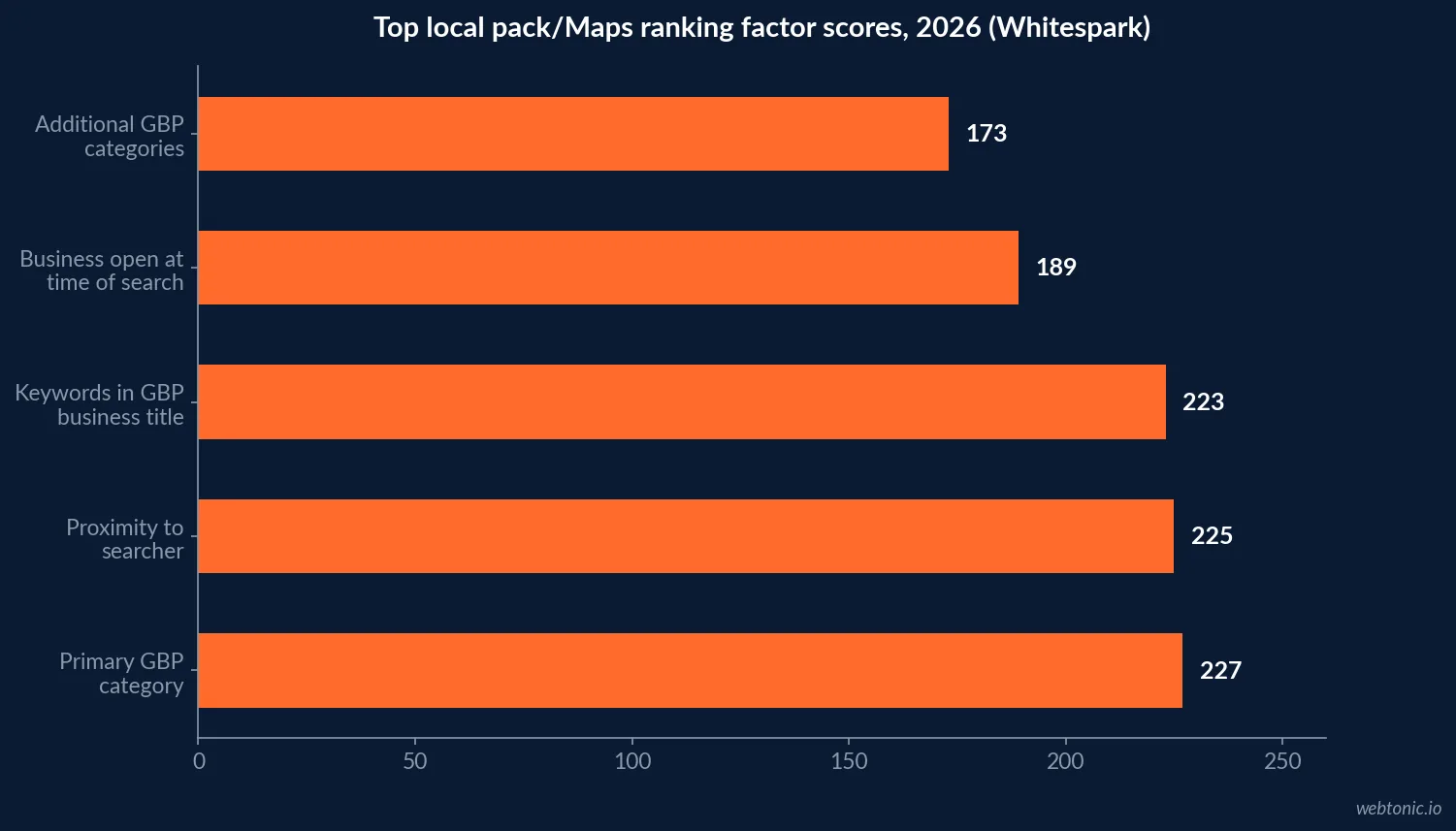
| Rank | Local pack/Maps ranking factor (2026) | Whitespark score |
|---|---|---|
| 1 | Primary GBP category | 227 |
| 2 | Proximity of address to the point of search | 225 |
| 3 | Keywords in GBP business title | 223 |
| 4 | Physical address in city of search | 213 |
| 5 | Business is open at time of search (business hours) | 189 |
| 8 | Additional GBP categories | 173 |
| 9 | Quantity of native Google reviews (with text) | 170 |
What actually moves the organic result below the pack
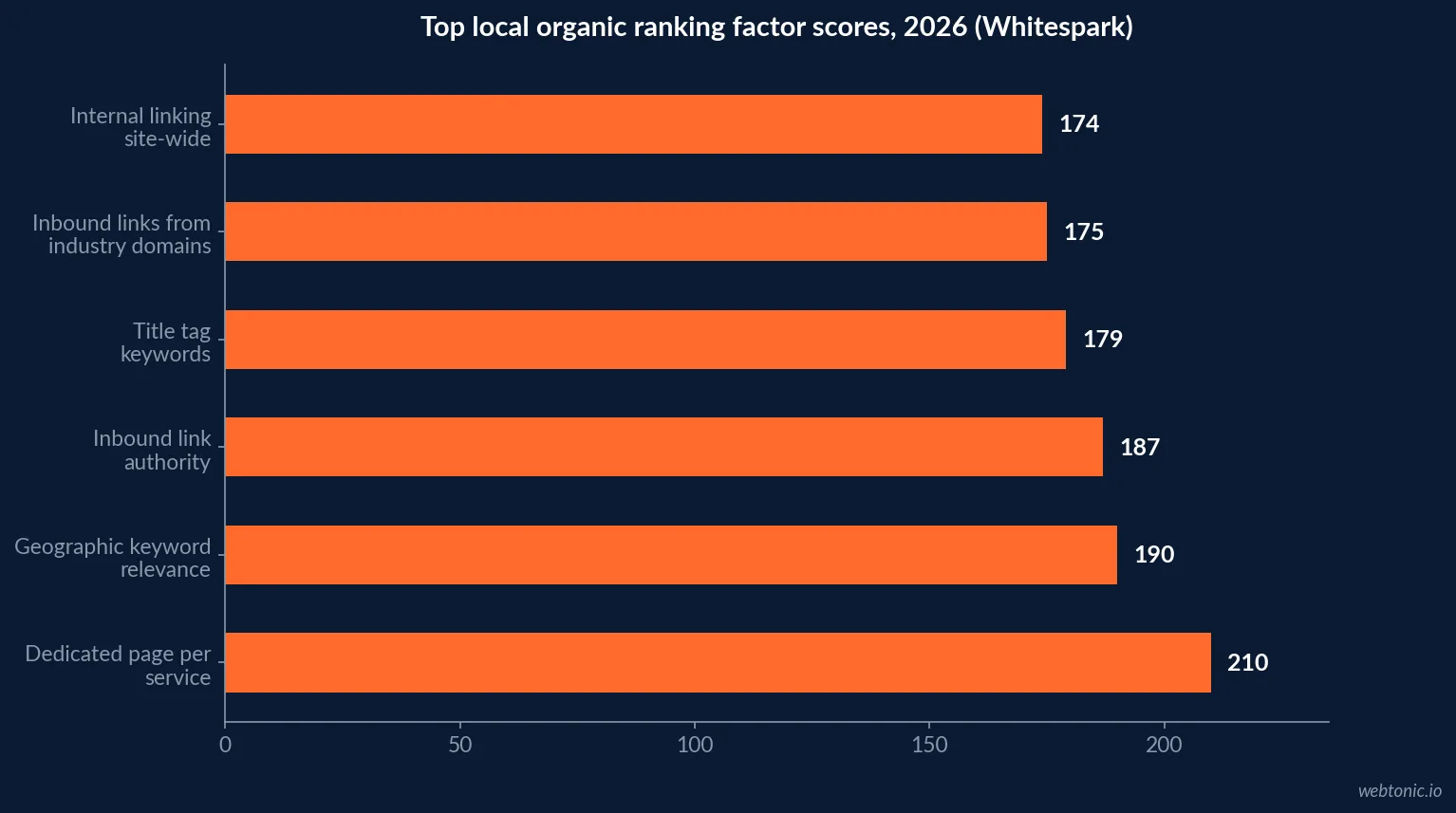
The organic list is a different exercise entirely. Dedicated Page for Each Service tops it at 210 - meaning a cleaning company that sells deep cleaning, move-out cleaning, and recurring residential cleaning from one blended homepage is leaving the highest-scored organic factor on the table. Geographic (city/neighborhood) keyword relevance of content follows at 190, and quality/authority of inbound links to the domain at 187.
None of the top three organic factors appear anywhere near the top of the Maps list. That is the practical version of "Maps vs Organic": a Google Business Profile can be perfectly configured and still sit above a thin, undifferentiated website in the organic results beneath it.
| Rank | Local organic ranking factor (2026) | Whitespark score |
|---|---|---|
| 1 | Dedicated page for each service | 210 |
| 2 | Geographic (city/neighborhood) keyword relevance of content | 190 |
| 3 | Quality/authority of inbound links to domain | 187 |
| 4 | Keywords in GBP landing page title tag | 179 |
| 5 | Quantity of inbound links from industry-relevant domains | 175 |
| 6 | Internal linking across entire website | 174 |
Why the local pack still needs reviews, even with a perfect profile
Reviews sit inside the top ten Maps factors even before the organic list is considered: native Google reviews with text (170) and recency of reviews (164) both outrank most technical GBP settings. BrightLocal's 2026 Local Consumer Review Survey found 97% of consumers still read reviews to guide a purchase decision, and that generative AI tools like ChatGPT have jumped from 6% to 45% usage as a source of local recommendations year over year - meaning the same review signal a cleaning business builds for Google Maps is increasingly what AI answer engines cite too.
The same BrightLocal research notes that just 35% of SMBs have a Google Business Profile at all, which means most of the competitive set in any given metro has not even claimed the highest-scoring ranking factor on this page.
| Review signal (Maps pack) | Whitespark score | Rank of 187 factors |
|---|---|---|
| Native Google reviews (with text) | 170 | 9th |
| Recency of reviews | 164 | 11th |
| Sustained influx of reviews over time (not bursts) | 154 | 14th |
| High numerical Google rating (4-5 stars) | 181 | 6th |
Compliance: reviews cannot be bought to skip this list
The FTC's rule on consumer reviews and testimonials, enforceable since October 21, 2024, bans buying fake reviews, incentivizing reviews conditioned on sentiment, and suppressing negative ones. For a cleaning business, the compliant version of "review velocity" the ranking-factor data rewards is a consistent post-job ask sent to every real customer - not a burst purchased before a slow quarter, which the rule specifically targets and which review-recency scoring would flag as unnatural anyway.
Near-me demand makes the fix worth doing now
Google's own research shows "near me" searches growing more than 130% year over year, with 88% happening on mobile devices, and "open now near me" queries up over 400%. Against a market IBISWorld sizes at USD 112.4 billion in 2026 and ISSA counts at roughly 1.23 million competing businesses, a well-configured Maps profile plus a dedicated service page is one of the few local SEO investments with a directly cited ranking-factor score behind every line item.
| Local intent fact (2026) | Figure | Source |
|---|---|---|
| "Near me" search growth | >130% YoY | Think with Google |
| Mobile share of "near me" searches | 88% | Think with Google |
| "Open now near me" query growth | >400% YoY | Think with Google |
| SMBs with a claimed Google Business Profile | 35% | BrightLocal 2026 |
The conversion-impact dimension most checklists skip
Whitespark's 2026 survey doesn't stop at ranking impact - it also asks the same 47 experts to score each factor's conversion impact, meaning how much it affects whether a searcher who sees the listing actually calls or books, independent of rank position. A cleaning business chasing rank alone can win the Maps pack position and still lose the click if the profile itself doesn't convert: complete business hours, a working phone number, and recent review text that answers "will this be a good experience" are the factors doing that work.
That distinction matters because rank and conversion are optimized by overlapping but not identical actions. A generic, unverified category might still rank if proximity is strong enough, but it will not convert as well as a fully completed profile with recent, detailed reviews - which is why completeness of GBP (score 147) and high numerical Google ratings (score 181) both appear on the Maps list even though neither is a proximity or keyword signal.
| Profile completeness factor | Whitespark score | Why it affects conversion, not just rank |
|---|---|---|
| High numerical Google rating (4-5 stars) | 181 | First thing a searcher scans before clicking through |
| Completeness of GBP | 147 | Missing hours, services or photos reads as an inactive business |
| Address showing on GBP (not service-area-only) | 176 | Confirms a real, local operation to a skeptical searcher |
| Proper hours set on GBP | 134 | Prevents a wasted call to a business the searcher assumes is open |
What's new for 2026: AI Search visibility scoring
The 2026 edition of the survey added a fourth scoring dimension for the first time: how much each factor influences whether a business is cited inside AI-generated search answers (Google's AI Overviews, ChatGPT, and similar tools), not just the traditional local pack and organic results. Whitespark's own analysis notes that citation consistency - which has been losing weight in the traditional local-pack scoring for several years running - appears to be recovering importance specifically because of AI search visibility, even as its Maps-ranking weight keeps declining.
For a cleaning business, the practical takeaway is not to abandon citation-building because its Maps-ranking score has drifted down; it is to treat citations as an AI-visibility investment now, on top of whatever local-pack value they still carry. BrightLocal's finding that ChatGPT usage for local recommendations jumped from 6% to 45% year over year makes that a near-term priority rather than a speculative one.
A 90-day sequence, ranked by the data above
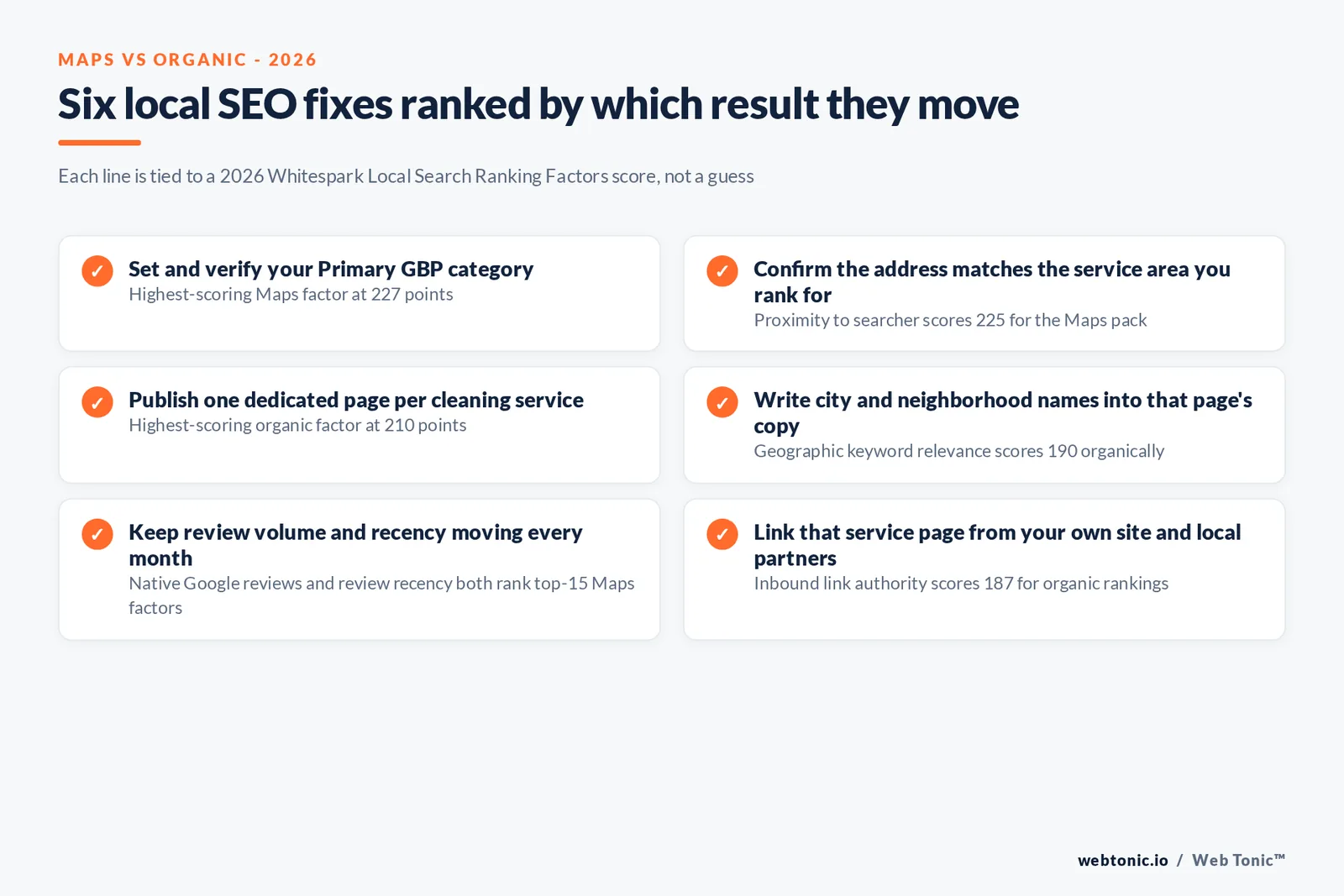
Fix the Maps-only factors first because they carry the highest individual scores and the shortest implementation time: correct the primary category, confirm the address matches the real service area, and get business hours accurate. Then move to the organic side: publish one page per service with real city and neighborhood names in the copy, and build inbound links from locally or industry-relevant domains. Reviews run in parallel throughout, because they score high on both lists.
Our growth marketing practice builds this sequencing into cleaning and home-service accounts directly, our Google Ads strategy guide covers how to pair paid local intent capture with the organic work above while the rankings compound, and our Google Ads agency page details how we scope local-service accounts specifically.
Frequently Asked Questions
Is ranking in the Google Maps 3-pack the same as ranking organically?
No, and treating them the same is the most common local SEO mistake. Whitespark's 2026 Local Search Ranking Factors survey - 47 local search experts scoring 187 factors - finds the top Maps/local-pack factor is Primary GBP Category (score 227), while the top organic-ranking factor is Dedicated Page for Each Service (score 210). A cleaning business can rank in the Maps pack with a well-configured Google Business Profile and still be invisible in organic results below it, or the reverse.
What is the single highest-impact fix for a cleaning company's Maps ranking?
Setting and verifying the Primary GBP Category correctly - "House Cleaning Service" rather than a generic "Cleaning Service" or a miscategorized listing - scores highest of all 187 factors Whitespark's experts evaluated, at 227 points, ahead of proximity to the searcher (225) and keywords in the business title (223).
What does the local pack actually reward that organic doesn't?
Proximity and immediacy. Business Is Open at Time of Search scores 189 for the Maps pack specifically - it has no equivalent in the organic list at all, because Google's local pack is built to answer "can this business help me right now, near me," a signal organic web ranking was never designed to carry.
Does having a Google Business Profile even matter if reviews and citations are thin?
Reviews matter more than most cleaning operators assume: Native Google Reviews (with text) scores 170 and Review Recency scores 164 for the Maps pack, both inside the top 15 of 187 factors. BrightLocal's 2026 Local Consumer Review Survey found 97% of consumers still read reviews before choosing a local business, even as awareness of fake reviews rises.
Can a cleaning business legally buy or incentivize reviews to fix this fast?
No. The FTC's rule banning fake or incentivized reviews has been enforceable since October 21, 2024, and it explicitly covers paying for positive reviews, review-gating, and undisclosed insider testimonials. The compliant path is what the ranking-factor data already rewards: ask every real customer, consistently, and let review velocity build naturally.
Sources
Whitespark - 2026 Local Search Ranking Factors report
BrightLocal - Local Consumer Review Survey 2026
Federal Trade Commission - Trade Regulation Rule on Consumer Reviews and Testimonials
Federal Register - Final rule text, consumer reviews and testimonials
Think with Google - Mobile-centric search strategy (near-me search data)
Think with Google - Store visits and local search trends
IBISWorld - Janitorial Services industry report, 2026
ISSA - The state of the cleaning and facility solutions industry, 2026