Table of contents
Local pack visibility decides which funeral home a grieving family calls first, often inside a single afternoon. This page separates what BrightLocal and Whitespark's own research show about review-reading and ranking weight from what NFDA's price-list data adds specifically for death care.
Key Takeaways
- 97% of consumers read reviews for local businesses, per BrightLocal's 2026 survey.
- 41% now "always" read reviews, up from 29% the year before.
- Google's share of "most used" review sources fell from 83% to 71% year over year.
- The average consumer checks six different review sites before deciding.
- Only about 35% of SMBs have claimed a Google Business Profile, per BrightLocal.
- 82.4% of consumers favor a firm that posts its price list online, per NFDA.
- Nearly 30% of families now complete arrangements entirely online, per NFDA.
- 44.4% would not feel confident planning without a director, up 7.1 points YoY.
- US funeral homes sit under NAICS 812210 in Census Bureau classification.
- The Funeral Rule's price-list clause lives at 16 CFR 453.2, enforceable by the FTC.
- Whitespark's 2026 survey scored 187 ranking factors across 47 practitioners.
- Review signals have climbed steadily in that survey since 2018, per Whitespark's own trend chart.
Why review-reading behavior matters more here than in most categories
BrightLocal's 2026 Local Consumer Review Survey, a representative panel of 1,002 US adults, found that 97% of consumers read reviews for local businesses and that 41% now "always" do so before choosing, a jump from 29% the year before. Funeral service carries the two conditions that make this behavior most acute: low personal experience (most people buy this once every several years) and high consequence (there is no do-over). A family with no frame of reference leans harder on review volume and recency than a family choosing a restaurant.
The same survey found the average consumer now checks six different review sites, and that Google's share of "most used" sources fell from 83% in 2025 to 71% in 2026 as AI tools and video platforms pick up search behavior. A funeral home's reputation surface is widening even as Google Business Profile stays the anchor.
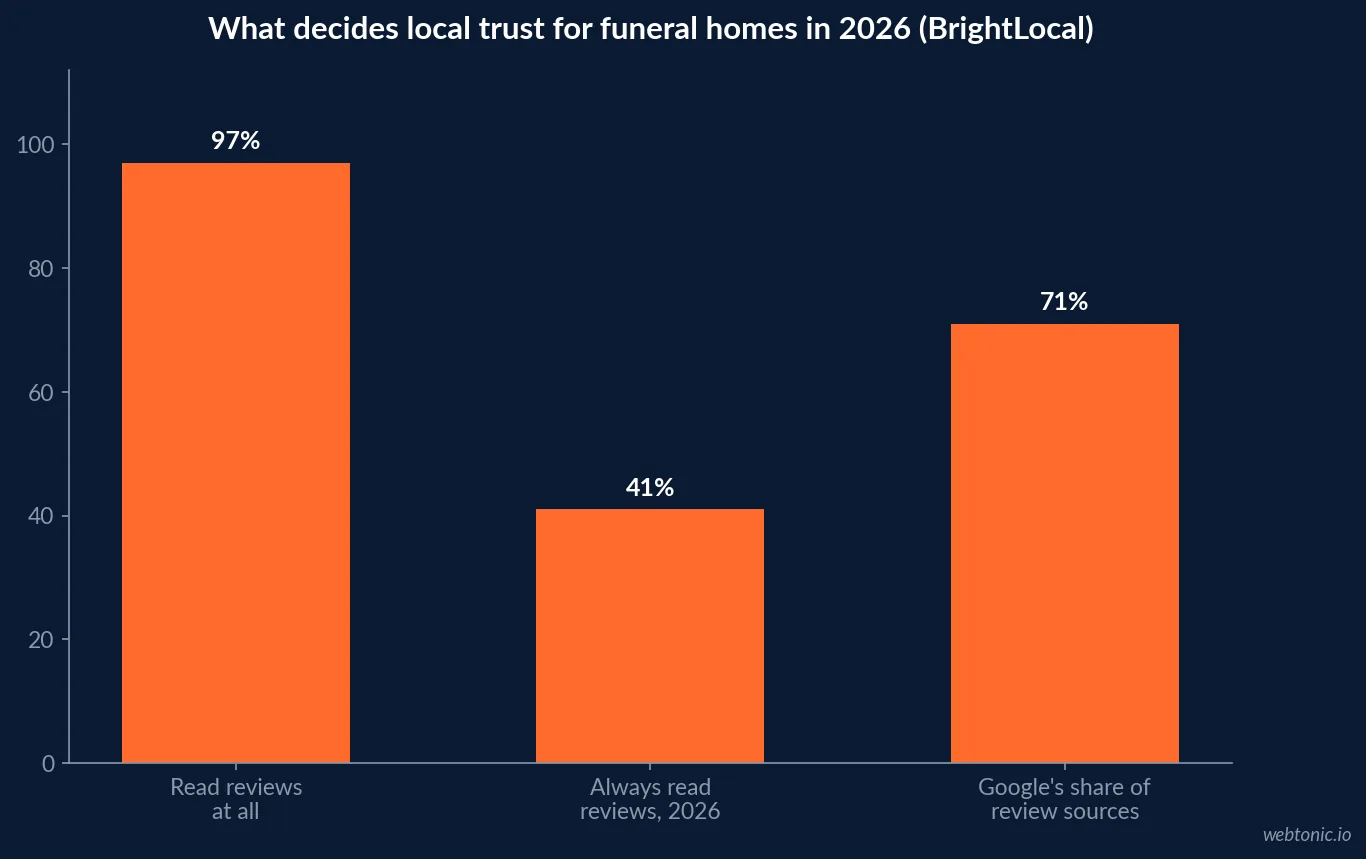
| BrightLocal 2026 finding | 2025 figure | 2026 figure | Local SEO implication |
|---|---|---|---|
| Consumers who read reviews at all | n/a | 97% | A thin review profile is a visibility risk, not a nice-to-have |
| Consumers who "always" read reviews | 29% | 41% | Review freshness now matters as much as star rating |
| Google's share of "most used" review sources | 83% | 71% | Diversify beyond GBP to Facebook, Yelp and video |
| Average number of review sites checked | n/a | 6 | A single glowing GBP profile is not enough anymore |
What Whitespark's own ranking-factors survey weighs
Whitespark's 2026 Local Search Ranking Factors report, running since 2008 and now compiled by Darren Shaw, surveyed 47 of the field's own practitioners across a two-hour session scoring 187 individual factors on a 0-to-5 scale across Google Business Profile signals, on-page signals, link signals and review signals. The report does not isolate funeral homes, so this is general local-SEO weighting applied to a death-care category, not a death-care-specific study - but it is the most current, methodologically transparent source on what actually moves a map pack, and its trend line shows review signal weight climbing steadily since the survey's earlier cycles.
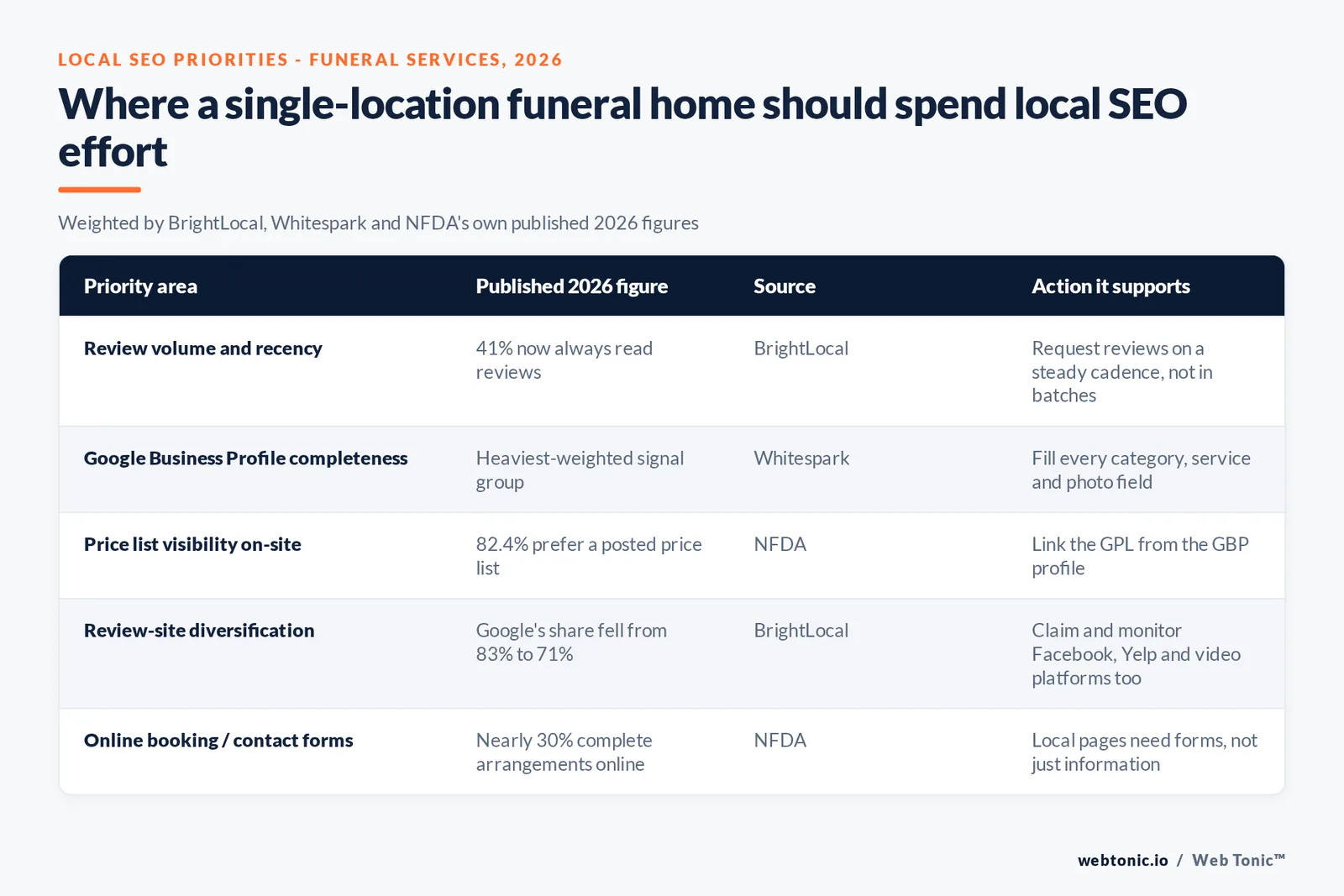
For an independently owned funeral home competing against a regional operator's multi-location GBP footprint, that shift toward review and GBP-signal weight is the lever most within reach: it does not require a rebuild of the website, only a disciplined review-request and response cadence.
| Local ranking signal group (Whitespark 2026) | Directional weight trend | What it means for a single-location funeral home |
|---|---|---|
| Google Business Profile signals | Historically the heaviest single group | Complete categories, services, hours, photos and Q&A |
| Review signals (volume, recency, response) | Rising across recent survey cycles | A steady, recent flow of reviews outweighs a large stale total |
| On-page signals | Stable, still material | Location-specific service pages beat one generic homepage |
| Link signals | Stable, lower relative weight than GBP/reviews for local | Local citations and association listings still matter, just less than GBP |
The price-list disclosure layer that is unique to this category
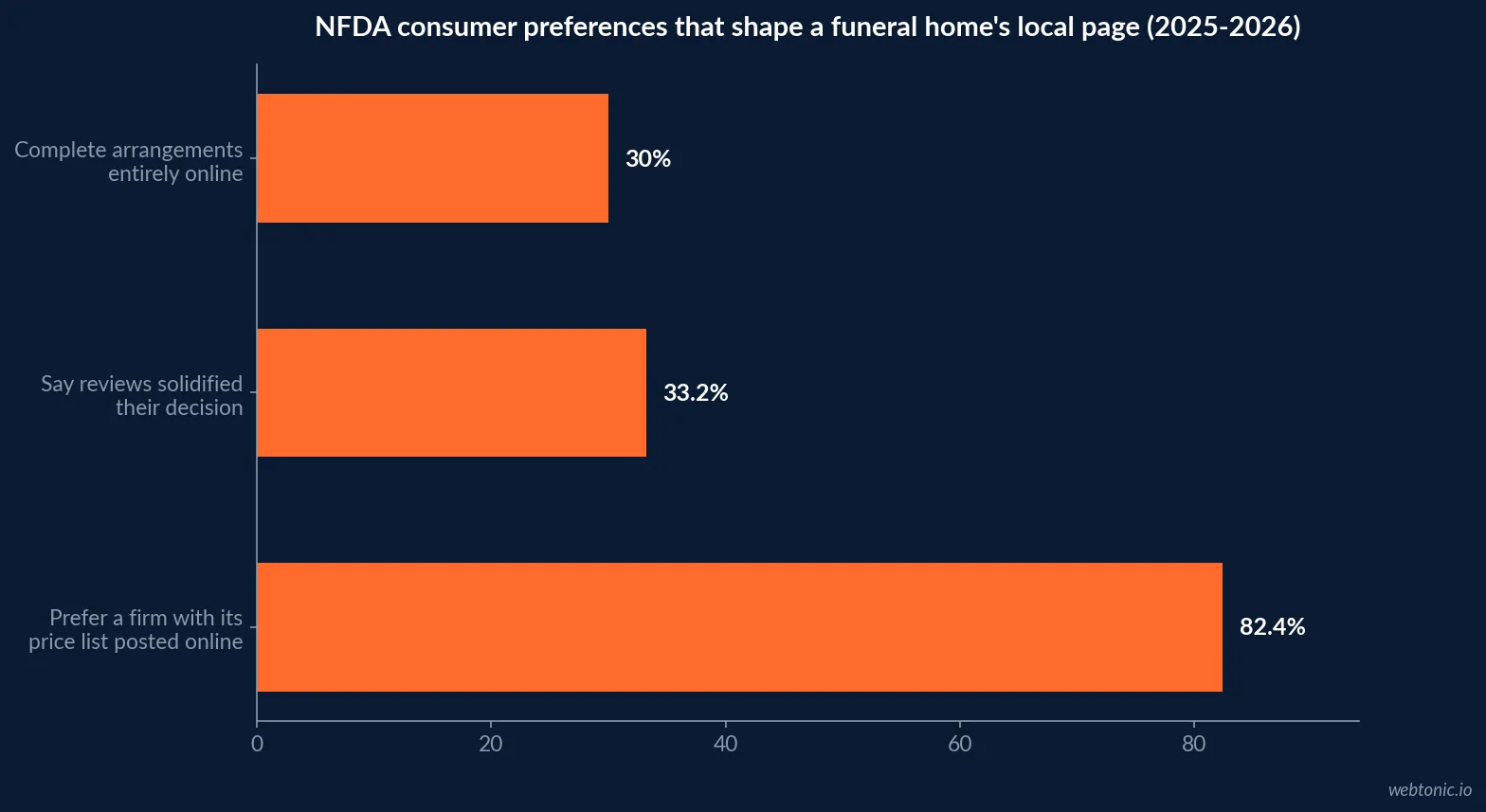
No other local-service category carries a federal price-disclosure rule quite like funeral service. The FTC Funeral Rule at 16 CFR 453.2 requires a General Price List be given to anyone who inquires in person, and the FTC's own Complying with the Funeral Rule guidance spells out the required disclosures. That legal requirement covers in-person and phone inquiries, not the website by default, but NFDA's 2026 Consumer Awareness & Preferences research found 82.4% of consumers more likely to engage a firm that voluntarily posts its price list online, and its companion release noted that 33.2% of families said online reviews solidified their decision, up from 14.4% the year before.
A local landing page that pairs a visible price list with a fresh review widget is answering two documented preferences with one page, which is the structural argument for building city- or chapel-level pages rather than a single generic "our services" page.
| NFDA finding (2025-2026 studies) | Figure | Local SEO / GBP action it supports |
|---|---|---|
| Prefer firms with an online price list | 82.4% | Publish the GPL as an indexable page, linked from GBP |
| Say reviews solidified their decision | 33.2%, up from 14.4% | Prioritize review volume and recency over review count alone |
| Complete arrangements entirely online | Nearly 30% | Local landing pages need forms, not just information |
| Not confident planning without a director | 44.4% (+7.1 pts YoY) | Local pages should route to a phone call, not just a form |
How many establishments are actually competing
The US Census Bureau's NAICS 812210 classification covers "establishments primarily engaged in preparing the dead for burial or interment and conducting funerals," including funeral homes combined with crematories. Census County Business Patterns cycles have placed the group in the low-to-mid five figures of US establishments, the large majority independently owned and single-location - a fragmented market where a strong local pack presence, not a national brand, decides who gets the call. The Bureau of Labor Statistics' funeral service occupations outlook projects funeral home manager roles growing from about 32,100 to 33,400 positions, a slow but positive trendline consistent with a stable, fragmented local market rather than consolidation into a handful of national chains.
Our data and analytics practice treats that fragmentation as the opportunity: in a market with thousands of near-identical single-location competitors, the map-pack and review signals above are disproportionately decisive.
What this data does not tell you
None of the sources above isolate funeral homes as their own surveyed category. BrightLocal and Whitespark speak to local businesses broadly; NFDA speaks to consumer preference, not ranking mechanics; Census and BLS describe market structure, not search behavior. Building a local SEO program from this page means applying general local-SEO weighting to a death-care compliance context, which is different from having a funeral-specific ranking study. Anyone who claims one exists should be asked to name it.
If a location strategy needs building from scratch, our growth marketing team starts from exactly this gap analysis before writing a single page, and our own view on paid search costs relative to organic effort is laid out in our Google Ads pricing guide, useful context for a budget conversation that has to weigh local SEO against paid search for the same location.
Building the city-level page, not just the profile
A completed Google Business Profile answers "does this business exist and where," but it does not answer the two preferences NFDA's own research keeps surfacing: whether the price list is visible, and whether a family can act (call, request information, or start planning) without leaving the page. A single generic "our services" page forces every local search intent - cremation, burial, pre-need, veterans' benefits - onto one URL competing against dedicated pages from larger, better-resourced operators.
The fix most within reach for an independent funeral home is a small set of dedicated location or service pages - one for the flagship chapel, one each for cremation and traditional burial services - each carrying its own price-list link, its own review widget, and its own call-to-action, rather than routing every visitor to a single undifferentiated homepage. That structure is also what a Google Business Profile's own website link should point families toward, not a homepage that makes them hunt for the information BrightLocal and NFDA both show they are already looking for.
| Page structure choice | What it fixes | Evidence it answers |
|---|---|---|
| One generic homepage for every service | Nothing specific; forces a hunt | Neither the 82.4% price-list preference nor the 41% review-reading habit |
| Dedicated cremation/burial/pre-need pages | Matches search intent to a specific answer | Supports the 30% who complete arrangements fully online |
| Price list linked from every location page | Removes the single biggest documented friction | 82.4% prefer a firm that posts it online (NFDA) |
| Review widget embedded, not just linked out | Keeps the 41% who always read reviews on-page | BrightLocal's 2026 review-reading behavior data |
Frequently Asked Questions
Do families really read reviews before choosing a funeral home?
Yes, at a rate that outpaces most retail categories. BrightLocal's 2026 Local Consumer Review Survey (1,002 US adults) found 97% of consumers read reviews for local businesses in general, and 41% now say they "always" read reviews when browsing, up sharply from 29% a year earlier. Funeral decisions carry higher stakes and less personal experience than most local purchases, which makes a thin or unmanaged review profile a bigger risk than it would be for, say, a coffee shop.
Is Google still the platform that matters most for funeral home reviews?
It is still the largest, but its share is falling. BrightLocal's 2026 survey found Google's share of "most used" review sources dropped from 83% in 2025 to 71% in 2026, as consumers spread research across an average of six different sites, including AI tools and video platforms. A Google Business Profile remains the foundation, but it is no longer the whole strategy.
What actually moves local map-pack rankings for a funeral home?
Whitespark's 2026 Local Search Ranking Factors report, built from a survey of 47 local SEO practitioners scoring 187 factors, has consistently found Google Business Profile signals and review signals among the heaviest-weighted groups, alongside on-page and link signals. No study isolates funeral homes specifically, so treat the weighting as general local-SEO guidance applied to a death-care category.
Does the FTC Funeral Rule affect the Google Business Profile itself?
Not directly - GBP is not the disclosure medium the Rule regulates. But NFDA's 2026 Consumer Awareness study found 82.4% of consumers more likely to engage a firm that posts its General Price List online, and a GBP listing routing to a site without a visible price list is losing that preference before the family ever calls.
How many funeral homes are actually competing for this search real estate?
The US Census Bureau classifies funeral homes and funeral services under NAICS 812210. The category spans roughly ten to fifteen thousand US establishments across recent County Business Patterns cycles, most of them independent, single-location businesses - which is exactly the profile that lives or dies on local pack visibility rather than national brand awareness.
Sources
BrightLocal - Local Consumer Review Survey 2026
Whitespark - 2026 Local Search Ranking Factors
NFDA - What Today's Families Really Want (2026 study recap)
NFDA - 2025 Consumer Awareness and Preferences Study release
eCFR - 16 CFR 453.2, Funeral Rule price disclosures
Federal Trade Commission - Complying with the Funeral Rule
US Census Bureau - NAICS 812210, Funeral Homes and Funeral Services
US Bureau of Labor Statistics - Funeral Service Occupations Outlook Handbook