Table of contents
Only 35% of US small businesses have claimed their Google Business Profile, in a category that added more than 55,000 new competitors in a single year. For cleaning companies, that gap between how much local SEO matters and how few competitors actually do it well is the whole opportunity - and the data below shows exactly where to close it first.
Key Takeaways
- The US janitorial services market reached $112.4 billion in 2026, growing at a 2.7% CAGR (IBISWorld).
- Roughly 1.23 million janitorial businesses compete for that revenue (ISSA).
- Firm count is growing about 4.2% a year, faster than the 2.7% revenue growth (ISSA).
- More than 55,000 net new janitorial companies entered the US market in one year (WordStream).
- Only 35% of small businesses have claimed a Google Business Profile (BrightLocal, 2025).
- Just 40% of small businesses have a dedicated website at all.
- Primary GBP category scored 227/250, the top-weighted local ranking factor (Whitespark 2026).
- Proximity to the point of search scored 225/250, ranked second.
- Keywords in the GBP business name scored 223/250, ranked third.
- 97% of consumers read reviews before choosing a local business (BrightLocal LCRS 2026).
- 41% of consumers now "always" read reviews, up from 29% a year earlier.
- Google's share of review-source mentions fell from 83% to 71% year over year.
- AI tools jumped from 6% to 45% as a local-recommendation source in the same period.
- 2,199,900 people worked as janitors and cleaners in May 2024 (BLS), plus 854,910 maids and housekeeping cleaners.
- Janitors and cleaners earned a mean annual wage of $37,460 (BLS OES, May 2024).
A market growing revenue slower than it's growing competitors
IBISWorld's 2026 Janitorial Services industry analysis puts the US market at $112.4 billion, expanding at a 2.7% compound annual rate. That would look healthy on its own - but ISSA's own state-of-the-industry commentary puts firm-count growth at roughly 4.2% a year against that 2.7% revenue growth, meaning more businesses are dividing a slower-growing pool of dollars. WordStream's home services benchmark data adds a sharper, dated figure on top: a net gain of more than 55,000 janitorial companies, including residential cleaners, between 2023 and 2024 alone. Local SEO is the mechanism that decides which of those firms actually get found.
| Market metric | Value | Source |
|---|---|---|
| 2026 US janitorial services market size | $112.4 billion | IBISWorld |
| Market revenue CAGR | 2.7% | IBISWorld |
| Estimated janitorial businesses | ~1.23 million | ISSA |
| Estimated annual firm-count growth | ~4.2% | ISSA |
| Net new janitorial firms, 2023-2024 | 55,000+ | WordStream Home Services 2025 |
The claimed-profile gap
Before ranking factors matter, a listing has to exist and be claimed. BrightLocal's SMB Marketing Report 2025, surveying roughly 780 US small businesses, found only 35% have claimed a Google Business Profile and just 17% actively use business directories at all. For a category where nearly every buying decision starts with a "near me" search, that is a majority of competitors starting from zero local visibility - the single largest addressable gap in this data set.
What actually ranks a cleaning company locally
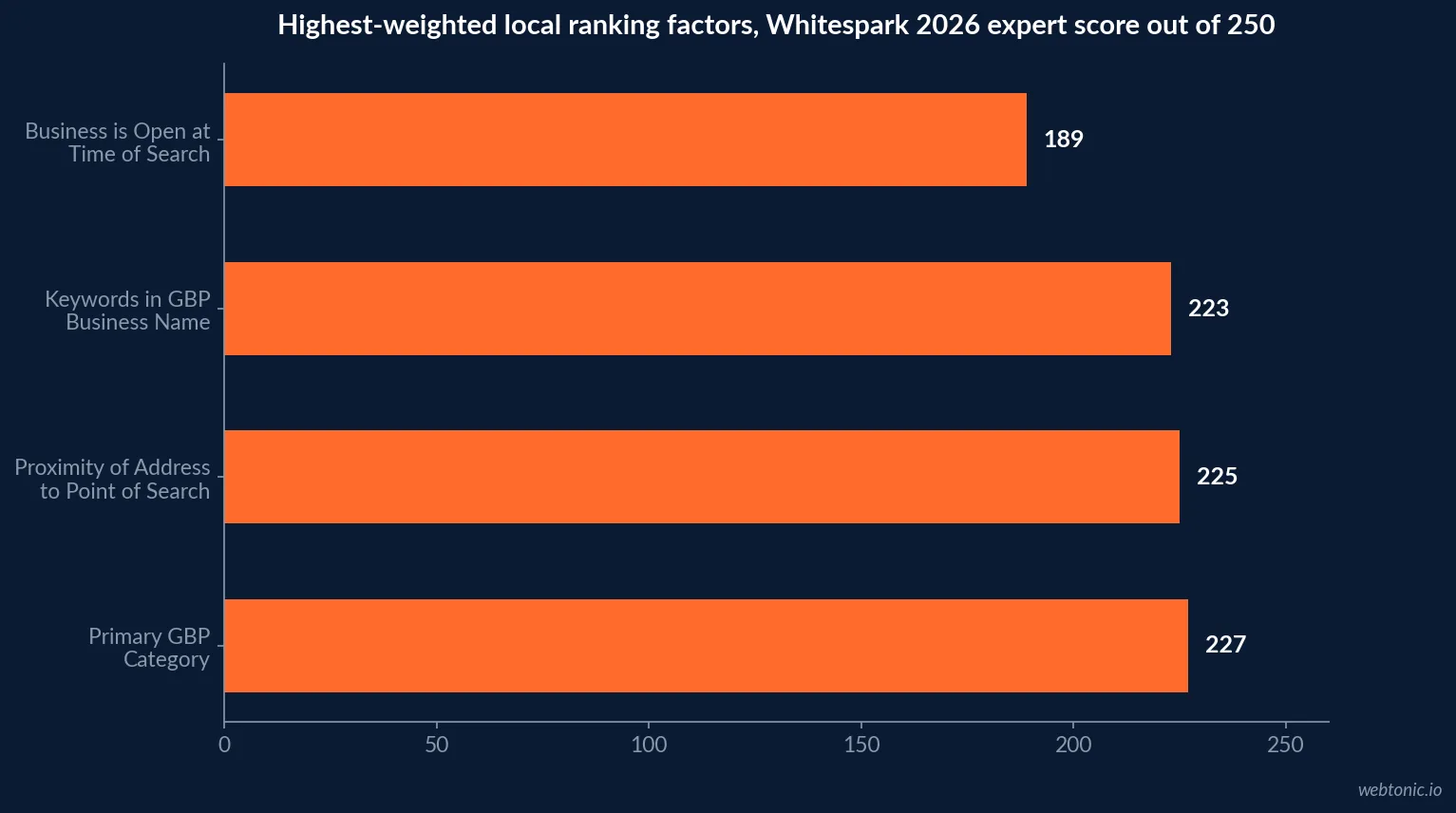
Whitespark's 2026 Local Search Ranking Factors report - a survey of 47 local SEO practitioners scoring 187 factors, running continuously since 2008 - puts a cleaning company's Google Business Profile category as the single highest-weighted factor in local search, ahead of any on-page or backlink signal. For a multi-service cleaner (residential, commercial, move-out, post-construction), that means the primary category choice and any secondary categories carry more ranking weight than most of what a website redesign would touch.
| Local ranking factor | Whitespark 2026 score (of ~250) | Rank |
|---|---|---|
| Primary GBP category | 227 | 1 |
| Proximity of address to point of search | 225 | 2 |
| Keywords in GBP business name | 223 | 3 |
| Business open at time of search | 189 | 5 |
Reviews: more consumers reading them, fewer only using Google
BrightLocal's 2026 Local Consumer Review Survey found 97% of consumers read reviews for local businesses, and the share who "always" read them jumped from 29% to 41% in a single year. What changed underneath that number matters for a cleaning company's review strategy: Google's share of review-source mentions fell from 83% to 71%, while AI tools like ChatGPT went from 6% to 45% as a recommendation source. A cleaning company optimizing only its Google star rating is optimizing for a shrinking share of where the decision actually gets made.
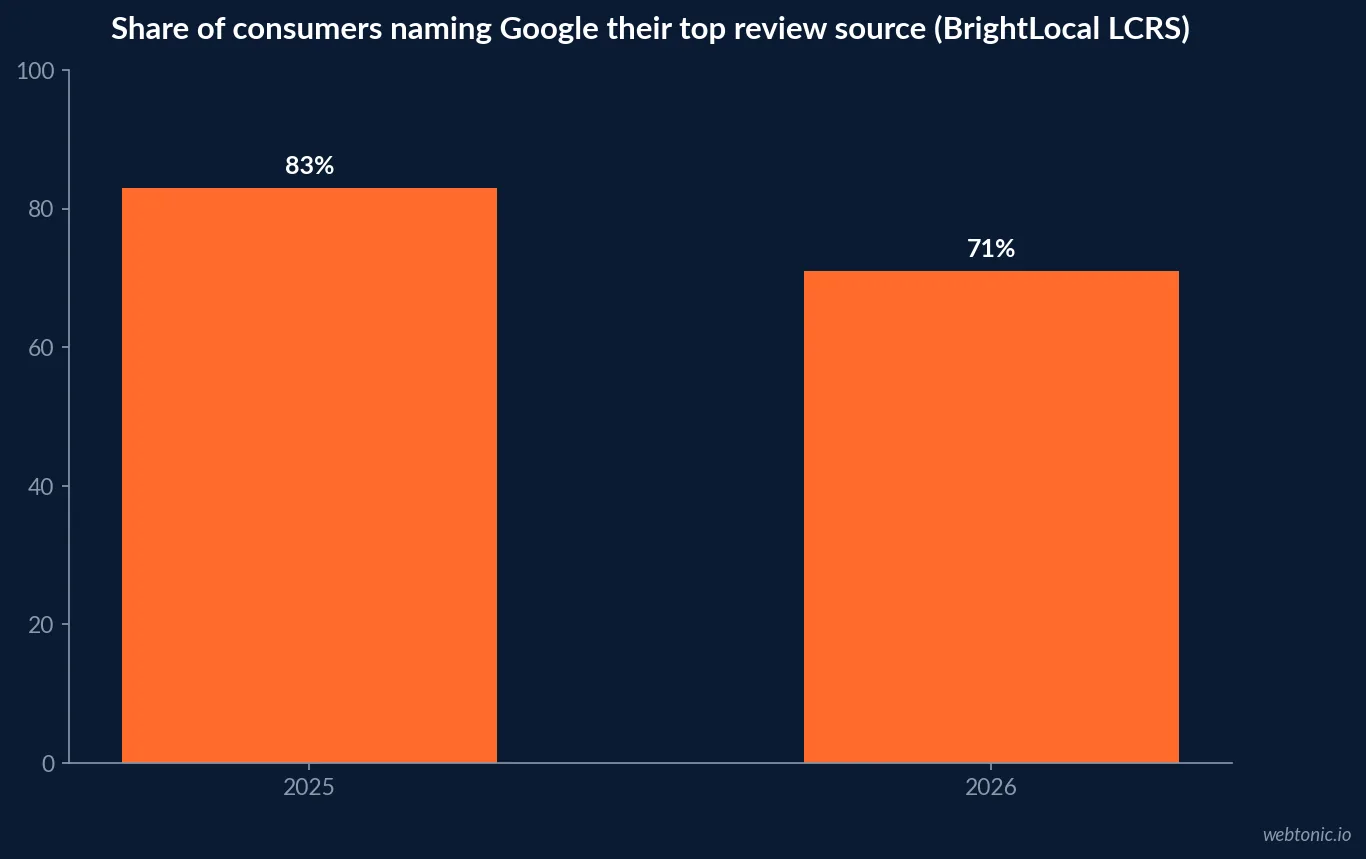
| Review discovery source | 2025 share | 2026 share |
|---|---|---|
| 83% | 71% | |
| AI tools (ChatGPT, etc.) | 6% | 45% |
| Consumers who 'always' read reviews | 29% | 41% |
| Consumers reading reviews at all | n/a | 97% |
The labor backdrop behind the content gap
Content built around real service delivery - not generic "we clean your home" copy - has to be written by someone who understands the labor structure behind the service. BLS's May 2024 Occupational Employment and Wage Statistics counted 2,199,900 janitors and cleaners and 854,910 maids and housekeeping cleaners nationally, with janitors and cleaners earning a mean annual wage of $37,460. Service pages that speak to staffing, training and vetting - not just price - answer the trust questions a commercial cleaning buyer actually has, and trust content is what earns the links and citations that compound local rankings over time.
| Cleaning workforce metric | May 2024 value | Source |
|---|---|---|
| Janitors and cleaners employed | 2,199,900 | BLS OES |
| Maids and housekeeping cleaners employed | 854,910 | BLS OES |
| Janitors and cleaners, mean annual wage | $37,460 | BLS OES |
| Maids and housekeeping cleaners, mean annual wage | $36,180 | BLS OES |
| First-line supervisors, housekeeping/janitorial | 174,660 | BLS OES |
Compliance note: reviews can't be manufactured
Because review volume and recency carry real ranking and conversion weight, the temptation to manufacture them is strong in a low-barrier category like residential cleaning. The FTC's Trade Regulation Rule on Consumer Reviews and Testimonials, in force since October 21, 2024, directly bans buying fake reviews, paying for only positive ones, and running a company-controlled site dressed up as an independent review platform. A compliant review-generation program - simply asking every completed job for an honest review - now doubles as the only version of this tactic that is both legal and, per the BrightLocal data above, still the one consumers say they trust.
Reading these sources against each other honestly
IBISWorld's $112.4 billion market figure, ISSA's 1.23 million firm count, and WordStream's 55,000-firm annual gain come from three different methodologies - a paid industry research firm, a trade association's own commentary, and an ad-platform's aggregated campaign data - and none of them is a government census. They agree directionally (a large, growing, increasingly crowded market) but should not be quoted as if they were reconciled against a single source. The BLS employment figures are the one government-sourced number in this data set and are the safest to cite without a methodology caveat attached.
Move-out and seasonal demand: a content gap most cleaners skip
Beyond recurring residential and commercial contracts, cleaning demand spikes around lease turnover, move-in/move-out cycles and post-construction cleanup - occasions that map to specific, high-intent search terms most cleaning-company websites never build a dedicated page for. A generic "services" page competing against 55,000 new entrants on head terms like "cleaning services near me" is fighting the hardest possible battle; a dedicated move-out cleaning page, a post-construction cleanup page, and a recurring-maintenance page each compete on a narrower, lower-competition term where the same Whitespark-weighted signals - category, proximity, keyword match - do more work with less content investment.
Franchise versus independent: a different SEO starting point
The 1.23 million janitorial businesses ISSA counts are not a uniform group. Franchise cleaning brands typically inherit a domain with existing authority and a corporate content template, while independent operators start from zero domain history but can move faster on genuinely local content - a specific neighborhood, a specific building type, a named local review. Neither structural advantage overrides the Whitespark data above: an independent cleaner with a correctly categorized, actively reviewed Google Business Profile can out-rank a franchise location that treats its listing as a set-and-forget asset, because category and proximity outweigh domain authority in Whitespark's own factor weighting for this kind of local-intent search.
Where the local SEO budget should go first
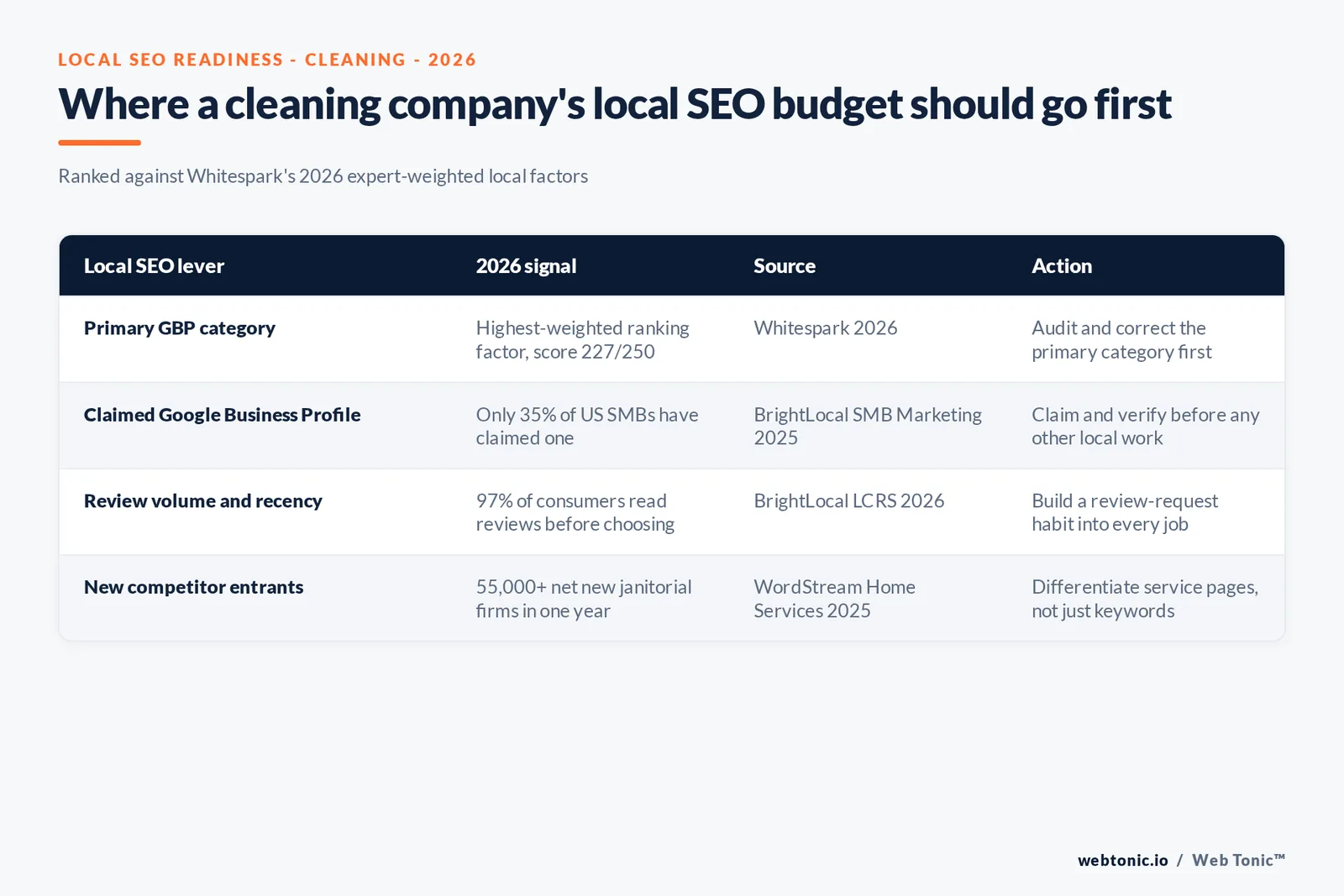
Ranked against the sourced data above: claim and correctly categorize the Google Business Profile first (it is both the biggest gap at 35% claimed and the single highest-weighted ranking factor); build a systematic review-request habit into every completed job second (97% of consumers read reviews, and the AI-recommendation channel is growing fastest); then differentiate service pages by segment - residential, commercial, move-out - since generic pages cannot out-rank 55,000 new entrants competing on the same head terms.
Frequently Asked Questions
What's the single highest-weighted local ranking factor for a cleaning company?
Primary Google Business Profile category, according to Whitespark's 2026 Local Search Ranking Factors survey of 47 local SEO practitioners, who scored it 227 out of a possible 250 - the single highest-weighted factor in the entire study. A cleaning company listed under a generic or wrong category is starting behind before anything else about its site is even evaluated.
How many cleaning companies are actually competing for the same searches?
More every year, and the pace is outrunning revenue growth. IBISWorld puts the 2026 US janitorial services market at $112.4 billion, growing at a 2.7% CAGR, while ISSA's own state-of-the-industry data counts roughly 1.23 million janitorial businesses chasing that revenue. WordStream's home services benchmark data adds a sharper number: a net gain of more than 55,000 janitorial companies, including residential cleaners, in the US between 2023 and 2024 alone.
Do most small cleaning businesses even have a claimed Google listing?
No - and that's the opportunity. BrightLocal's SMB Marketing Report 2025, surveying roughly 780 US small businesses, found only 35% have claimed a Google Business Profile and just 40% have a dedicated website. For a category this local-search-dependent, an unclaimed or unoptimized profile is the most common gap a competitor audit will find.
How much do reviews actually matter for a cleaning company's visibility?
A lot, and it's getting more concentrated on fewer platforms even as consumers check more of them. BrightLocal's 2026 Local Consumer Review Survey found 97% of consumers read reviews before choosing a local business, and the share who 'always' read reviews jumped from 29% to 41% in one year. Google's own share of review-source mentions actually dropped, from 83% in 2025 to 71% in 2026, as AI tools like ChatGPT jumped from 6% to 45% as a recommendation source - meaning review content now needs to be legible to an AI summary, not just a human scanning stars.
Can a cleaning company legally use fake or incentivized reviews to compete?
No. The FTC's Trade Regulation Rule on Consumer Reviews and Testimonials, effective October 21, 2024, specifically bans buying fake reviews, paying for only positive reviews, and running a company-controlled site that poses as an independent review platform - all tactics that show up disproportionately in low-barrier, high-competition categories like residential cleaning.
Sources
IBISWorld - Janitorial Services in the US Industry Analysis, 2026
ISSA - Inside the Forces Reshaping Cleaning and Facility Solutions
WordStream by LocaliQ - Home Services Search Ads Benchmarks 2025
BrightLocal - SMB Marketing Report 2025
BrightLocal - Local Consumer Review Survey 2026
Whitespark - 2026 Local Search Ranking Factors Report
US Bureau of Labor Statistics - May 2024 Occupational Employment and Wage Statistics
Federal Trade Commission - Trade Regulation Rule on Consumer Reviews and Testimonials
Web Tonic's growth marketing team builds local SEO programs for home-service brands and tracks the same review and profile signals covered here. See how cleaning compares on paid channels in our best Google Ads agencies roundup, review conversion rate benchmarks across industries, or learn more about the team.