Table of contents
No benchmark report prices "cleaning services ad creative" as its own category, so this page applies 2025-2026 Meta and video-marketing data to the two formats a cleaning business actually runs: before/after visuals and customer testimonials. The closest published Meta proxy converts worse than most tracked industries and got 36% worse year over year, which raises the stakes on getting the creative itself right.
Key Takeaways
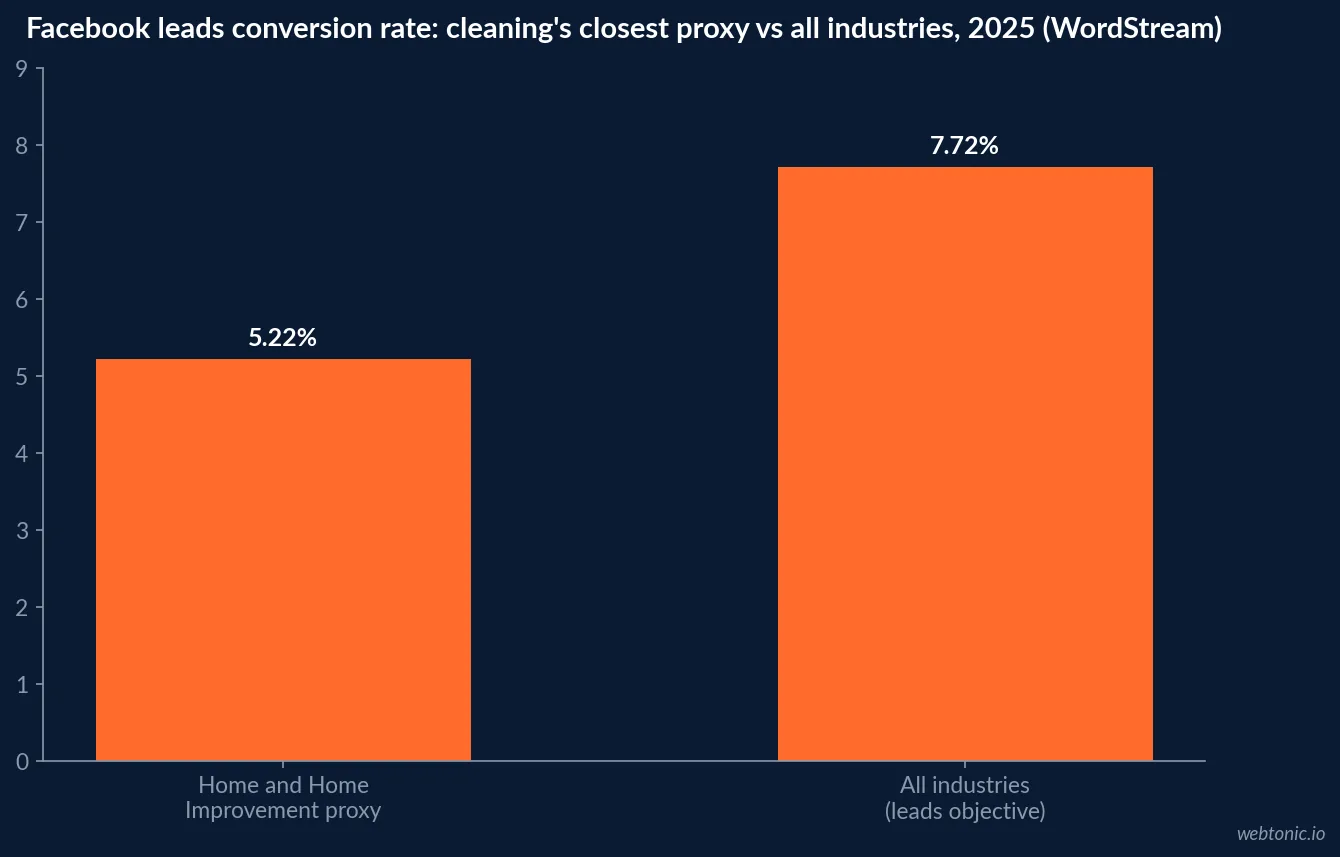
- Home and Home Improvement, the closest Meta proxy for cleaning, converts at just 5.22% on the leads objective, third-lowest of roughly 20 tracked categories (WordStream, 2025).
- That conversion rate fell 36% year over year, one of the three largest declines WordStream tracked (WordStream, 2025).
- Traffic-objective cost per click for the same proxy is USD 0.99, the third-highest of any category (WordStream, 2025).
- All-industry Facebook leads CPL is USD 27.66, up 20% year over year (WordStream, 2025).
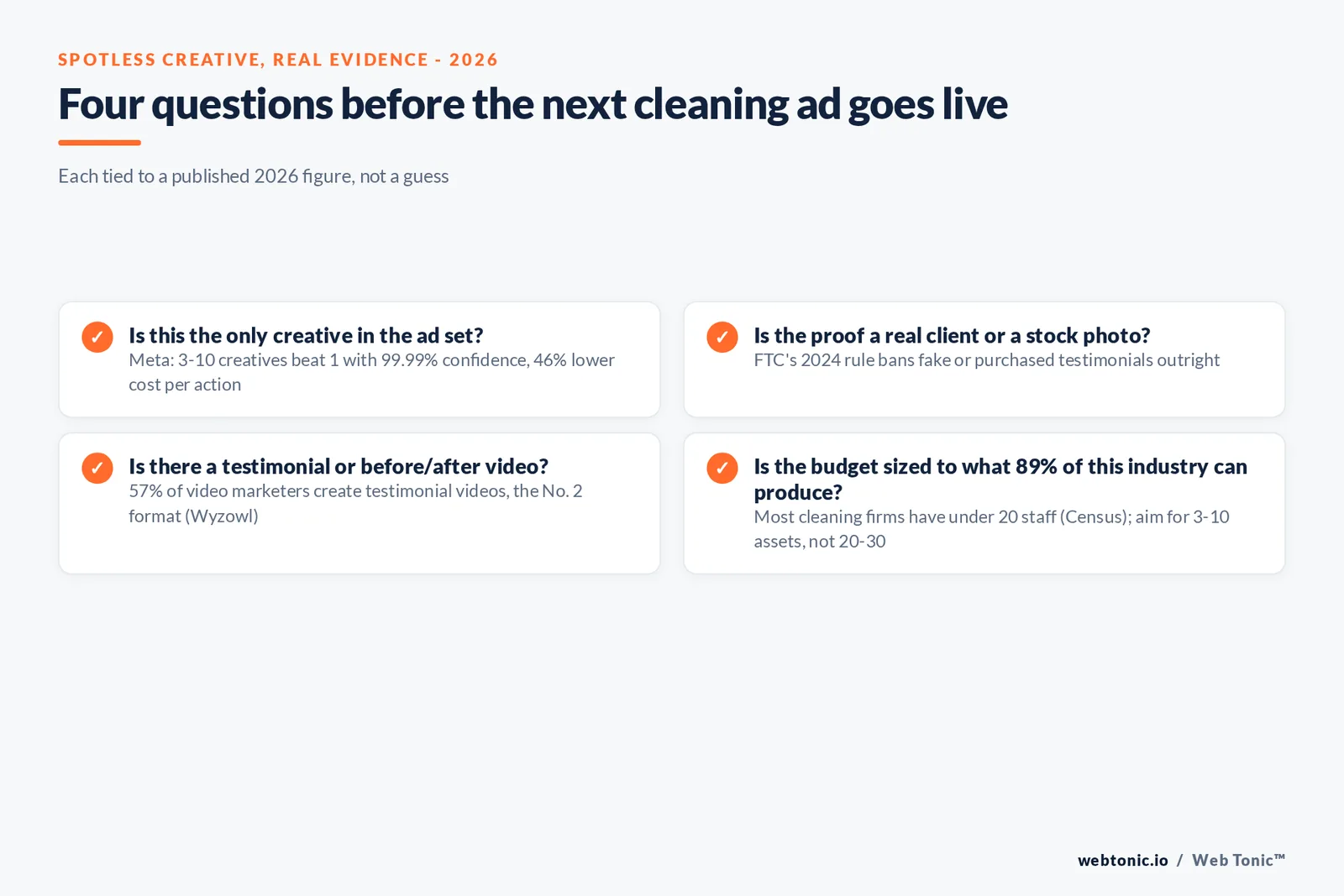
- Ad sets with 3-10 creatives beat single-creative ad sets with 99.99% confidence, at a 46% lower median cost per action (Meta, SMB advertiser experiment).
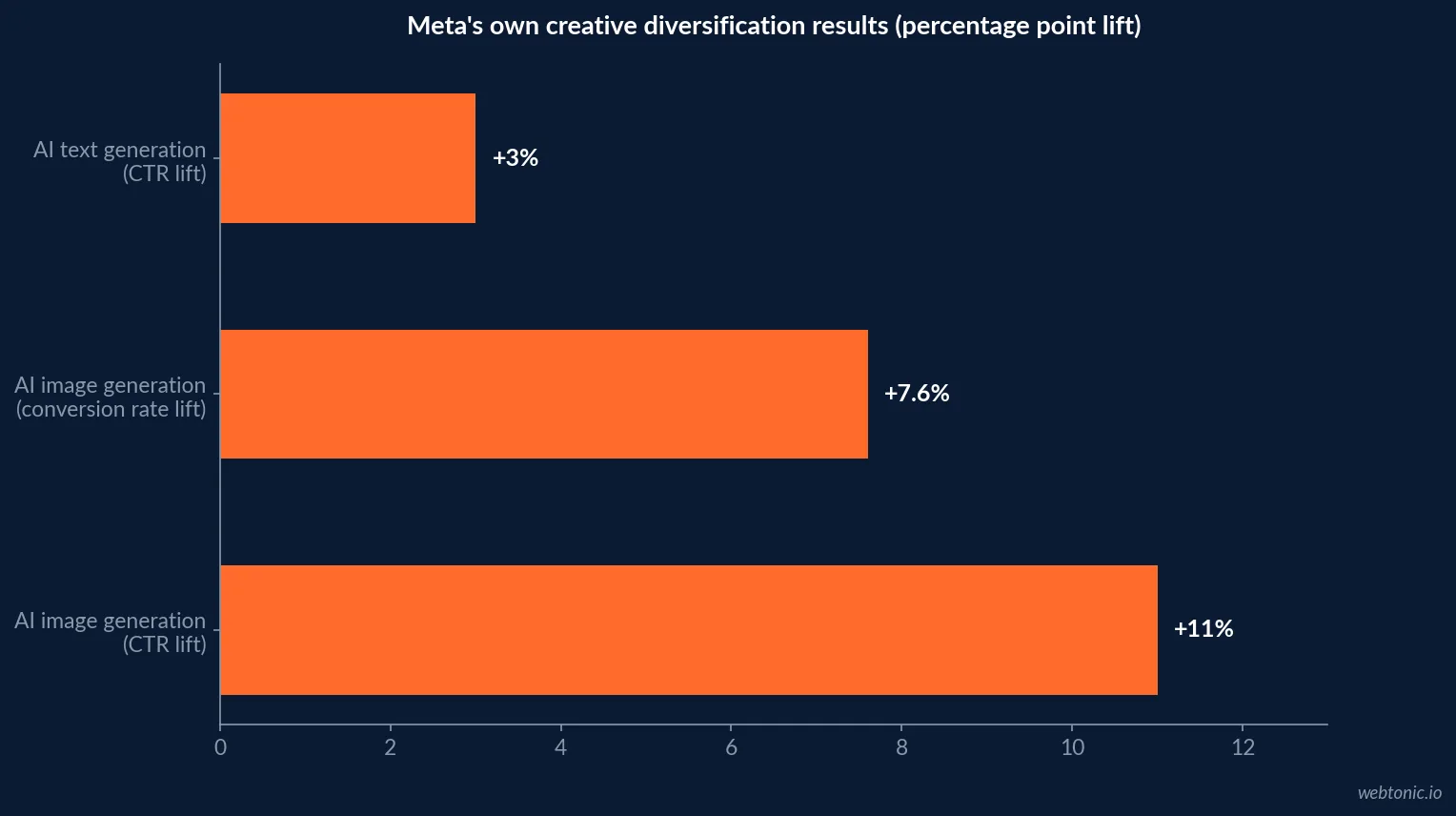
- Meta's AI image-generation feature lifts CTR 11% and conversion rate 7.6% (Meta, Demystifying Creative Diversification).
- Meta's text-generation feature lifts CTR 3% (Meta).
- 91% of businesses now use video as a marketing tool (Wyzowl, 2026, 266 respondents).
- Testimonial videos are the second most-created video type, made by 57% of video marketers, behind only explainer videos at 68% (Wyzowl, 2026).
- 85% of people say a video convinced them to buy a product or service (Wyzowl, 2026).
- The FTC's consumer reviews and testimonials rule took effect October 21, 2024 (16 CFR Part 465), directly governing testimonial-based ad creative.
- 89.0% of janitorial-services firms employ fewer than 20 people (U.S. Census Bureau, 2022), which caps most cleaning ad budgets far below the volume Meta's own research says produces the strongest results.
- The U.S. janitorial services market reached USD 112.4 billion in 2026, growing 2.7% a year (IBISWorld industry summary).
The proxy this page uses, and why
WordStream's Facebook Ads Benchmarks 2025, built from 1,180 campaigns running April 1, 2024 through June 30, 2025, groups roughly 20 industries and does not list cleaning services separately. The closest tracked category is Home and Home Improvement, which bundles residential cleaning in with contractors, HVAC, landscaping and similar trades. Every figure below is stated against that proxy, never as an exact cleaning number, and the gap between "cleaning" and "home improvement broadly" is real: cleaning is a recurring, trust-based service sold mostly on reputation, while much of the rest of the category is a one-time, higher-ticket purchase decision.
| Home and Home Improvement proxy, 2025 (WordStream) | Figure | Rank among ~20 categories |
|---|---|---|
| Cost per click, traffic objective | USD 0.99 | 3rd highest |
| Conversion rate, leads objective | 5.22% | 3rd lowest |
| Conversion rate, year over year | -36% | One of 3 largest declines |
| All-industry cost per lead (context) | USD 27.66 | up 20% YoY |
| All-industry CTR, leads objective (context) | 2.59% | roughly flat YoY |
What that proxy means for the creative, not just the targeting
A falling conversion rate against a rising cost per click is a specific signal: the same ad is working harder to convert the same click. When targeting and bidding are held roughly constant across a category, that pressure lands on the ad creative itself, the image, video, copy and offer a prospect actually sees. For cleaning specifically, that argues for creative that does more of the persuasion work before the click, since the proxy data shows the category is not converting well after it.
What Meta's own research says about volume and format
Independent of the cleaning-specific gap, Meta has published its own findings on what moves creative performance inside its ad system. An internal SMB advertiser experiment found ad sets built with three to ten creative variations beat single-creative ad sets with 99.99% confidence, at a median cost per action 46% lower. Meta's own "Demystifying Creative Diversification" post goes further: campaigns using its AI image-generation feature see an 11% higher click-through rate and 7.6% higher conversion rate, and its text-generation feature alone delivers a 3% higher CTR.
None of this is specific to cleaning. But it is a direct, sourced answer to why a cleaning business running one static photo ad is working against the platform's own evidence about what its delivery system rewards.
| Meta creative-diversification finding | Effect | Source |
|---|---|---|
| Ad sets with 3-10 creatives vs. 1 | 46% lower median cost per action (99.99% confidence) | Meta, SMB advertiser experiment |
| AI image-generation feature | +11% CTR, +7.6% conversion rate | Meta, Demystifying Creative Diversification |
| AI text-generation feature | +3% CTR | Meta |
| Advantage+ Shopping minimum creative recommendation | 10 assets minimum, 20-30 for optimal results | Meta guidance via Shuttlerock |
The two formats cleaning ad creative actually runs on
Cleaning is sold on trust in a stranger entering someone's home, which is why the category's real-world creative concentrates on two formats: before/after visuals and customer testimonials. Wyzowl's 2026 Video Marketing Statistics, a survey of 266 marketing professionals and consumers, found 91% of businesses now use video as a marketing tool, and among video marketers specifically, testimonial videos are the second most-created type at 57%, behind only explainer videos (68%). Separately, 85% of Wyzowl's respondents say a video has convinced them to buy a product or service.
Before/after is not a category Wyzowl tracks by name, but it is the visual equivalent of the "explainer" logic that tops its list: it shows the outcome instead of describing it, which is exactly the kind of proof a first-time buyer letting a stranger into their home is looking for.
| Video format (Wyzowl 2026, 266 respondents) | Share of video marketers who create it |
|---|---|
| Explainer videos | 68% |
| Testimonial videos | 57% |
| Presentation videos | 48% |
| Video ads | 48% |
| Product demos | 39% |
The compliance layer testimonial creative has to clear
Testimonial and review-driven creative, the exact format the data above favors, is now directly regulated. The FTC's Rule on the Use of Consumer Reviews and Testimonials (16 CFR Part 465) took effect October 21, 2024 and prohibits writing, buying, or selling fake reviews and testimonials, and requires clear disclosure when an insider, including an employee's immediate relative, posts a review about the business. A cleaning company's before/after ad built on a real client's actual photo and an unedited quote clears this rule easily; one built on a staged review or an employee-written testimonial without disclosure is precisely the practice the rule was written to stop, and it now carries civil penalty exposure for a knowing violation.
| FTC 16 CFR Part 465 requirement | What it means for cleaning ad creative |
|---|---|
| No fake or purchased reviews/testimonials | Only use real client quotes and photos |
| Disclose insider relationships | An owner's family member's review needs a clear disclosure if used in an ad |
| No company-run fake independent review site | Don't dress up owned content as third-party proof |
| Effective date | October 21, 2024 - already enforceable |
Sizing the budget against a fragmented industry
The creative recommendations above (3-10+ variations, AI-assisted generation, video, testimonials) assume a production budget most of this industry does not have. The U.S. Census Bureau's 2022 County Business Patterns data counts 89.0% of janitorial-services firms with fewer than 20 employees, in a market IBISWorld sizes at USD 112.4 billion in 2026. A one-truck or five-person cleaning operation is not going to produce 20-30 Advantage+ Shopping-grade assets; the realistic target for most of this industry is the 3-10 creative range Meta's own data says clears the single-creative baseline by a wide margin, built around whatever real customer photos and quotes the business already has on hand.
What a realistic creative production cadence looks like
Matching Meta's own 3-10 creative recommendation without matching its 20-30 asset Advantage+ Shopping ceiling is a reasonable target for a business this fragmented. In practice that means a monthly cadence, not a one-time shoot: one new before/after set from a recent job, one testimonial capture (video where possible, given Wyzowl's 85% "convinced me to buy" figure), and one or two copy-only variations of the strongest performer from the month before. That cadence produces the 3-10 asset range Meta's own experiment ties to a 46% lower cost per action, without requiring the dedicated creative team the 20-30 asset ceiling assumes.
| Monthly creative cadence for a small cleaning operator | Format | Ties to |
|---|---|---|
| 1x before/after set | Static image, real job | Meta's 3-10 asset minimum |
| 1x testimonial capture | Video preferred | Wyzowl: 57% of video marketers create these; 85% say video convinced them to buy |
| 1-2x copy variations of the top performer | Static or AI text-assisted | Meta: AI text generation feature, +3% CTR |
Where to go from here
Our performance creative practice builds the testimonial and before/after asset sets this data points to, compliant with the FTC's 2024 rule from the first draft. Our Meta Ads practice runs the media those creatives sit inside. For the paid-media side those creatives run on, our breakdown of what Facebook ads cost is a useful next read.
Frequently Asked Questions
Why isn't there a published cleaning-services ad creative benchmark?
Meta ad benchmark reports group by roughly 20 broad categories, and cleaning services sit inside "Home and Home Improvement" alongside contractors, HVAC and landscaping. WordStream's Facebook Ads Benchmarks 2025, built from 1,180 campaigns running April 2024 through June 2025, is explicit that these are medians across a broad category, not a cleaning-specific figure. This page treats Home and Home Improvement as the closest available proxy throughout, never as an exact cleaning number.
Does that proxy category convert well on Meta?
Not especially, on the published data. Home and Home Improvement posted a 5.22% conversion rate on the leads objective, the third-lowest of roughly 20 tracked categories, and that rate fell 36% year over year, one of the three largest declines WordStream recorded. Traffic-objective cost per click for the category was $0.99, the third-highest of any tracked industry. Read together, this proxy is getting more expensive to reach and converting worse, which puts more pressure on the ad creative itself to do the work.
What does Meta's own research say about how many creatives to run?
Meta's Advantage+ and Andromeda system documentation states that ad sets built with three to ten creative variations outperform single-creative ad sets with 99.99% confidence in Meta's own SMB experiment, with a median 46% lower cost per action. Separately, Meta's demystifying-creative-diversification post reports campaigns using its AI image-generation feature see an 11% higher click-through rate and 7.6% higher conversion rate, and its text-generation feature delivers a 3% higher CTR. None of this is cleaning-specific, but a small cleaning business running one static ad is working against Meta's own published evidence.
Should a cleaning business run video ads, and what kind?
The category evidence favors it as a format, with the specific creative type still an open question. Wyzowl's 2026 survey (266 respondents) found 91% of businesses now use video as a marketing tool, and among video marketers, testimonial videos are the second most-created type at 57%, behind only explainer videos (68%). For a trade that sells trust in a stranger being let into a home, testimonial and before/after formats map directly onto what buyers say they respond to, though no study isolates cleaning as its own segment.
What's the compliance risk in cleaning ad creative specifically?
Testimonials and before/after claims, the two formats this page's evidence points to, are exactly what the FTC's 2024 Rule on the Use of Consumer Reviews and Testimonials (16 CFR Part 465, effective October 21, 2024) regulates. The rule prohibits writing or buying fake reviews and testimonials, and requires clear disclosure when an insider, including an employee's relative, posts one. A before/after ad built on a real client's photo and a genuine quote is compliant; one built on a staged "testimonial" or an employee-written review is exactly the practice the rule targets.
Sources
WordStream - Facebook Ads Benchmarks 2025
Meta for Business - Demystifying Creative Diversification
Meta for Business - Unlocking the Power of Diversification with Meta Andromeda
Wyzowl - Video Marketing Statistics 2026
eCFR - 16 CFR Part 465, Rule on the Use of Consumer Reviews and Testimonials
Federal Trade Commission - Consumer Reviews and Testimonials Rule Q&A
U.S. Census Bureau - County Business Patterns datasets
IBISWorld - Janitorial Services industry summary, 2026