Table of contents
Funeral ad creative is filtered by platform policy before it is ever judged on performance. NFDA's own research shows funeral directors concentrate their attention on Facebook more than any other platform, while Meta's and Google's sensitive-category rules quietly narrow what can be said in the ad itself. This page uses 2025-2026 primary sources to separate what the data reveals about creative reach from what platform policy allows the creative to do.
Key Takeaways
- 78.7% of funeral directors turn to Facebook for industry information, more than any other platform.
- NFDA's own Facebook page reaches 30,000 followers, its largest owned audience.
- 40% of families found their funeral home through Facebook in 2025, up from 21% in 2023.
- Meta bans ads that assert personal attributes, including health and family circumstances.
- Meta separately bans commercial exploitation of crises and controversial events.
- Google classifies health and personal-circumstance content as sensitive interest categories with restricted audience types.
- Advertiser-curated audiences are banned in sensitive categories on Google; only predefined audiences are allowed.
- The FTC's 16 CFR Part 465 rule (2024) bans fake or paid-for-sentiment testimonials.
- Insider testimonials without disclosure are also banned under the same 2024 rule.
- 44% of families want a director present even after researching online - a reassurance-first creative signal.
- 31.8% want a hybrid online-plus-director path, again favoring guidance-led over urgency-led creative.
- 36% of NFDA member firms already offer online cremation arrangements to promote in creative.
- 63.4% of 2025 dispositions are cremations, changing which service the creative should lead with.
- NFDA's 2026 homepage ad inventory reaches 119K monthly page views as a B2B creative placement for suppliers.
- 90% of NFDA.org webpages carry a rotating ad slot per its own 2026 media kit.
Where funeral creative actually runs
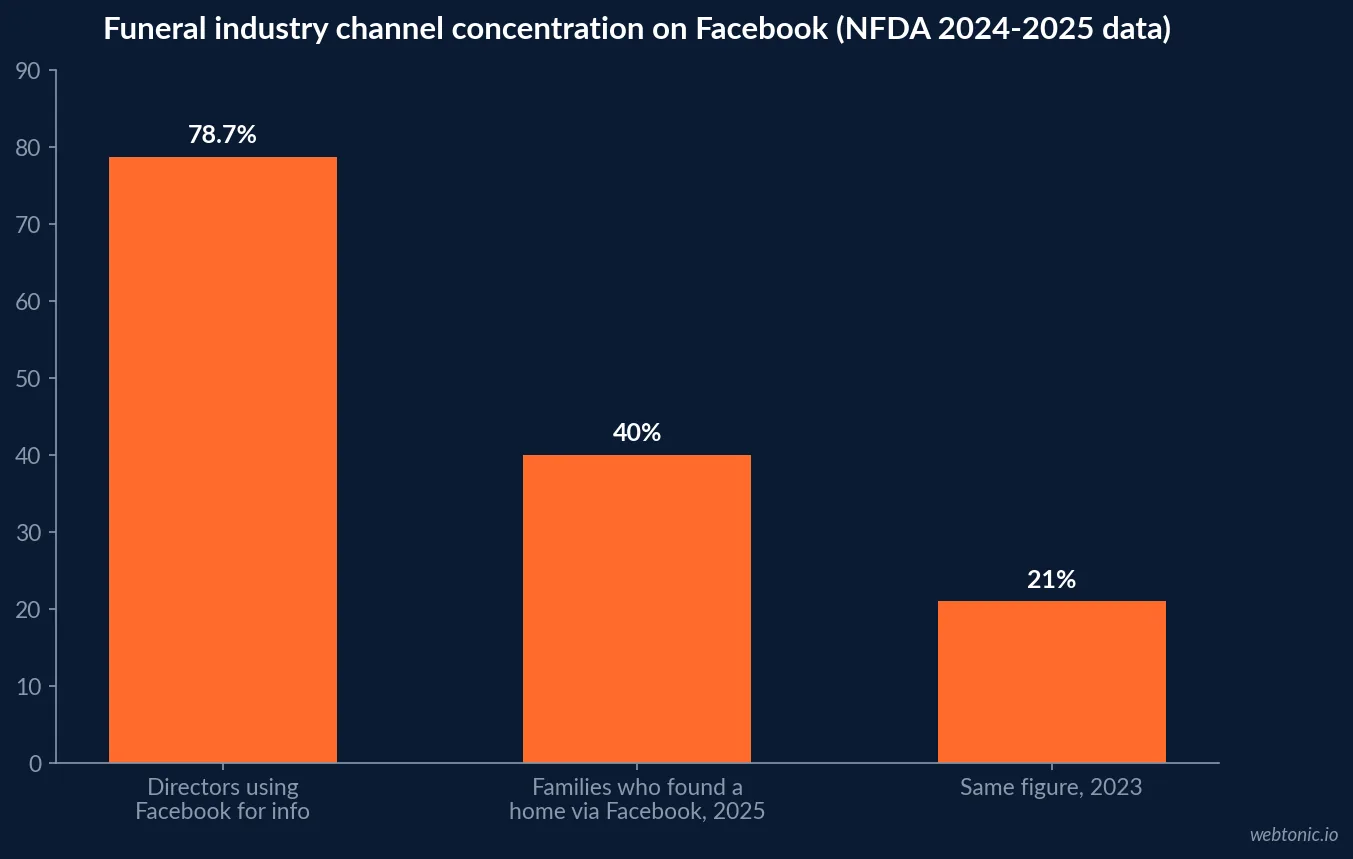
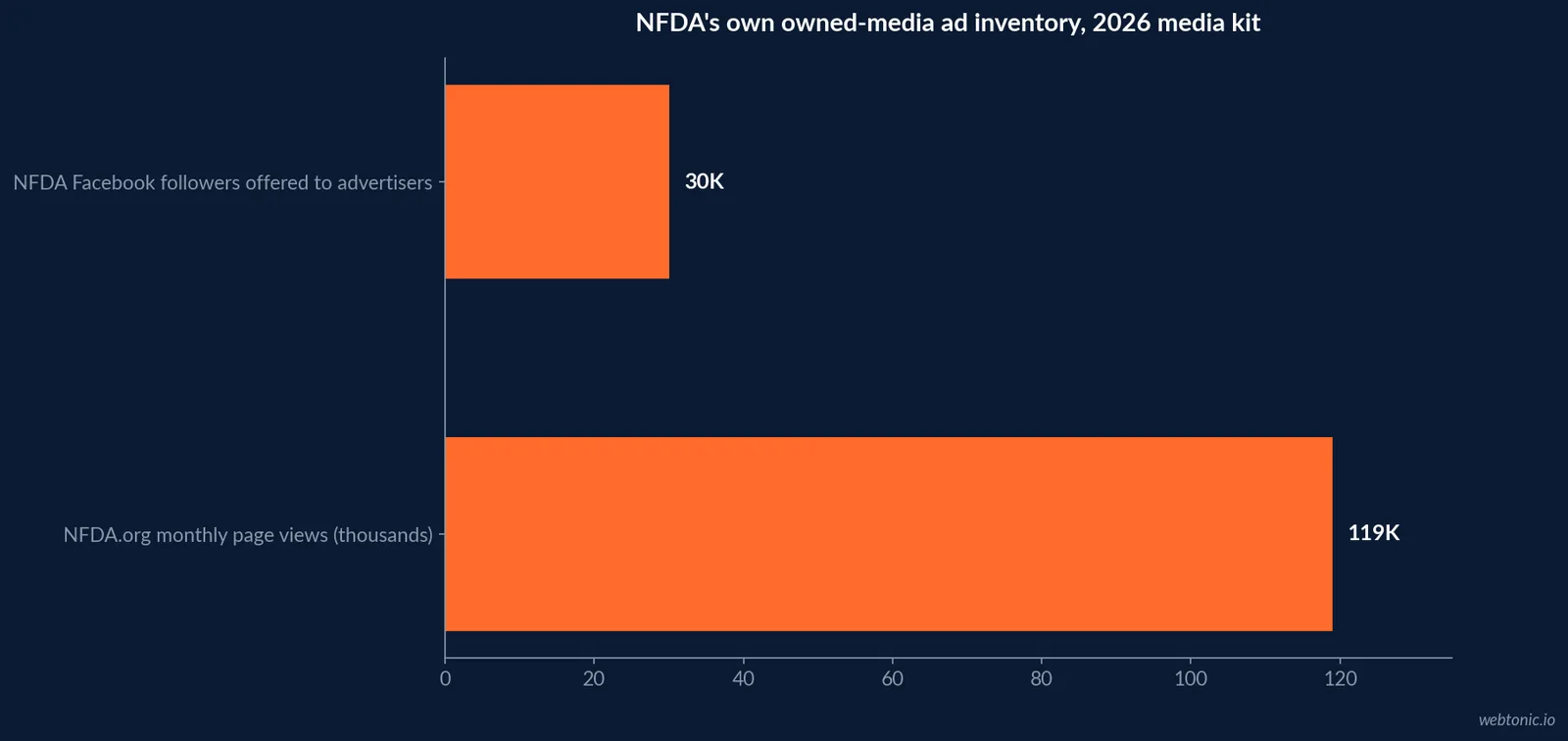
NFDA's own 2026 Media Kit, citing its 2024 study of funeral director communications preferences, reports that 78.7% of funeral directors turn to Facebook when looking for the latest funeral service information - more than any other social platform, including LinkedIn. NFDA's own Facebook presence reflects the same concentration: its advertising product offers exclusive access to 30,000 followers, its largest owned social audience. On the consumer side, NFDA's 2025 Consumer Awareness & Preferences Study found 40% of families used the services of a funeral home they found on Facebook, nearly double the 21% who said so in 2023.
That concentration on one platform means one platform's ad-standards team effectively edits every funeral home's creative brief, whether the advertiser has read the policy or not.
| Channel signal (NFDA data) | Figure | Year | What it means for creative |
|---|---|---|---|
| Directors who use Facebook for industry info | 78.7% | 2024 study, 2026 media kit | Facebook is the default paid + organic channel |
| Families who found a home via Facebook | 40% | 2025 | Consumer-facing creative concentrates there too |
| Same figure in 2023 | 21% | 2023 | Nearly doubled in two years |
| NFDA.org monthly page views (B2B ad inventory) | 119K | As of Nov 2025 | A supplier-facing placement, not consumer-facing |
| NFDA Facebook follower base offered to advertisers | 30,000 | 2026 | Small relative to a funeral home's own local reach needed |
What Meta's own policy narrows before CTR is even measured
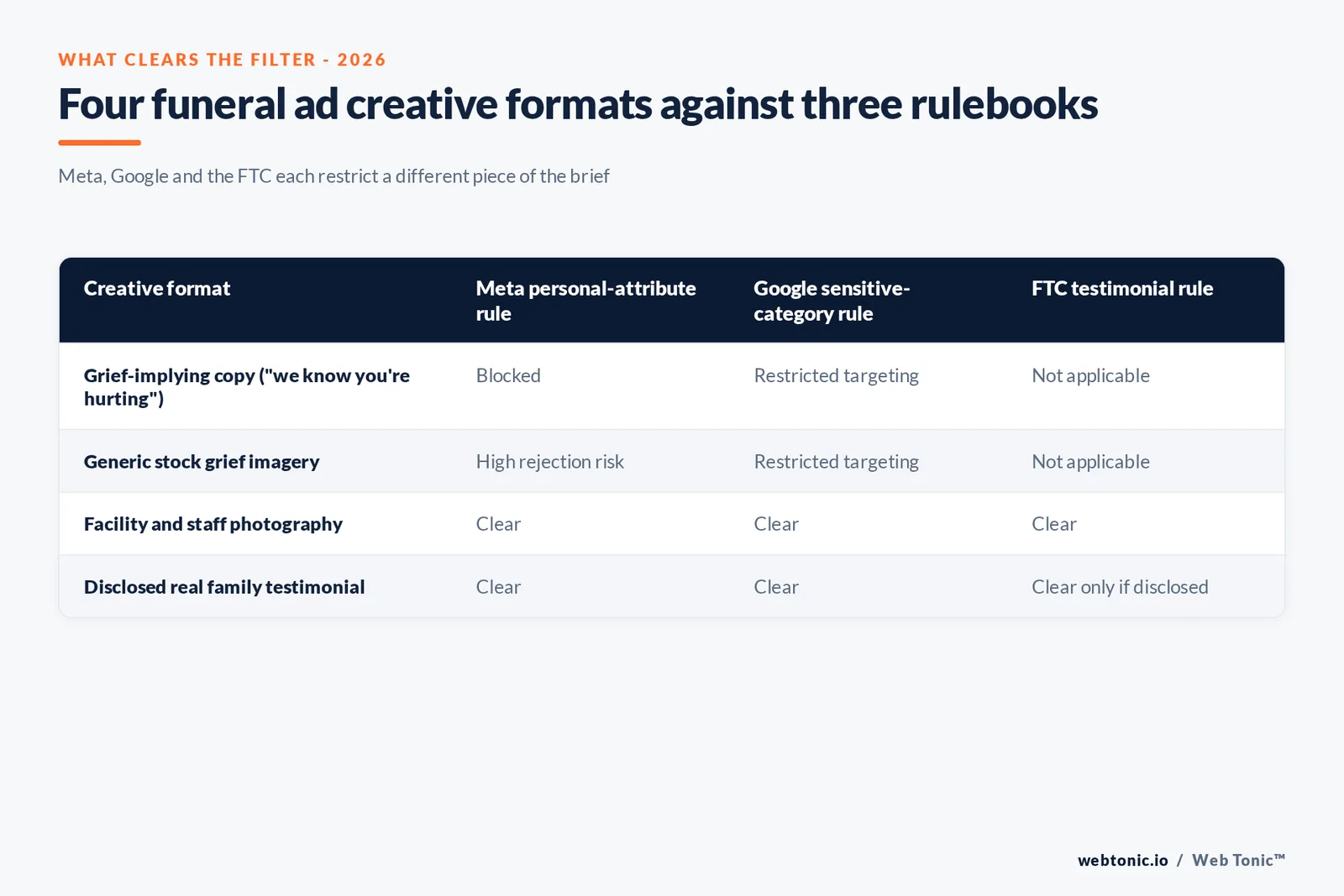
Meta's Advertising Standards on personal attributes prohibit ads that assert or imply a person's personal attributes or those of their family, including health and family-circumstance references, and instead require creative to focus on the product or service itself. Meta separately restricts commercial exploitation of crises and controversial events. Neither rule bans funeral advertising outright, but together they push the winning creative pattern toward "here is our facility, our services and our price list" and away from "we know you just lost someone" - even though the second framing is what a direct-response copywriter would normally reach for first in this category.
Google's ad policy runs a parallel, separately worded filter: its Health in personalized advertising policy classifies health and chronic-care-adjacent content as a sensitive interest category, and its relationship hardships policy does the same for bereavement-adjacent life events. In both categories, advertiser-curated audiences are banned; only Google's own predefined audiences, which automatically exclude sensitive signals, may be used.
| Platform rule | What it restricts | What still works | Source |
|---|---|---|---|
| Meta personal attributes | Copy/imagery implying the viewer is grieving | Service description, facility imagery, disclosed testimonials | Meta Transparency Center |
| Meta crisis exploitation | Commercial use of a controversial/crisis event | Standard service and pricing messaging | Meta Transparency Center |
| Google sensitive interest categories (health, relationship hardships) | Advertiser-curated audience targeting | Google's predefined audiences, contextual and location targeting | Google Ads Policy Help |
| FTC 16 CFR 465 (2024) | Fake, paid-for-sentiment or undisclosed insider testimonials | Real, disclosed family testimonials | FTC final rule, Aug 2024 |
The testimonial rule that actually helps this category
The FTC's August 2024 final rule, codified at 16 CFR Part 465, bans fake or false consumer and celebrity testimonials, prohibits paying for reviews conditioned on a particular sentiment, and bans undisclosed insider testimonials from officers or managers. None of that restricts a genuine family testimonial, properly attributed and disclosed - which is precisely the creative format least affected by Meta's personal-attribute rule, since a real family describing their own experience is not the advertiser asserting an attribute about the viewer.
For a category where 44% of families say they would not feel confident planning without a director present and 31.8% want a hybrid path, a disclosed testimonial from a past family - showing the reassurance a director provided - is the one creative asset that satisfies the FTC's testimonial rule, clears Meta's attribute rule, and matches what the consumer research says families actually want to see.
Building the brief around what the disposition mix rewards
With 63.4% of 2025 U.S. dispositions now cremations per NFDA and CANA, and 36% of NFDA member firms already offering online cremation arrangements, creative that still leads exclusively with a casket showroom or a burial plot is aimed at a shrinking share of the decision. Creative that shows the online arrangement flow itself - a screenshot, a walkthrough, a real staff member describing it - is both compliant (it is a service description, not an attribute claim) and aligned with where the category is actually moving.
Our performance creative practice builds ad concepts that are pressure-tested against platform policy before spend goes behind them, which matters more in a sensitive category than in almost any other vertical we work in.
Preneed creative reads differently than at-need creative
The two audiences a funeral home advertises to are not interchangeable, and the platform-policy environment treats them differently in practice even though no rule names "preneed" or "at-need" explicitly. Preneed creative reaches someone 55 and over who is planning ahead, not someone in an active bereavement window, so benefit-led copy about cost certainty and relieving family burden reads as ordinary service marketing rather than an implied personal-attribute claim. At-need creative, by contrast, is addressed into the exact moment Meta's personal-attribute rule is built to guard, which is why the safest at-need creative is the most restrained: facility, staff, price list, a testimonial - and nothing that assumes the viewer's emotional state.
NFDA's own consumer data supports keeping the two briefs separate rather than running one funeral creative concept across both audiences. 19.4% of families have already pre-planned and prepaid, which is the preneed audience responding to exactly the cost-certainty message that would be inappropriate to run at-need; 44% want a director present even after online research, which is the at-need audience responding to reassurance rather than to a hard offer.
| Creative dimension | Preneed brief (55+, planning ahead) | At-need brief (active bereavement) |
|---|---|---|
| Primary message | Cost certainty, relieving family burden | Reassurance, availability, compassionate service |
| Platform-policy exposure | Low - a benefit claim, not an attribute claim | High - personal-attribute rule applies directly |
| Best-performing format (by NFDA consumer signal) | Direct benefit copy, price transparency | Disclosed testimonial, facility/staff photography |
| Audience proof point | 19.4% have already pre-planned and prepaid | 44% still want a director present |
What the statistics reveal, in one line
Funeral ad creative statistics reveal a category concentrated on one platform (Facebook, at 78.7%/40%), operating under two overlapping sensitive-category policy regimes that reward service-description and testimonial creative over attribute- or urgency-led creative, at the exact moment the underlying service mix (63.4% cremation) is shifting toward more digital-first, comparison- shopping behavior. The winning creative brief in 2026 is compliant almost by necessity, and the compliant version turns out to also be the one the consumer research says families want.
Talk to us about a funeral-service creative audit, or read how we approach Facebook ad budgeting for a category with a comparably narrow allowed-creative window. Our Meta Ads practice reviews every funeral-services concept against the same policy set before a dollar goes behind it.
Frequently Asked Questions
What do funeral ad creative statistics actually reveal?
They reveal a compliance ceiling before a creative ceiling. NFDA's own 2026 media kit reports that 78.7% of funeral directors turn to Facebook for industry information, more than any other platform including LinkedIn, which is why Facebook is the default paid channel - but Meta's ad standards on personal-attribute and crisis-exploitation content restrict exactly the kind of grief-specific messaging that would otherwise perform best. The revealed pattern is broad, reassurance-first creative winning over narrowly targeted, emotionally specific creative, because the second kind gets rejected.
Can a funeral ad reference grief or loss directly in the copy or image?
Cautiously. Meta's Advertising Standards prohibit ads that assert or imply a person's personal attributes, including health and family-circumstance attributes, and separately prohibit ads that commercially exploit a crisis or controversial event. A death is not itself a listed 'crisis' event in the way a natural disaster is, but Meta's personal-attribute rule still blocks copy that implies 'you are grieving' rather than describing the service on offer. The safer creative pattern in the industry is testimonial- and facility-led, not attribute-led.
Are testimonials still allowed in funeral ad creative after the FTC's 2024 rule?
Yes, but not fabricated or undisclosed ones. The FTC's 16 CFR Part 465 rule, finalized August 2024, bans fake or false consumer and celebrity testimonials, paying for a particular sentiment, and undisclosed insider reviews - it does not ban real family testimonials with disclosed context. For a category built on trust, a genuine family testimonial, properly sourced and disclosed, is now one of the few creative formats with no ambiguity left in it.
How does preneed creative differ from at-need creative?
By audience and by allowed sensitivity. Preneed creative targets people 55 and over who are planning ahead, and can be more benefit-led - cost certainty, relieving family burden - because it is not addressed to someone currently grieving. At-need creative reaches someone in an active bereavement window and carries the tightest compliance and tone requirements; NFDA's consumer research shows 44% of families still want a director present even after researching online, which argues for reassurance-first at-need creative over urgency-based creative.
Does stock photography work for this category?
Practitioner guidance in the space consistently advises against it, and the platform-policy environment reinforces that advice indirectly: generic grief-themed stock imagery paired with attribute-implying copy is the combination most likely to draw a Meta rejection, while real facility and staff photography paired with service description is not restricted by any platform policy. The creative safest from both a brand and a compliance standpoint is the same creative: specific, real, low on manufactured emotion.
Sources
NFDA - 2026 Advertising Media Kit
NFDA - 2025 Consumer Awareness & Preferences Study release
Meta Transparency Center - Privacy violations and personal attributes
Meta Transparency Center - Commercial exploitation of crises and controversial events
Google Ads Policy Help - Health in personalized advertising
Google Ads Policy Help - Relationship hardships in personalized advertising
FTC - Final rule banning fake reviews and testimonials
CANA - 2025 Annual Statistics Report preview