Table of contents

How we vet every listicle
Every agency featured on Web Tonic passes our 84-point editorial review before a single listicle goes live. This is how we vet each pick:
Verified client outcomes: We require real case studies with measurable KPIs — revenue, ROAS, CPA, retention — tied to the exact category being ranked. No cherry-picked wins, no unverifiable numbers.
Independent reputation: We cross-check Clutch, Google, G2, and Trustpilot ratings, and screen for review-bombing or suspicious patterns. Only operators with a consistent, verifiable track record make the cut.
Beyond that, every listing goes through a quarterly re-audit. We check 84 criteria across 6 pillars to make sure it still holds up — here are some of the checks we run:
No honest list can rank the best PPC companies for every business, because the right agency depends on your spend, platforms and margin. What can be ranked is the evidence: this page gives the criteria, price benchmarks and questions that separate a strong PPC management company from an expensive one.
Key Takeaways
- 3 billing models dominate PPC management: a percentage of ad spend (typically 10-20%), a flat monthly retainer, or a hybrid base plus performance fee.
- $1,500 to $5,000 per month is the common management fee band for accounts spending $10,000-$50,000 monthly across Google Ads and Microsoft Ads.
- $5.42 average cost per click, 6.64% click-through rate and $66.69 cost per lead across 23 categories (LocaliQ benchmarks) are the numbers any agency proposal should be measured against.
- 100% account ownership must stay with you — your Google Ads account, Merchant Center, analytics and conversion tags, with the agency added as a user.
- 8 criteria — account access, reporting, measurement rigour, platform coverage, industry fit, team seniority, contract terms and pricing model — decide the outcome more than any award badge.
What a PPC management company actually does
PPC advertising services vary enormously in scope, and most disappointing engagements are scope failures rather than skill failures. A pay-per-click management company can own anything from a single Google Ads account to the full paid media stack across search, shopping, social and retail media, plus the tracking and landing pages underneath it. Write down which of the deliverables below you are buying before you compare two quotes, because a $900 retainer and a $6,000 retainer are usually buying different rows in this table.
| Service area | What it includes | Usually in a basic retainer? | Why it matters |
|---|---|---|---|
| Account structure | Campaign, ad group and keyword architecture | Yes | Bad structure caps every later optimisation |
| Keyword and search term work | Research, match types, negative lists | Yes | Wasted queries are the largest single leak |
| Ad creation | Responsive search ads, assets, extensions | Yes | Asset variety is what automation optimises with |
| Bid and budget management | Smart Bidding targets, pacing, budget splits | Yes | Targets set wrong throttle volume or blow CPA |
| Conversion tracking | Tag setup, offline imports, value tracking | Sometimes | Every automated bid depends on this signal |
| Feed management | Merchant Center feed fixes and rules | Rarely | For ecommerce the feed is the creative |
| Creative production | Static, video and vertical ad assets | Rarely | Required for Performance Max, video and Demand Gen |
| Conversion rate optimisation | Landing page tests and rebuilds | No | Often a bigger lever than bid management |
| Reporting and analysis | Dashboards, cohort and channel analysis | Yes | Decides whether you can audit the work at all |
Rule 1 — 1 page of scope agreed in writing before signature. Trap 1 — 0 clarity on who owns tracking and landing pages is the most common cause of a stalled first quarter, because the agency waits on your developer while the retainer clock runs.
The eight criteria that actually predict results
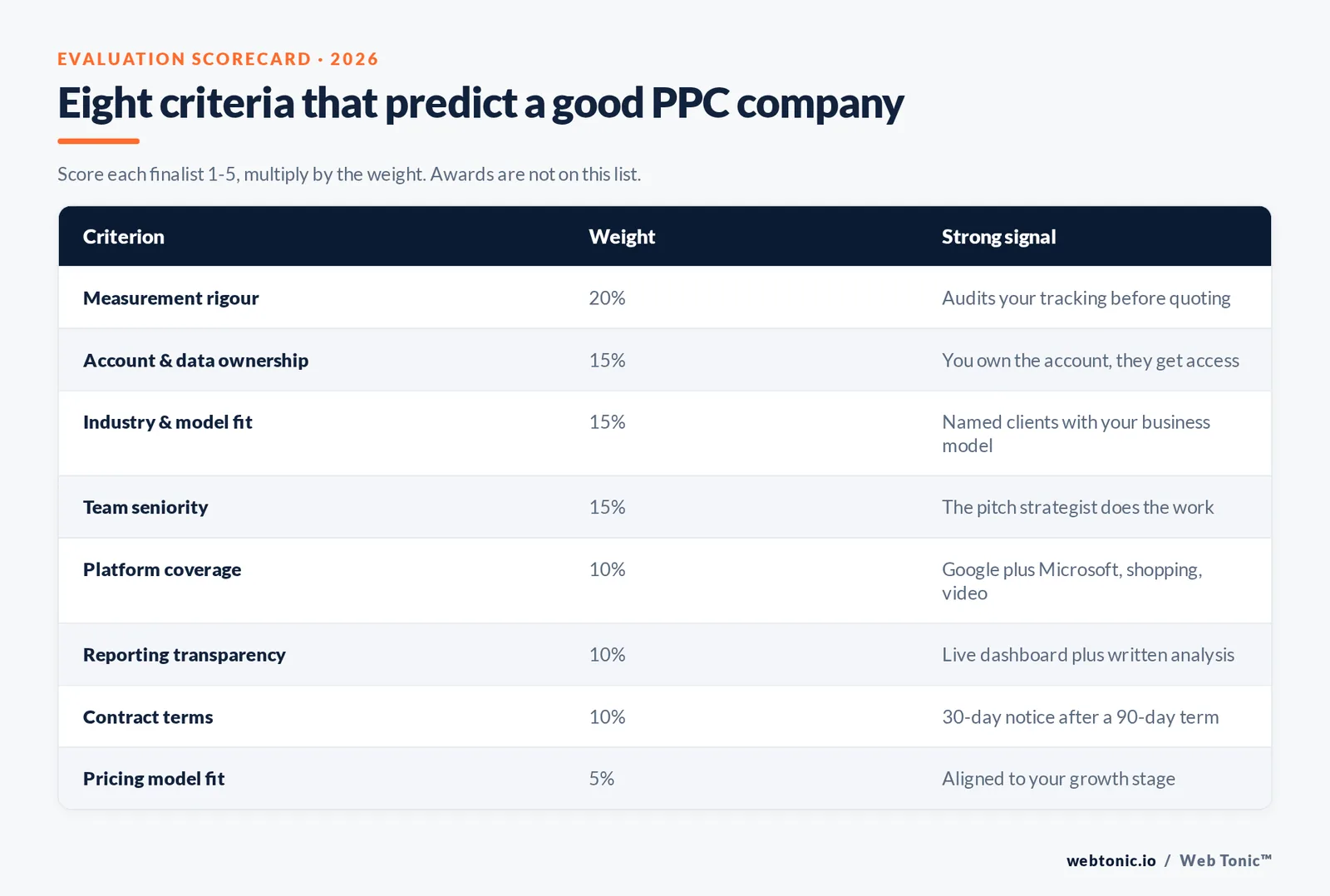
Directory rankings and "top PPC agencies" awards are largely a function of who submits an entry. A weighted scorecard applied to two or three finalists is a better use of an afternoon. Score each criterion from 1 to 5, multiply by the weight, and you will usually find the cheapest quote is not the lowest-risk one.
| Criterion | Weight | Strong signal | Weak signal |
|---|---|---|---|
| Measurement rigour | 20% | Audits your conversion tracking before quoting | Quotes off a screenshot of clicks |
| Account and data ownership | 15% | You own the account, they get user access | Ads run inside the agency's own account |
| Industry and model fit | 15% | Named clients with your business model and margin | Logo wall from unrelated verticals |
| Team seniority on your account | 15% | The strategist in the pitch does the work | Handover to an unnamed junior after week 2 |
| Platform coverage | 10% | Google Ads plus Microsoft Ads, shopping and video | Google search only, whatever the goal |
| Reporting transparency | 10% | Live dashboard plus monthly written analysis | A PDF of platform screenshots |
| Contract terms | 10% | 30-day notice after a 90-day initial term | 12-month lock with no performance break |
| Pricing model fit | 5% | Model aligned to your growth stage | Percentage of spend with no cap |
Rule 2 — 20% of the score sits on measurement, because an agency optimising to a broken conversion action will produce confident reports and no revenue. Google's own documentation on how conversion tracking works is short enough to read before the call, and it will tell you whether the answers you get are real.
How PPC management companies price the work
Pricing models are not neutral: each one creates an incentive. A percentage of ad spend rewards spending more; a flat retainer rewards spending less time; performance-based pricing rewards whichever metric you agreed, whether or not it is the one that pays your bills.
| Pricing model | Typical rate | Best for | Built-in incentive risk |
|---|---|---|---|
| Percentage of ad spend | 10-20% of monthly spend | Scaling accounts above $20,000/month | Rewards higher spend, not higher profit |
| Flat monthly retainer | $1,000-$8,000/month | Predictable budgets and lead gen | Rewards minimum hours once signed |
| Hybrid base plus performance | Base $1,500 plus 5-10% of tracked revenue | Ecommerce with clean attribution | Disputes over what attribution counts |
| Performance-based only | $50-$300 per qualified lead | High-ticket local services | Lead quality arguments every month |
| Hourly consulting | $100-$300/hour | Audits, training, in-house support | No accountability for outcomes |
| One-off audit or build | $1,500-$6,000 fixed | Testing an agency before committing | Findings without implementation |
Rule 3 — 15% of ad spend is a fair ceiling for pure management at mid-market spend levels; above $50,000 monthly, negotiate a tapering percentage or a capped fee. Google's guidance on managing your spend is a reminder that budgets are levers you control, not the agency.
What PPC management should cost at your spend level
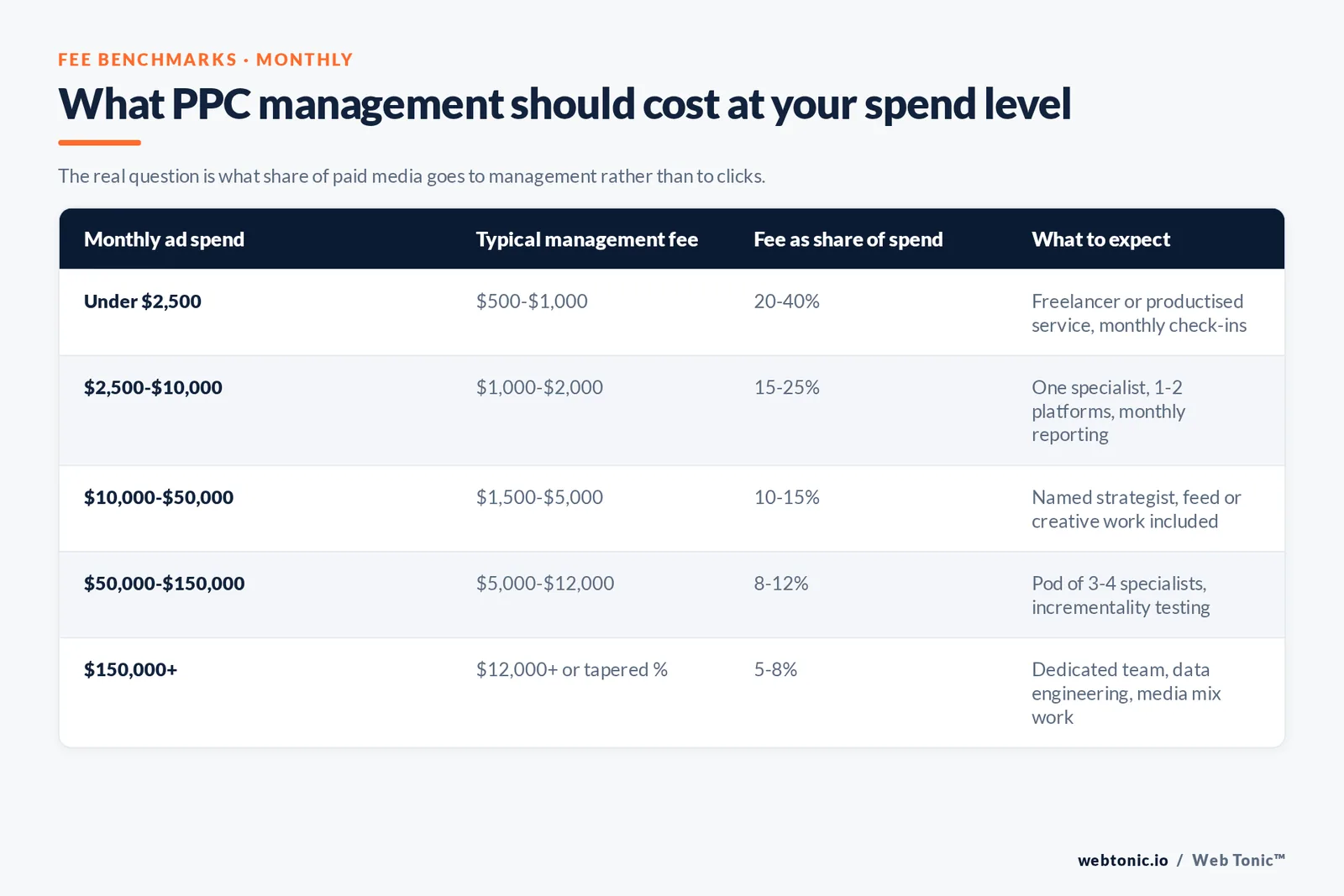
The right question is not "what does an agency charge", it is "what percentage of my total paid media investment is going to management rather than to clicks". Once fees exceed roughly a quarter of the media budget, the maths rarely works unless the agency is also producing creative and landing pages.
| Monthly ad spend | Typical management fee | Fee as share of spend | What to expect at this level |
|---|---|---|---|
| Under $2,500 | $500-$1,000 | 20-40% | Freelancer or productised service; monthly check-ins |
| $2,500-$10,000 | $1,000-$2,000 | 15-25% | One specialist, 1-2 platforms, monthly reporting |
| $10,000-$50,000 | $1,500-$5,000 | 10-15% | Named strategist, feed or creative work included |
| $50,000-$150,000 | $5,000-$12,000 | 8-12% | Pod of 3-4 specialists, incrementality testing |
| $150,000+ | $12,000+ or tapered % | 5-8% | Dedicated team, data engineering, media mix work |
Trap 2 — 40% of budget going to fees at very low spend levels is common and usually means you should either raise the budget or run the account in-house with a paid audit twice a year. Our own growth marketing engagements start from the same arithmetic: media has to be large enough to pay for the thinking.
Which type of PPC company fits your business
"Best" is a function of fit. A one-person specialist can beat a 200-person digital marketing agency on a single Google Ads account, and lose badly on a programme that spans paid search, paid social, feed engineering and creative production.
| Provider type | Team size | Where they win | Where they struggle |
|---|---|---|---|
| Freelance PPC specialist | 1 | Single-platform accounts under $20,000/month | Holiday cover, creative volume, breadth |
| Boutique PPC agency | 3-15 | Senior attention, fast iteration, niche depth | Capacity spikes and multi-market rollouts |
| Full-service digital agency | 20-200 | PPC plus SEO, CRO, creative and analytics | Junior execution on smaller accounts |
| Performance holding company | 200+ | Global scale, media buying leverage | Slow change requests, high minimums |
| Productised subscription service | Pooled | Low fixed cost, fast start | Little strategic or cross-channel work |
| In-house hire plus consultant | 1 plus advisor | Product knowledge and speed | Single point of failure, no benchmark data |
Credentials: what Google Partner status does and does not prove
Badges are a filter, not a verdict. The Google Partners programme sets requirements around certifications, spend thresholds and performance, and Premier status is limited to a share of partners in each country. That tells you the company manages real budgets; it says nothing about whether they will manage yours well.
| Credential or claim | What it genuinely proves | What it does not prove | How to verify |
|---|---|---|---|
| Google Partner badge | Certifications, spend threshold, performance floor | Quality of work on accounts like yours | Search the official partner directory |
| Google Premier Partner | Top tier of partners in that country by year | That your account gets senior staff | Ask which year and country it was awarded |
| Microsoft Ads Partner | Active Microsoft Advertising practice | Meaningful Microsoft spend under management | Ask for a live Microsoft account example |
| Industry awards | Somebody wrote a strong entry | Repeatable process across the client base | Ask for the entry and its result data |
| Case studies | One documented outcome | Median client outcome | Ask for the median, and for a churned client |
| Client reviews | Service experience | Profitability of the media | Ask reviewers about reporting and turnover |
| Business accreditation | Complaint history and registration | Marketing competence | Check the BBB profile and filings |
Rule 4 — 2 references minimum, one current and one former client, and ask the former client why they left. Trap 3 — 1 flagship case study repeated in every pitch usually means the median result is unremarkable.
Twelve questions that separate finalists
Every agency can answer "do you do PPC". These questions are harder to fake, because good answers require having done the work. Bring the list to the call and take notes on the specificity, not the confidence.
| Question | What a strong answer sounds like | Red-flag answer |
|---|---|---|
| Who owns the Google Ads account? | You do; we request user access | We run it in our MCC-owned account |
| How will you verify my conversion tracking? | Tag audit, test conversions, offline import plan | It already looks fine |
| What will you change in month one? | Three named fixes with expected impact | A full rebuild before any diagnosis |
| Which bidding strategy will you use and why? | Tied to conversion volume and target economics | Whatever Google recommends |
| How do you handle Performance Max brand overlap? | Separate brand campaign plus channel reporting | Performance Max handles everything |
| What is your negative keyword process? | Weekly search term review with match-type rules | Quarterly, if needed |
| Who does the work day to day? | Named specialist, hours per week stated | Our team handles it |
| What happens to landing pages? | Owned scope or explicit handoff and testing plan | That is on your side |
| What does your reporting show? | Spend to revenue with assumptions stated | Impressions, clicks and CTR only |
| How do you report on Microsoft Ads? | Separate view plus blended efficiency | We do not run Microsoft |
| What are the exit terms? | 30-day notice, assets and data handed over | 12 months, no early exit |
| What would make you decline this account? | A specific, honest disqualifier | Nothing, we can help anyone |
The benchmarks to hold any PPC company to
Agree the numbers before the first invoice. LocaliQ's search advertising benchmarks across 23 categories give a defensible starting point: an all-industry average cost per click of $5.42, click-through rate of 6.64%, conversion rate of 8.18% and cost per lead of $66.69. Category spread is wide — legal at $9.87 per click, arts and entertainment at $1.63 — so use your own category, not the average.
| Metric | Reference point | Review cadence | What a miss usually means |
|---|---|---|---|
| Cost per click | Category average, not all-industry | Monthly | Match types or bid targets are too loose |
| Click-through rate | 6.64% all-industry search average | Monthly | Weak ad assets or poor query relevance |
| Conversion rate | 8.18% all-industry average | Monthly | Landing page or offer problem, not bidding |
| Cost per lead | $66.69 all-industry average | Monthly | Unqualified query mix or thin negatives |
| Share of wasted spend | Under 10% of spend on zero-conversion queries | Weekly | Search term review is not happening |
| Return on ad spend | Your break-even multiple, calculated on margin | Monthly | Target set on revenue, not contribution |
| Quality Score components | Expected CTR, relevance, page experience | Quarterly | Ad-to-page mismatch |
Two Google references are worth reading before you sign off targets: choosing a bid strategy based on your goals and the Quality Score breakdown. Both make it obvious when an agency is describing effort instead of mechanics. For search-market context, Statcounter still shows Google handling close to nine in ten global search referrals, which is why Microsoft Ads is a supplement rather than a substitute.
Agency versus in-house: the real cost comparison
Hiring is the alternative nobody prices properly. A single mid-level paid media manager costs far more than the salary line once you add tools, training and the cost of that person being your only source of benchmark data.
| Cost line | Agency | In-house hire | Note |
|---|---|---|---|
| Direct cost per year | $18,000-$60,000 in fees | $70,000-$120,000 loaded | Loaded cost includes taxes and benefits |
| Tooling | Included | $3,000-$15,000/year | Bid, feed, reporting and call tracking tools |
| Time to productivity | 2-4 weeks | 2-4 months | Recruitment adds 6-10 weeks before that |
| Breadth of skills | Search, shopping, video, feed, analytics | Usually 1-2 strengths | Breadth is the main reason to outsource |
| Cross-account benchmarks | Yes, across many advertisers | Only your own history | Matters most in volatile auctions |
| Product knowledge | Learned, second-hand | Deep and immediate | The main reason to hire instead |
| Continuity risk | Account manager turnover | One resignation stops everything | Document process either way |
If creative volume is the gap rather than bid management, a specialist performance creative team alongside a lean media partner often costs less than one full-service retainer. Rule 5 — 3 months of fees is a reasonable trial commitment; anything longer should come with a documented performance break clause. The US Small Business Administration's marketing guidance makes the same basic point about tying spend to measurable outcomes.
Nine red flags in PPC agency proposals
Most bad engagements are visible in the proposal if you know what to look for. These are the patterns that reliably precede a cancelled contract.
| Red flag | Why it appears | What it costs you |
|---|---|---|
| Flag 1: guaranteed rankings or ROAS | Sales pressure | No auction outcome can be guaranteed |
| Flag 2: ads run in the agency's account | Retention leverage | You lose 100% of history when you leave |
| Flag 3: 12-month lock-in | Cash certainty | No pressure to perform in months 4-12 |
| Flag 4: reporting on clicks only | Weak measurement | Impossible to link spend to revenue |
| Flag 5: no named account owner | Pooled staffing | Junior execution at senior prices |
| Flag 6: uncapped percentage of spend | Fee growth | Incentive to scale spend past efficiency |
| Flag 7: templated audit | Automated tooling | Generic findings, no prioritisation |
| Flag 8: refusal to discuss failures | Positioning | You learn nothing about their judgement |
| Flag 9: no landing page opinion | Narrow scope | Bid work on a page that cannot convert |
Marketing claims themselves are regulated, and the FTC's advertising disclosure guidance applies to the ads an agency writes on your behalf — the liability is yours, not theirs.
Onboarding: what the first 90 days should look like
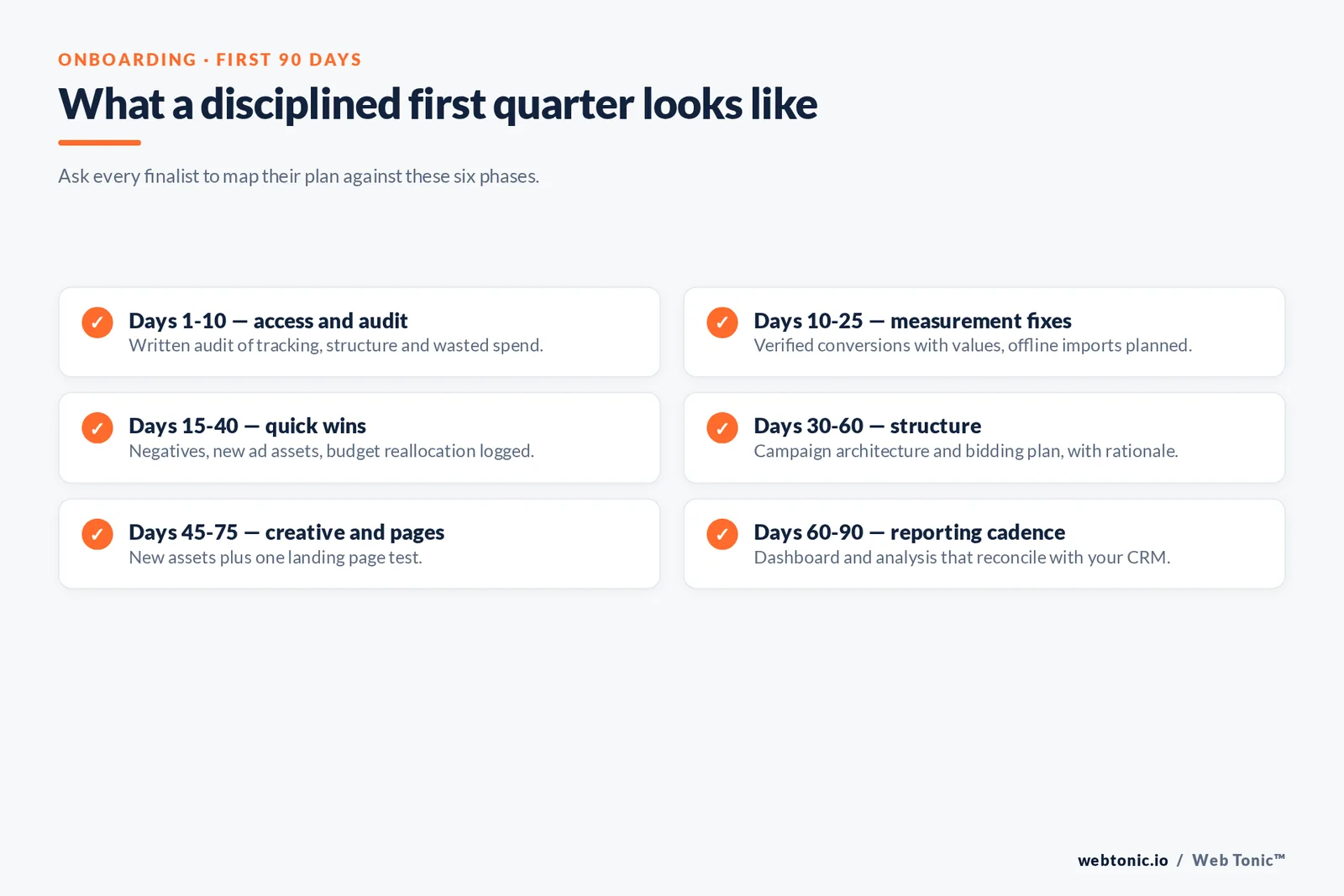
The strongest predictor of a good year is a disciplined first quarter. Ask any finalist to map their plan against this timeline and compare.
| Phase | Timing | Deliverable | How you verify it |
|---|---|---|---|
| Phase 1: access and audit | Days 1-10 | Written audit of tracking, structure and waste | You can reproduce 3 findings yourself |
| Phase 2: measurement fixes | Days 10-25 | Verified conversions with values | Test conversion appears in reporting |
| Phase 3: quick wins | Days 15-40 | Negatives, ad assets, budget reallocation | Change history log in the account |
| Phase 4: structure | Days 30-60 | Campaign architecture and bidding plan | Documented rationale per campaign |
| Phase 5: creative and pages | Days 45-75 | New assets and one page test | Before-and-after conversion rate |
| Phase 6: reporting cadence | Days 60-90 | Dashboard plus monthly written analysis | Numbers reconcile with your CRM |
Reconciliation is where most engagements quietly fail; if platform conversions and CRM records never match, nobody can tell whether the media worked. That gap is exactly what our data intelligence practice exists to close, and it is worth solving before you change agency again.
How to switch PPC companies without losing performance
Switching badly costs more than staying with a mediocre agency for another quarter. Six steps keep the history and the momentum.
| Step | Action | Why it matters |
|---|---|---|
| Step 1 | Confirm you are the account owner and remove nothing | Account history feeds Smart Bidding |
| Step 2 | Export 24 months of performance and search term data | Your only baseline for judging the new team |
| Step 3 | Inventory tags, feeds, call tracking and landing pages | Third-party tools often sit in agency accounts |
| Step 4 | Overlap the two teams by 2 weeks, read-only | Prevents a dark week with no optimisation |
| Step 5 | Freeze structural changes for the first 14 days | Rebuilds reset learning and hide causation |
| Step 6 | Agree the 90-day scorecard before day 1 | Turns month 4 into a decision, not an argument |
Rule 6 — 14 days frozen before any restructure, and Rule 7 — 1 scorecard with no more than five metrics on it. If a new agency insists on a full rebuild in week one, ask which of the recent platform changes makes that necessary and judge the specificity of the answer. Broader marketing benchmark context is available in HubSpot's marketing statistics library, useful for sanity-checking claims about channel mix.

FAQ
How much do PPC management companies charge?
Most charge either 10-20% of ad spend or a flat retainer between $1,000 and $8,000 per month. At $10,000-$50,000 in monthly spend, expect $1,500-$5,000 in management fees. If fees exceed roughly 25% of your media budget, either raise the budget or reduce the scope.
Is a Google Premier Partner worth paying more for?
Premier status confirms certifications, a spend threshold and a performance floor in that country and year. It is a useful filter, not proof of fit. Ask which year it was awarded, which country, and who from that team will actually work on your account each week.
Should the agency own my Google Ads account?
No. You should own the Google Ads, Merchant Center, analytics and tag manager accounts, with the agency granted user access. Agency-owned accounts mean you lose conversion history when the relationship ends, and that history is what automated bidding depends on.
How long before a new PPC company shows results?
Expect measurement fixes and waste reduction within 30 days, structural improvement by day 60, and a fair efficiency comparison at day 90. Accounts with fewer than 30 conversions per month need longer, because there is not enough data for confident optimisation.
Can a small business run PPC without an agency?
Yes, below roughly $2,500 in monthly spend it is often the better economics, because management fees would take 20-40% of the budget. A practical middle path is running it in-house and buying a paid audit twice a year from a specialist.
What is the single best predictor of a good PPC agency?
Whether they audit your conversion tracking before quoting. It is the one behaviour that correlates with everything else — measurement rigour, honesty about uncertainty, and a willingness to fix unglamorous plumbing before touching bids.
Sources
LocaliQ search advertising benchmarks (23 categories, Google and Microsoft) · Google Ads Help — conversion tracking, managing your spend, bid strategy selection, Quality Score · Google Partners programme requirements · Statcounter global search engine market share · US Federal Trade Commission advertising disclosure guidance · US Small Business Administration marketing and sales guidance · Better Business Bureau business profiles · Search Engine Land Google Ads platform library · HubSpot marketing statistics library. Fee ranges reflect published agency pricing observed across the US market and are checked August 2026.