Table of contents

A good AI advisory quarter produces one working workflow with a measured before-and-after, not a tooling roadmap. The phases below are what that looks like day by day.
Key Takeaways
- The consensus structure is three 30-day phases: audit and readiness, pilot and prove, then scale and systematise.
- Days 1–30 exist to capture baselines — cycle times, volumes, error rates and current cost per asset. Without them nothing after day 60 can be proven.
- Days 31–60 should build 1–2 workflows with strict scope, not five. Narrow scope is the single strongest predictor of a pilot that survives.
- Days 61–90 measure against exit criteria and document, so the quarter ends with a decision: scale, fix or stop.
- Realistic pilot windows run 8–12 weeks, and full programme payback including setup typically appears within 90–180 days.
- Target savings are concrete: a median 6.1 hours per person per week, with senior staff nearer 8–10 and junior staff 3–4.
- The failure to avoid is scale without proof — 87% of teams already use generative AI in recurring workflows, yet only 9% have fully automated journeys and just 41% of organisations can demonstrate ROI.
Why the quarter is structured this way
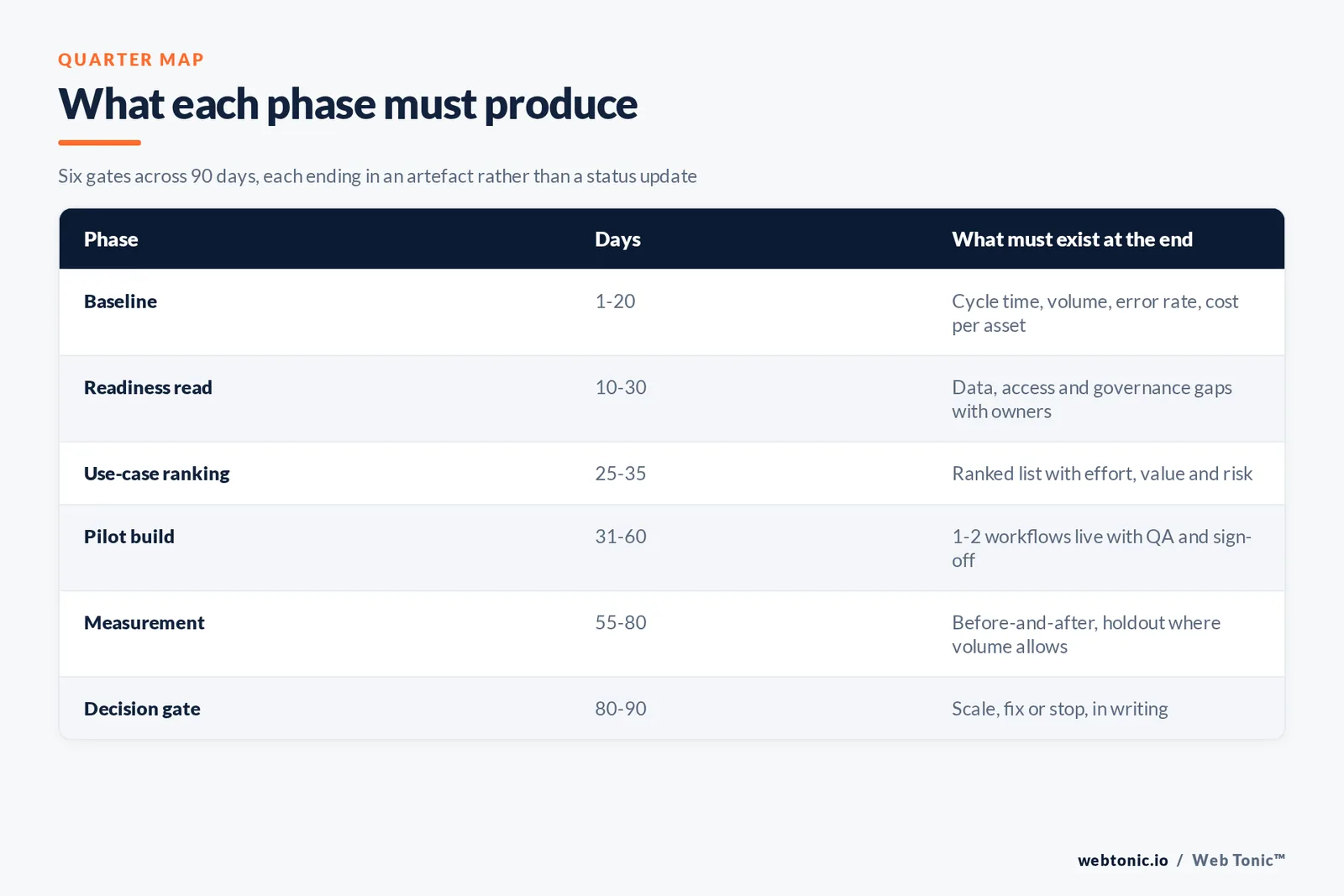
Independent 2026 playbooks converge on almost identical phasing, which is unusual and worth noting. One activation framework splits the quarter into audit and readiness (days 1–30), pilot and prove (days 31–60) and scale and systematise (days 61–90). A practical leader's playbook uses the same brackets and adds a discipline most plans skip: in days 31–60 you identify the 1–2 highest-use workflows, build them with strict scope, and communicate the strategy while doing it.
The convergence exists because the failure pattern is consistent. One implementation roadmap describes it as buying tools and automating chaos — teams add software before they know which process is broken. A quarter spent the other way round, on workflow choice, governance, QA and measurement, produces something operable.
| Phase | Days | What must exist at the end |
|---|---|---|
| Baseline | 1–20 | Cycle time, volume, error rate and cost per asset, measured |
| Readiness read | 10–30 | Data, access and governance gaps written down with owners |
| Use-case ranking | 25–35 | Ranked list with effort, value and risk per candidate |
| Pilot build | 31–60 | 1–2 workflows live with QA steps and a human sign-off gate |
| Measurement | 55–80 | Before-and-after on the baseline metrics, holdout where possible |
| Decision gate | 80–90 | Scale, fix or stop, in writing, with next-quarter scope |
Days 1–30: measure before you touch anything
The first month is unglamorous and non-negotiable. One 90-day roadmap is explicit about what to collect: cycle times, volumes, error rates and current cost per unit — per content asset, per report — alongside targets stated as numbers, such as reducing campaign build time by 30%, lifting marketing-sourced pipeline by 15%, or cutting reporting from 6 hours to 1. Those are the sentences a day-90 review is graded against.
Three baselines matter most. First, hours per recurring output, gathered from the people doing the work rather than estimated by a manager. Second, cycle time from brief to live, because AI usually shortens a queue rather than a task. Third, quality and rework rate, since a workflow that halves production time and doubles revisions has saved nothing. A readiness read runs alongside: where the data actually sits, who can grant tool access, which content types carry legal or clinical review, and what the approval chain is when a machine drafts something.
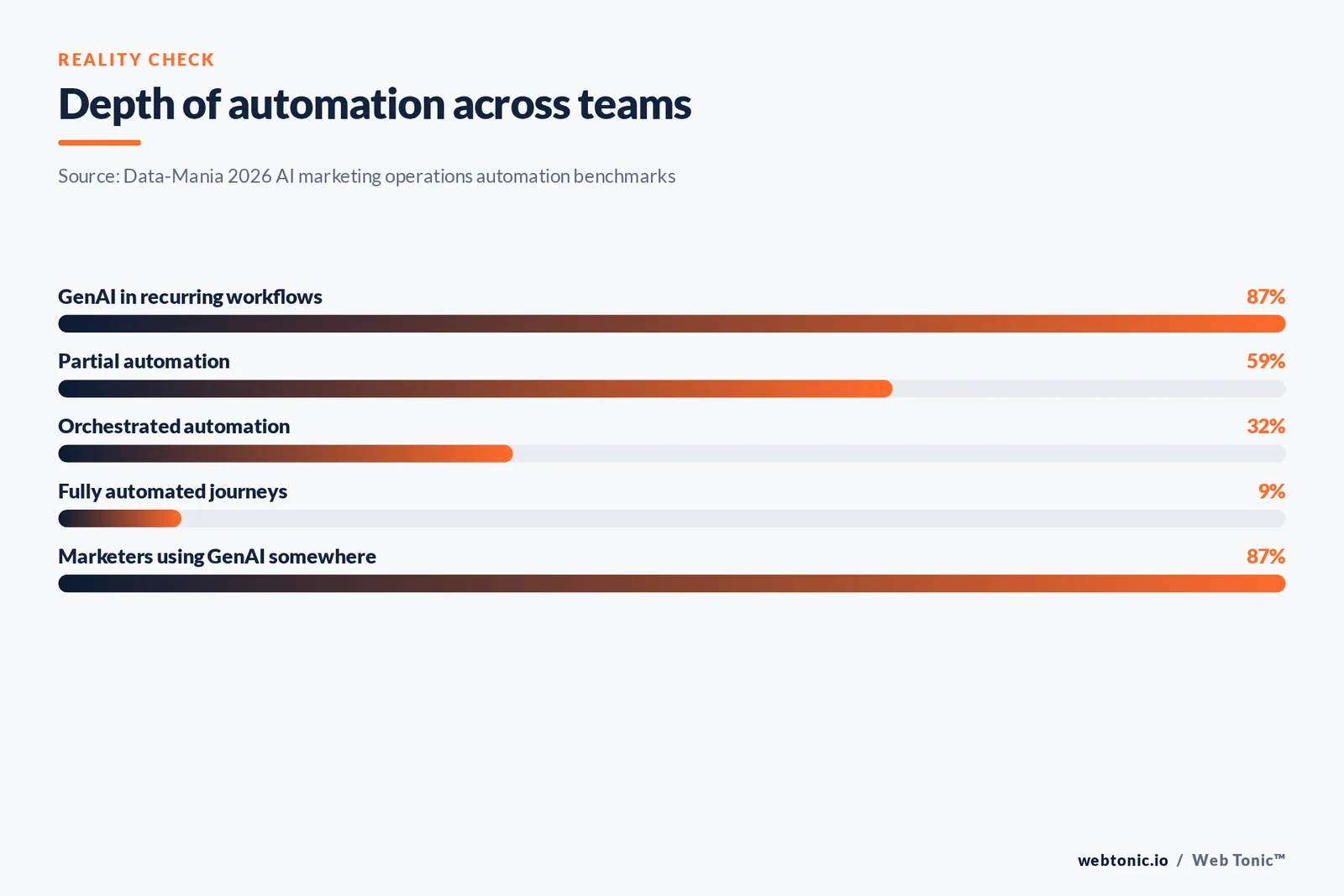
Expect the audit to surface uncomfortable truths about the shallowness of current usage. Adoption is near-universal — adoption research puts 87% of marketers using generative AI in at least one workflow, up from 51% in 2024 — while operations benchmarks show only 9% of customer journeys fully automated and 32% orchestrated. Individual improvisation is not a capability.
Days 31–60: build one thing properly
The pilot month lives or dies on scope. Pick the workflow with the highest frequency, the clearest baseline and the lowest brand risk — usually a production or reporting workflow rather than anything customer-facing. Build it with the QA step included from the start: an evaluation rubric, a human sign-off gate, and a written rule for what happens when output fails the rubric twice.
One AI-ready team guide recommends running the pilot as a focused experiment with holdouts over 8–12 weeks, which is a useful reality check on the calendar: a pilot started at day 31 may still be maturing at day 90. That is fine, provided the day-90 gate reads a trend rather than a final verdict. A 2026 implementation checklist makes the same structural point, that the 30-60-90 shape matters more than the specific tools chosen.
Governance gets written this month, not later. Three documents are enough: an approved-tools list with data-handling notes, a disclosure and review rule per content type, and a prompt or asset library with named owners. Teams that defer governance to the scale phase generally discover their pilot used data it should not have.
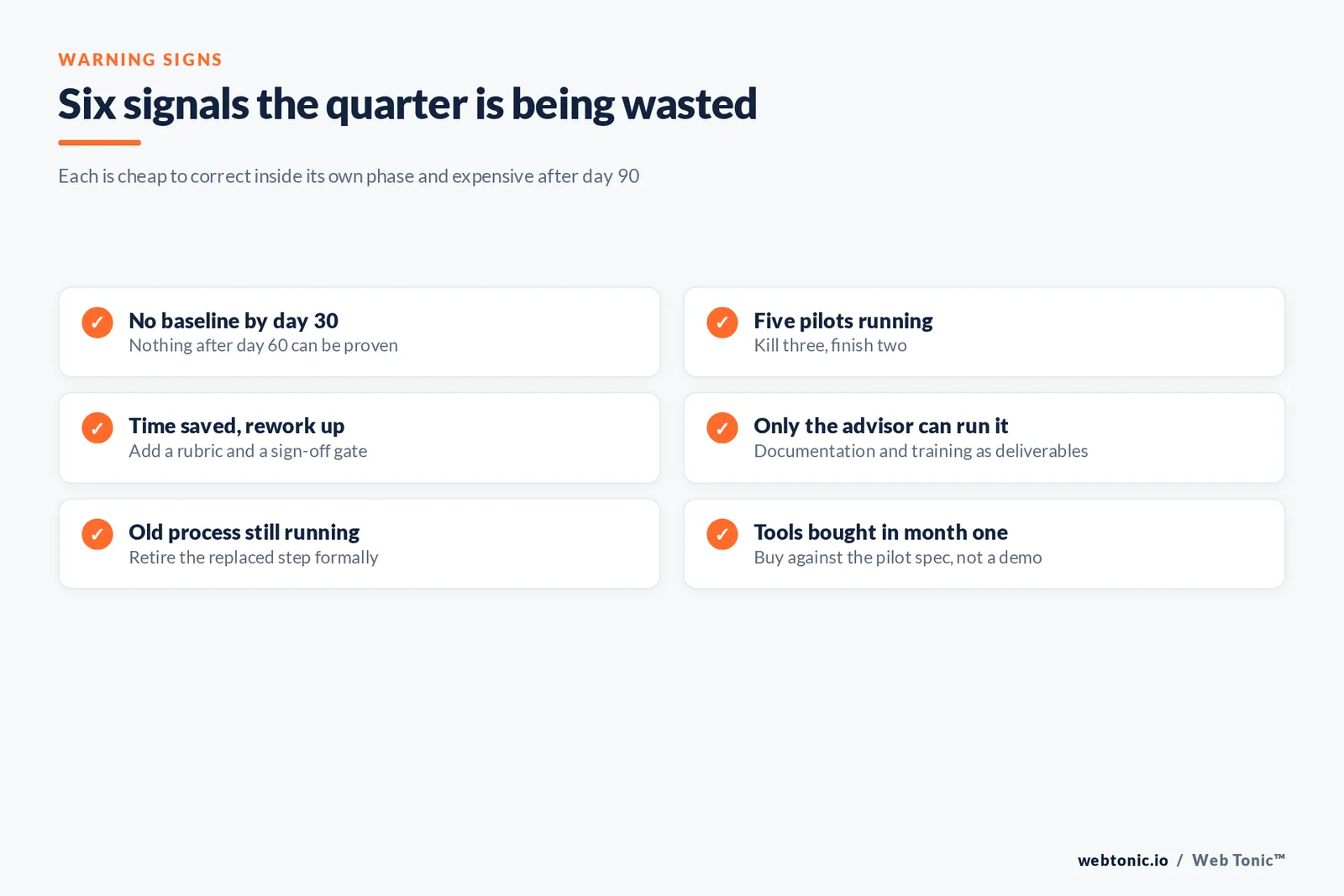
| Signal at the gate | Reads as | Action |
|---|---|---|
| No baseline captured by day 30 | Nothing will be provable | Pause the build; measure for two weeks |
| Five pilots running | Scope discipline failed | Kill three, finish two |
| Time saved, rework up | Quality gate is missing | Add rubric and sign-off before scaling |
| Only the advisor can run it | Handover risk | Documentation and training as deliverables |
| Savings claimed, hours unchanged | Queue moved, not shortened | Re-measure cycle time end to end |
| Nothing stopped | Old process still running in parallel | Retire the replaced step formally |
Days 61–90: prove it, then decide
The final month converts activity into a decision. One roadmap frames day 90 as a checkpoint against exit criteria: document what worked, what did not, and what the next quarter should address. That is the correct posture. A quarter that ends with "we are learning a lot" ended badly.
Measure at two levels. The efficiency layer is what most pilots move: hours per asset, cycle time, cost per unit. One CMO framework uses exactly this split, pairing productivity metrics such as hours saved with performance metrics such as pipeline contribution and operational metrics such as time to launch — cutting a campaign from 14 days to 5, for example. The business layer follows later; ROI guidance citing Jasper's 2026 research notes that teams tracking business outcomes are 45% more likely to report meaningful AI impact, and that setting baselines is the single most important step.
Be honest about timing. Benchmark compilations put organisational AI use at 88% and marketing generative AI use at 87%, so being late is a competitive issue rather than an early-adopter one. But payback usually lands at 90–180 days including setup, which means a day-90 review often reports a credible trend and a projected payback rather than a completed return. Say that plainly to the board instead of inflating the number.
What the advisor should hand over
By day 90 you should hold five artefacts: the measured baseline, the ranked use-case list with effort and value, the built workflow with its QA rubric, the governance pack, and a next-quarter scope with a named internal owner. If documentation, admin credentials and a training session are not deliverables in the statement of work, add them before signing — that single clause is what separates a capability from a dependency.
The internal owner matters as much as the build. Someone on your team should be able to run and modify the workflow without the advisor by day 90, even if the advisor stays on for the next phase. Where the work touches reporting and data plumbing, our data intelligence practice treats that handover as part of delivery, and the same principle sits behind our marketing ops consulting engagements.

Common ways the quarter is wasted
The most expensive mistake is buying tools in month one. The second is choosing a customer-facing pilot for visibility, then spending the quarter on approvals rather than output. The third is measuring adoption instead of outcome: seat counts and prompt volumes rise in every organisation and prove nothing. One 2026 statistics review from Axis Intelligence captures the resulting gap, with widespread workflow adoption alongside 84% of teams still admitting to generic, one-way campaigns.
The fourth is skipping the stop decision. If the pilot did not clear its exit criteria, retiring it is a legitimate and cheap outcome — cheaper than scaling something unproven across a department. A quarter that kills one workflow and scales another with numbers attached has done its job. If you want the shape of that quarter mapped for your own team, get in touch, or browse more implementation writing on the Web Tonic blog.
How the quarter is resourced
A 90-day engagement is not a full-time occupation for anyone, and it should not be sold as one. In practice the advisory side runs a few days a month, weighted towards the first and last phases, while the middle phase needs internal time — typically one process owner giving 2–4 hours a week and the people who do the work giving an hour or two for baselining and testing. Budget that internal time explicitly. Quarters fail more often from unavailable internal reviewers than from bad builds.
Sequencing beats parallelism for a second reason: tools. Deferring procurement until day 45 or later means you buy against a specification the pilot produced, not a vendor demo, and you buy the smallest viable plan rather than the enterprise tier. Where a tool must be trialled early, use a monthly plan and record the intended annual cost so the day-90 net saving is honest.
Finally, write the communication plan into the quarter. The published playbooks put communication inside the pilot phase for good reason: staff who suspect a workflow exists to remove headcount will not report accurate baselines, and inaccurate baselines make the whole quarter unreadable. State the purpose, name what will and will not change, and share the measured results at day 90 with the team that produced them.
A last word on expectations. The quarter's purpose is not to finish the AI programme; it is to convert an open-ended ambition into one proven workflow, a set of baselines nobody argues about, and a scope for the next ninety days that a finance director can read without a translator. Teams that accept that narrower goal tend to be two quarters ahead of teams that tried to transform the whole function at once, because each of their decisions after day 90 rests on measured numbers rather than on a vendor's projection. Everything else — additional workflows, broader governance, tooling consolidation — is easier once one thing demonstrably works and one old process has been formally retired.
Where the plan meets the rest of the funnel
A 90-day AI plan does not sit apart from the growth motion it serves. The workflows worth piloting are the ones that unblock a channel the company already relies on: paid channels where creative volume limits testing, the content engine that feeds organic demand, or the lifecycle programme that talks to existing customers. Choosing a pilot that serves a live channel means the leadership conversation at day 90 is about pipeline and launch speed rather than about software, and it keeps the work anchored to the product and the customers it is meant to reach.
That framing also decides who leads. In the first months the role usually belongs to a senior marketing leader with authority over process, supported by whoever owns the data. Leaders who delegate the plan to a junior tool enthusiast get insights about features; leaders who own it get decisions about how the team works. Over the following months the same foundation supports the next series of workflows, and the trust earned by one honest measured result is what makes the second quarter's scope easy to approve.
Frequently Asked Questions
Can 90 days really produce measurable savings?
On one narrow workflow, yes. Median reported saving across teams is 6.1 hours per person per week, and a single production workflow can deliver a visible share of that inside a quarter. Programme-level payback more often lands at 90–180 days.
How many pilots should run at once?
One or two. The published playbooks agree on this, and it is the most frequently broken rule. Five simultaneous pilots produce five partial builds and no baseline comparison.
What if our data is not ready?
Then days 1–30 become a data-readiness sprint and the pilot targets a workflow that does not depend on the broken pipeline — usually content production or internal reporting rather than personalisation or scoring.
Who should own the plan internally?
One accountable owner with authority to retire the old process. Pilots that add a step without removing one always show cost with no saving.
Should the pilot include a holdout?
Where volume allows, yes — an 8–12 week experiment with a holdout gives a defensible read. Where volume is small, use a pre-period versus post-period comparison and state the limitation in the report.
Sources
How to implement AI in marketing in 90 days · AI for marketing leaders in their first 90 days · AI implementation roadmap for marketing teams · Your 90-day AI roadmap for marketing · Build a 90-day AI marketing roadmap · Marketing AI implementation checklist 2026 · Guide to building an AI-ready team · AI marketing ROI framework for CMOs · How to measure AI marketing ROI · AI marketing operations benchmarks 2026 · AI marketing statistics 2026 · Generative AI in marketing benchmarks.