Table of contents

Key Takeaways
- Addiction treatment search advertising CPC ranges from $11.42 to $94.50, reflecting one of the most expensive keyword categories in all of PPC (CUFinder, Benchmarketing).
- Non-branded cost per lead is $100–$285 depending on methodology, with the typical range for well-managed accounts at $100–$140 (Practice Growth Co).
- LegitScript certification is mandatory for advertising addiction treatment on the platform — no certification means no ads (Webserv).
- Click-to-call converts at 18.5%, making phone calls the highest-converting action for treatment-seeking audiences (CUFinder).
- Monthly budgets typically range from $8,000 to $30,000, with the algorithm requiring at least 15 conversions within 21 days to optimize effectively (SCALZ.AI, Webserv).
- Average CPA ranges from $1,500 to $6,000 per admitted patient, with CLV of $18,000–$35,000 providing substantial margin when campaigns are properly optimized (CUFinder, SCALZ.AI).
Rehab Search Advertising Benchmarks at a Glance
The table below consolidates 2026 performance data for paid search campaigns in the addiction recovery vertical. Use these benchmarks to evaluate your own account against industry standards.
| Metric | Benchmark (2026) | Source |
|---|---|---|
| CPC (Non-Branded) | $94.50 | CUFinder |
| CPC (Blended) | $11.42 | Benchmarketing |
| CTR (Search) | 3.85–4.84% | CUFinder / Benchmarketing |
| CVR | 4.10–5.8% | CUFinder / Benchmarketing |
| CPL (Non-Branded) | $100–$285 | Practice Growth Co / CUFinder |
| CPA (Per Admission) | $1,500–$6,000 | SCALZ.AI |
| Display CTR | 0.55% | CUFinder |
| Landing Page CVR | 5.2% | CUFinder |
| Click-to-Call CVR | 18.5% | CUFinder |
| Form Fill CVR | 2.8% | CUFinder |
Understanding the CPC Range: Why Sources Disagree
The wide CPC range — from $11.42 (Benchmarketing) to $94.50 (CUFinder) — is not a contradiction. The figures reflect fundamentally different measurement approaches:
- Benchmarketing's $11.42 represents a median across a broad benchmark cohort that includes branded traffic, lower-intent informational queries, and geographic markets with less competition.
- CUFinder's $94.50 focuses on non-branded, treatment-intent search terms — the high-value clicks that actually generate admissions inquiries.
The practical lesson: blended CPC metrics are misleading. A facility evaluating its own performance should isolate non-branded, treatment-intent campaigns from branded and informational traffic. The near-$100 CPC for high-intent keywords is the figure that matters for budget planning and ROI forecasting.
For a deeper look at how paid search pricing works across industries, treatment operators should benchmark against other high-CPC verticals like legal and insurance.
LegitScript Certification: The Mandatory Gate to Entry
Unlike most verticals, addiction recovery advertising on the search platform is gated by a third-party certification requirement. Webserv's 2026 strategy guide lays out the framework:
- LegitScript certification is mandatory — no certification, no ads. Lead generators, call centers reselling admissions, and sober living homes are not eligible.
- Application takes 30–60 days and requires documentation of clinical licensing, regulatory compliance, treatment practices, and advertising disclosures.
- Renewal is annual, maintaining an ongoing compliance burden.
- The order matters: LegitScript first, then the platform's Healthcare and Medicines policy approval. Operators who apply to the ad platform first trigger automatic rejection.
The certification requirement serves as a quality filter that benefits compliant operators: it keeps the auction less crowded than it would be in an unregulated vertical, which partially offsets the high CPCs. Facilities that maintain certification have a structural advantage over new entrants who face the 30–60 day delay.
Conversion Funnel: From Click to Admission
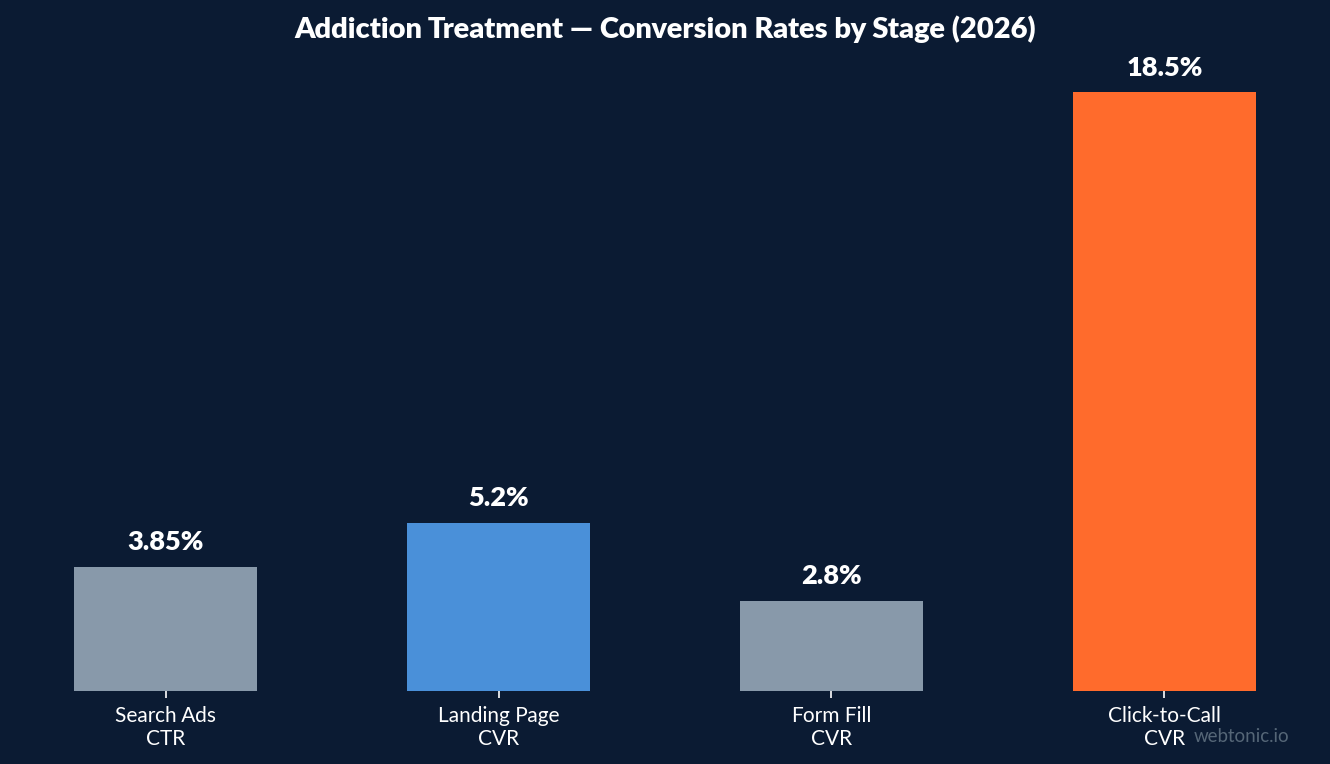
The conversion data reveals a clear hierarchy of on-site actions. Click-to-call converts at 18.5% — the highest rate by far — followed by landing page conversions at 5.2% and form fills at 2.8% (CUFinder). For facilities running paid search campaigns, this data strongly supports prioritizing phone calls as the primary conversion action.
The distinction between cost per lead and cost per admitted patient is critical in this vertical. While CPL runs $100–$285, the CPA per actual admission ranges from $1,500 to $6,000 (SCALZ.AI). The gap reflects the long, multi-touch admissions process: insurance verification, clinical assessment, family consultations, and scheduling — each step introducing drop-off.
Practice Growth Co makes an important nuance: cost per kept consultation is a more meaningful metric than raw CPL. A facility with a $160 CPL and 55% lead-to-show rate ($291 per consultation) outperforms one with a $90 CPL and 20% lead-to-show rate ($450 per consultation). The second account appears better in standard reports but produces worse economics.
Budget Planning and Bidding Strategy
Search advertising budgets for addiction recovery typically range from $8,000 to $30,000 per month (SCALZ.AI). The mathematical floor is set by the algorithm's learning requirements: 15 conversions of the target type within 21 days (Webserv). Underfunded campaigns rarely accumulate enough signal to optimize, which is why minimum viable budgets in this vertical start higher than in most industries.
The recommended bidding approach is Max Conversion Value with weighted signals:
| Conversion Type | Assigned Value | Rationale |
|---|---|---|
| Lead (Initial Inquiry) | $200 | Baseline contact, needs qualification |
| Private-Policy VOB | $2,000 | Verification of benefits confirms coverage |
| Approved VOB | $5,000 | Highest-value conversion, admission imminent |
Search impression share ceilings at roughly 35% for treatment-intent queries (Webserv). Beyond that threshold, diminishing returns set in as incremental impressions come from lower-quality placements and time slots. Operators should resist the temptation to chase impression share above this ceiling and instead focus on conversion quality and downstream metrics. For additional context on how budget levels affect performance across verticals, see our data intelligence resources.
CPL Benchmarks Across Medical Specialties
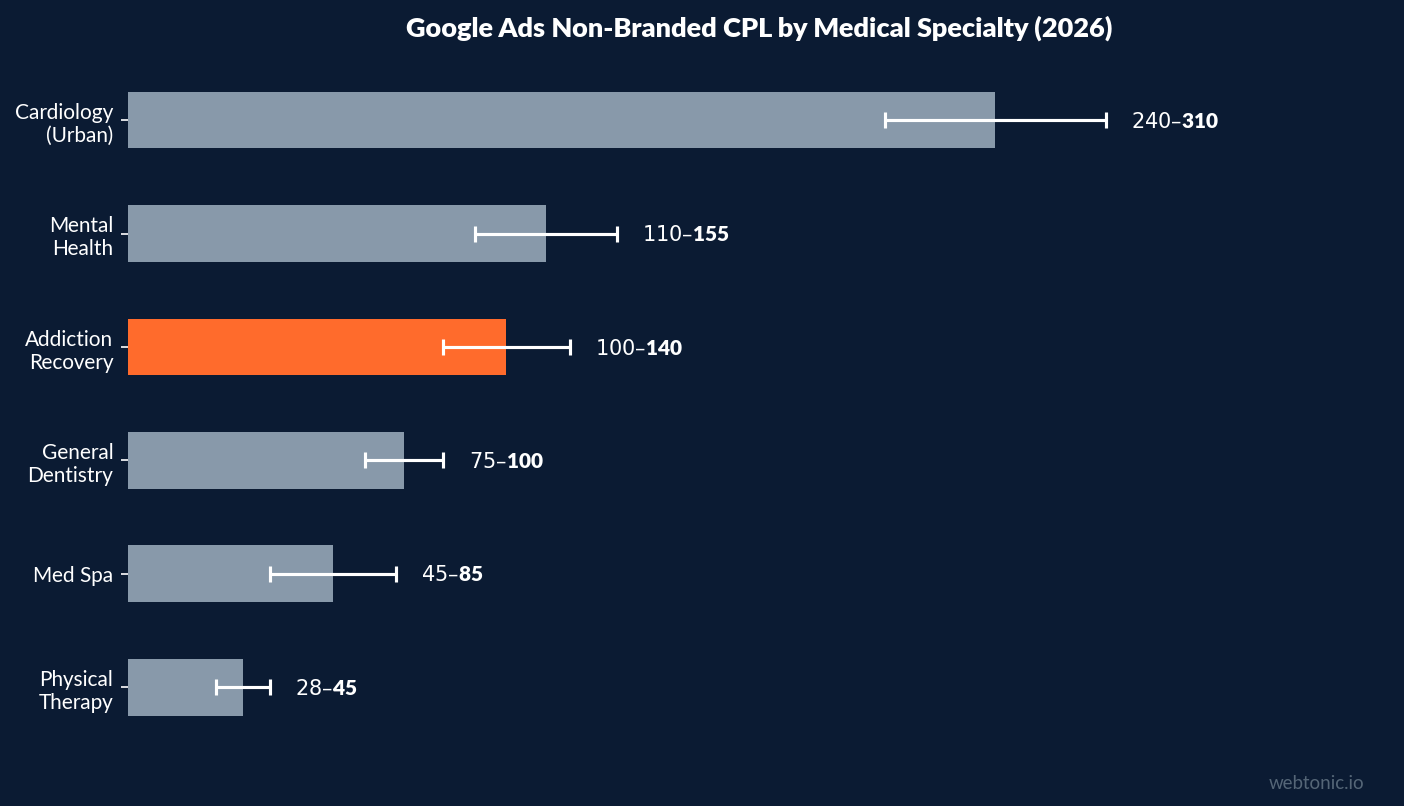
Addiction recovery sits in the upper tier of medical PPC costs, but it is not the most expensive. The table below, based on Practice Growth Co's 2026 analysis, provides context:
| Specialty | Non-Branded CPL Range | Notes |
|---|---|---|
| Physical Therapy | $28–$45 | Lower CPC, high immediate-need intent |
| Med Spa / Aesthetics | $45–$85 | Service-specific campaigns outperform general |
| General Dentistry | $75–$100 | Implant campaigns carry higher CPL |
| Addiction Recovery | $100–$140 | Lead quality depends on intake qualification |
| Mental Health / Psychiatry | $110–$155 | CPL rising year over year in metro markets |
| Cardiology (Urban) | $240–$310 | Competing against directories |
Best Practices for Rehab Search Advertising
- Secure LegitScript certification before building campaigns — the 30–60 day timeline is a hard constraint.
- Prioritize click-to-call — the 18.5% conversion rate dwarfs form fills (2.8%). Make phone numbers prominent on every landing page.
- Use Max Conversion Value with weighted signals — assign different values to leads, VOBs, and approved VOBs to let the algorithm optimize for downstream quality.
- Track cost per kept consultation, not just CPL — the metric that connects ad spend to revenue is cost per patient who actually arrives for treatment.
- Maintain budget above the learning threshold — 15 conversions within 21 days is the mathematical floor for algorithmic optimization.
- Cap impression share at ~35% — diminishing returns set in beyond this level for treatment-intent queries.
- Separate branded from non-branded campaigns — blended metrics obscure true acquisition costs and inflate apparent performance.
Regional CPC Variations Across the U.S.
The CPC benchmarks cited above represent national averages, but paid search costs for addiction treatment vary dramatically by geography. Markets in Florida and Southern California — where treatment facility density is highest — report CPCs 30–50% above the national median. A keyword that costs $70 in the Midwest may cost $120+ in South Florida or the Los Angeles metro area.
These regional differences reflect both competitive density and patient value. Behavioral health facilities in premium markets typically treat higher-acuity cases with better insurance coverage, supporting the elevated advertising costs. Operators expanding into new geographies should budget for a 90-day calibration period during which data accumulates to support algorithmic optimization in the new market.
For facilities working with a digital marketing agency, ensuring the agency understands these geographic nuances is essential. A national benchmark applied to a Florida-only account will lead to miscalibrated targets and misallocated budget.
Compliance Framework: Beyond LegitScript
LegitScript certification is the entry gate, but the full compliance landscape for addiction treatment advertising extends further. The search platform's Healthcare and Medicines policy governs ad content, landing page requirements, and targeting restrictions. Key policy constraints include:
- No misleading claims about treatment outcomes or success rates in ad copy.
- Landing pages must include licensing information, accreditation details, and a physical address.
- Call-only campaigns must route to licensed intake staff, not third-party call centers reselling leads.
- HIPAA-compliant tracking is required for any conversion data that touches patient information.
Microsoft Advertising (Bing Ads) mirrors these restrictions and also requires LegitScript verification. However, Microsoft's auction is less competitive than the primary search platform, with CPCs running 25–40% lower for equivalent treatment-intent keywords. For centers already certified, adding a Microsoft campaign is a low-effort way to expand reach at a lower cost per call and per lead.
The enforcement environment in the U.S. continues to tighten. HHS Office for Civil Rights has increased audits of behavioral health providers' digital advertising practices, with penalties for non-compliant pixel implementations and improper data sharing with ad platforms. Treatment centers should conduct a quarterly compliance audit of their tracking stack, policy adherence, and landing page content to avoid account suspensions and regulatory penalties.
Tracking and Data Infrastructure
Effective paid search management in the addiction treatment vertical demands more sophisticated data infrastructure than most industries. The gap between a click and an admission can span weeks or months, involving insurance verification, clinical assessment, and family call consultations. Without full-funnel tracking that connects ad clicks to admitted patients, operators cannot distinguish campaigns that generate inquiries from campaigns that generate admissions.
Best-in-class programs implement offline conversion imports that feed admission outcomes back to the advertising platform, enabling the algorithm to optimize for downstream value rather than surface-level call volume. This data loop is the single most impactful infrastructure investment a rehab center can make — it transforms bidding from guesswork into precision targeting. Centers without this tracking systematically overspend on campaigns that produce low-quality leads while underinvesting in campaigns that drive actual admissions.
Related reading
- Mental Health and Counseling Google Ads Data, 2026
- Trucking and logistics Google ads statistics, 2026
- Garage Doors and Windows Google Ads Data, 2026
- Paid Search services at Web Tonic
FAQ
What is the average Google Ads CPC for addiction treatment?
The average CPC for addiction treatment search advertising ranges from $11.42 (Benchmarketing median) to $94.50 (CUFinder non-branded estimate). The wide range reflects differences in keyword intent, geographic targeting, and whether branded traffic is included.
Do rehab centers need LegitScript certification for Google Ads?
Yes. LegitScript certification is mandatory for advertising addiction treatment services on the search platform. Without certification, ad accounts are automatically rejected during the Healthcare and Medicines policy review. The application takes 30–60 days and requires annual renewal.
What is the average cost per lead for rehab Google Ads?
The average non-branded cost per lead ranges from $100 to $285 depending on the source and methodology. Practice Growth Co reports $100–$140 for addiction recovery, while CUFinder reports $285 based on broader benchmark data.
How much should a rehab center spend on Google Ads per month?
Monthly search advertising budgets for addiction treatment typically range from $8,000 to $30,000. The algorithm needs at least 15 conversions within 21 days to optimize effectively, which sets a mathematical floor on viable budget levels.
What conversion rate should rehab Google Ads achieve?
Conversion rates for addiction treatment search campaigns range from 4.10% to 5.8%. Landing page conversion rate averages 5.2%, with click-to-call converting at 18.5% and form fills at 2.8%.
Sources
https://cufinder.io/blog/benchmarks/addiction-treatment/
https://www.benchmarketing.org/benchmarks/industries/addiction-treatment
https://webserv.io/resources/blog/google-ads-strategy-behavioral-health-providers/
https://practicegrowthco.com/blog/google-ads-cost-per-lead-medical-practice
https://scalz.ai/blog/rehab-marketing-cost/
https://treatmentcenteragency.com/addiction-treatment-marketing-compliance-hipaa-legitscript-google-ads-rules-explained/
https://brandhousela.com/blog/google-ads-statistics/