Table of contents
Key Takeaways
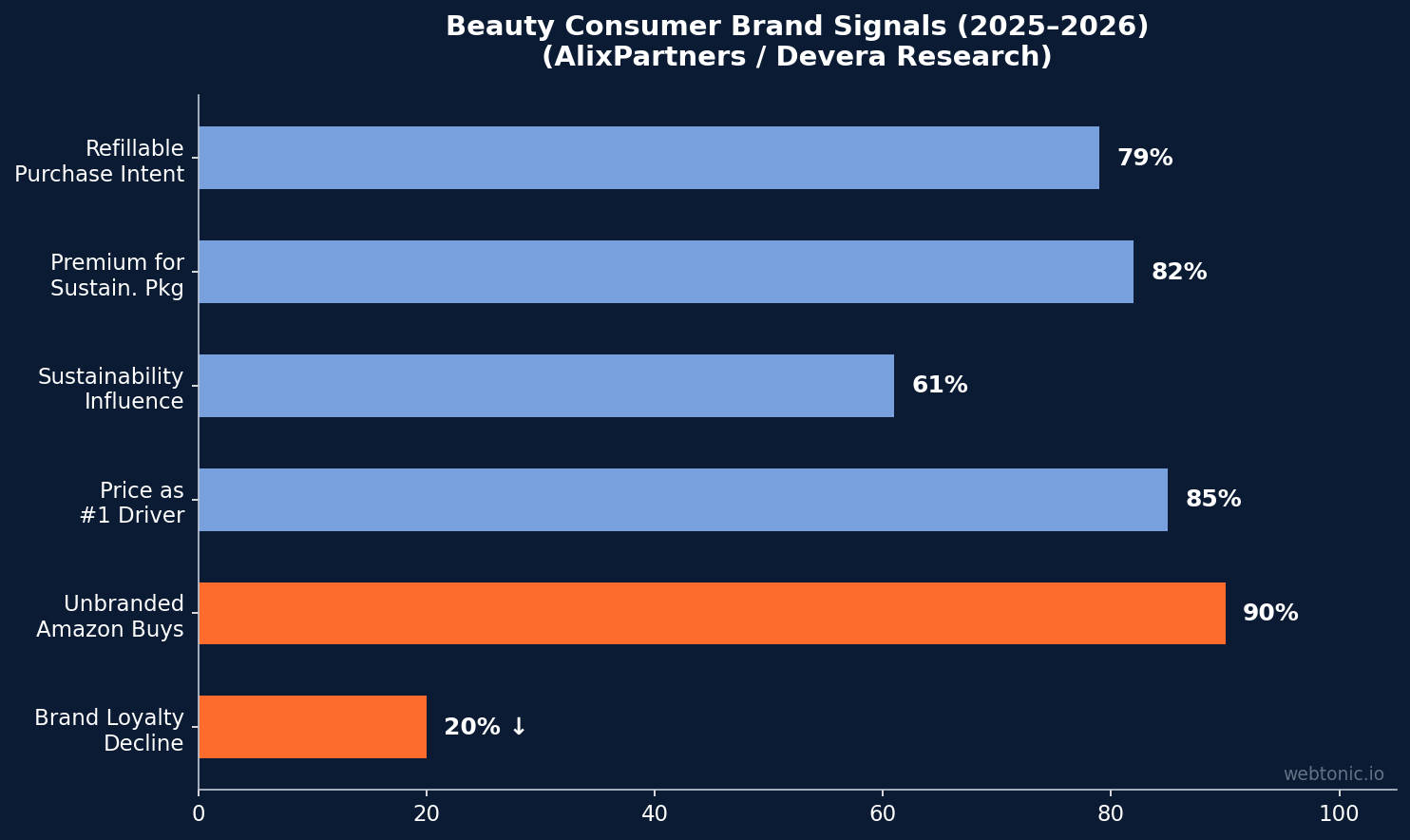
- Beauty brand loyalty has dropped 20% in just two years, with 90% of Amazon beauty purchases now going to unbranded products (AlixPartners).
- DTC beauty customer acquisition cost (CAC) now runs $40–$100+ per new customer, rising 8–16% annually against a $66 median AOV (Eightx).
- 80% of beauty consumers say consistent pricing builds brand trust, and 85% cite price as the #1 purchase driver (AlixPartners).
- 82% of beauty shoppers would pay a premium for sustainable packaging, and 61% say sustainability influences purchasing decisions (Devera).
- IsaDora's rebrand grew retail sales +10% vs. 4.2% market growth and lifted perceived value from 16% to 50% (Gitnux).
- DTC beauty repeat purchase rates average 20–30%, meaning first-order economics are frequently negative and the business model lives on retention (Foundry CRO).
Beauty Brand Loyalty Is Eroding: The Numbers
The beauty industry's relationship with brand loyalty is changing faster than most marketers realize. Consumers are more willing to switch brands, trade down, or buy unbranded products than at any point in the past decade. The shift is structural, not cyclical — driven by transparency, price sensitivity, and platform dynamics.
| Loyalty Metric | Value | Source |
|---|---|---|
| Brand loyalty decline (2-year) | -20% | AlixPartners 2025 |
| Unbranded beauty purchases on Amazon | 90% | AlixPartners 2025 |
| Consumers citing price as #1 driver | 85% | AlixPartners 2025 |
| Consumers who'd pay more for price stability | 42% | AlixPartners / CXM |
| Consumers saying consistent pricing builds trust | 80% | AlixPartners 2025 |
| Skincare repeat purchase rate | 20–30% | Eightx / Foundry CRO 2026 |
| Beauty return rates (skincare) | 10–15% | Eightx 2026 |
| Beauty return rates (makeup) | 12–15% | Eightx 2026 |
The 20% loyalty drop is not a cyclical dip — it reflects a structural shift where consumers now evaluate products on merit, ingredient transparency, and price-to-value ratio rather than brand heritage alone. The 90% unbranded purchase rate on Amazon is particularly telling: when consumers search by product type or ingredient rather than brand name, heritage brands lose their built-in advantage. For beauty brands, this means branding investment must shift from awareness to trust-building. Explore how performance creative can strengthen brand perception.
DTC Beauty Economics: Acquisition vs. Retention
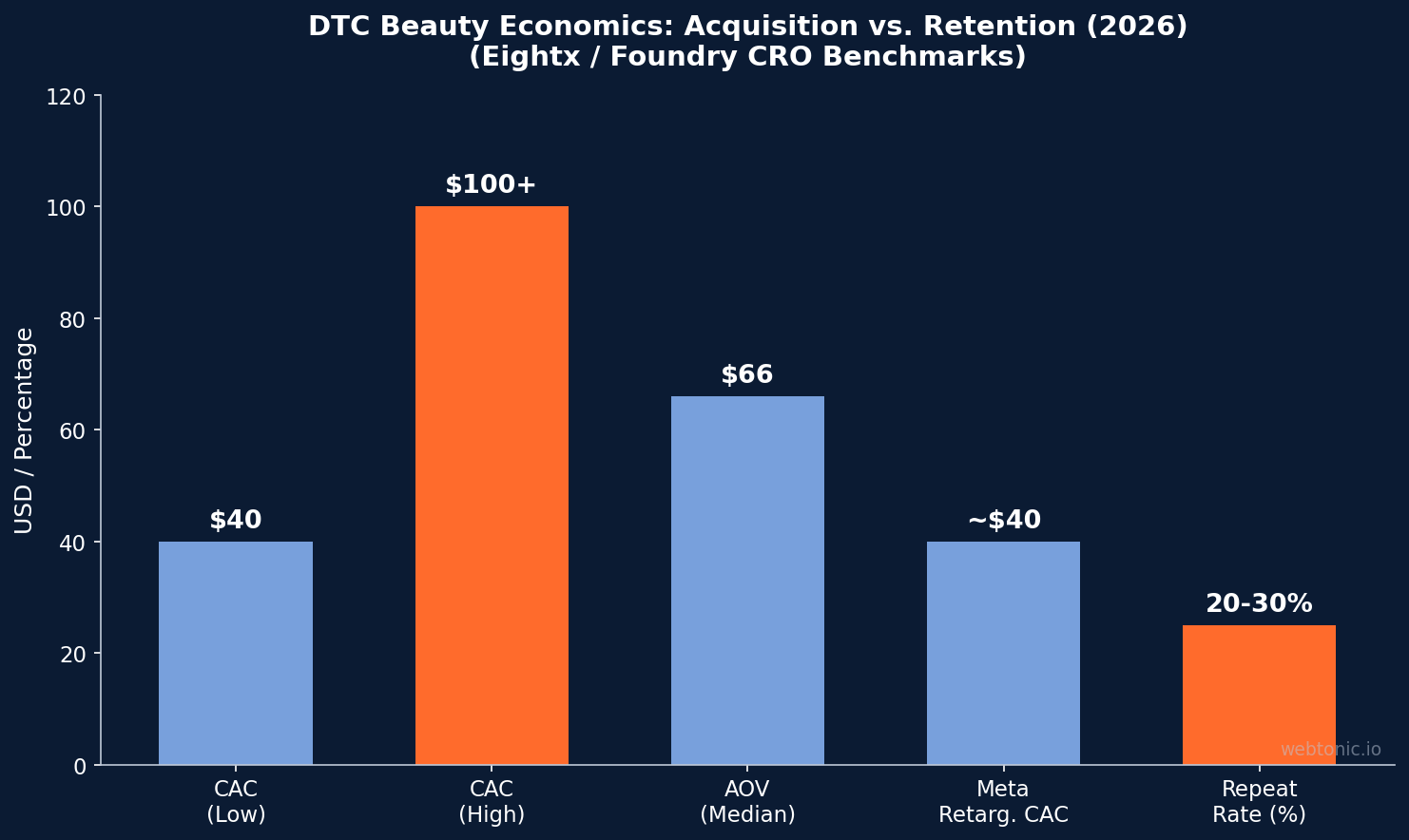
The economics of direct-to-consumer beauty have tightened significantly as paid media costs rise and consumer attention fragments across platforms. Here is where the numbers stand in 2026, and why retention metrics matter more than ever for brand viability.
| Financial Metric | DTC Beauty Benchmark | Trend |
|---|---|---|
| Customer Acquisition Cost (CAC) | $40–$100+ | Rising 8–16%/year |
| Average Order Value (AOV) | $50–$70 (median $66) | Flat to slightly up |
| Repeat purchase rate | 20–30% | Critical for profitability |
| First-order profitability | Frequently negative | CAC ≥ AOV for many |
| Blended ROAS (paid media) | 2.0–3.5× | Declining from 4×+ in 2021 |
| Meta retargeting CAC | ~$40 | Most efficient channel |
| Beauty return rate (overall) | 4–10% | Higher in skincare/makeup |
| Fragrance return rate | 5–7% | Lowest in beauty |
When CAC sits at or above AOV, the entire DTC model depends on repeat purchases. Brands with repeat rates below 25% face a structural challenge that no amount of top-funnel advertising can fix — the math simply does not work without a compelling product and retention strategy. The brands thriving in this environment are those that treat branding as a retention tool, not just an awareness one: packaging, unboxing experience, loyalty programs, and subscription mechanics all contribute to whether a first-time buyer becomes a repeat customer.
Packaging Design and Sustainability as Brand Signals
In beauty, packaging is branding. The container, label, and unboxing experience often carry more weight than the product formulation itself in driving first-purchase decisions. Sustainability has added a new dimension to this equation, creating both opportunities and risks for brands that get it right or wrong.
| Packaging & Sustainability Stat | Value | Source |
|---|---|---|
| Shoppers influenced by sustainability | 61% | Devera / Global Survey |
| Would pay premium for sustainable packaging | 82% | Devera |
| Higher purchase intent with refillable claims | 79% | Devera |
| Clean beauty market growth (CAGR) | ~11.5% | Technavio / GII Research |
| Clean beauty market expansion | +$7.65 billion by 2029 | Technavio |
| Minimalist packaging boosting perceived quality | Positive correlation | AUEB Study 2025 |
The 82% willingness-to-pay-premium figure for sustainable packaging is one of the strongest consumer signals in recent beauty research. But it comes with a caveat: consumers increasingly verify sustainability claims through ingredient lists, certification logos, and social media scrutiny, and greenwashing carries reputational risk that can erode the very trust brands are trying to build. Third-party certifications (B Corp, Leaping Bunny, EWG Verified) have become table stakes for brands claiming sustainability positioning.
The Global Beauty Market: Scale and Opportunity
Understanding branding effectiveness requires context about the total market opportunity. The beauty and personal care market continues to grow despite economic headwinds, driven by premiumization, geographic expansion, and digital-first distribution models.
- The global beauty market grew 10% year-over-year as AI-powered product discovery and e-commerce reshaped consumer buying patterns (NIQ).
- Online beauty sales outpaced in-store growth by 6×, accelerating the shift toward digital-first brand building and DTC models.
- K-Beauty has moved beyond trend status to become a benchmark for skin-first routines and ingredient-led formulation. Its influence is shaping expectations for performance, innovation, and affordability across Western markets.
- Premium beauty continues to outperform mass-market segments, suggesting that consumers are not trading down — they are becoming more selective about where they invest, choosing fewer brands but higher-quality products.
- The clean beauty segment alone is adding $7.65 billion by 2029, growing at approximately 11.5% CAGR — outpacing the overall beauty market growth rate by roughly 3×.
Rebranding ROI: When Beauty Brand Refreshes Pay Off
Rebranding is risky in any industry, but beauty brands face unique stakes — existing customers may have emotional attachments to packaging, colors, and naming conventions that a refresh disrupts. The data shows that successful rebrands share common elements that separate them from costly failures.
- IsaDora Cosmetics grew retail sales +10% (vs. 4.2% market growth) after rebranding as "True Swedish Beauty," with perceived value jumping from 16% to 50% and penetration among 18–39-year-olds rising by +16 percentage points.
- Brands that align rebrand messaging with ingredient transparency see the highest ROI — consumers are more receptive to visual refreshes when they are paired with product honesty and substantive formulation improvements.
- K-Beauty's influence has pushed Western brands to rebrand around ingredient-led formulation and clinical proof points, moving away from aspirational lifestyle positioning toward evidence-based claims (Eightx).
- Successful beauty rebrands typically invest 4–8% of annual revenue in the transition, including packaging redesign, digital asset updates, influencer seeding, and launch marketing across owned and paid channels.
- Failed rebrands often share a common mistake: changing visual identity without addressing the underlying product or value proposition issues that triggered the rebrand in the first place. Cosmetic changes alone rarely move consumer perception.
For insights on connecting your brand strategy to measurable outcomes, check our Facebook Ads ROI analysis.
Beauty Branding Best Practices for 2026
- Lead with price transparency. With 85% of consumers citing price as their top purchase driver, hidden fees, inconsistent pricing, or opaque subscription terms actively erode trust. Display prices clearly and avoid "gateway pricing" that increases sharply after trial periods.
- Invest in packaging as a performance channel. Treat packaging design with the same rigor as paid media creative — test colors, copy, and materials with real consumer panels before committing to production runs. Track unboxing share rates on social media as a direct packaging performance metric.
- Build retention before scaling acquisition. With DTC CAC at $40–$100+ and repeat rates at 20–30%, brands should hit at least 30% repeat rate before increasing top-funnel spend. A 5% improvement in repeat rate often generates more profit than a 20% increase in new customer volume at current CAC levels.
- Substantiate sustainability claims with certification. Third-party certifications (B Corp, Leaping Bunny, EWG Verified) prevent greenwashing backlash and build the credibility that 61% of consumers demand. Unsubstantiated claims carry both reputational and regulatory risk.
- Design for social-first brand moments. Unboxing experiences, refill rituals, and limited-edition packaging designed for sharing generate organic brand exposure at near-zero marginal cost. The best packaging doubles as content that customers voluntarily create and distribute.
- Use cohort analysis to measure brand equity over time. Track 30/60/90-day repeat rates, branded search volume, and direct traffic as proxies for brand strength — not just awareness surveys that lag reality by months.
See how data-driven branding ties into a complete marketing strategy with our growth marketing services.
Beauty Branding vs. Other Consumer Industries
| Industry | Avg CAC | Brand Loyalty Trend | Key Differentiator |
|---|---|---|---|
| Beauty & Skincare | $40–$100+ | Declining (−20% in 2 yrs) | Ingredient trust, packaging |
| Fashion / Apparel | $30–$80 | Low (fast fashion churn) | Trend speed, influencer reach |
| Health & Wellness | $50–$120 | Moderate (subscription model) | Clinical proof, efficacy |
| Food & Beverage (DTC) | $25–$60 | Stable (repeat consumption) | Taste preference, convenience |
| Pet Care | $35–$90 | High (emotional attachment) | Pet health anxiety, community |
Beauty's combination of high CAC and declining loyalty makes it one of the most challenging consumer categories for brand building. Unlike pet care (high emotional attachment) or food (consumption-driven repeat), beauty brands must continuously earn trust through product performance, transparency, and consistency. The brands winning in this environment treat branding as an operational discipline — not a creative exercise — with measurable KPIs tied to retention, share of wallet, and lifetime value.
FAQ
Why is beauty brand loyalty declining?
Beauty brand loyalty has dropped 20% in two years due to a combination of ingredient transparency (consumers can now compare formulations easily), price sensitivity (85% cite price as top driver), and platform dynamics — 90% of Amazon beauty purchases are unbranded, meaning consumers search by ingredient or product type rather than brand name. The rise of clean beauty, indie brands, and social commerce has also fractured attention away from legacy brands that once dominated shelf space.
How much does it cost to acquire a DTC beauty customer?
DTC beauty CAC ranges from $40 to $100+ depending on channel, product price point, and brand maturity. Meta retargeting is typically the most efficient at ~$40, while prospecting campaigns can push CAC above AOV ($66 median). CAC is rising 8–16% annually, making retention economics — not acquisition volume — the critical lever for profitability. Brands with CAC above AOV need repeat purchase rates above 30% to achieve payback within 12 months.
Does packaging design really affect beauty brand sales?
Yes. Research shows 82% of beauty shoppers would pay a premium for sustainable packaging and 79% show higher purchase intent for products with refillable claims. Minimalist packaging design has also been linked to higher perceived quality in academic studies. In beauty, packaging is often the first and sometimes only brand touchpoint before purchase — it functions as a silent salesperson on both physical shelves and e-commerce product pages.
What makes a beauty rebrand successful?
Successful beauty rebrands like IsaDora (+10% sales, +34 ppt value perception) share common traits: they align visual changes with genuine product or positioning improvements, maintain recognizable elements for existing customers, and invest 4–8% of annual revenue in the transition. Rebrands that focus solely on aesthetics without substantive messaging changes or product improvements tend to underperform. The strongest rebrands solve a real consumer perception problem, not just a creative boredom problem.
How do you measure beauty brand equity?
Effective brand equity measurement combines behavioral metrics (repeat purchase rate, branded search volume, direct traffic share) with perception metrics (aided/unaided awareness, Net Promoter Score, price premium willingness). For DTC beauty brands, the most actionable proxy is 30/60/90-day repeat purchase rate segmented by acquisition channel — it reveals which channels attract brand-aligned customers vs. one-time deal seekers. Branded search volume trends also serve as a real-time brand health indicator.
Sources
AlixPartners — 2025 Consumer Sentiment Index: Beauty
Eightx — Beauty Brand Financial Benchmarks 2026
Foundry CRO — DTC Beauty Marketing Benchmarks 2026
Devera — Refillable Beauty Packaging: Statistics & Trends
Gitnux — Marketing in the Beauty Industry Statistics
NIQ — Beauty in 2026: Global Shifts, Local Realities