



Table of contents
Mortgage Shopify & E-Commerce Statistics: Platform Data, Conversion Rates & Market Trends for 2026
The intersection of mortgage services and e-commerce platforms like Shopify is growing as lending firms digitize their customer acquisition, product distribution, and ancillary revenue streams. While traditional mortgage origination does not happen on Shopify, the ecosystem around home lending — from DIY inspection kits to rate comparison tools and branded merchandise — increasingly leverages e-commerce infrastructure. The data below maps Shopify platform performance against the expanding online mortgage market.
Key Takeaways
- The US online mortgage brokers market reached $647.5 million in 2025, reflecting the continued shift toward digital-first lending experiences (IBISWorld).
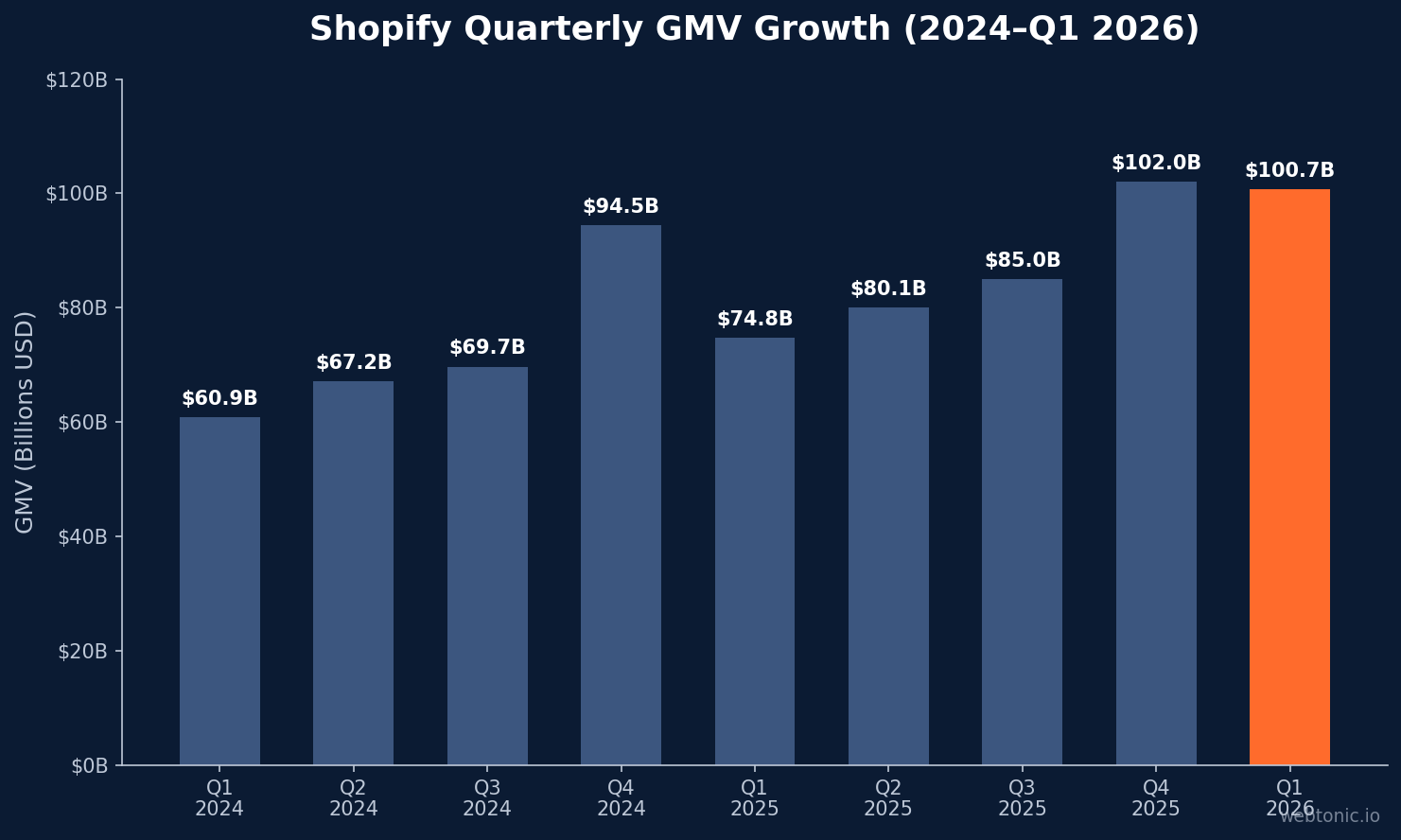
- Shopify processed $100.7 billion in Q1 2026 GMV, up from $74.8 billion in Q1 2025, signaling the platform's dominance across regulated and consumer verticals (SaaSStats Hub).
- Average Shopify store conversion rate is 1.4%, with top-performing stores reaching 3.3%+ (Enstacked).
- Shopify commands 30% of the US e-commerce platform market by site count, making it the default infrastructure choice for financial product storefronts (Kaspian Fuad / Statista).
- Shopify Payments processed $181 billion (62% of GMV) in 2024, with availability in 39 countries for integrated checkout (Popular Fintech).
- Full-year 2025 Shopify revenue reached $11.6 billion, approximately 30% growth year-over-year (BackToFront Show).
- The global mold remover and home maintenance products market — a category commonly sold via Shopify to homeowners during the mortgage process — is projected to reach $874 million with a 7.5% CAGR through 2034 (FactMR).
- Online penetration for household products is projected to reach 42% by 2034, creating new revenue channels for mortgage-adjacent product sellers (MarketIntelo).
Online Mortgage Market Size and Digital Adoption
How the lending industry's digital transformation creates e-commerce opportunity.
| Metric | Value | Source |
|---|---|---|
| US online mortgage brokers market (2025) | $647.5 million | IBISWorld |
| Digital mortgage application adoption | 87.3% use e-signatures | AD Mortgage / HousingWire |
| CRM adoption among mortgage brokers | 82.7% | AD Mortgage Survey 2026 |
| Online pricing calculator adoption | 80.2% | AD Mortgage Survey 2026 |
| AI tool adoption in mortgage operations | ~71% | AD Mortgage / HousingWire |
| Total US mortgage searches (June 2026) | 1,774,749 | Twenty7Tec |
The $647.5 million US online mortgage brokers market reflects a broader industry where 87.3% of firms already use e-signatures and 82.7% rely on CRM systems. This digital infrastructure baseline creates natural demand for e-commerce tools that support the customer journey — from rate calculators embedded in landing pages to post-closing product recommendations delivered via automated email sequences. Firms leveraging growth marketing strategies can integrate their Shopify storefronts with CRM-triggered flows to monetize the post-close relationship.
Shopify Platform Performance Benchmarks
Understanding Shopify's core platform metrics helps lending firms evaluate whether the ecosystem supports their specific use case — whether that is selling branded merchandise, home inspection kits, or financial education products.
| Platform Metric | 2025/2026 Value | Context |
|---|---|---|
| Q1 2026 GMV | $100.7 billion | Up from $74.8B in Q1 2025 |
| Full-year 2024 GMV | $292 billion | Last full-year reported figure |
| 2025 annual revenue | $11.6 billion | ~30% YoY growth |
| Q1 2026 MRR | $212 million | Up from $182M in Q1 2025 |
| Active Shopify stores | 6.81 million | 75 million total stores created |
| US e-commerce platform market share | 30% | By site count (Statista 2025) |
| Shopify Payments volume (2024) | $181 billion (62% of GMV) | Available in 39 countries |
Shopify's $100.7 billion Q1 2026 GMV — a 35% increase over the prior year — demonstrates the platform's scalability for businesses across verticals, including those adjacent to financial services. For lending firms exploring ancillary revenue through e-commerce, Shopify's integrated payments infrastructure (processing 62% of all platform GMV) eliminates the need for separate payment gateway contracts, reducing operational complexity.
E-Commerce Conversion Rates and Optimization
Conversion rate benchmarks help mortgage-adjacent e-commerce operators set realistic targets and identify optimization opportunities across their product funnels.
| Conversion Tier | Rate | Characteristics |
|---|---|---|
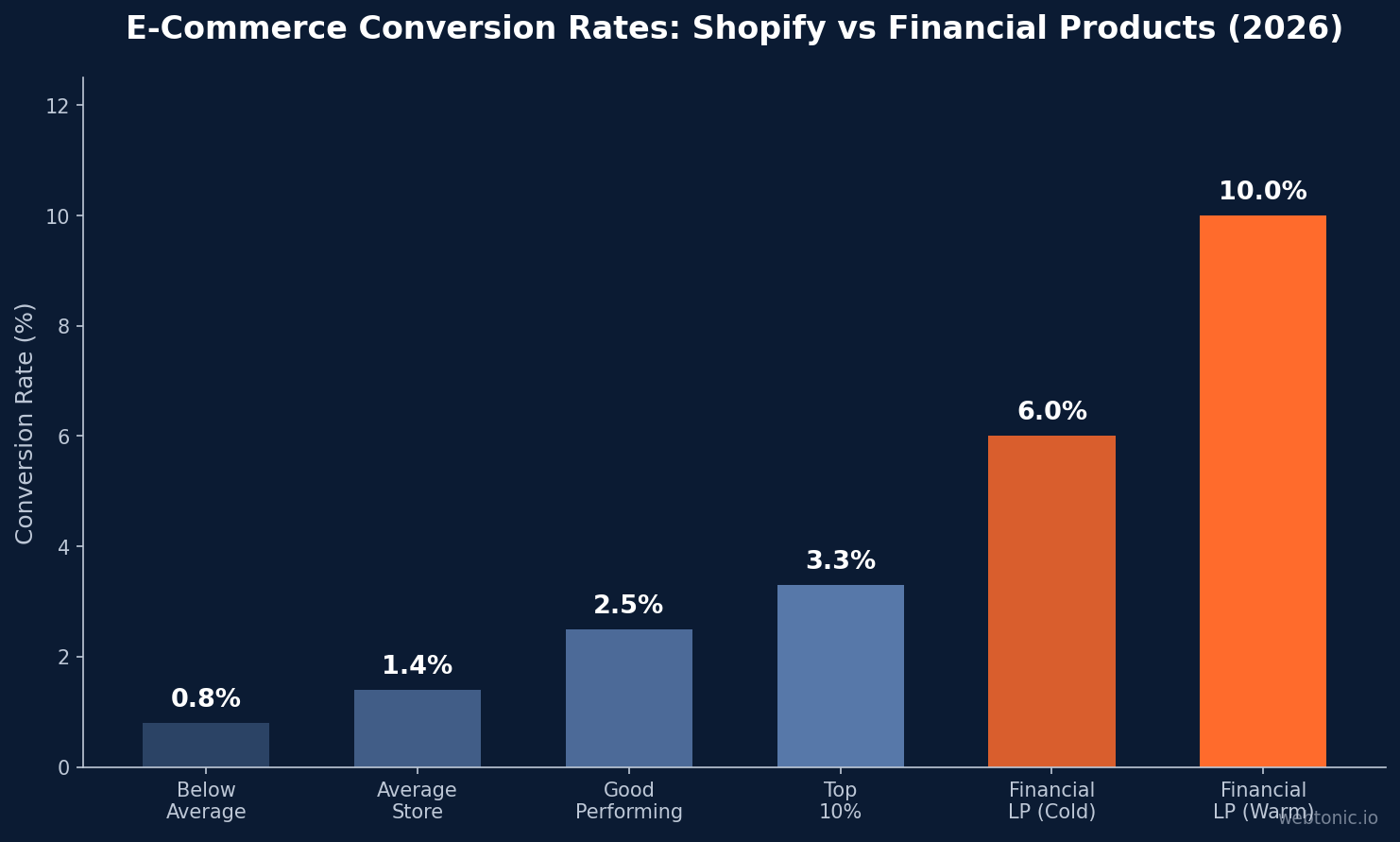
| Average Shopify store | 1.4% | All industries combined |
| Good performing store | 1.8–3.2% | Optimized checkout, strong product pages |
| Top 10% of Shopify stores | 3.3%+ | UX-optimized, strong trust signals |
| Financial product landing pages (cold) | 4–8% | Pre-qualification flows, calculator tools |
| Financial product landing pages (warm) | 10%+ | Retargeted or email-driven traffic |
While the average Shopify store converts at 1.4%, financial product pages operate on different dynamics. Pre-qualification calculators and rate comparison tools — frequently embedded on landing pages that funnel into the origination process — achieve 4–8% conversion rates for cold traffic and 10%+ for warm or retargeted visitors. This distinction matters for lending firms: a Shopify-hosted resource page linking to a mortgage application converts differently than a standard product catalog, and optimization should target the specific user journey, not generic e-commerce benchmarks.
The gap between average and top-performing Shopify stores illustrates an important optimization opportunity. A mortgage brokerage launching a post-close product store at the 1.4% baseline can realistically reach the 1.8–3.2% range within 3–6 months through targeted improvements: adding trust badges (NMLS license number, industry certifications), implementing one-click checkout via Shop Pay, adding authentic customer reviews, and creating product bundles tailored to specific home purchase stages (pre-inspection, closing day, move-in essentials). Each percentage point improvement in conversion rate has an outsized impact on revenue because the traffic source — existing mortgage clients — is already highly qualified.
Understanding how paid traffic performance feeds into these conversion funnels is critical. The Google Ads cost guide breaks down CPC benchmarks that directly impact customer acquisition cost for any e-commerce or lead-generation funnel.
Mortgage-Adjacent Product Categories on E-Commerce
The strongest e-commerce use case for mortgage-related businesses is not selling loans online — it is selling the products and services that surround the home purchase journey. Several product categories naturally align with the lending audience.
- Home inspection and testing kits — the DIY mold test kit market alone reached $439 million (IntelMarketResearch), with Shopify stores in the $20–$50 price band capturing 37% of sales volume.
- Home maintenance products — the mold remover market is projected at $874 million with 7.5% CAGR through 2034 (FactMR), driven by first-time homeowner demand.
- Financial education products — courses, guides, and consulting packages for first-time buyers, refinancers, and real estate investors.
- Branded merchandise — closing gifts, brokerage swag, and referral incentive items shipped through Shopify fulfillment.
- Online hardware and home improvement — the US online hardware market reached $49.6 billion (IBISWorld), with Shopify powering a growing share of independent retailers.
- Household product penetration online projected to reach 42% by 2034 (MarketIntelo), representing a $230B+ addressable market for e-commerce sellers targeting homeowners.
For lending firms, the strategic play is not building a product catalog from scratch. Rather, it is identifying post-close product partnerships where the brokerage's existing client relationships provide qualified buyer access, while the Shopify-powered storefront handles fulfillment and payment processing. A well-integrated performance creative approach can drive these adjacent product sales through email sequences triggered by loan milestone events.
Shopify vs Custom Platforms for Financial Services
| Criteria | Shopify | Custom Platform |
|---|---|---|
| Setup time | Days to weeks | 3–6 months |
| Monthly cost | $39–$399 | $2,000–$10,000+ |
| Payment processing | Built-in (62% of GMV) | Separate integration needed |
| Compliance customization | Limited (app-dependent) | Full control |
| SEO capabilities | Good (built-in) | Fully customizable |
| Scalability | Enterprise-ready ($100B+ GMV) | Depends on architecture |
| Integration ecosystem | 8,000+ apps | Custom-built integrations |
For ancillary product sales and post-close commerce, Shopify's speed-to-market (days vs months) and $39–$399 monthly cost make it the practical choice. For core mortgage application workflows requiring TRID compliance, ECOA adherence, and HMDA reporting, custom platforms remain necessary. The optimal architecture for most lending firms is a hybrid: a Shopify storefront for consumer-facing product sales connected via API to the core loan origination system. Firms looking at data-driven optimization of these e-commerce channels benefit from integrating data intelligence workflows that connect purchase behavior back to loan-pipeline events.
Shopify Financial Services Integration
Shopify's evolution from a pure e-commerce platform into a financial services ecosystem has direct implications for the lending industry. The platform's built-in financial products — Shopify Capital, Shopify Payments, and Shop Pay Installments — demonstrate how commerce and lending are converging.
- Shopify Capital has distributed $6.8 billion in merchant funding since launch, proving the platform's appetite for financial product integration within the commerce experience.
- Shop Pay Installments (BNPL) processed significant volume, with buy-now-pay-later becoming a standard checkout option across Shopify stores — a trend that parallels the consumer preference for flexible payment structures in mortgage products.
- Shopify's B2B wholesale channel enables multi-tier pricing that mortgage-adjacent product suppliers (home inspectors, title companies, insurance brokers) can use to sell directly to lending partners at negotiated rates.
- The platform's 8,000+ app ecosystem includes CRM connectors, automated email marketing, and analytics tools that mirror the tech stack mortgage firms already use — reducing integration friction when adding an e-commerce revenue channel.
- Shopify Markets enables cross-border selling with localized pricing and currency conversion, relevant for international lending firms or brokerages serving diaspora communities purchasing property abroad.
For mortgage operations teams evaluating whether e-commerce technology fits their business model, the evidence suggests that Shopify's infrastructure has matured beyond simple retail. The platform now supports subscription products (ideal for ongoing homeowner service packages), digital downloads (closing document templates, financial planning worksheets), and API-based integrations with loan origination systems. Combined with paid acquisition campaigns driving targeted traffic to product pages, these capabilities unlock post-close monetization at relatively low operational cost.
Best Practices for Mortgage E-Commerce Success
- Start with post-close products. Home inspection kits, maintenance supplies, and branded closing gifts generate immediate revenue from existing clients without regulatory complexity.
- Target the 1.8–3.2% conversion band. Optimize product pages and checkout flows to exceed the 1.4% Shopify average through trust signals, testimonials, and streamlined forms.
- Use Shopify Payments for simplicity. With 62% of platform GMV flowing through integrated payments, the infrastructure is proven at scale — no separate gateway contracts needed.
- Connect your CRM to your storefront. Trigger product recommendations based on loan stage milestones. Post-closing automated emails convert at 10%+ when targeting relevant products.
- Leverage Shopify's SEO capabilities. Target long-tail keywords around home purchase products (e.g., "first-time homeowner starter kit") that your lending content can cross-promote.
- Track PPC-to-purchase attribution to understand which paid channels drive the highest-value storefront customers and optimize accordingly.
- Consider Shopify Plus for multi-location brokerages. At enterprise scale, the $2,300+/month investment unlocks B2B wholesale pricing, custom checkout, and advanced analytics.
FAQ
Can mortgage companies sell products on Shopify?
Yes. While core lending operations require specialized loan origination software, mortgage companies use Shopify for ancillary product sales — home inspection kits, maintenance products, branded closing gifts, and financial education materials. The $647.5 million online mortgage brokers market increasingly leverages e-commerce platforms for post-close revenue streams.
What is the average Shopify conversion rate for financial products?
The average Shopify store converts at 1.4%, but financial product landing pages perform differently: cold traffic converts at 4–8% on pre-qualification tools, while warm or retargeted traffic reaches 10%+. Top-performing Shopify stores across all categories achieve 3.3%+ conversion rates.
How big is the online mortgage market?
The US online mortgage brokers market reached $647.5 million in 2025 (IBISWorld). The broader digital lending ecosystem is much larger: 87.3% of firms use e-signatures, 82.7% use CRM systems, and total mortgage searches in the US hit 1,774,749 in June 2026 alone.
What mortgage-related products sell best on e-commerce platforms?
The top categories are: home inspection and mold testing kits ($439M market), home maintenance products ($874M projected), financial education materials, branded closing gifts, and home improvement supplies. Products in the $20–$50 price range capture the largest share of volume on Shopify.
Is Shopify or a custom platform better for mortgage businesses?
For ancillary product sales, Shopify is the practical choice — setup takes days, costs $39–$399/month, and includes integrated payment processing. For core loan origination with compliance requirements (TRID, ECOA, HMDA), custom platforms are necessary. Most successful firms run a hybrid model connecting Shopify for consumer products to their loan origination system via API.
Sources
ibisworld.com/online-mortgage-brokers
saasstatshub.com/shopify-statistics-2026
enstacked.com/shopify-statistics
kaspianfuad.com/shopify-statistics-2026
popularfintech.com/shopify-second-act
backtofrontshow.com/shopify-statistics
axis-intelligence.com/shopify-statistics
factmr.com
marketintelo.com


