Table of contents

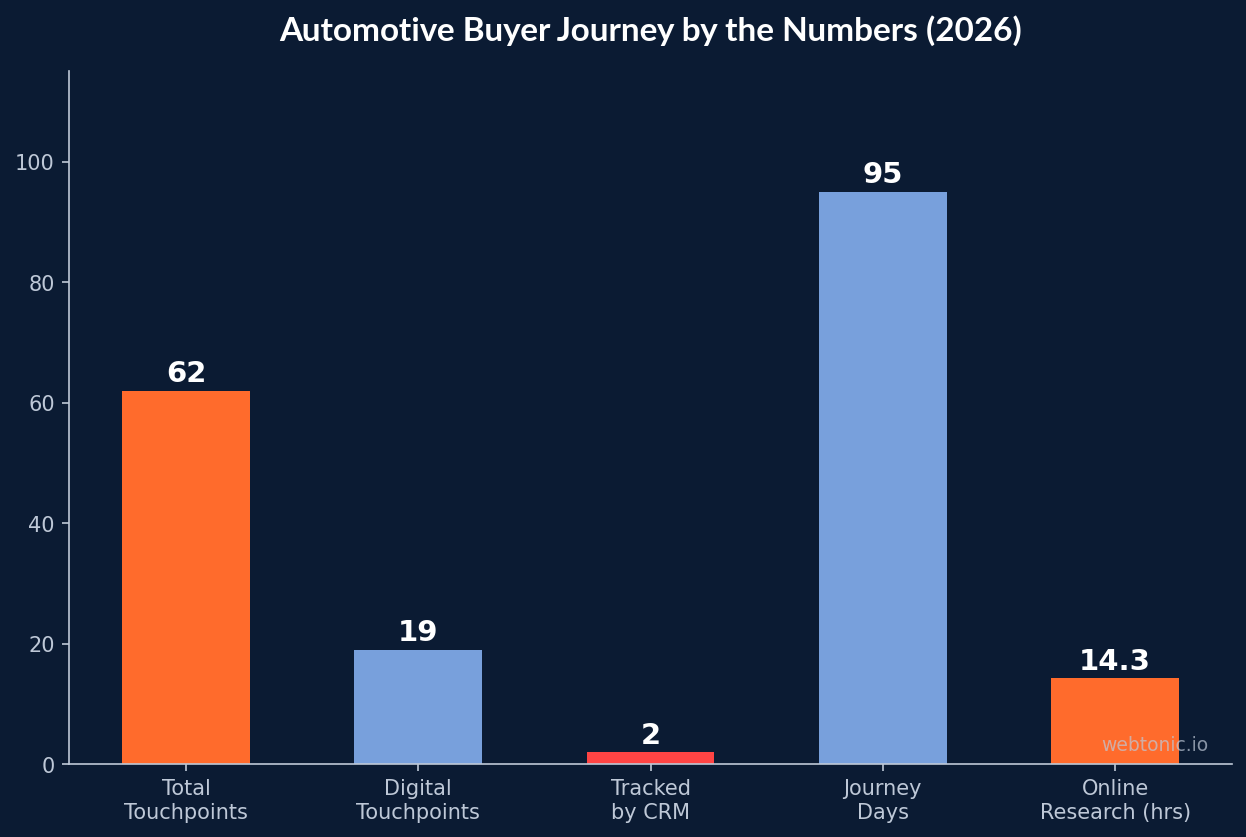
The average car buyer interacts with 62 touchpoints over 95 days before purchasing a vehicle, yet the average dealership tracks only 2 of those touchpoints in its CRM. That gap — where 92 % of vehicle sales are untraceable to any marketing source — is the defining attribution challenge of the automotive industry in 2026.
Key Takeaways
- 92 % of vehicle sales are untraceable in dealer CRM systems, leaving a massive attribution blind spot (Autotrader / Clarivoy 2025).
- Dealers capture only 3.5 % of actual touchpoints, tracking an average of 2 touchpoints while buyers navigate 62 (Demand Local / Cox Automotive).
- Multi-touch attribution reveals Autotrader influenced 55 % of sales vs. just 4 % visible in last-touch CRM data (Cox Automotive).
- Dealers with better attribution grow 2.3× faster in market share compared to those relying on basic metrics (MyDigipal 2026).
- 11.7 % of all sales leads converted to purchases in 2026, up from 10.2 % in 2025, with website form submissions driving the majority (Foureyes).
Attribution & BI Benchmarks at a Glance
| Metric | Value | Source |
|---|---|---|
| Untraceable vehicle sales | 92 % | Autotrader / Clarivoy 2025 |
| Avg touchpoints per buyer | 62 over 95 days | Demand Local / Cox |
| Touchpoints tracked by CRM | 2 (3.5 %) | Cox Automotive 2025 |
| Sales lead conversion rate | 11.7 % | Foureyes 2026 |
| Attribution-driven market share growth | 2.3× faster | MyDigipal 2026 |
| Autotrader influence (multi-touch) | 55 % of sales | Cox / Clarivoy |
| Same in last-touch CRM | 4 % of sales | Cox / Clarivoy |
| Online research time | 14 h 19 min | Demand Local 2026 |
The 92 % Attribution Blind Spot
Autotrader's 2025 study, powered by Clarivoy data on 1.2 million transactions, found that 92 % of vehicle sales are untraceable in dealer CRM systems. The root cause: most dealers still rely on last-touch attribution, crediting the final channel (usually the dealer website) while ignoring the dozens of earlier interactions that influenced the purchase.
When multi-touch attribution was applied to the same dataset, Autotrader influenced 55 % of sales — over 2.5× more than the 4 % visible in CRM data. AutoSuccess reported that by crediting every interaction, dealers could finally see which channels deserved budget and which were being over-credited.
The Buyer Journey: 62 Touchpoints Over 95 Days
Demand Local's 2026 analysis shows the modern car buyer interacts with 62 touchpoints over 95 days, with 19 of those being digital. Buyers spend an average of 14 hours and 19 minutes researching online before visiting a dealership, and 71 % of digital interactions are mobile-first.
Cox Automotive's 2025 Car Buyer Journey Study adds context: 53 % of buyers completed all purchase steps at the dealership, while only 7 % bought completely online. When asked their preference, 63 % said an omnichannel approach would be ideal. This complexity is exactly why attribution matters — a single-touch model cannot capture the reality of how buyers move between organic search, social media, third-party marketplaces, and showroom visits.
The Cost of Poor Attribution
The financial impact of attribution gaps is staggering. When dealers rely on last-touch attribution, they systematically over-credit their own website (which appears as the final touchpoint in nearly every journey) and under-credit upstream channels like social media, third-party marketplaces, and content marketing. This misallocation means budgets flow to channels that close sales rather than channels that create demand.
Consider the math: if a dealership spends $631,000 per year on marketing (the industry average) and misallocates 30 % of that budget due to flawed attribution, that\'s $189,000 annually wasted on the wrong channels. Multiply that across 18,000+ U.S. franchise dealerships, and the industry-wide attribution gap represents $3.4 billion in potentially misallocated marketing spend every year.
CDP and Data Infrastructure Trends
Customer Data Platforms (CDPs) are emerging as the backbone of automotive attribution. Platforms like Fullpath, Orbee, and CDK Global\'s built-in CDP centralize website behavior, CRM records, ad platform data, and service history into a single customer view. This unification is what makes multi-touch attribution possible — without it, data lives in silos that cannot be connected.
The CDP market for automotive is growing rapidly because dealers face a unique challenge: their primary conversion event (a vehicle purchase) happens offline, often weeks or months after the last digital interaction. Bridging that digital-to-physical gap requires identity resolution technology that matches a website visitor\'s cookie or device ID to a CRM contact record and ultimately to a sales transaction in the DMS (dealer management system). Leading CDPs achieve match rates above 85 % for known visitors, but the challenge remains for the 40–60 % of shoppers who browse anonymously.

Attribution Models Used in Automotive
| Model | How It Works | Auto Industry Adoption |
|---|---|---|
| Last-touch (default CRM) | Credits only the final interaction | ~70 % of dealers (baseline) |
| Multi-touch attribution | Distributes credit across all touchpoints | ~25 % of dealers |
| Marketing mix modeling (MMM) | Statistical model of channel contribution | Used by OEMs and large groups |
| Incrementality testing | Holdout-based causal measurement | Emerging — ~5 % adoption |
| Hybrid (MTA + MMM) | Combines granular + aggregate signals | Best practice for tier-1 dealers |
Relevant Dealer's 2026 guide recommends defining one north-star outcome metric tied directly to revenue — sold units, ROs booked, qualified pipeline, or net retention — and tracking three to four leading indicators as early-warning signals. This is a shift from the vanity-metric era of impressions and clicks.
Business Intelligence and Dealer Analytics
Foureyes' 2026 dealer benchmarks report found that 11.7 % of all sales leads ended up buying — up from 10.2 % in 2025 — with website form submissions driving the majority of conversions. This improvement correlates with better lead-routing and data intelligence adoption across franchise networks.
MyDigipal's 2026 analysis reports that 90 % of automotive purchases begin online, and competitive dealers with better attribution grow 2.3× faster in market share compared to those relying on basic metrics. The business case is clear: every dollar invested in attribution infrastructure returns multiples in optimized ad spend and higher close rates.
The Ad Spend Waste Problem
Digital Dealer reported that some dealerships waste up to $4,000 monthly and nearly $48,000 annually in impressions that never reach a real car buyer — due to missing geographic exclusions, absent fraud filters, and unconfigured audience boundaries. Without proper attribution, these leaks are invisible.
Fullpath's 2026 analysis of dealership digital advertising shows that the gap between "clicks" and "actual buyers" widens when attribution is weak. Dealers who adopted multi-touch attribution shifted focus from chasing leads to measuring real engagement, helping them close more sales and improve return on ad spend. Integrating paid search and paid social data into a unified attribution layer is the minimum viable approach.
Offline Conversion Tracking for Automotive
The automotive industry\'s unique offline conversion challenge — where 90 % of purchases still happen at the dealership — makes offline conversion tracking essential. Technologies that bridge this gap include:
- CRM-to-ad platform data connections — uploading purchase records from the DMS to Google Ads and Meta to close the attribution loop on sold units.
- Store visit measurement — Google\'s and Meta\'s location-based signals estimate showroom visits attributable to ad impressions.
- Call tracking with attribution — services like CallRail and Marchex tie phone calls to specific ad clicks, keywords, and campaigns.
- Multi-touch identity resolution — Clarivoy\'s technology (used in the Autotrader study) matches anonymous web visitors to known buyers using probabilistic and deterministic matching.
Demand Local\'s analysis emphasizes that without offline conversion tracking, digital campaigns are judged on proxy metrics (clicks, form fills, calls) rather than actual revenue outcomes. The dealers who have closed this gap report 20–40 % improvement in marketing ROI simply by reallocating budget to channels that actually drive purchases rather than channels that appear to drive leads.
The Future of Automotive Attribution
The automotive industry is converging on a unified measurement approach that combines three complementary methods: multi-touch attribution for granular touchpoint-level credit, marketing mix modeling for channel-level budget optimization, and incrementality testing for causal validation. eMarketer notes that incrementality testing is particularly valuable for automotive because it isolates the true causal impact of advertising on vehicle purchases — filtering out buyers who would have purchased regardless of ad exposure.
The shift toward outcome-based measurement is also being driven by OEM co-op program requirements. As manufacturers demand better proof of advertising effectiveness from their dealer partners, sophisticated attribution becomes a competitive necessity rather than an optional upgrade. Dealers who invest early in attribution infrastructure position themselves for both better co-op fund utilization and more efficient independent marketing — a double return on the technology investment.
Incrementality Testing and Marketing Mix Modeling
Lifesight's case study shows a premier auto dealership chain increased incremental revenue by 65 % after implementing a unified measurement framework consisting of MMM, causal attribution, and geo experiments. This three-layer approach is becoming the gold standard for large dealer groups.
Demand Local's offline conversion tracking data confirms that advanced attribution is no longer optional for automotive. With customers interacting across 62 touchpoints over 95 days, single-channel measurement creates a distorted picture that leads to budget misallocation. The industry is moving toward outcome-based measurement, where digital ad investments are evaluated against sold units rather than click-through rates.
Attribution Best Practices for Automotive Marketers
- Upgrade from last-touch to multi-touch attribution — the 92 % blind spot exists because dealers credit only the final click. Multi-touch reveals 2.5× more influence per channel.
- Define one north-star revenue metric — sold units, ROs booked, or qualified pipeline. Track 3–4 leading indicators (VDP views, lead form fills, showroom appointments) as early warnings.
- Invest in offline conversion tracking — connect digital ad clicks to CRM outcomes (showroom visits, test drives, purchases) using tools like Clarivoy, Foureyes, or custom data layers.
- Run incrementality tests quarterly — use holdout audiences or geo experiments to measure true causal impact, not just correlation between ad spend and sales.
- Unify your data stack — CDPs like Fullpath or Orbee centralize website, CRM, and ad data into a single customer view, eliminating the silos that cause attribution gaps.
- Audit for waste before scaling — check geographic exclusions, fraud filters, and audience boundaries. Even small leaks compound to $48 K+ annual waste at scale.
Frequently Asked Questions
Why are 92 % of vehicle sales untraceable?
Most dealers use last-touch attribution, which credits only the final interaction (usually the dealer website). Since buyers average 62 touchpoints over 95 days, last-touch captures only 3.5 % of the actual journey.
What is multi-touch attribution for automotive?
Multi-touch attribution distributes credit across every touchpoint in the buyer journey — from initial search to social engagement to showroom visit. It revealed Autotrader influenced 55 % of sales vs. just 4 % in last-touch CRM data.
How much do dealerships waste on unattributed ad spend?
Some dealerships waste up to $48,000 annually on impressions that never reach real buyers, according to Digital Dealer. Without proper attribution, these leaks remain invisible.
What ROI does better attribution deliver?
Dealers with advanced attribution grow 2.3× faster in market share (MyDigipal). One dealer chain saw 65 % incremental revenue growth after implementing unified MMM + causal attribution (Lifesight).
What tools do dealers use for automotive attribution?
Leading tools include Clarivoy (Cox Automotive / multi-touch), Foureyes (lead tracking), Fullpath and Orbee (CDPs), and Lifesight (MMM + incrementality). Most connect CRM data to digital ad platforms.
Sources
Cox Automotive — Autotrader 92 % Blind Spot Study
AutoSuccess — Auto Dealer Marketing ROI Study
Demand Local — Digital Touchpoint Statistics 2026
Demand Local — Offline Conversion Tracking Statistics
Relevant Dealer — Multi-Touch Attribution for Car Dealerships 2026
Foureyes — 2026 Automotive Dealer Benchmarks Report
MyDigipal — Cross-Channel Attribution Automotive 2026
Lifesight — Auto Dealership +65 % Incremental Revenue
Fullpath — Dealership Digital Advertising Waste 2026
Digital Dealer — AI Ad Spend Waste 2026