



Table of contents
Brand trust is the primary driver of patient acquisition for allergy and immunology practices, with 94% of patients using online reviews as a first step in choosing a healthcare provider (WorldMetrics). This page compiles 50+ verified branding statistics for the allergy and immunology sector, covering patient trust, brand consistency, online reputation management, and practice growth benchmarks. For practices building a performance creative strategy, these numbers show exactly why branding investment delivers measurable patient acquisition returns in this specialty.
Key Takeaways
- 94% of patients use online reviews as their first step in choosing a healthcare provider, making reputation management a core branding activity (WorldMetrics).
- 45.8% of allergy and immunology patients are self-referring, meaning your brand is often the first touchpoint before any physician recommendation (Aragil / NAMCS data).
- Consistent brand presentation across all channels increases revenue by 23% to 33% depending on the study period and methodology (DashoContent / Lucidpress research).
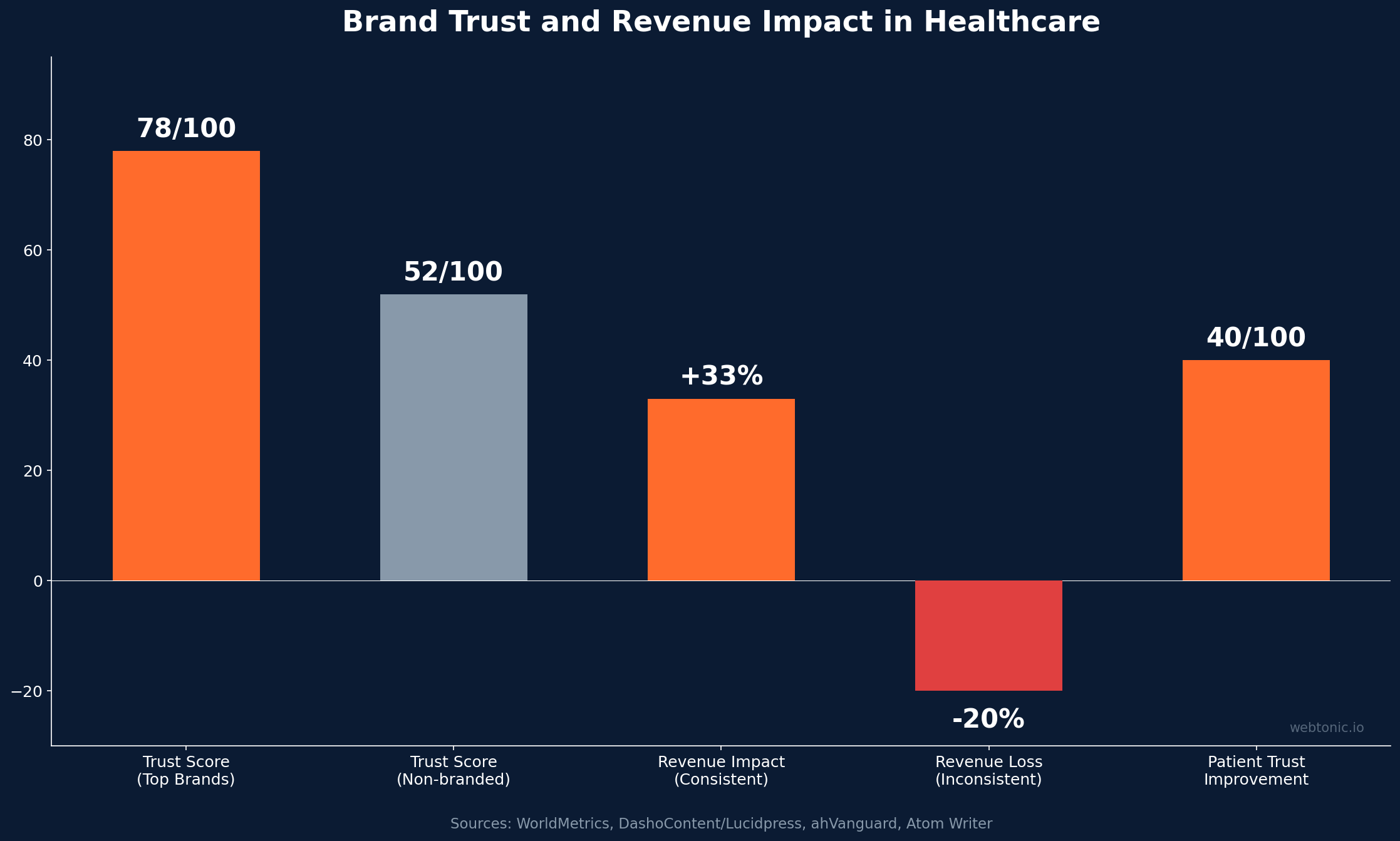
- Healthcare brands with strong trust scores see 55% patient retention rates, while top-10 healthcare brands average a trust score of 78/100 versus just 52/100 for non-branded providers (Gitnux / WorldMetrics).
- 48% of patients say a provider's logo and visual identity influence their perception of care quality (WorldMetrics).
- Hospitals with strong brand recognition see 24% higher patient volumes than lesser-known competitors in the same market.
Allergy and Immunology Branding Statistics at a Glance
| Metric | Value | Source |
|---|---|---|
| Patients using reviews to choose providers | 94% | WorldMetrics |
| Self-referring allergy patients | 45.8% | Aragil / NAMCS |
| Revenue increase from consistent branding | 23–33% | DashoContent |
| Top healthcare brand trust score | 78/100 | WorldMetrics |
| Patient retention with strong brand trust | 55% | Gitnux 2023 |
| Logo and visual identity influences quality perception | 48% | WorldMetrics |
| Higher patient volumes with strong brand | +24% | Industry data |
| Patient trust improvement with consistent voice | +40% | Atom Writer |
Why Branding Matters More for Allergy Practices: The Self-Referral Factor
Allergy and immunology is uniquely brand-dependent among medical specialties. 45.8% of allergy and immunology patients are self-referring, finding their allergist through their own online research rather than through a physician referral (Aragil / NAMCS). This self-referral rate is significantly higher than most medical specialties, which means that brand visibility, online presence, and reputation are the primary factors determining which practice a patient chooses. Unlike cardiology or oncology where physician referrals dominate, allergy patients behave more like consumers choosing a service provider.
The allergy market also operates on a demand cycle unlike almost any other specialty, with violent seasonal surges where a single well-handled season can determine whether a practice grows or stagnates year-round (VT Wyatt). Practices that build brand recognition before peak pollen seasons capture a disproportionate share of new patients during surge periods. Those without established brand equity lose these patients to competitors who invested in trust-building months earlier through consistent branding efforts and strategic content marketing across digital channels.
Combined case studies show the impact clearly: one allergy practice achieved 9× more qualified leads with 30% monthly growth through a brand-focused digital strategy that combined visual identity overhaul with targeted content marketing. Another new entrant, AllergyDox, built its patient base from zero in a competitive market by investing in cohesive brand identity and targeted digital advertising before launching (Aragil). These results demonstrate that brand investment in allergy and immunology produces measurable patient acquisition outcomes, not merely aesthetic improvements that are difficult to quantify.

Brand Consistency and Revenue Impact in Healthcare
The financial case for brand consistency is well-documented across healthcare and professional services. Consistent brand presentation increases revenue by 23% according to foundational research by Demand Metric and Lucidpress, with subsequent studies raising the figure to up to 33% (DashoContent). The growing gap between these figures suggests the commercial penalty for inconsistency is increasing over time as patients become more digitally savvy and routinely compare providers across multiple touchpoints before making contact with any practice.
For healthcare practices specifically, consistent branding generates 30–40% higher retention and acquisition rates, while inconsistent branding causes confusion over available services and erodes clinical credibility, leading to up to 20% revenue loss (ahVanguard). A consistent brand voice produces a 40% improvement in patient trust scores and 31.2% click-to-open rates on email communications with consistent messaging (Atom Writer). These numbers are particularly relevant for allergy practices that send seasonal health alerts, appointment reminders, and immunotherapy progress updates.
Yet only 25–30% of organizations enforce brand consistency across all touchpoints (Atom Writer). For allergy and immunology practices with multiple locations, seasonal campaigns, and physician-specific sub-brands, the consistency challenge is particularly acute. Practices that implement comprehensive brand guidelines covering logo usage, color palettes, photography style, and messaging tone across every patient touchpoint consistently outperform those that treat branding as a one-time project rather than an ongoing operational discipline.
Online Reputation and Patient Trust Statistics
Online reputation has become the gateway to patient relationships in allergy and immunology. 94% of patients use online reviews as a first step in choosing a healthcare provider, and 66% say that seeing a provider's response to online reviews directly influences whether they trust the provider, which represents the largest year-over-year movement across all metrics in recent patient choice survey data (Rater8, 2026).
| Reputation Metric | Value | Source |
|---|---|---|
| Patients using online reviews to choose providers | 94% | WorldMetrics |
| Provider response influences trust | 66% | Rater8 2026 |
| Top-10 healthcare brand trust score | 78/100 | WorldMetrics |
| Non-branded provider trust score | 52/100 | WorldMetrics |
| Trusters more likely to stay with provider | 6× | Accenture |
| Consumers expecting expectations met | 68% | NRC Health 2026 |
| Expectations actually met by providers | 42% | NRC Health 2026 |
The trust gap is significant: 68% of consumers expect healthcare providers to meet or exceed their expectations, yet only 42% believe those expectations are actually met (NRC Health, 2026). For allergy practices, closing this gap through visible credentials, consistent visual identity, responsive review management, and transparent pricing is the most direct path to patient acquisition growth. Practices interested in broader digital strategies can explore growth marketing approaches that integrate branding with performance channels.
Medical Practice Branding Costs and Investment Benchmarks
A complete brand identity for a medical practice in the United States ranges from $3,000 to $25,000 depending on scope, agency experience, and market complexity (Futurise Studio, 2026). For allergy and immunology practices specifically, branding investment should be proportional to the self-referral-driven acquisition model where brand visibility directly generates patient volume without relying on physician referral networks.
- Foundation ($3,000–$7,000) — logo design, color palette, typography selection, basic brand guidelines document, and social media profile consistency across all platforms.
- Growth ($8,000–$15,000) — includes website redesign with brand integration, professional photography sessions, patient communication templates, office signage, and branded intake materials aligned to visual standards.
- Comprehensive ($15,000–$25,000) — full brand strategy with market positioning research, competitive differentiation analysis, multi-location consistency systems, physician sub-branding, and seasonal campaign frameworks.
The ROI calculation for branding investment is straightforward: if a practice spends $10,000 on branding and generates $40,000 in incremental revenue through improved patient acquisition, the ROI is 300%. Given the average patient lifetime value in allergy and immunology, which includes ongoing immunotherapy cycles, annual visits, biologic prescription management, and food allergy monitoring that can span multiple years, even modest improvements in acquisition efficiency produce outsized returns over the patient relationship lifecycle.
Allergy Clinic Marketing Benchmarks for 2026
| Marketing Metric | Allergy Clinics | Medical Avg. | Source |
|---|---|---|---|
| Google Ads CTR | 4.84% | 3.6% | Benchmarketing |
| Google Ads CPC | $4.24 | $4.22 | Benchmarketing |
| Google Ads conversion rate | 6.8% | 3.6% | Benchmarketing / CuFinder |
| Landing page conversion rate | 6.4% | 6.1% | Benchmarketing / CuFinder |
| Patient retention rate | ~78% | 78% | CuFinder |
| Seasonal ad effectiveness boost | +35% | N/A | Aragil |
Allergy clinics outperform the average medical practice on click-through rate (4.84% vs. 3.6%) and conversion rate (6.8% vs. 3.6%), suggesting that patients searching for allergy services have higher purchase intent and are more responsive to well-branded advertising that communicates expertise and availability. For practices optimizing their paid search campaigns, these benchmarks provide useful performance targets and budget planning data.
Building a Brand Identity Framework for Allergy Practices
A structured brand identity framework ensures consistency across every patient touchpoint from the first Google search to the follow-up appointment reminder. For allergy practices, this framework must account for seasonal demand fluctuations, high self-referral rates, and the growing role of biologics and immunotherapy in treatment plans.
- Visual identity system — primary logo, secondary mark, color palette, typography hierarchy, and photography guidelines that evoke clinical competence and patient comfort simultaneously without appearing sterile or impersonal.
- Messaging architecture — brand positioning statement, tagline, key service descriptions, and approved claims for each treatment modality ensuring consistent value proposition communication across all team members and marketing channels.
- Digital asset library — standardized templates for social media posts, email campaigns, patient education materials, and seasonal campaign assets that reduce production time during peak allergy seasons when marketing resources are stretched.
- Patient experience touchpoints — branded intake forms, appointment confirmations, treatment summaries, and follow-up communications that reinforce identity and professionalism at every patient interaction point.
- Review and reputation protocol — a documented process for requesting, monitoring, and responding to online reviews across Google, Healthgrades, and specialty-specific platforms.
Best Practices for Allergy and Immunology Practice Branding
- Own your online reputation. With 94% of patients checking reviews first, implement systematic review requests and respond to every review within 24 hours to demonstrate engagement and care.
- Build brand before peak season. The seasonal demand cycle means practices that invest in brand visibility during off-season months capture disproportionate patient volume during allergy surges when competition for attention is fiercest.
- Enforce visual consistency. Ensure logo, colors, photography style, and messaging tone are identical across website, social profiles, directory listings, and office signage. Brand inconsistency costs up to 20% in revenue.
- Leverage the self-referral advantage. With 45.8% of patients self-referring, invest in SEO, content marketing, and brand awareness channels that reach patients directly.
- Display credentials prominently. Board certifications, fellowship training, and clinical specializations are trust signals that 48% of patients evaluate through visual identity cues on your website and profiles.
- Invest in professional photography. Team photos, office interiors, and procedure environment images create familiarity and reduce patient anxiety before the first appointment.
- Monitor brand consistency quarterly. Audit all patient touchpoints to ensure alignment with current brand standards and identify drift before it impacts patient perception.
Practices seeking comprehensive digital branding can explore how data intelligence supports brand performance measurement across all marketing channels.
Related reading
- Allergy & Immunology Ad Creative Statistics: 2026 Market Data & Campaign Benchmarks
- The Complete Allergy & Immunology Video Marketing Statistics Report (2026)
- Plumbing Branding & Logo Design Benchmarks: What the Data Says (2026)
- Branding services at Web Tonic
Frequently Asked Questions
How does branding affect patient acquisition for allergy practices?
Branding directly drives patient acquisition because 45.8% of allergy patients self-refer, choosing their allergist based on online research, reviews, and brand perception rather than physician referrals. Practices with strong brand recognition see 24% higher patient volumes, and consistent branding increases revenue by 23–33%. In a specialty where nearly half of patients find their provider independently, brand visibility is the primary acquisition mechanism rather than a nice-to-have marketing supplement.
How much does it cost to brand a medical practice?
A complete brand identity for an allergy practice costs $3,000–$25,000 depending on scope. Foundation-level branding (logo, color palette, basic guidelines) starts at $3,000–$7,000, while comprehensive strategies that include multi-location consistency, competitive positioning research, and seasonal campaign frameworks range from $15,000–$25,000.
What role do online reviews play in allergy practice branding?
94% of patients use online reviews as their first step in choosing a provider, and 66% say provider responses to reviews directly influence whether they trust the practice. Review management is not separate from branding; it is a core brand activity that shapes patient perception before any direct interaction with the practice or its staff.
Why is brand consistency important for healthcare practices?
Consistent brand presentation increases revenue by 23–33% and improves patient trust scores by 40%. Inconsistent branding causes confusion about services and erodes clinical credibility, potentially costing up to 20% in revenue. Only 25–30% of organizations enforce consistency across all touchpoints, creating a significant competitive opportunity for practices that invest in brand standards and enforcement.
How should allergy practices prepare for seasonal demand surges?
Build brand recognition during off-season months through consistent content publishing, community health engagement, and SEO investment. Seasonal campaign planning increases ad effectiveness by 35% for allergy practices. The goal is to establish trust before patients need you, so your practice is top-of-mind when symptoms drive them to search for an allergist in their area.
Sources
worldmetrics.org — Healthcare Marketing Statistics
aragil.com — Allergy Clinic Growth Case Studies
vtwyatt.com — Allergy & Immunology Market Intelligence
dashocontent.com — Brand Consistency Statistics 2026
atomwriter.com — ROI of Brand Voice Consistency
ahvanguard.com — Brand Consistency 2026
gitnux.org — Branding Statistics 2026
nrchealth.com — Brand Experience and Trust 2026
rater8.com — 2026 Patient Choice Report
benchmarketing.org — Allergy Clinics Benchmarks
cufinder.io — Medical Practices Benchmarks 2026
futurise.studio — Medical Practice Branding Cost 2026


