Table of contents
29% of pet owners have already ruled out a clinic because of its website, and 36% call a bad site a deal-breaker. That is the real stake in the veterinary platform debate - not design taste. Here is what the 2026 data says about Webflow, WordPress and the clinic websites running on both.
Key Takeaways
- Webflow powers roughly 822,550 live sites, about 0.8% of all websites and 1.2% of CMS-identifiable sites - close to 1 in 125 sites.
- Active Webflow sites grew about 54% year over year, from ~320,600 in early 2024 to ~493,000 by April 2025, with revenue at USD 213 million in 2024 (+66%).
- 58% of Webflow sites pass all three Core Web Vitals versus 42% of WordPress sites, with mobile LCP near 2.4s vs 3.2s.
- WordPress logged 7,966 disclosed vulnerabilities in 2025; 56% of hacked WordPress sites had an outdated plugin and cleanup runs USD 4,000-8,000.
- Webflow Premium is USD 25/month billed yearly (USD 39 monthly) after the 13 May 2026 plan merge; full seats are USD 39 and limited seats USD 15.
- Only 9.8% of 267 US veterinary sites run detectable WordPress - most sit on vendor or agency templates, which is why platform migrations in this vertical are template exits.
- 73.3% of graded veterinary homepages have no client portal and 13.3% offer no online booking, while 78% of pet owners want 24/7 booking.
- The average veterinary site takes 9.31 seconds to render its main content, so platform choice alone will not save a slow clinic build.
Webflow adoption: small share, fast curve
Webflow is not a mass-market CMS and never has been. It is detected on about 822,550 live websites, equal to 0.8% of all sites and roughly 1.2% of sites with an identifiable CMS - about 1 in 125 sites online (Popupsmart, Enricher). Where it looks bigger is at the top of the web: Webflow holds around 2.5% of the top 10 million sites, up from 1.8% in 2024. Adoption is concentrated in the US (160,696 sites), the UK (14,891) and Germany (14,510).
Growth, not size, is the argument. Active sites climbed roughly 54% year over year - about 320,600 in early 2024 to ~493,000 by April 2025 - CMS share moved from 0.9% in 2022 to 1.2% in 2025 (about a 10% CAGR), and revenue hit USD 213 million in 2024, up 66% from USD 128 million. Ecommerce sites on the platform grew 647.8% across three years, from 1,598 to 11,950. Meanwhile WordPress slipped from a 43.6% peak in mid-2025 to 42.6% of all websites by April 2026 - its first sustained decline in over a decade.
| Platform | Share of all websites | CMS market share | Notable 2026 signal |
|---|---|---|---|
| Webflow | 0.8% | ~1.2% | ~54% YoY site growth; 2.5% of top 10M sites |
| WordPress | 42.6% | 59.8% | Down from a 43.6% peak in mid-2025 |
| Shopify | Not reported | 6.7% | Ecommerce-first |
| Wix | Not reported | 3.3% | Beginner-oriented builders |
| Squarespace | Not reported | 2.2% | Template-led creative sites |
| Drupal | Not reported | 1.2% | Enterprise complexity, ties Webflow |
What veterinary websites actually run on
The surprise in the veterinary vertical is how little of it is classic WordPress. Across 267 US clinic websites, technology detection found WordPress on just 9.8%, alongside jQuery on 13.8%, Google Analytics on 13.3%, Tag Manager on 10.2% and Cloudflare on 8.8% (Borah Labs). Most clinics are on practice-management vendor templates or agency builds where the CMS is not publicly detectable - which reframes the decision. A clinic evaluating Webflow is usually not leaving WordPress; it is leaving a template it cannot edit.
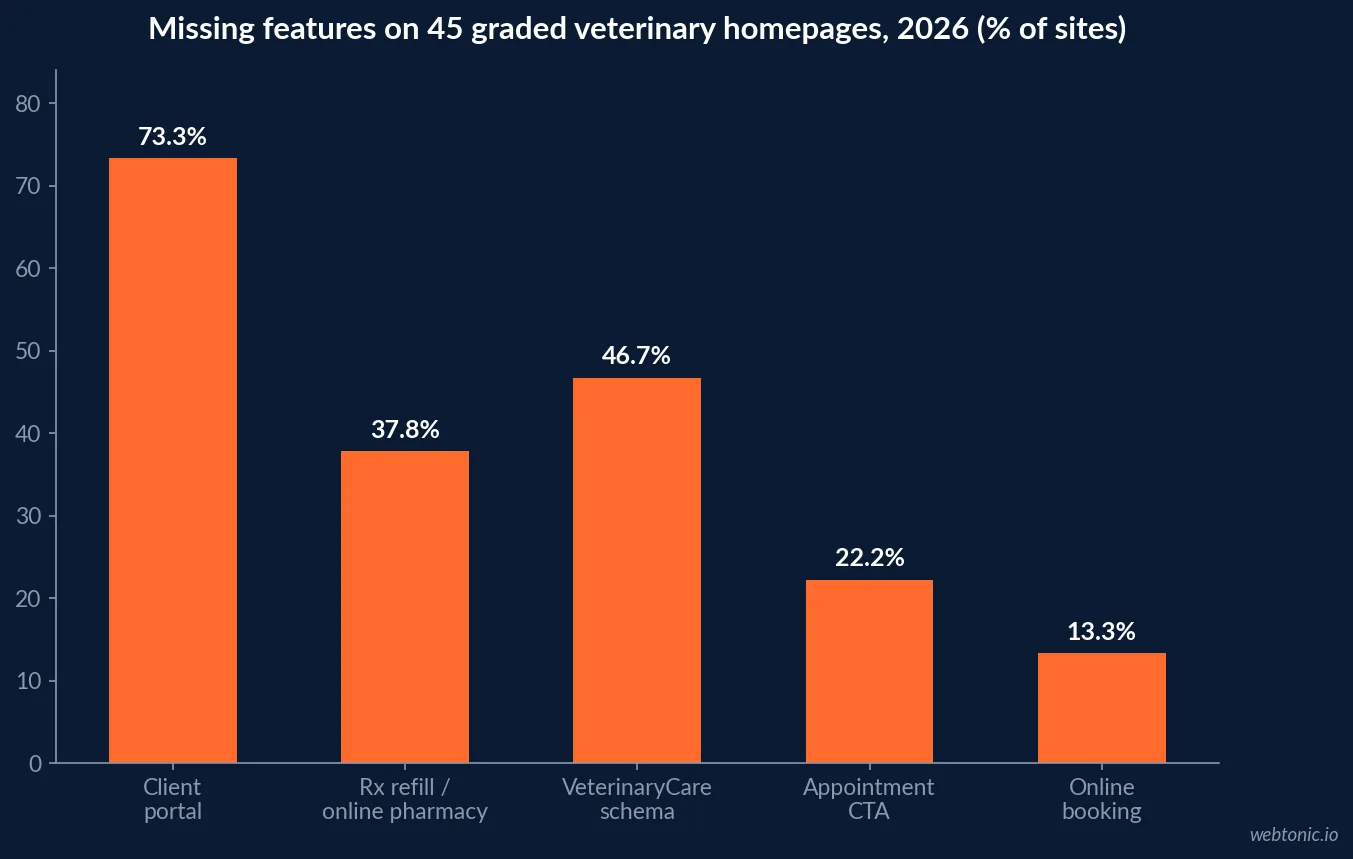
That shows up in what those homepages are missing. Codivox graded 45 US veterinary homepages and found a median score of 88/100, with 33.3% earning an A but 11% at a C or lower and 4.4% failing. The gaps are structural, not cosmetic: 73.3% have no client portal, 37.8% no Rx refill or online pharmacy, 22.2% no appointment CTA, 13.3% no online booking and 46.7% no VeterinaryCare or LocalBusiness schema. Those are content-model problems - exactly what a CMS is for.

Performance: 58% vs 42%, and why neither saves a clinic
Aggregated HTTP Archive and CMS-level analyses put the Core Web Vitals pass rate at 58% for Webflow against 42% for WordPress, with average mobile LCP around 2.4 seconds versus 3.2 seconds (Tech Insider, PageSpeed Matters). Webflow ships without a plugin stack, which removes the most common source of render-blocking weight, and migration case studies report mobile PageSpeed scores moving from the mid-60s to the low 90s.
Now the reality check. The average veterinary site renders its main content in 9.31 seconds and 78% of clinic sites score below 70 on PageSpeed, while Time to First Byte averages 0.11 seconds - meaning the delay is front-end, not hosting. A platform migration that keeps the same 4MB hero images and three third-party widgets will produce a fast platform serving a slow page. Our veterinary landing page statistics and agency benchmarks break down the conversion side of that same problem.
| Metric | Webflow | WordPress | Veterinary industry average |
|---|---|---|---|
| Core Web Vitals pass rate | 58% | 42% | 78% of sites score below 70 on PageSpeed |
| Average mobile LCP | ~2.4s | ~3.2s | 9.31s |
| Disclosed vulnerabilities, 2025 | Managed platform, none published | 7,966 | 27 of 267 sites lack SSL |
| Plugin dependency | None required | 56% of hacked sites had an outdated plugin | jQuery on 13.8% of sites |
| Entry cost | USD 15/mo (Basic, yearly) | USD 0 licence + hosting | Varies by vendor template |
| Year-one total cost of ownership | ~USD 180-468 + seats | USD 300-1,800 | Often bundled in PIMS fees |
| Pet owner expectation | Share who value it | Where it lives on the site |
|---|---|---|
| 24/7 online booking | 78% | Embedded widget, above the fold on mobile |
| Appointment reminders | 89% | Booking system + automated messaging |
| Post-visit summaries | 85% | Client portal (missing on 73.3% of homepages) |
| Booking online at all | 84% | Primary CTA on every service page |
| Paperwork completed ahead of time | 78% of owners aged 18-34 | Forms or portal |
| Paying on any device | 77% of owners aged 18-34 | Payment integration |
Security and maintenance: the hidden line item
WordPress recorded 7,966 disclosed vulnerabilities in 2025, and the exposure is operational rather than theoretical: about 40% of installations run outdated versions, 56% of hacked sites had at least one outdated plugin at the time of compromise, and malware cleanup costs small businesses USD 4,000-8,000 per incident. For a clinic with a two-person front desk and no webmaster, that is a real risk profile, and it sits beside a smaller but more common failure: 27 of 267 veterinary sites serve no SSL at all, so browsers warn visitors before the page even loads.
Webflow removes patching from the practice’s job list - hosting, CDN and updates are the vendor’s problem, with a 99.9% uptime commitment on AWS infrastructure. The trade is control: no server-side code, no plugin ecosystem, and Ecommerce capped at 5,000 items on the Plus plan with a 2% transaction fee on Standard. For a clinic selling a handful of wellness plans that is irrelevant; for a practice running a full online pharmacy it is a blocker.
Real 2026 pricing, including the part that surprises people
Webflow reworked its lineup on 13 May 2026, merging the old CMS and Business plans into Premium at USD 25 per month billed yearly (USD 39 monthly) and moving Basic to USD 15 yearly while doubling its static page limit from 150 to 300. Team sits at USD 2,500 per month on an annual contract - USD 30,000 a year - which no independent clinic needs (Karpi Studio).
Seats are the line that breaks budgets. A full seat is USD 39 per month billed yearly and a limited content seat is USD 15; a five-person marketing team adds about USD 84 per month, or USD 1,008 a year, on top of the site plan. Add-ons compound it: Analyze from USD 9, Localization from USD 9 per locale and Optimize from USD 299 per month. Two dates matter for anyone planning a build this year: the legacy Editor retires 4 August 2026, and Freelancer or Agency Workspace pricing converts at the first renewal on or after 16 November 2026.
| Line item | 2026 price | Who needs it in a clinic |
|---|---|---|
| Basic site plan | USD 15/mo yearly | Single-location brochure site, no CMS collections |
| Premium site plan | USD 25/mo yearly (USD 39 monthly) | Services, team, locations and a blog in the CMS |
| Full seat | USD 39/mo yearly | Whoever builds and restructures pages |
| Limited seat | USD 15/mo yearly | Practice manager editing hours, offers and posts |
| Analyze add-on | From USD 9/mo | Optional; GA4 covers most clinics |
| Optimize add-on | From USD 299/mo | Multi-location groups running real A/B tests |
Booking is the feature that pays for the rebuild
Every platform argument in veterinary resolves to one question: can a pet owner book at 9pm? 78% of pet owners want 24/7 online booking and 84% value being able to book online, alongside 89% who value reminders and 85% who value post-visit summaries (Vetstoria, Digitail). Yet 58% report problems when trying to book and 34% cite the inability to book online specifically.
The website is doing selection work too: 81-83% of pet owners say website quality matters when choosing a practice, 29% have rejected a clinic because of its site and 36% treat a poor site as a deal-breaker. Younger owners raise the bar further - 78% want to complete paperwork ahead of time and 77% want to pay on any device. Whatever platform you pick, an embedded booking widget beats a redirect, and the page it sits on has to load before the owner gives up.
Where Webflow fits a veterinary practice - and where it does not
The honest split, based on the data above rather than platform loyalty:
- Good fit: single or multi-site clinics that need to publish service pages, seasonal offers and locations without a developer, and that value the 58% CWV pass rate as a starting floor.
- Good fit: practices consolidating a slow vendor template where 46.7% schema absence and missing appointment CTAs need fixing in one rebuild.
- Poor fit: full online pharmacies and large product catalogues - Ecommerce caps at 5,000 items with a 2% fee on Standard, and WooCommerce still powers 28% of online stores for a reason.
- Poor fit: anything requiring server-side logic, membership tiers or deep PIMS integration beyond embeds and APIs.
- Neutral: raw speed. Borah Labs’ own conclusion after 267 sites is that well-tuned WordPress routinely beats poorly built custom work; configuration outranks platform.
If you are weighing a rebuild against a fix, our team can model both - see growth marketing services or get in touch.
A migration checklist that protects the numbers
- Baseline before you move. Record LCP, PageSpeed, bounce rate and booking completions; the industry references are 9.31s LCP and 78% below 70.
- Model content first. Services, team, locations and FAQs as CMS collections - this is what fixes the 73.3% portal gap and missing CTAs at the structural level.
- Embed booking, do not link out. With 78% wanting 24/7 booking, the widget belongs above the fold on mobile.
- Ship schema at launch. VeterinaryCare plus LocalBusiness and FAQPage; 46.7% of graded homepages have none.
- Budget the seats, not just the plan. A five-person team is about USD 1,008 a year in seats on top of USD 300.
- Redirect every old URL and re-verify Core Web Vitals on real mobile hardware against the 2.5-second threshold.
- Measure bookings, not build quality. Track click-to-call and completed appointment requests for 90 days post-launch.
Limits of this data
Three caveats. First, no published study measures Webflow adoption inside the veterinary vertical specifically - the 822,550 sites and 0.8% figures are platform-wide, and the 9.8% WordPress detection in the 267-site sample tells us what is detectable, not what is deployed. Second, the 58% vs 42% CWV comparison is a population average across very different site types; a Webflow marketing site and a WordPress membership portal are not like-for-like. Third, pricing moves - the 13 May 2026 plan merge and the 16 November 2026 workspace conversion both landed inside this year, so verify the current plan page before you sign a retainer that assumes today’s numbers.
Frequently Asked Questions
How many websites run on Webflow in 2026?
Roughly 822,550 live sites are detected on Webflow, which is about 0.8% of all websites and about 1.2% of sites where a CMS is identifiable - close to 1 in 125 sites on the internet. That is small next to WordPress at 42.6% of all websites and 59.8% of the CMS market, but the growth curve is the story: active Webflow sites rose about 54% year over year, from roughly 320,600 in early 2024 to about 493,000 by April 2025, and the platform holds around 2.5% of the top 10 million sites, up from 1.8% in 2024. Webflow revenue reached about USD 213 million in 2024, up 66%.
Is Webflow actually faster than WordPress for a veterinary clinic?
On aggregate, yes, though configuration beats platform. HTTP Archive-based CMS analyses put the Core Web Vitals pass rate at 58% for Webflow against 42% for WordPress, with average mobile LCP near 2.4 seconds versus roughly 3.2 seconds. For context, the average veterinary website is far worse than either: 9.31 seconds to render its main content across a 267-site US sample, with 78% of clinic sites scoring below 70 on PageSpeed. A migration only helps if you also fix the hero images, embedded booking widgets and third-party scripts that caused the delay.
What does a Webflow site really cost a veterinary practice in 2026?
The Site plan is the small number. Basic is USD 15 per month billed yearly for brochure sites, and Premium - which replaced the old CMS and Business plans on 13 May 2026 - is USD 25 per month billed yearly or USD 39 monthly. Seats are where budgets slip: a full seat is USD 39 per month yearly and a limited content seat is USD 15, so a five-person marketing team adds about USD 84 per month, roughly USD 1,008 a year. Add-ons scale hard (Analyze from USD 9, Localization from USD 9 per locale, Optimize from USD 299). Compare that against WordPress total cost of ownership of USD 300 to 1,800 in year one plus maintenance.
Does the website really change whether a pet owner books?
It does, and the effect sizes are large. Between 81% and 83% of pet owners say website quality matters when choosing a practice, 29% have decided against a clinic because of its website, and 36% call a poor website a deal-breaker. Booking is the friction point: 58% of pet owners report trouble booking, 34% specifically cite the inability to book online, and 78% want 24/7 online booking. Yet 73.3% of graded veterinary homepages have no client portal and 13.3% have no online booking at all.
Should a clinic migrate to Webflow or fix what it has?
Fix first, migrate second. The 267-site veterinary sample shows a Time to First Byte of 0.11 seconds, so hosting is rarely the constraint - front-end weight is, and that travels with you through a migration. Migrate when the real blocker is editing: when a practice manager cannot publish a new service page or a seasonal offer without a developer, when the current build fails the 2.5-second LCP threshold after image and script work, or when you need structured content (locations, team, services) that a template cannot model. Otherwise spend the budget on booking integration and schema.
Sources
Popupsmart - Webflow Statistics 2026
Enricher - Webflow Market Share Statistics
Tech Insider - WordPress vs Webflow 2026
Karpi Studio - Webflow Pricing in 2026
Borah Labs - Veterinary website benchmarks (267 sites)
Codivox - State of Veterinary Websites 2026
Vetstoria - Veterinary Industry Trends & Statistics
Digitail - Pet Parent Demands 2026
PageSpeed Matters - CMS INP & CWV 2026
Webflow - 2026 State of the Website