



Table of contents
Key Takeaways
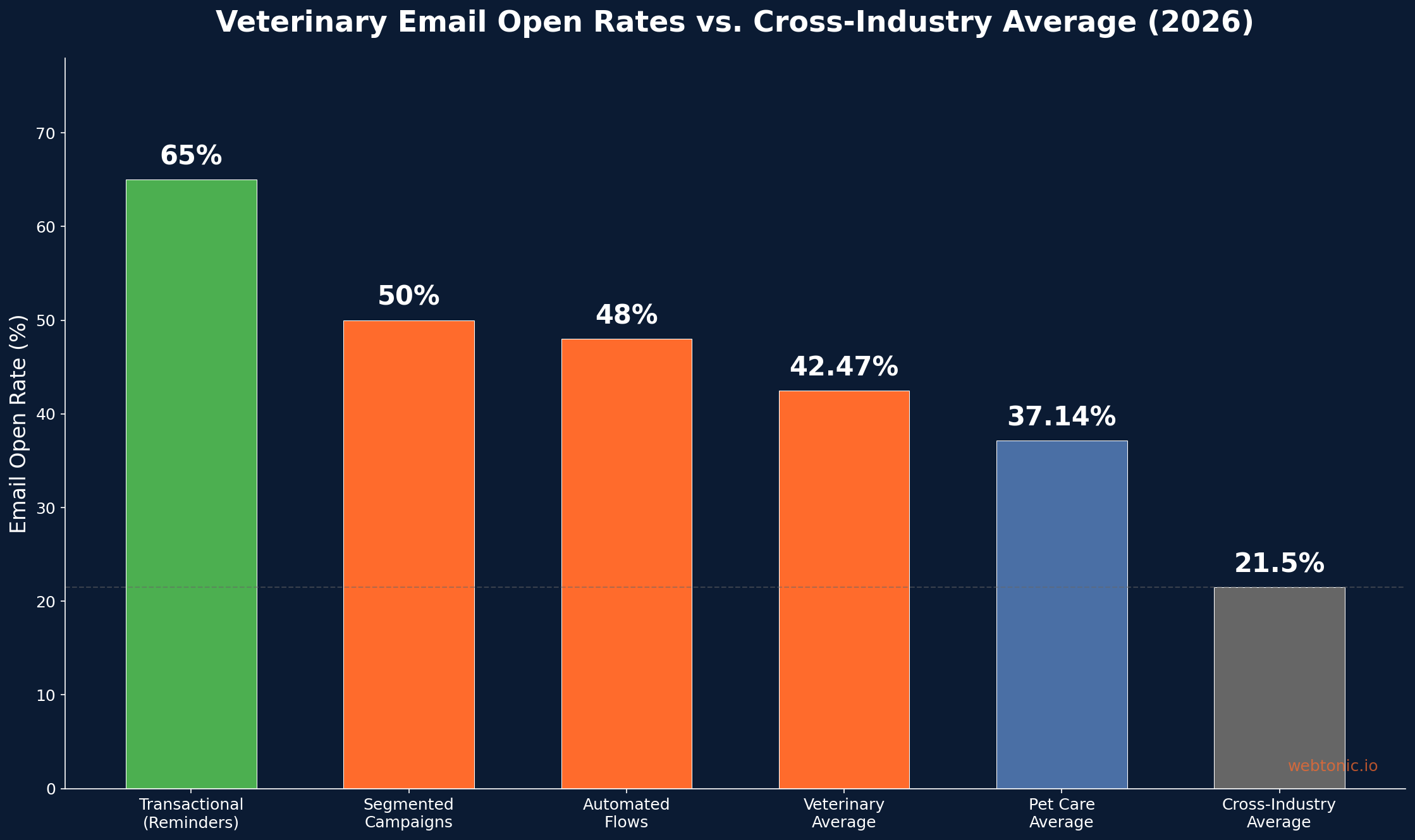
- Veterinary email open rates reach 38.4–45.8%, nearly double the cross-industry average of 21.5%, making veterinary one of the highest-performing email verticals.
- Email ROI in veterinary is estimated at $38–$42 per $1 spent, exceeding the general marketing average and rivaling the best-performing DTC verticals.
- Vaccination reminder automation increases compliance by 30–40%, with clinics recouping implementation costs within 60–90 days from recovered appointment revenue.
- Only 33% of veterinary clinics use email marketing regularly, despite 48% of pet owners responding to reminder emails — representing a massive untapped channel.
- Segmented, personalized veterinary emails achieve 50% open rates compared to 15–20% for generic blasts, while AI-powered segmentation by species, breed, and visit history is now practical for independent practices.
- Automated email flows (welcome, reminders, reactivation) deliver open rates up to 48–65%, and a three-touch sequence (email → SMS → overdue notice) consistently outperforms any single-channel approach.
Veterinary Email Marketing Benchmarks at a Glance
Email marketing in the veterinary space dramatically outperforms most industries — and the data makes the case impossible to ignore. With open rates nearly double the cross-industry average and an estimated ROI of $38–$42 per dollar spent, email is the most cost-effective digital channel available to veterinary practices. The benchmarks below provide the performance baseline every clinic should measure against.
| Metric | Veterinary Benchmark | Cross-Industry Avg. | Source |
|---|---|---|---|
| Open Rate (Veterinary/Animal) | 42.47–45.84% | 21.5% | Benchmark Email / Promodo |
| Open Rate (Pet Care) | 37.14–39.5% | 21.5% | Promodo / CuFinder |
| Click-Through Rate | 1.5–2.8% | 1.45% | Stethon / CuFinder |
| Unsubscribe Rate | 0.18–0.47% | 0.26% | CuFinder / Benchmark Email |
| Hard Bounce Rate | 0.2–0.6% | 0.40% | CuFinder |
| Transactional Email Open Rate | Up to 65% | ~40% | CuFinder 2026 |
| Automated Flow Open Rate | 48% | ~35% | CuFinder 2026 |
| Email ROI | $38–$42 per $1 | ~$36 per $1 | Stethon Digital 2026 |
The gap between veterinary/animal sector open rates (42.47–45.84%) and the cross-industry average (21.5%) reflects the inherently personal nature of pet healthcare communication. Pet owners open emails about their animals' health with the same urgency they apply to their own medical correspondence — because for most owners, pets are family members, not products. This emotional connection creates a uniquely receptive audience that no other marketing channel can match at this scale.
Email Automation and Vaccination Reminder Performance
The most impactful application of email marketing in veterinary is automated reminders — particularly vaccination compliance sequences. US Tech Automations reports that vaccination reminder automation increases compliance by 30–40%, closing a 25–35% compliance gap that exists at most independent practices according to AVMA 2024 practice performance data. The revenue implications are direct: every missed vaccination is a missed appointment worth $75–$200.
| Automation Type | Performance Metric | Benchmark |
|---|---|---|
| Vaccination Reminders | Compliance Lift | 30–40% |
| Vaccination Reminders | Booking Conversion | 60–70% |
| Lapsed Client Reactivation | Reactivation Rate (90-day) | 8–15% |
| Welcome Sequence | Open Rate | 48% |
| Segmented Campaigns | Open Rate | ~50% |
| Generic Blast Newsletters | Open Rate | 15–20% |
| Three-Touch Sequence | Combined Response Rate | 70–85% |
The three-touch reminder sequence (email → SMS → overdue notice) consistently outperforms single-channel approaches, with combined response rates of 70–85%. AI-powered platforms now enable practices to segment by species, breed, age, and visit history — sending cat dental health reminders only to cat owners, for example — which drives 50% open rates on segmented sends versus 15–20% on generic blasts. The segmentation capability transforms email from a broadcast channel into a personalized patient communication tool.
Lapsed client reactivation is the second-highest-impact automation: Lilach Bullock reports that a three-email reactivation sequence targeting clients who have not visited in 18+ months achieves 8–15% reactivation rates within 90 days. For a practice with 500 lapsed clients, that represents 40–75 recovered patients — each worth hundreds in appointment revenue and potentially thousands in lifetime value.
Cost of Manual vs. Automated Email Systems
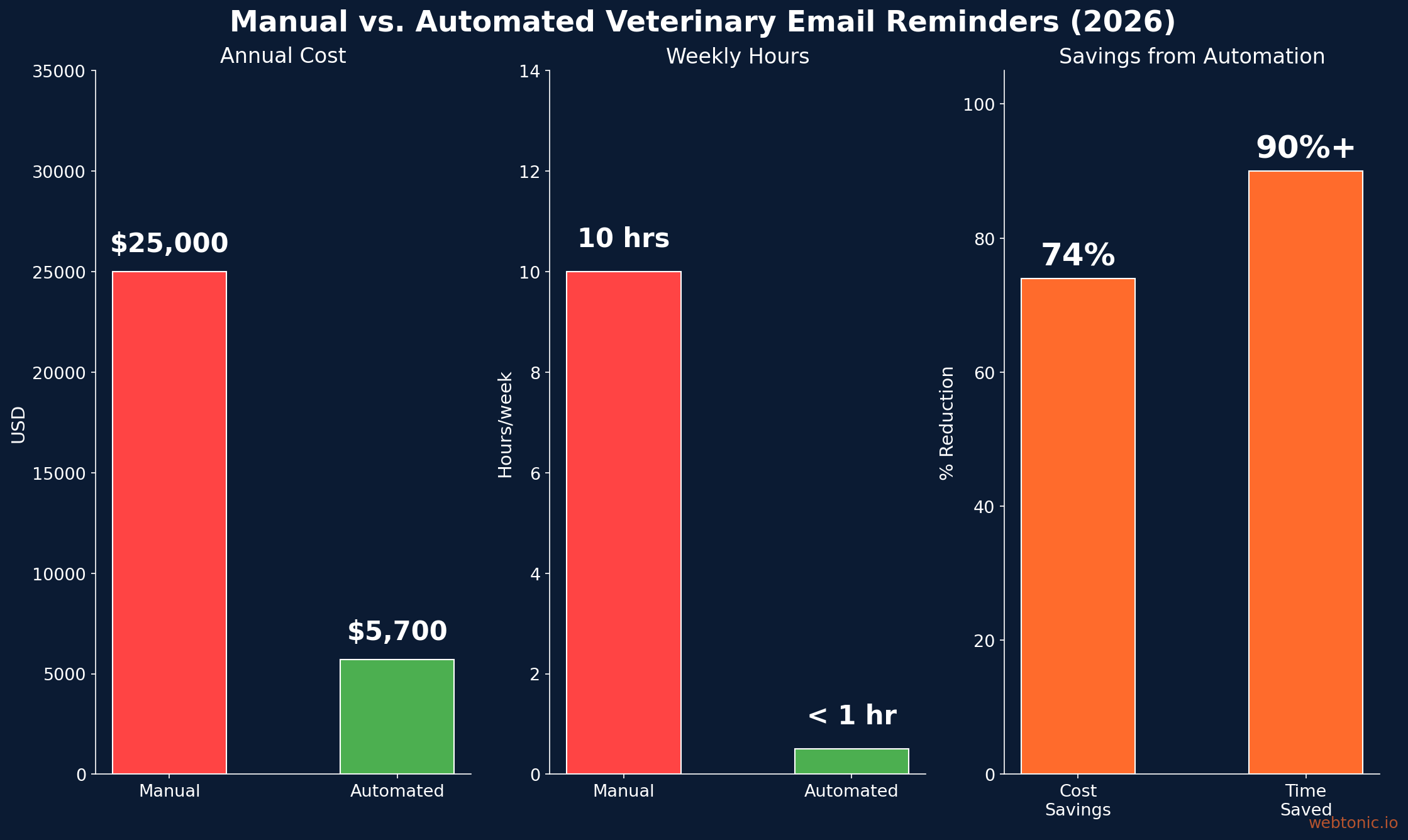
The financial case for email automation in veterinary is compelling and straightforward. Manual phone-tag reminders cost staff 8–12 hours per week at a typical 3-doctor practice, translating to $18,000–$32,000 per year in blended staff costs at $22–$28 per hour. Automation platforms range from $199–$699/month depending on features and practice size.
| Cost Category | Manual Process | Automated Process | Savings |
|---|---|---|---|
| Annual Reminder Staff Cost | $18,000–$32,000 | $3,000–$8,400 | Up to 74% |
| Staff Hours/Week on Reminders | 8–12 hours | < 1 hour | 90%+ time reclaimed |
| Automation Platform Cost/Mo. | N/A | $199–$699 | Varies by tier |
| ROI Timeline | N/A | 60–90 days | Fastest vet tech ROI |
| SMS Per-Message Cost | N/A | $0.008–$0.012 | ~$50–$90/mo for 2K patients |
The 60–90 day ROI timeline makes vaccination reminder automation one of the fastest-returning technology investments in veterinary practice — faster than most PIMS upgrades, website redesigns, or marketing campaigns. Clinics that automate reminders recoup tool costs from recovered appointment revenue alone, before accounting for the staff time redirected to patient care. The hidden cost most vendors omit is the PIMS connector fee ($50–$150/month) and SMS overage charges ($0.008–$0.012 per message), which should be factored into the total cost comparison.
Email Performance by Platform and Vertical
Email service providers report consistent veterinary outperformance across all engagement metrics. Klaviyo's pet products benchmarks and Benchmark Email's industry data both confirm that veterinary and pet care emails significantly exceed cross-industry averages on every measured dimension.
| Platform | Email Metric | Veterinary/Pet | Cross-Industry |
|---|---|---|---|
| Klaviyo | Open Rate | 32–40% | 25–30% |
| Klaviyo | Click Rate | 3.5–5.5% | 2.5–3.5% |
| Klaviyo | Revenue/Recipient | $0.15–$0.25 | $0.10–$0.15 |
| Benchmark Email | Open Rate (Vet) | 42.47% | 27.85% (avg) |
| Benchmark Email | Click Rate (Vet) | 1.81% | 1.45% (avg) |
| Broadcast Sends | Revenue/Recipient | $0.20–$0.60 | $0.10–$0.20 |
| Lifecycle Flows | Revenue/Recipient | $0.80–$2.50 | $0.40–$0.80 |
The revenue-per-recipient gap is especially notable: lifecycle-triggered flows (replenishment, vaccination reminders, wellness plan renewals) deliver $0.80–$2.50 per recipient versus $0.20–$0.60 for broadcast sends. This 4x multiplier explains why automated sequences outperform newsletters — each email is triggered by a specific pet healthcare event rather than sent on a calendar schedule. Everything PR's 2026 Pet Email Marketing Playbook confirms that the highest-performing pet brands are shifting budget from broadcast to lifecycle automation at a rate of 60/40 allocation.
Email Adoption Gaps in Veterinary
Despite the compelling performance data, email marketing remains dramatically underutilized across the veterinary industry. Marketing LTB's 2026 survey reveals the adoption gap in stark terms:
- 33% of clinics use email marketing regularly — leaving two-thirds of practices without a systematic email program despite industry-leading open rates.
- 31% send email newsletters — typically monthly, generic, and unsegmented, which explains why many practices see low engagement and conclude email does not work.
- 33% run seasonal email campaigns — usually around holidays and flea/tick season, missing year-round engagement opportunities across vaccination schedules, wellness plans, and dental care.
- 26% use SMS appointment reminders — often as standalone tools without integration to the email workflow, creating fragmented patient communication.
- 48% of pet owners respond to reminder emails — yet the majority of practices still rely on manual phone calls for recall, spending 8–12 hours weekly on tasks automation handles in minutes.
- 24% use automated review requests — despite 72% of pet owners reading at least 5 reviews before booking, making post-visit review solicitation a high-impact automated workflow.
The disconnect between high pet owner email responsiveness and low practice adoption represents one of the largest untapped opportunities in veterinary marketing. Practices that implement even basic email automation — vaccination reminders and post-visit review requests — capture value their competitors are leaving on the table.
AI-Powered Email Personalization
Lilach Bullock's analysis of AI email marketing for veterinary clinics identifies the key shift: practices sitting on rich PIMS data (species, breed, age, treatment history, purchase records) can now use AI tools to segment and personalize at scale without dedicating staff time. The performance difference is dramatic — segmented, personalized sends achieve approximately 50% open rates versus 15–20% on generic blasts.
Practical AI applications in veterinary email include species-specific content (dog dental health to dog owners only), breed-specific health alerts (hip dysplasia screening reminders for large-breed owners), age-based wellness plans (senior pet checkup sequences), and treatment-history-driven follow-ups (post-surgery care instructions). The click-through rates on relevant seasonal or reminder content reach 6–12%, compared to 1.5–2.8% for standard campaign emails. This performance gap is widening as AI segmentation tools become more accessible to independent practices that previously lacked the technical resources to implement granular personalization.
Email Marketing vs. Other Veterinary Channels
How does email compare to other digital marketing channels available to veterinary practices? The data positions email as the highest-ROI channel available, particularly for client retention and reactivation:
- Email ROI ($38–$42 per $1) far exceeds Google Ads ROI at veterinary CPA levels of $48 search / $65 social — making email the most cost-efficient channel on a per-dollar basis.
- Email open rates (38.4–45.8%) outperform social media organic reach, which averages 5–8% of followers on Facebook and continues to decline.
- Automated email sequences require minimal ongoing effort compared to social media content creation — once configured, vaccination and reactivation flows run indefinitely.
- Email excels at retention and reactivation while Google Ads excels at new patient acquisition — the two channels are complementary, not competing. Best-in-class practices invest in both.
- SMS outperforms email on urgency — pet retailers report ~25% click rates on SMS versus 2–5% CTR on email — but email provides richer content, better deliverability, and higher revenue per touchpoint at scale.
Related reading
- Rehab & Addiction Treatment Email Marketing: 47+ Statistics for 2026
- Solar Energy Email Marketing Statistics: 2026 Benchmarks, Open Rates & ROI Data
- Health & Wellness Email Marketing Statistics 2026: Open Rates, Revenue & Automation Benchmarks
- Email Marketing services at Web Tonic
Frequently Asked Questions
What is the average email open rate for veterinary clinics?
Veterinary and animal-sector email open rates range from 38.4% to 45.84% depending on the source and segment — Benchmark Email reports 42.47% for veterinary specifically, and Promodo reports 45.84% for the animal/vet niche. This is nearly double the cross-industry average of 21.5%. Transactional emails (vaccination reminders, appointment confirmations) can reach 65%.
How effective are vaccination reminder emails for veterinary practices?
Vaccination reminder automation increases compliance by 30–40% according to AVMA practice benchmarks. A three-touch sequence (email → SMS → overdue notice) achieves 70–85% combined response rates, and vaccination reminder conversion (email to booked appointment) reaches 60–70%. Clinics typically recoup automation costs within 60–90 days from recovered appointment revenue alone.
What is the ROI of email marketing for veterinary practices?
Veterinary email ROI is estimated at $38–$42 per $1 spent, above the general marketing average of approximately $36 per dollar. The ROI is highest for automated lifecycle flows (vaccination reminders, lapsed client reactivation, wellness plan renewals) which generate $0.80–$2.50 revenue per recipient compared to $0.20–$0.60 for broadcast newsletters.
How can a veterinary clinic improve email click-through rates?
Segment by species, breed, and visit history to send relevant content — AI-segmented campaigns achieve 6–12% CTR versus 1.5–2.8% for generic sends. Include direct booking links in every email, use personalized subject lines referencing the pet's name, and send at optimal frequency (2–3 emails per month rather than weekly blasts that drive unsubscribes).
What email automation platform is best for veterinary clinics?
The best platform depends on practice size and needs. Basic SMS-only tools ($79–$149/month) suit solo practices with low volume. PIMS-integrated platforms ($199–$499/month) work for 2–4 doctor practices needing email plus SMS with practice management sync. Full-stack solutions ($299–$699/month) provide PIMS integration, multi-channel delivery, booking links, overdue escalation, and analytics for larger groups.
Sources
cufinder.io — Veterinarians Industry Marketing Benchmarks 2026
stethondigitalmarketing.com — 100+ Veterinary Marketing Statistics 2026
foundrycro.com — DTC Pet Marketing Benchmarks 2026
marketingltb.com — Veterinary Marketing Statistics 2026
lilachbullock.com — AI Email Marketing for Veterinary Clinics
ustechautomations.com — Veterinary Vaccination Reminder Automation 2026
everything-pr.com — Pet Email Marketing: The 2026 Playbook
cufinder.io — Pet Care Industry Marketing Benchmarks 2026
goshdigital.co — Klaviyo Benchmarks by Industry 2026


