



Table of contents
Key Takeaways
- Veterinary practices allocate 4–8% of gross revenue to marketing, with growth-phase clinics investing up to 10–15% of annual revenue to build market share.
- 52% of new veterinary clients come from Google Search, making paid and organic search the dominant acquisition channel for practices of all sizes.
- The $158 billion US pet industry continues to grow, with Americans spending record amounts on pet healthcare and creating an increasingly competitive digital landscape.
- Google Ads CPC for veterinary averages $3.45 with a 12.6% conversion rate — the highest CVR of any local service industry, yet only 29% of clinics invest in paid ads.
- 67% of mobile searches for veterinary services lead to same-day action, underscoring the urgency-driven nature of pet healthcare marketing.
- 42% of clinics report digital marketing as their fastest-growing channel, with social media engagement rates for pet content (4.2% on TikTok) far exceeding cross-industry averages.
Veterinary Digital Marketing Benchmarks at a Glance
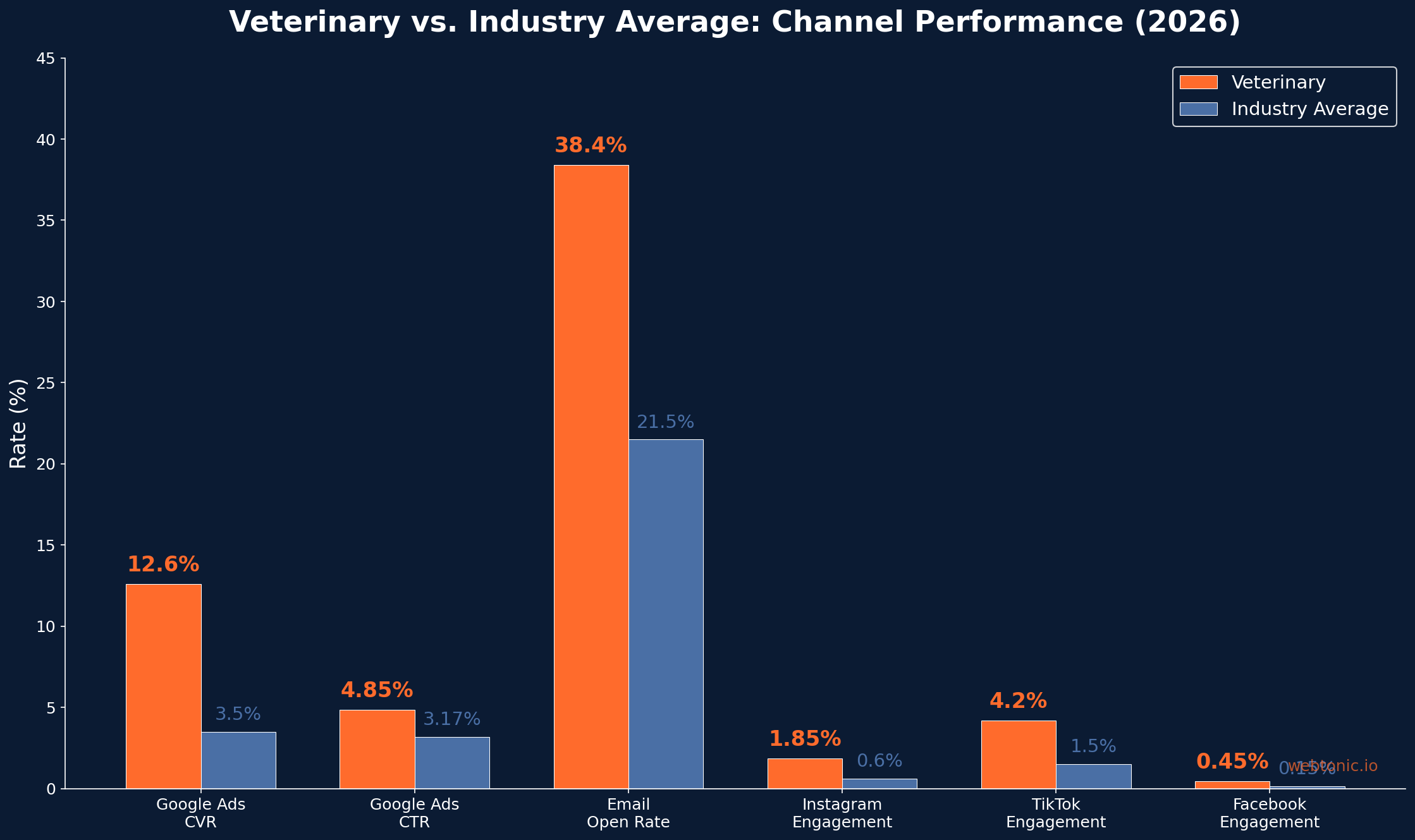
The veterinary digital marketing landscape in 2026 is defined by high-intent search behavior, mobile dominance, and pet content that dramatically outperforms cross-industry averages on social platforms. This table captures the core channel benchmarks every practice should measure against when evaluating their marketing performance.
| Channel | Key Metric | Veterinary Benchmark | Source |
|---|---|---|---|
| Google Ads | CPC | $3.45 | CuFinder 2026 |
| Google Ads | CVR | 12.6% | CuFinder 2026 |
| Google Ads | CTR | 4.85% | CuFinder 2026 |
| Facebook Ads | CPC | $0.61–$1.15 | Promodo / CuFinder |
| Facebook Ads | CPA | $15.29 | Promodo 2026 |
| Organic Search | Traffic Share (US) | 46.5% | CuFinder 2026 |
| Engagement Rate | 1.85% | CuFinder 2026 | |
| TikTok | Engagement Rate | 4.2% | CuFinder 2026 |
| Open Rate | 38.4% | CuFinder 2026 | |
| CTR | 2.8% | CuFinder 2026 |
The standout number is the 12.6% Google Ads conversion rate — nearly triple the local services average. Combined with a $3.45 CPC that remains well below dental ($7–8) or personal injury law ($50+), veterinary paid search delivers one of the most efficient cost-per-acquisition ratios in any healthcare-adjacent vertical. Yet only 29% of clinics invest in paid advertising, creating a significant first-mover opportunity for practices willing to enter the auction.
Marketing Budget Allocation and Spend
How much should a veterinary practice spend on marketing? Industry data consistently points to 4–8% of gross revenue as the established-practice baseline, with newer clinics investing up to 10–15% during their growth phase. A practice grossing $1M annually should expect a $20,000–$40,000 marketing budget, according to Sprout Sage Solutions' 2026 veterinary marketing cost analysis.
| Budget Range | Revenue Tier | Annual Budget | Allocation |
|---|---|---|---|
| Established Practice | $1M–$2M revenue | $20,000–$40,000 | 4% of gross |
| Growth-Phase Clinic | $500K–$1M revenue | $25,000–$80,000 | 5–8% of gross |
| New Practice | Pre-revenue to $500K | $50,000–$75,000 | 10–15% of gross |
| Multi-Location Group | $5M+ revenue | $200,000–$400,000 | 4–8% of gross |
Adwave's recommended channel allocation for veterinary practices puts Google Ads at 35–40% of the digital budget (approximately $280–$800/month), with the remainder split among SEO, social media, email, and reputation management. The cost per lead for veterinary averages $44 CAD according to Get X Media, with clicks at $5 CAD and the highest conversion rate (16.22%) of any industry they benchmark. These numbers suggest veterinary is one of the most budget-efficient verticals for paid acquisition.
The budget gap between independent practices and corporate consolidators is widening. Multi-location groups backed by private equity (Mars, NVA, VCA) deploy $200,000–$400,000+ annually with centralized analytics, while the median independent practice spends under $40,000. The competitive response for independents is not to outspend but to outmeasure — using smarter attribution to extract more patients per dollar from the same channels.
Pet Owner Digital Behavior
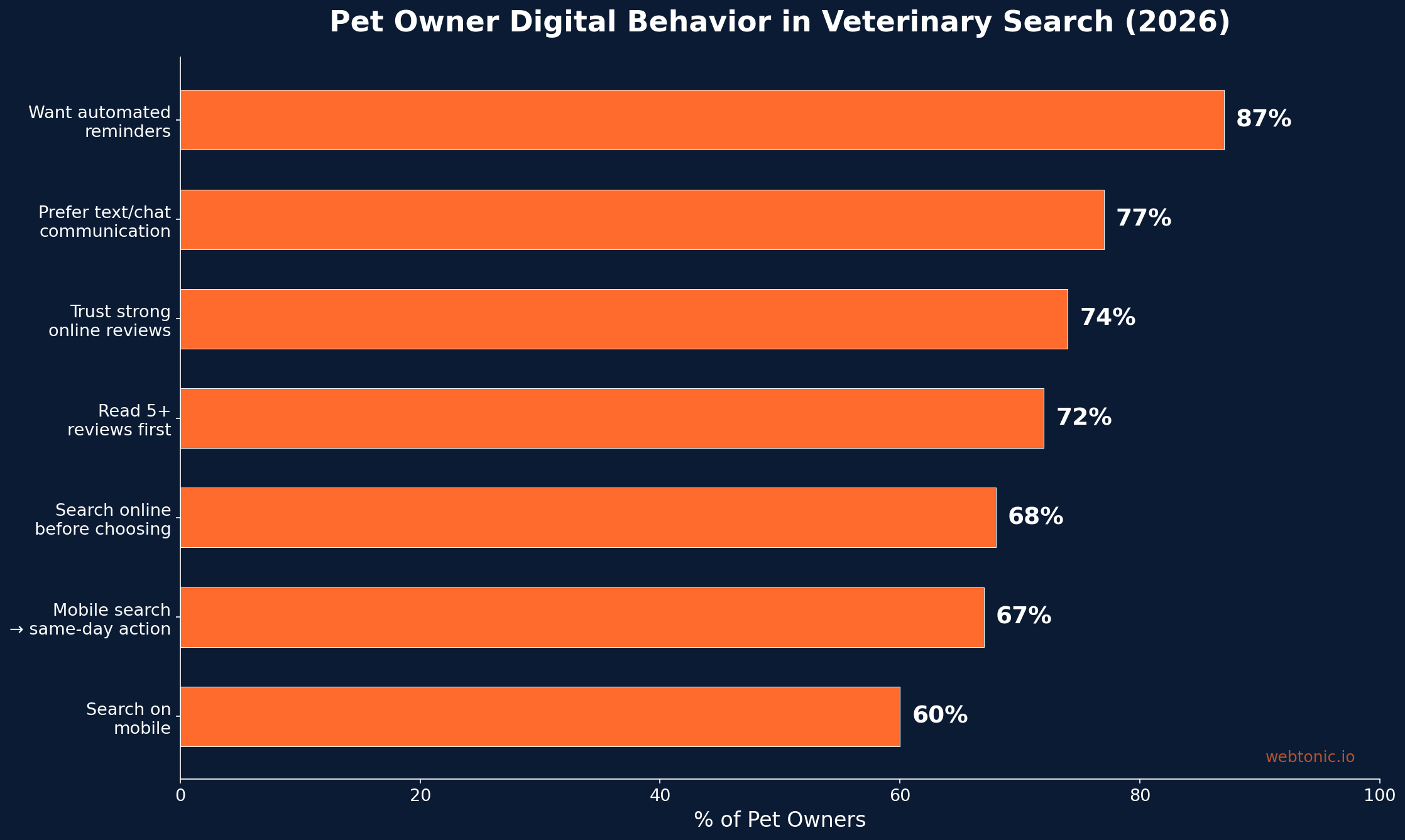
Understanding how pet owners search, compare, and choose veterinary services is the foundation of any effective digital marketing strategy. The data reveals a population that is mobile-first, review-dependent, and increasingly impatient.
| Pet Owner Behavior | Percentage | Source |
|---|---|---|
| Search online before choosing a vet | 68% | Marketing LTB 2026 |
| Trust clinics with strong online reviews | 74% | Marketing LTB 2026 |
| Read at least 5 reviews before booking | 72% | Marketing LTB 2026 |
| Prefer clinics with online booking | 41% | Marketing LTB 2026 |
| Search for vet services on mobile | 60% | Marketing LTB 2026 |
| Mobile search leads to same-day action | 67% | Marketing LTB 2026 |
| Prefer clinics with transparent pricing | 58% | Marketing LTB 2026 |
| Want 24/7 online booking access | 78% | Stethon Digital 2026 |
| Prefer text/chat communication | 77% | Stethon Digital 2026 |
| Want automated reminders | 87% | Stethon Digital 2026 |
The 67% same-day action rate from mobile searches is particularly striking — it is one of the highest urgency signals in local services marketing. When a pet is sick, the owner does not browse; they search, call, and book within minutes. This urgency explains why Google Ads converts at 12.6% and why clinics without online booking or mobile-optimized websites lose patients to competitors who make the conversion frictionless. The 87% who want automated reminders underscores the opportunity in retention marketing, not just acquisition.
Social Media Marketing Performance
Pet content is a natural fit for visual social platforms, and the engagement numbers reflect this advantage clearly. Veterinary practices consistently outperform cross-industry averages, particularly on Instagram and TikTok where pet-related content is inherently shareable and emotionally engaging.
| Social Platform | Engagement Rate | Clinic Usage | Key Stat |
|---|---|---|---|
| 0.45% | 63% top channel | 38% of owners follow vet clinics | |
| 1.85% | 39.9% link from site | 3x the 0.60% industry average | |
| TikTok | 4.2% | 19% of clinics active | Pet searches grew 180% since 2023 |
| YouTube | $0.01–$0.03 CPV | 23% use for education | 27% use video marketing overall |
TikTok pet product searches grew 180% from 2023 to 2025 (Accio 2025), and 63% of pet owners follow pet-focused influencers (5W PR 2026). Despite this, only 19% of veterinary clinics actively use TikTok, creating a significant first-mover advantage for early adopters. The 4.2% engagement rate dwarfs the 0.60% industry average — making TikTok the highest-engagement platform available to vet practices by a wide margin.
Facebook remains the workhorse: 63% of clinics report it as their top social channel, and 49% of pet owners trust clinics with active social media posts. Instagram's 1.85% engagement rate is 3x the industry average, driven by pet photos, before/after treatment content, and team introductions. The practices seeing the best returns combine organic community building on Facebook with reach amplification on TikTok/Reels and paid retargeting on Meta Ads.
SEO and Organic Search Performance
Authority Specialist's 2026 benchmark study analyzed 34 veterinary practices and found that most need 9–12 months before organic traffic contributes meaningfully to new client volume in competitive metro markets. Local SEO dominates the veterinary search landscape: 46% of clients discover clinics via maps apps, and "veterinarian near me" remains the highest-volume search query in the category.
From a website infrastructure standpoint, only 39% of clinics invest in local SEO according to Marketing LTB. iVET360's data shows that just 15.2% of mid-tier practices are properly SEO-optimized, compared to 95% of top-tier practices. The gap between leaders and laggards in veterinary organic search visibility is wider than in most local service industries, meaning the opportunity for improvement is substantial for any practice willing to invest in the fundamentals.
The $158 Billion Pet Industry Context
All veterinary digital marketing operates within the broader $158 billion US pet industry (American Pet Products Association, 2025), projected to reach $165 billion in 2026. US pet ad spending reached $5.2 billion in 2023, a 10% increase from the prior year. Pet brands now spend 12% of marketing budgets on digital ads, up from 8% in 2020, according to ZipDo's Digital Transformation in the Pet Industry report.
This macro growth creates both opportunity and competition. Corporate veterinary consolidators — Mars Veterinary Health, NVA, VCA — bring enterprise-level marketing budgets and analytics that independent practices cannot match dollar-for-dollar. The competitive response for independents is hyper-local targeting, community content, and conversion optimization — areas where small practices can outperform corporate chains through authenticity and creative differentiation.
Digital Marketing Adoption Gaps
The gap between what veterinary practices should do and what they actually do remains wide across multiple digital marketing activities. Each gap represents an untapped channel where early adopters gain outsized returns:
- 44% use content marketing or blogging — yet 60% of pet owners prefer clinics with educational content, and 64% trust clinics with before/after case content.
- 29% invest in paid ads — despite veterinary having the highest Google Ads CVR (12.6%) in local services. The remaining 71% are leaving high-intent patients to competitors.
- 27% use video marketing — even though video-first platforms (TikTok, YouTube, Instagram Reels) deliver the highest engagement rates across all social channels.
- 22% actively manage Google Business Profile weekly — while 46% of new clients discover clinics through maps. Weekly GBP management is one of the lowest-effort, highest-impact activities available.
- 25% use chatbot systems — but 77% of pet owners prefer text/chat communication, making live chat or AI chatbots a conversion rate multiplier.
- 18% use influencer partnerships — despite 63% of pet owners following pet-focused influencers and pet content generating the highest engagement on social platforms.
Frequently Asked Questions
How much should a veterinary practice spend on digital marketing?
Established practices should allocate 4–8% of gross revenue to marketing, while growth-phase or new clinics should invest 5–15%. For a practice grossing $1M annually, that translates to $20,000–$80,000 per year. Google Ads should receive 35–40% of the digital budget given veterinary's industry-leading conversion rate of 12.6 percent.
What is the most effective digital marketing channel for veterinary clinics?
Google Search (paid and organic combined) drives 52% of new clients, making it the most effective acquisition channel. However, email marketing delivers the highest ROI per dollar spent with a 38.4% open rate, and social media builds the long-term trust that influences 49% of pet owners who check a clinic's social presence before booking.
What social media platform works best for veterinary marketing?
Facebook remains the top platform with 63% of clinics using it as their primary social channel. However, TikTok delivers the highest engagement at 4.2% — 7x the industry average. For practices with limited budgets, starting with Facebook for community building and adding TikTok or Instagram Reels for reach provides the best balance of effort and results.
How do corporate veterinary groups compare to independents in digital marketing?
Corporate consolidators (Mars, NVA, VCA) bring enterprise-level marketing budgets and centralized analytics, but independent practices can compete through hyper-local SEO, authentic community content, and faster conversion paths. Get X Media reports that veterinary has the highest conversion rate of any industry they benchmark (16.22%), and this rate favors practices that make booking frictionless regardless of organizational size.
What percentage of pet owners use AI to find veterinary clinics?
As of 2026, 24% of US pet owners have used AI assistants (ChatGPT, Google AI Overviews, Perplexity) during veterinary research, according to the AVMA's 2026 Pet Owner Survey. Among pet owners under 40, the figure rises to 31%. AI-driven clinic discovery is growing fastest for emergency, exotic, and specialty referral queries where urgency drives pet owners to seek quick text-based answers.
Sources
cufinder.io — Veterinarians Industry Marketing Benchmarks 2026
marketingltb.com — Veterinary Marketing Statistics 2026
stethondigitalmarketing.com — 100+ Veterinary Marketing Statistics 2026
getxmedia.com — Veterinary Marketing Benchmarks 2026
adwave.com — Veterinary Advertising Channels 2026
openlens.com — Do Pet Owners Use ChatGPT to Find Vets
worldmetrics.org — Marketing in the Pet Industry Statistics
americanpetproducts.org — American Pet Products Association
authorityspecialist.com — Veterinary SEO Benchmarks 2026


