Table of contents

No study prices video marketing for urgent care or primary care specifically, so this page states that gap up front and builds the budget from Wyzowl's 2026 cross-industry survey of 266 respondents - the only recurring, named-methodology video marketing dataset available - then layers in the operational facts (visit time, volume, access) that should shape what the video says, which nobody publishes as a "healthcare video" line item.
Key Takeaways
- No published study prices video marketing by healthcare specialty - treat every figure below as cross-industry unless labeled otherwise.
- 91% of businesses use video as a marketing tool in 2026, per Wyzowl.
- 93% of marketers call video an important part of strategy.
- 46% of marketers allocate a third or less of budget to video.
- 17% of marketers do not track their video spend at all.
- 41% of marketers have spent on video ads this year, up from 36% last year.
- 82% of marketers report a good ROI from video, down from 93% at its peak.
- 85% say video has helped generate leads directly.
- 96% of consumers have watched an explainer video to learn about a product or service.
- 63% would rather watch a short video than read an article, beating every other format.
- 71% rate 30-second-to-2-minute videos as most effective.
- 68% of video marketers created explainer videos in the past year, the second most common type.
- 51% of video is live action against 23% animated.
- 59% of businesses create video in house, with 32% using a mix of internal and external teams.
- Average urgent care visit time is 56 minutes against a median ED wait of 150 minutes.
- 89.4% of the US population is within a 20-minute drive of an urgent care center.
- Average daily visit volume reached 33.96 patients per center in 2025.
- 6% of adults had at least one urgent care visit in the past 12 months.
There is no healthcare-specific video budget study - here is why
Video marketing spend is tracked at the marketer level, not the specialty level. Wyzowl's 2026 report - based on 266 respondents surveyed in late 2025, split between marketing professionals and consumers, in its twelfth consecutive year of data - is the closest thing to a recurring, methodologically transparent benchmark, and it does not break results out by healthcare vertical. Any figure claiming to be "the urgent care video marketing budget for 2026" is not sourced to a real study; the honest position is to build from the cross-industry number and adjust for what a clinic's video actually has to do.
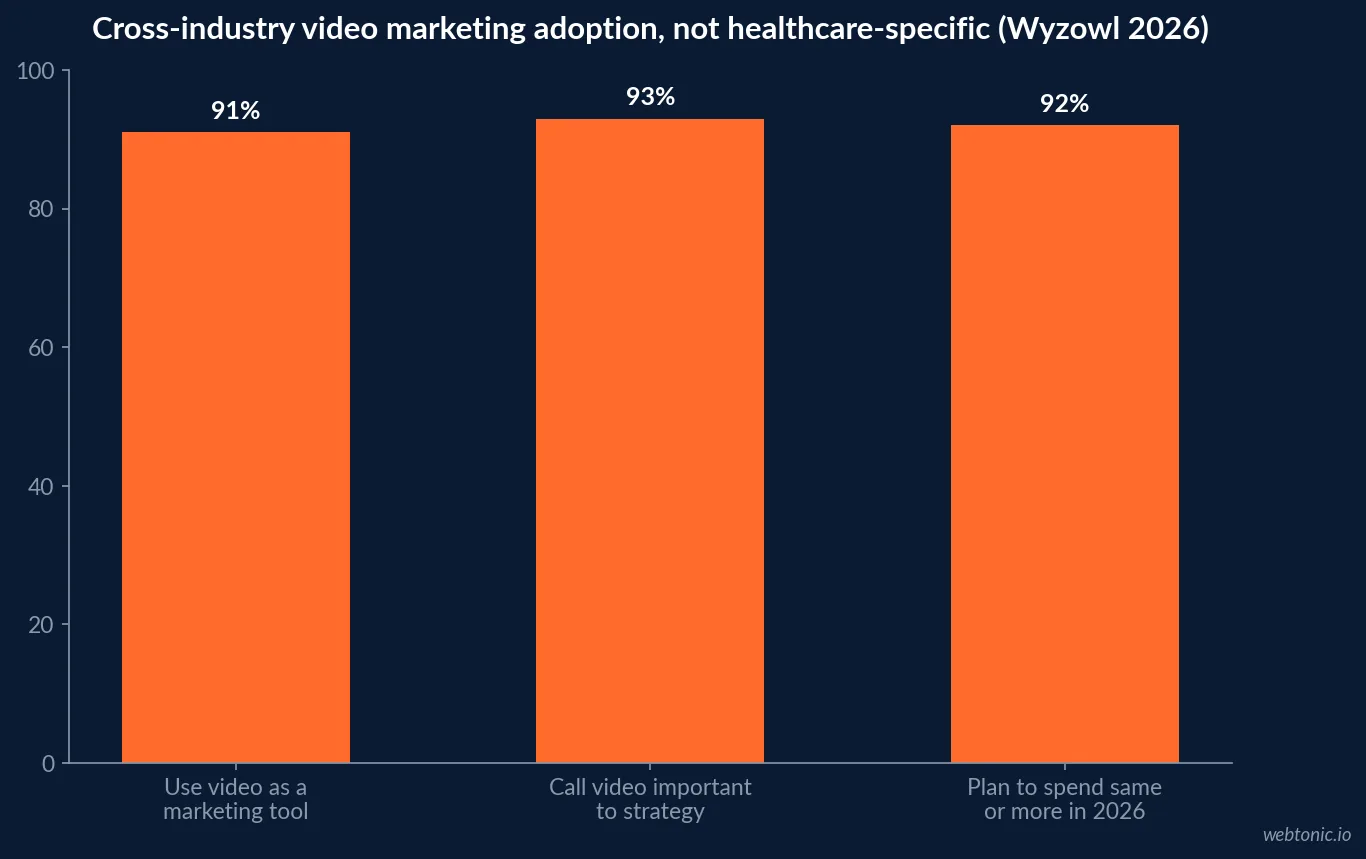
| Cross-industry video metric (Wyzowl, 2026) | Figure | What it means for a clinic budget |
|---|---|---|
| Businesses using video as a marketing tool | 91% | Not having video is now the outlier, not the norm |
| Marketers calling video important to strategy | 93% | Video competes for core budget, not a nice-to-have line |
| Marketers allocating a third or less of budget to video | 46% | A reasonable starting ceiling to test against |
| Marketers who do not track video spend | 17% | Set a tracked line item from day one, unlike a sixth of the market |
| Marketers who spent on video ads this year | 41% | Paid distribution is now a minority-but-growing practice |
Why the ROI case still applies to a first-visit decision
The strongest argument for spending anything on video is not industry-specific, but it maps well onto healthcare's particular problem: uncertainty before a first visit. Wyzowl reports 82% of marketers say video marketing has given them a good ROI, and on the consumer side, 96% have watched an explainer video to learn about a product or service and 63% say they would rather watch a short video than read an article, use an ebook, or sit through a sales call or webinar when learning something new.
A patient choosing between clinics is making exactly that kind of learning decision. The format Wyzowl's data says people prefer generally is also the format best suited to answering "what happens when I walk in," which is the actual question a first-time urgent care or primary care visitor is trying to answer.
| Consumer-side stat (Wyzowl, 2026, cross-industry) | Figure |
|---|---|
| Have watched an explainer video to learn about a product/service | 96% |
| Would rather watch a short video than read an article | 63% vs 12% for articles |
| Say video quality affects trust in a brand | 89% |
| Rate 30-second-to-2-minute videos as most effective | 71% |
| Have been convinced to buy after watching a video | 85% |
What the video should actually say for each specialty
This is where the cross-industry data has to hand off to specialty facts. For urgent care, the Urgent Care Association reports an average visit time of 56 minutes against a median emergency department wait it cites at 150 minutes, 89.4% of the population within a 20-minute drive, and an average daily visit volume of 33.96 patients per center in 2025. A 45-second video that shows a real waiting room, states the average wait, and points to a map is doing something a family-medicine video does not need to: reassuring a comparison-shopping, mid-symptom viewer.
Primary care's video job is closer to relationship-building - provider introductions, what a first appointment covers, how to switch a usual source of care - because CDC/NCHS data shows the share of adults naming a doctor's office as their usual source of care rises with age, meaning the video is competing for a longer-term decision, not a same-day one.
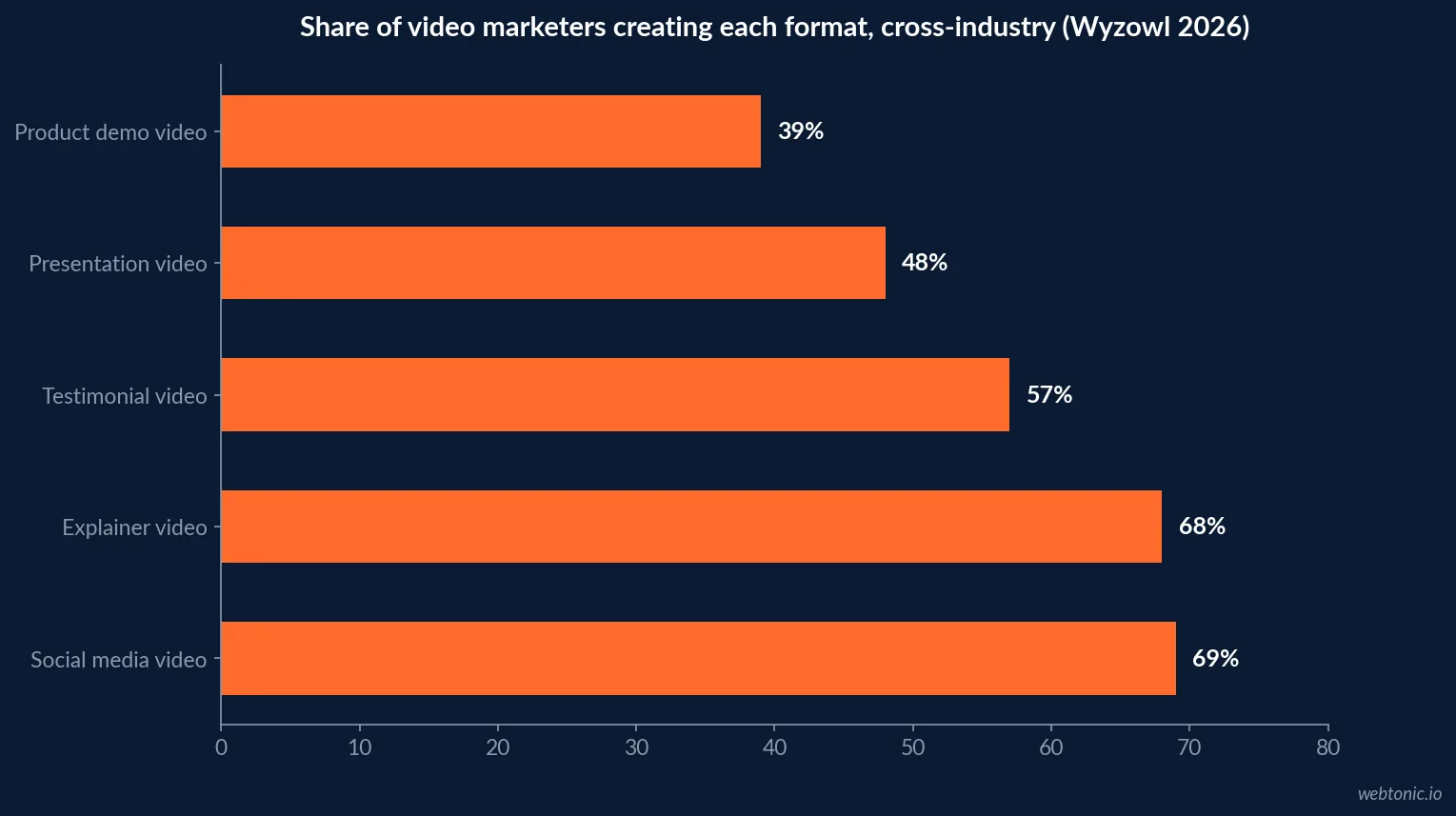
| Video type (Wyzowl, 2026, cross-industry share of marketers creating it) | Best fit |
|---|---|
| Explainer video - 68% | What to expect on a first urgent care visit |
| Testimonial video - 57% | Primary care provider trust, subject to FTC/state-board rules |
| Social media video - 69% | Wait-time or hours updates, seasonal (flu season) reminders |
| Presentation video - 48% | New-patient onboarding for a primary care practice |
| Product demo video - 39% | Portal/app walkthrough for scheduling or check-in |
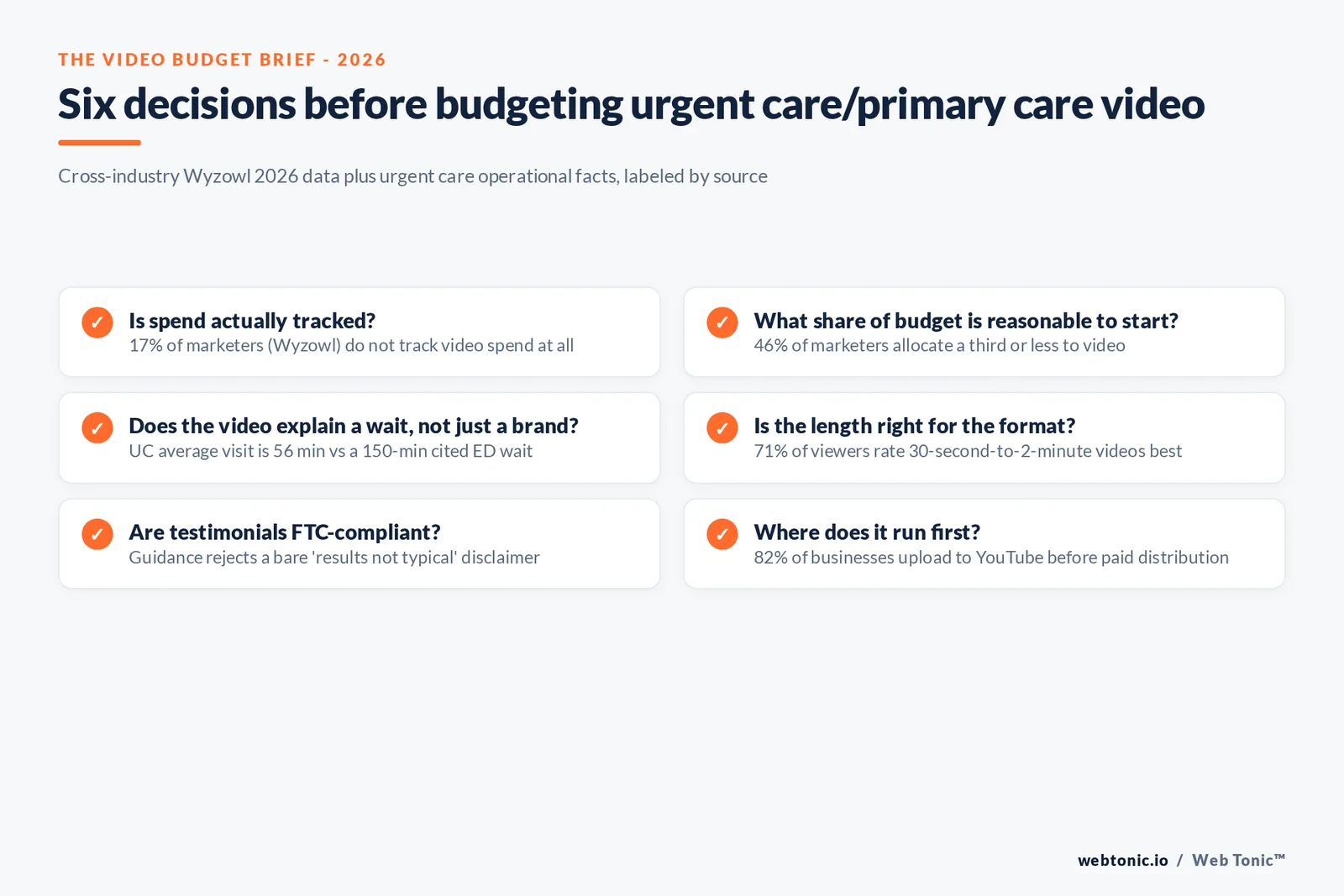
What "spending the same or more" actually funds
Wyzowl's 2026 data shows 92% of marketers plan to spend around the same or more on video in 2026, and separately that 41% have spent money on video ads this year, up from 36% the year before. Read together, that is a market where video budgets are stable to growing and where paid distribution of that video is still a minority practice - meaning a clinic that pairs a modest production budget with even a small paid push is ahead of a large share of the market it is competing with for attention.
Views on whether video itself is getting cheaper or more expensive to produce are split almost evenly: 30% say costs are falling, 32% see no change, and 38% say costs are rising. That split is itself useful context: nobody should assume AI tools have already made healthcare-appropriate video free to produce at scale.
| Video spend signal (Wyzowl, 2026, cross-industry) | Figure |
|---|---|
| Plan to spend the same or more on video in 2026 | 92% |
| Have spent on video ads this year | 41% |
| Say video production costs are increasing | 38% |
| Say video production costs are unchanged | 32% |
| Say video production costs are falling | 30% |
How marketers judge whether it worked
Beyond the headline 82% ROI figure, Wyzowl's respondents measure success through several overlapping signals: 67% quantify ROI through video views, 63% through engagement such as likes and shares, and 52% through leads or clicks directly. For a clinic, the clean equivalent is pairing a view/engagement metric on the hosting platform with a leads/clicks metric on the booking page itself, rather than picking only one.
On outcomes, 93% say video increased user understanding of what they offer, 85% say it helped generate leads, and 83% say it directly increased sales - three different claims that, taken together, describe video doing both an education job and a conversion job at once, which matters for a first-time patient weighing an unfamiliar provider.
| Outcome marketers attribute to video (Wyzowl, 2026) | Figure |
|---|---|
| Increased user understanding of the product/service | 93% |
| Helped generate leads | 85% |
| Directly increased sales | 83% |
| Increased web traffic | 82% |
| Reduced support queries | 57% |
Where the video should live first
Wyzowl's channel data puts YouTube as the most-used hosting platform at 82% of businesses, ahead of every social platform, which mirrors the LinkedIn/TikTok pattern seen elsewhere in healthcare marketing: the video is produced once and distributed to an owned page first, then to social as a secondary placement. For a clinic, the practical order is the booking page itself, then the practice's Google Business Profile (where video is increasingly supported), then YouTube as the canonical host, before any paid social distribution is considered.
What to skip for now
Two categories are lower priority for most urgent care and primary care budgets in this data: customer onboarding videos (created by only 16% of marketers) and app demo videos (17%), both of which assume a patient portal or app maturity most independent practices have not reached yet. Explainer, social and testimonial formats cover the actual decision-stage questions a prospective patient is asking, and are a better first three formats to fund before expanding into onboarding or product-demo content.
Video marketing versus the video visit - two different investments
It is worth separating this page's subject, video marketing content, from telehealth video visits, which is a different investment entirely. AAFP reports more than 80% of family physicians began offering virtual visits during COVID-19, up from a baseline where only 13% of AAFP members had provided a video or telephone visit before March 2020, rising to 94% doing so regularly by that May. That infrastructure - a patient's comfort with a clinical video call - is a separate budget line from the marketing explainer this page is about, but it does suggest patients in this audience are no longer unfamiliar with video as a format for a healthcare interaction, which lowers the adoption barrier for a marketing video too.
Where the compliance line sits
Two rules bind any healthcare video regardless of specialty. The FTC's Health Products Compliance Guidance requires patient testimonials to reflect a typical result, and explicitly rejects a bare "results not typical" disclaimer as sufficient cover. Separately, state medical board advertising rules on testimonials and outcome claims vary by state and should be checked before a testimonial video runs as a paid ad, since a script cleared for organic use is not automatically cleared for paid distribution on every platform.
Our performance creative team builds both the explainer and the compliance pass together rather than as separate steps; see also our note on when paid video spend is worth it before committing distribution budget, or talk to us about scoping a first explainer video against this data.
Frequently Asked Questions
What does urgent care or primary care video marketing actually cost?
No published benchmark prices this deliverable for the specialty, so the honest starting point is the cross-industry data: Wyzowl's 2026 survey of 266 respondents finds 46% of marketers allocate a third or less of their total marketing budget to video, and 17% do not track video spend at all. There is no healthcare-specific split published, so a clinic should treat that 'a third or less' figure as a ceiling to test against, not a target to hit.
Is video marketing worth the budget for a clinic?
The cross-industry signal is strongly positive: 82% of marketers in Wyzowl's 2026 survey report a good ROI from video, 85% say video has helped generate leads, and 96% of consumers say they have watched an explainer video to learn about a product or service before buying. None of that is healthcare-specific, but a first visit to an unfamiliar provider is exactly the kind of high-uncertainty decision explainer video is shown to help with.
What should the video actually explain for an urgent care audience?
What to expect on arrival. The Urgent Care Association reports an average visit time of 56 minutes against a median emergency department wait it cites at 150 minutes, and that 89.4% of the population is within a 20-minute drive of a center - a short video that sets those two expectations (fast, nearby) does more work than a generic 'about us' piece, and Wyzowl's own data shows 71% of viewers rate 30-second-to-2-minute videos as the most effective length.
What can and cannot go in a healthcare explainer video?
The FTC's Health Products Compliance Guidance requires that any patient testimonial reflect a typical result, with results disclaimers alone ("results not typical") explicitly ruled insufficient. State medical board rules on testimonials and before-and-after imagery vary and should be checked before a testimonial-driven video goes into paid rotation, and platform ad policies (TikTok, Meta) separately restrict health-outcome claims regardless of what state law allows.
Where should the video run first: the website or paid social?
The website, based on cross-industry viewing behavior. Wyzowl's 2026 data shows YouTube as the most used hosting platform at 82% of businesses, with the video then embedded on-site; 63% of people say they would rather learn about a product or service by watching a short video than by any other format including text articles or sales calls. A clinic's own booking page is the highest-intent placement before any paid distribution budget is spent.
Sources
Wyzowl - Video Marketing Statistics 2026 (12 years of data)
Urgent Care Association - Urgent Care Data
CDC/NCHS - Source of Usual Health Care for Adults Age 18 and Older: United States, 2024
FTC - Health Products Compliance Guidance