Table of contents
TikTok's own ad policy puts healthcare in a Restricted category that requires advertiser pre-authorization before a campaign can run - a fact that changes the budget conversation before any cost-per-click number does. This page states plainly which figures below are cross-industry benchmarks, since no named study prices TikTok ads for urgent care or primary care specifically.
Key Takeaways
- TikTok classifies healthcare and pharmaceuticals as a Restricted ad category, requiring pre-authorization.
- Guaranteed health-outcome claims are explicitly prohibited under TikTok's Branded Content Policy.
- Before-and-after imagery for health or body transformation is banned under the same policy.
- No named study prices TikTok ads by healthcare specialty - every cost figure below is cross-industry.
- TikTok's average engagement rate by followers is 2.60% across all industries, per Socialinsider.
- US TikTok ad revenue is forecast above $17 billion in 2026, per eMarketer.
- Roughly 1 in 4 American adults is a family caregiver, per AARP's 2025 report.
- 29% of caregivers are "sandwich generation," supporting both children and an older adult.
- Caregiver use of remote monitoring tools rose from 13% in 2020 to 25% in 2025.
- 59 million caregivers report caring for an adult age 18 or older.
- 94% of caregivers in AARP's survey care for an adult, versus a child under 18.
- 39% of Gen Z consumers plan to increase TikTok use in 2026, per Sprout Social's content strategy data.
- 71% of marketers overall plan to increase TikTok investment, the most of any platform tracked.
- 6% of US adults had at least one urgent care visit in the past 12 months.
- Average urgent care visit time is 56 minutes, a fact better suited to caregiver reassurance content than to a claims-heavy ad.
The policy comes before the budget
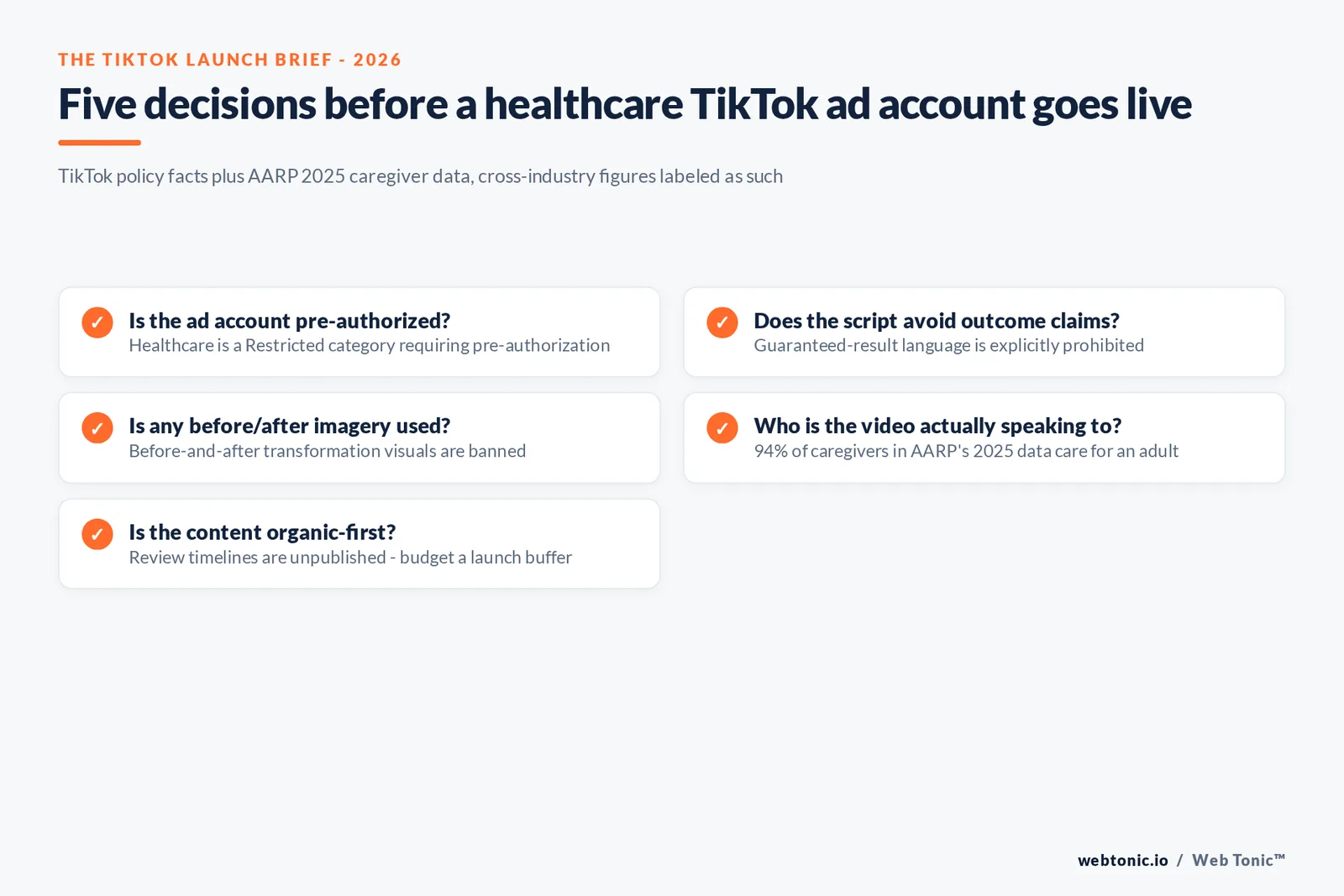
Before any cost-per-click number is relevant, TikTok's own Branded Content Policy and its advertiser-facing Introduction to TikTok Ad Policies classify healthcare and pharmaceutical advertising as Restricted, a category that requires pre-authorization before a campaign can go live and can vary by target market. Within that category, the policy separately and explicitly bans guaranteed health-outcome claims - language like "cures" or "guarantees" - and before-and-after visuals for health or body transformation.
None of that is a reason to skip TikTok. It is a reason to budget review and authorization time into the launch plan the same way a media budget gets built, since a clinic that treats TikTok like an unrestricted platform will lose the first campaign cycle to policy review, not to weak creative.
| TikTok healthcare ad rule | What it means for launch planning |
|---|---|
| Healthcare is a Restricted category | Pre-authorization required before spend can go live |
| Guaranteed outcome claims prohibited | No 'cures,' 'guarantees,' or similar language in ad copy |
| Before-and-after imagery banned | Educational or explainer format performs better under review |
| Age-gating applies in some markets | Prescription-adjacent content restricted to 18+ audiences |
| Review timelines are not published | Build a buffer week into any first-campaign launch plan |
The cross-industry numbers, honestly labeled
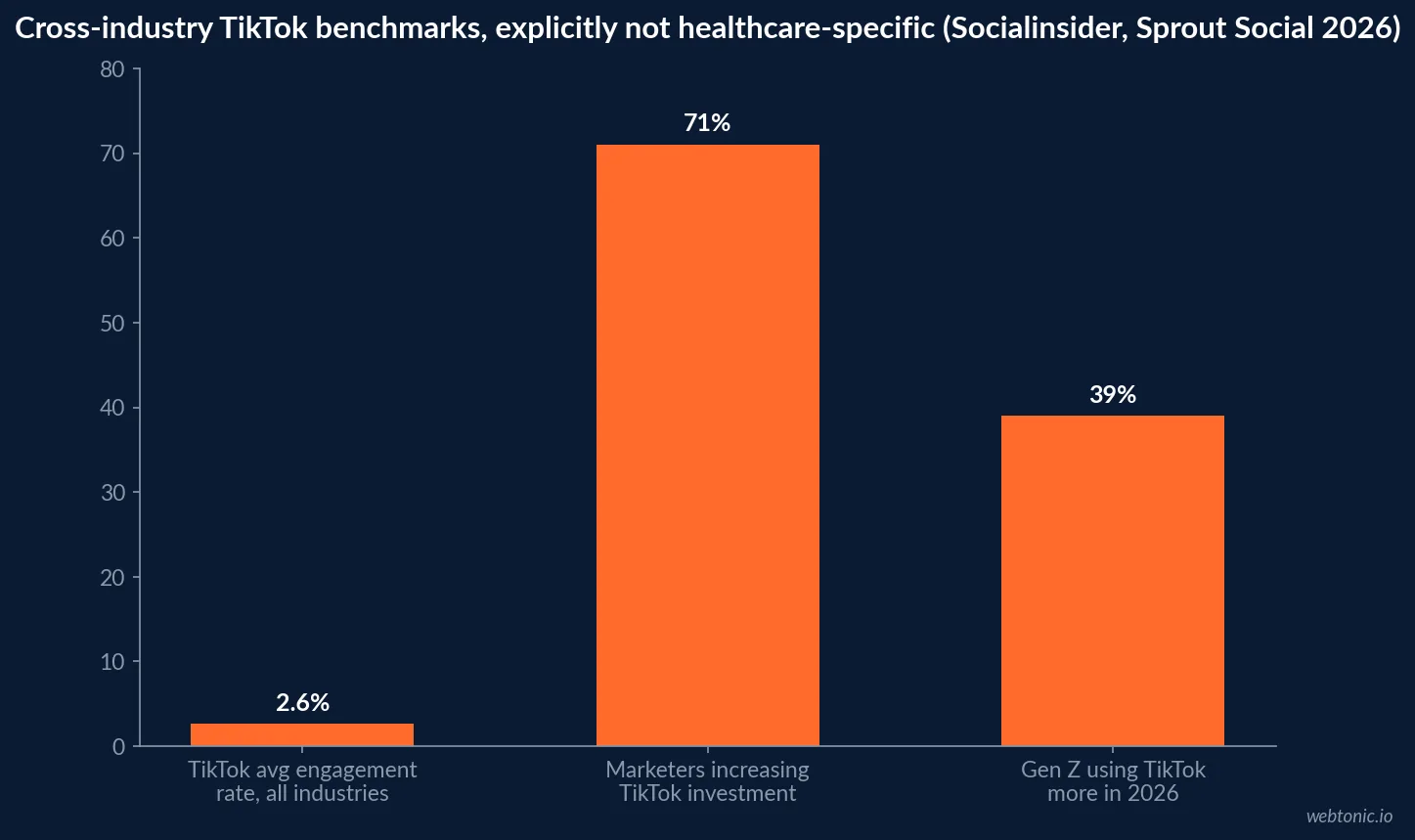
No named-methodology study prices TikTok ads for urgent care or primary care as a vertical. The closest available figures are platform-wide: Socialinsider's 2026 Social Media Benchmarks put TikTok's average engagement rate by followers at 2.60% across all tracked industries, a 10% year-over-year decrease, while eMarketer's 2026 TikTok forecast puts US ad revenue above $17 billion for the year, a scale signal rather than a cost benchmark a single clinic can plan a budget from.
Treat both as context for how competitive and how large the platform is, not as a healthcare CPC or CPM figure - none exists with a stated sample and method for this vertical, and a page that invented one would be publishing a guess dressed as data.
| Cross-industry TikTok figure (2026) | Value | Source |
|---|---|---|
| Average engagement rate by followers, all industries | 2.60% | Socialinsider 2026 Social Media Benchmarks |
| US TikTok ad revenue forecast | $17B+ | eMarketer TikTok Marketing 2026 |
| Marketers planning to increase TikTok investment | 71% | Sprout Social 2026 Social Media Content Strategy Report |
| Gen Z consumers planning to use TikTok more in 2026 | 39% | Sprout Social 2026 Social Media Content Strategy Report |
Who the real audience is
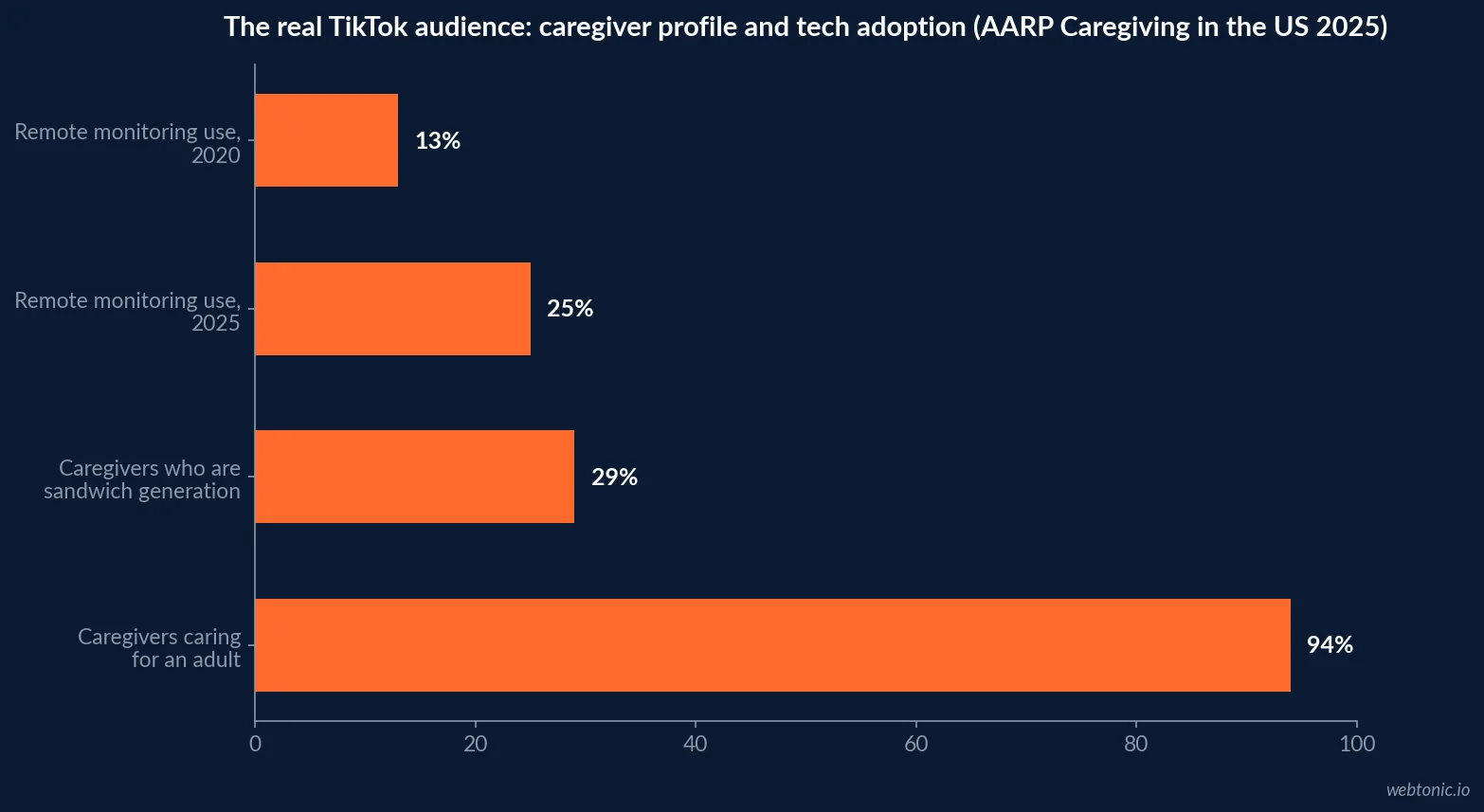
Neither an urgent care patient mid-symptom nor most primary care patients scheduling routine care are a natural TikTok ad audience in the moment of need. The more plausible audience is the adult child managing a parent's care, or a parent choosing a pediatric provider. AARP's Caregiving in the US 2025 report, a near-30-year research series, finds roughly one in four American adults is a family caregiver, that 94% of caregivers care for an adult rather than a child, that 29% are "sandwich generation" caregivers supporting both a child and an older adult simultaneously, and that caregiver use of remote monitoring tools rose from 13% in 2020 to 25% in 2025.
That is a research and comparison-shopping audience, which maps far better onto short-form video than a same-day urgent care decision does. A TikTok strategy built around "what to look for in your parent's urgent care" or "how to choose a pediatrician" content speaks to that caregiver, where a generic "book now" ad does not.
| Caregiver fact (AARP, 2025) | Figure |
|---|---|
| Share of US adults who are family caregivers | ~1 in 4 (24%) |
| Caregivers who care for an adult (not a child) | 94% |
| Total caregivers caring for an adult age 18+ | 59 million |
| Sandwich-generation caregivers (child + older adult) | 29% |
| Remote monitoring tool use, 2020 vs 2025 | 13% -> 25% |
The demand-side numbers a caregiver-first strategy still has to respect
Even a caregiver-focused TikTok strategy has to be built on real utilization patterns, not assumptions. CDC/NCHS data brief 562 reports 6% of US adults had at least one urgent care visit and 19.0% had at least one retail health clinic visit in the prior 12 months, and the Urgent Care Association reports an average visit time of 56 minutes against a median emergency department wait it cites at 150 minutes. Those numbers are more useful as content material - a caregiver explainer on "when to choose urgent care over the ER for your parent" - than as a targeting metric, since TikTok's ad platform cannot target by health condition or care-seeking behavior in the way search intent data can.
The occupational medicine angle explored in this batch's LinkedIn Ads page is a B2B relationship, not a consumer one, and does not transfer to TikTok - a platform built for consumer short-form video is a poor fit for reaching an employer HR buyer or a hospital discharge planner, who are better reached on a professional network.
What content clears review versus what does not
TikTok's advertiser guidance draws a fairly clean line: content that informs tends to clear the restricted-category review; content that promises tends to get flagged. A video explaining how to read an urgent care wait-time estimate, what an insurance card needs to show at check-in, or how occupational medicine visits work for an employer audience sits closer to educational content. A video implying a guaranteed diagnosis, a specific cure, or showing a before-and-after health transformation sits squarely inside the banned category regardless of how it is worded.
| Content type | Review likelihood | Why |
|---|---|---|
| Wait-time or hours explainer | Clears more easily | Informational, no outcome claim |
| "What to expect at your visit" walkthrough | Clears more easily | Educational, sets expectations rather than promises |
| Employer/occupational-health explainer | Clears more easily | B2B informational content, not a consumer health claim |
| Patient testimonial implying a specific cure | High risk of rejection | Reads as a guaranteed-outcome claim |
| Before-and-after style content | Banned outright | Explicitly prohibited under the Branded Content Policy |
How this compares to Meta's healthcare ad rules
TikTok is not uniquely strict - Meta's advertising policies impose comparable restrictions on personal health claims and targeting by health condition, and Google Ads applies its own healthcare and medicines policy with country-specific certification requirements. The practical difference for a first campaign is process speed: TikTok's pre-authorization step for Restricted categories adds a review stage before spend can start that Meta and Google handle more through ongoing ad-level review after launch. Budgeting a longer runway before the first TikTok healthcare campaign goes live is the safer assumption.
What a realistic first campaign looks like
Given the authorization requirement and the thin evidence base, a realistic first move is organic caregiver-relevant education content while the ad account clears TikTok's restricted-category review, then a small paid test built around one caregiver decision point (choosing a provider, understanding wait times, what a visit costs) rather than a direct-response "book now" push. Our growth marketing team sequences platform authorization alongside creative production so neither one blocks the other; see also our note on channel-by-channel healthcare ad ROI for how TikTok compares to Meta on the same decision, or talk to our team before submitting a healthcare ad account for review.
Frequently Asked Questions
Can urgent care or primary care clinics even run TikTok ads?
Yes, but not freely. TikTok's Branded Content Policy and its Introduction to TikTok Ad Policies classify healthcare and pharmaceuticals as a Restricted category, which requires advertiser pre-authorization before a campaign can launch, and separately prohibits guaranteed health-outcome claims and before-and-after imagery for health or body transformation. A clinic's ads have to clear that authorization step before any spend goes live, which most marketers underestimate at the planning stage.
Is there a published TikTok ad benchmark for urgent care or primary care specifically?
No. No named-methodology study breaks TikTok ad cost or engagement out by healthcare specialty. The only figures with a stated method are cross-industry: Socialinsider's 2026 benchmark puts average TikTok engagement rate by followers at 2.60% across all industries tracked, and eMarketer forecasts $17 billion-plus in US TikTok ad revenue for 2026. Neither is healthcare-specific, and this page does not manufacture a specialty number to fill that gap.
If patients are not the real TikTok audience, who is?
Adult-child caregivers, more than the patient in the moment of symptoms. AARP's Caregiving in the US 2025 report finds roughly one in four American adults is a caregiver, that 29% are 'sandwich generation' caregivers supporting both children and an older relative, and that caregiver use of remote monitoring and health-tracking tools rose from 13% in 2020 to 25% in 2025. A caregiver researching a parent's provider or a pediatric urgent care option is a more plausible TikTok audience than someone mid-symptom.
What content is actually allowed under TikTok's healthcare policy?
Educational and informational content generally clears review more easily than promotional claims. TikTok's policy documents explicitly prohibit guaranteed outcome language ('cures,' 'guarantees') and before-and-after transformation visuals, and require age-gating in some markets for pharmaceutical or prescription-adjacent branded content. A video explaining wait times, hours, or what an urgent care visit involves sits in safer territory than one implying a specific clinical result.
Should a clinic budget for TikTok ads or organic content first?
Organic first, in most cases. Given the pre-authorization requirement and the restricted-category review TikTok applies to healthcare ad accounts, the platform is a slower on-ramp than Meta or Google for this vertical. Building an organic presence around caregiver-relevant, educational content while the ad account clears authorization is a more realistic sequence than budgeting paid spend for week one.
Sources
TikTok - Branded Content Policy
Socialinsider - Social Media Benchmarks for 2026
eMarketer - TikTok Marketing 2026
AARP - Caregiving in the US 2025
Urgent Care Association - Urgent Care Data