Table of contents
The Urgent Care Association counts 15,398 urgent care centers in the U.S. and finds 89.4% of the population within a 20-minute drive of one, while AAFP projects a shortfall of up to 48,000 primary care physicians by 2034. Those two facts point SEO budget in the same direction: toward proximity, access and same-day-availability content, and away from the condition-page arms race that hospital systems can outspend. This page uses UCA's own visit data, AAFP and KFF workforce figures, and BrightLocal's review-threshold research (labeled cross-industry where it is) to make that case with sourced numbers.
Key Takeaways
- There are 15,398 urgent care centers in the U.S., per UCA.
- Centers grew from 9,000 to 15,000 between 2016 and 2024.
- 89.4% of the U.S. population is within a 20-minute drive of an urgent care center.
- Urgent care sees 185 million+ patients a year, per UCA.
- Average daily visit volume reached 33.96 patients/center in 2025.
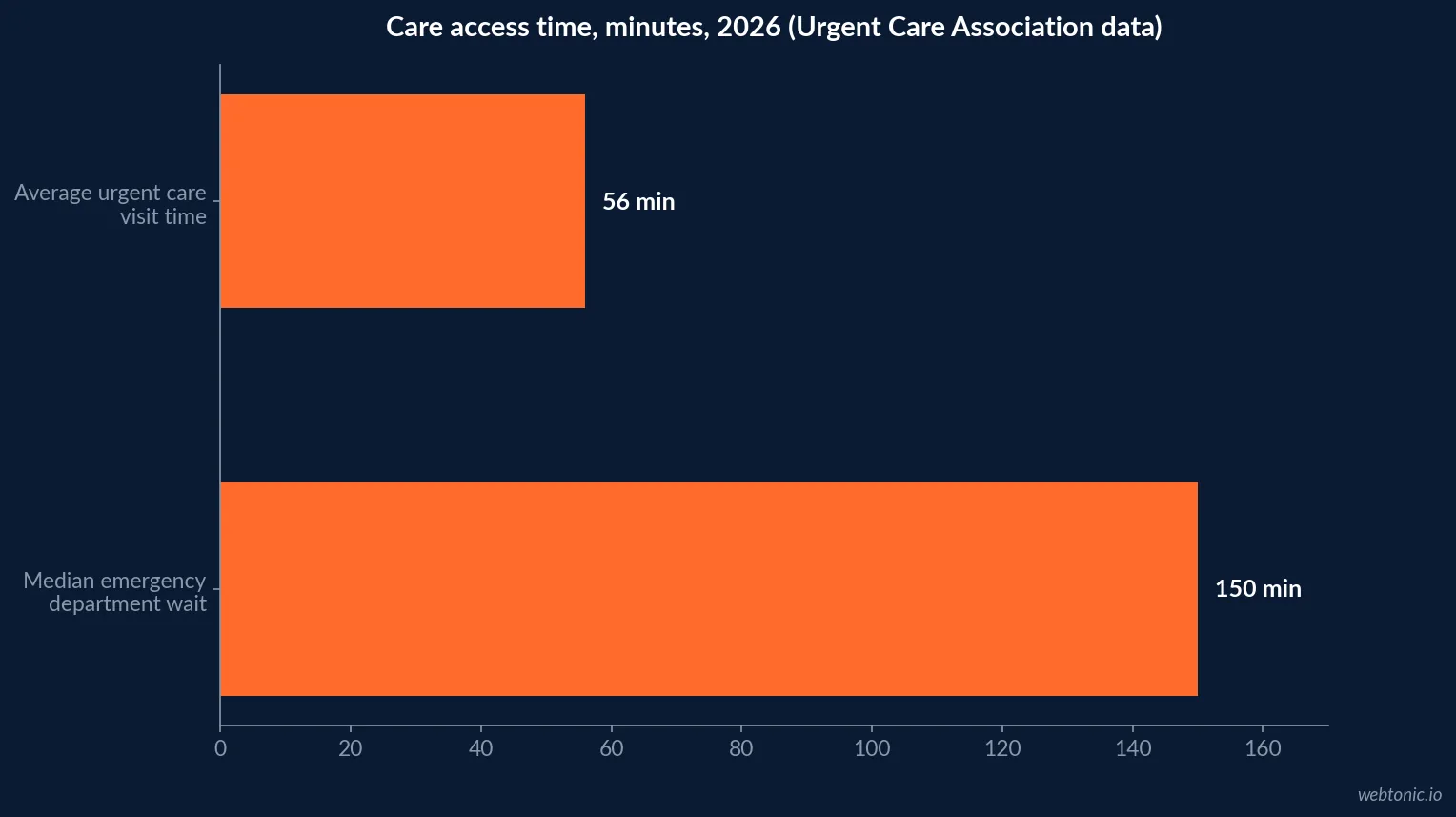
- The median emergency department wait was about 150 minutes.
- Average urgent care visit time was 56 minutes.
- More than 1 in 3 ED presentations were classified inappropriate for that setting.
- The U.S. will need up to 48,000 more primary care physicians by 2034, per AAFP.
- 62.8% of urgent care visits are children, teens and adults under 40.
- 81% of urgent care centers sit in metropolitan (RUCA 1-3) areas.
- 40% of urgent care centers are hospital-owned or affiliated.
- Roughly 5 million urgent care visits happen "after hours," per patient-arrival data.
- 68% of consumers (cross-industry) won't use a business under 4 stars.
- 31% now require 4.5 stars or higher, up from 17% a year earlier.
- 85% are more likely to use a business after reading positive reviews.
- Family medicine residency filled a record 4,613 positions in the 2026 Match.
- The 2026 Top 100 operators run 41.3% of all U.S. urgent care locations.
- New-patient primary care waits averaged 31 days across 15 metros in 2026, per MGMA-cited data.
- Google fields more than 1 billion health-related searches a day, per LocaliQ.
The access map SEO content should be built around
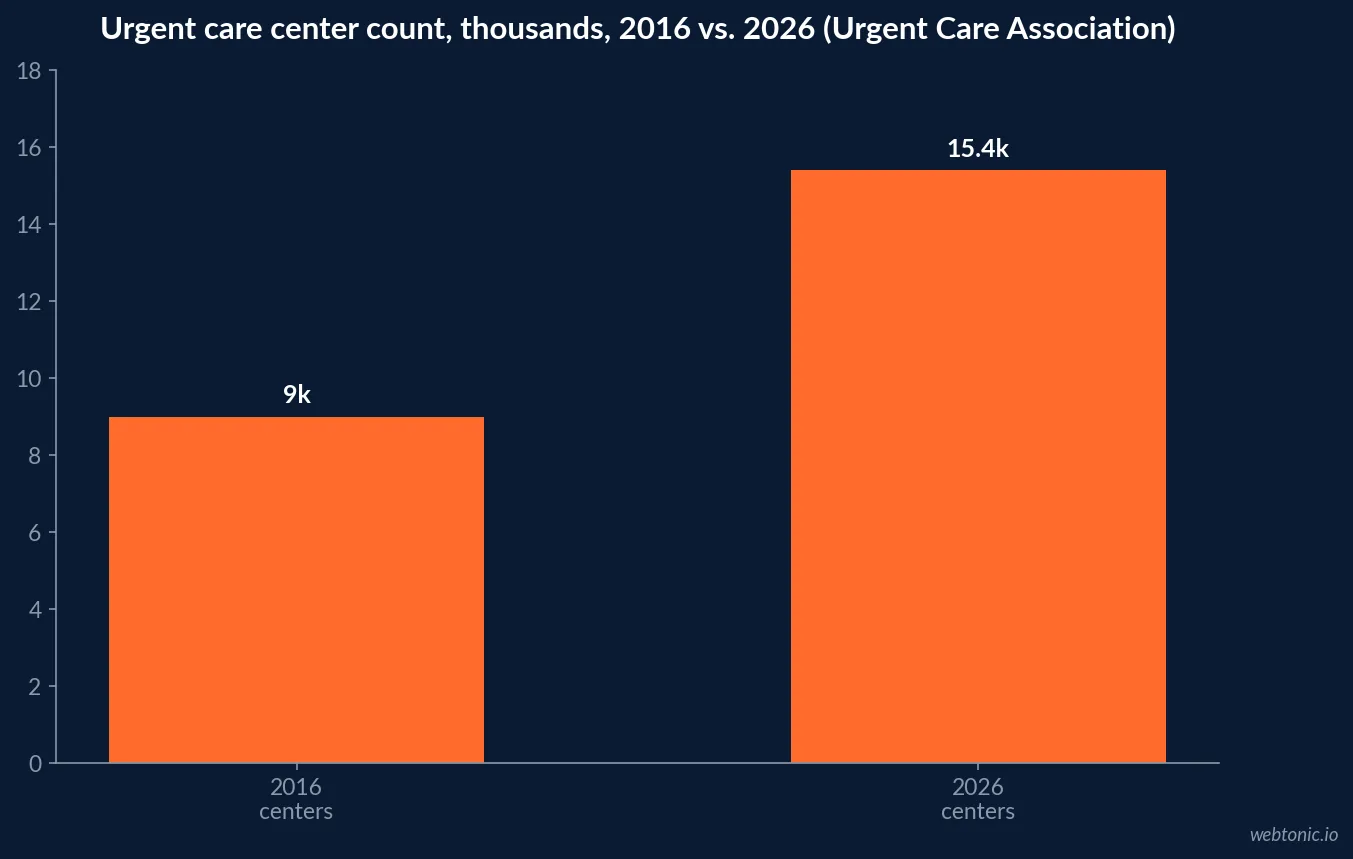
The Urgent Care Association reports 15,398 open urgent care centers as of 2026, up from roughly 9,000 in 2016, treating more than 185 million patients a year. 89.4% of the U.S. population lives within a 20-minute drive of one, and 81% of centers sit in metropolitan areas, with only 4% in genuinely rural locations. That distribution is the SEO opportunity map: a near-saturated metro footprint means local pack ranking and review volume decide which specific center gets the click, not whether urgent care exists as a category nearby.
| Urgent care access metric (UCA, 2026) | Figure |
|---|---|
| Urgent care centers in the U.S. | 15,398 |
| Growth since 2016 | 9,000 to 15,000+ |
| Population within a 20-minute drive | 89.4% |
| Patients treated per year | 185 million+ |
| Share in metropolitan areas (RUCA 1-3) | 81% |
| Share in rural areas (RUCA 10) | 4% |
| Share hospital-owned or -affiliated | 40% |
The wait-time argument content can make honestly
UCA's own data compares a median emergency department wait of about 150 minutes against an average urgent care visit time of 56 minutes, and cites Advisory Board research finding more than a third of all ED presentations in 2019 were classified as inappropriate for that setting — conditions that could have been treated faster and cheaper at urgent care. That gap is the single strongest, sourced argument an "urgent care vs. emergency room" content page can make, and it beats symptom-checker content because it answers a decision, not a diagnosis.
Roughly 5 million urgent care visits happen after 5 p.m., based on a survey of 13 million patient encounters from January to March 2024 — supporting hours-based content ("open until 9pm near me") as a distinct, high-intent search category separate from general condition pages.
| Wait / access comparison | Figure | Source |
|---|---|---|
| Median emergency department wait | ~150 minutes | ER wait data via UCA |
| Average urgent care visit time | 56 minutes | Experity data via UCA |
| Share of ED visits classified inappropriate (2019) | 34% | Advisory Board, 2023, via UCA |
| Urgent care visits occurring after 5pm | ~5 million | Patient arrival time data via UCA |
The shortage pushing search behavior toward same-day access
AAFP projects the U.S. will need up to 48,000 more primary care physicians by 2034, driven by patient panels growing faster than physician supply and a low share of national health spending directed at primary care. KFF's Health Professional Shortage Area tracker confirms designated primary care shortage areas across large parts of the country as of late 2025. On the supply side, the 2026 residency Match filled a record 4,613 family medicine positions out of 5,512 offered, per AAFP's Match Day release — genuine growth, but not fast enough to close a 48,000-physician gap by 2034.
That combination is exactly why "same day doctor near me" and "walk-in clinic today" searches are growing faster than condition-specific primary care queries: when the regular doctor isn't available for weeks, urgent care becomes the de facto same-day primary care option, and its SEO content should say so directly.
The American Board of Family Medicine's Family Medicine Factbook 2.0 — drawn directly from ABFM-administered physician surveys — is the kind of primary-source workforce data an SEO content plan should cite over a marketing blog's paraphrase of it, since it documents supply-side trends (practice patterns, scope of practice, retirement timing) that shape how urgent enough a given local shortage actually is.
| Primary care supply/demand fact | Figure | Source |
|---|---|---|
| Additional primary care physicians needed by 2034 | Up to 48,000 | AAFP |
| Family medicine residency positions offered, 2026 Match | 5,512 | AAFP |
| Family medicine residency positions filled, 2026 Match | 4,613 | AAFP |
| Medicare GME spending, annual | ~$16 billion | AAFP |
| Primary care HPSA designations | Widespread as of Dec 2025 | KFF State Health Facts |
| Average new-patient wait, 6 specialties, 15 metros (2026) | 31 days, up from 26 | Survey data cited via MGMA |
Search volume already reflects the shortage
LocaliQ reports that Google fields more than 1 billion health-related searches every day, with 7% of all Google searches touching on health in some way. Consolidation is also concentrating supply: the Journal of Urgent Care Medicine's 2026 Top 100 ranking found the nation's 14,655 urgent care centers include 6,056 locations (41.3%) run by a Top 100 entity, and 55.9% of those Top 100 locations carry a hospital-system affiliation. For an independent or regional operator, that means competing for the same "urgent care near me" query against brands with far larger content and local-SEO budgets, which is exactly why proximity- and hours-based long-tail pages, not broad brand pages, are the more winnable target.
Why the local pack decides more than the website does
This is cross-industry data, not urgent-care specific, but it applies directly to a same-day care decision: BrightLocal's 2026 Local Consumer Review Survey found 68% of consumers will only use a business rated 4 stars or higher, and 31% now require 4.5 stars or above, up from 17% just a year earlier. 85% are more likely to use a business after reading positive reviews, and 92% say star ratings matter to their decision at all. For a walk-in decision made in minutes, the Google Business Profile and its review count effectively is the landing page most searchers evaluate before a website ever loads.
| Local decision signal (BrightLocal, 2026, cross-industry) | Share |
|---|---|
| Care about star ratings when choosing a business | 92% |
| Won't use a business rated below 4 stars | 68% |
| Now require 4.5 stars or higher | 31% |
| More likely to use a business after positive reviews | 85% |
| Deterred by negative reviews | 77% |
What this means for the content plan
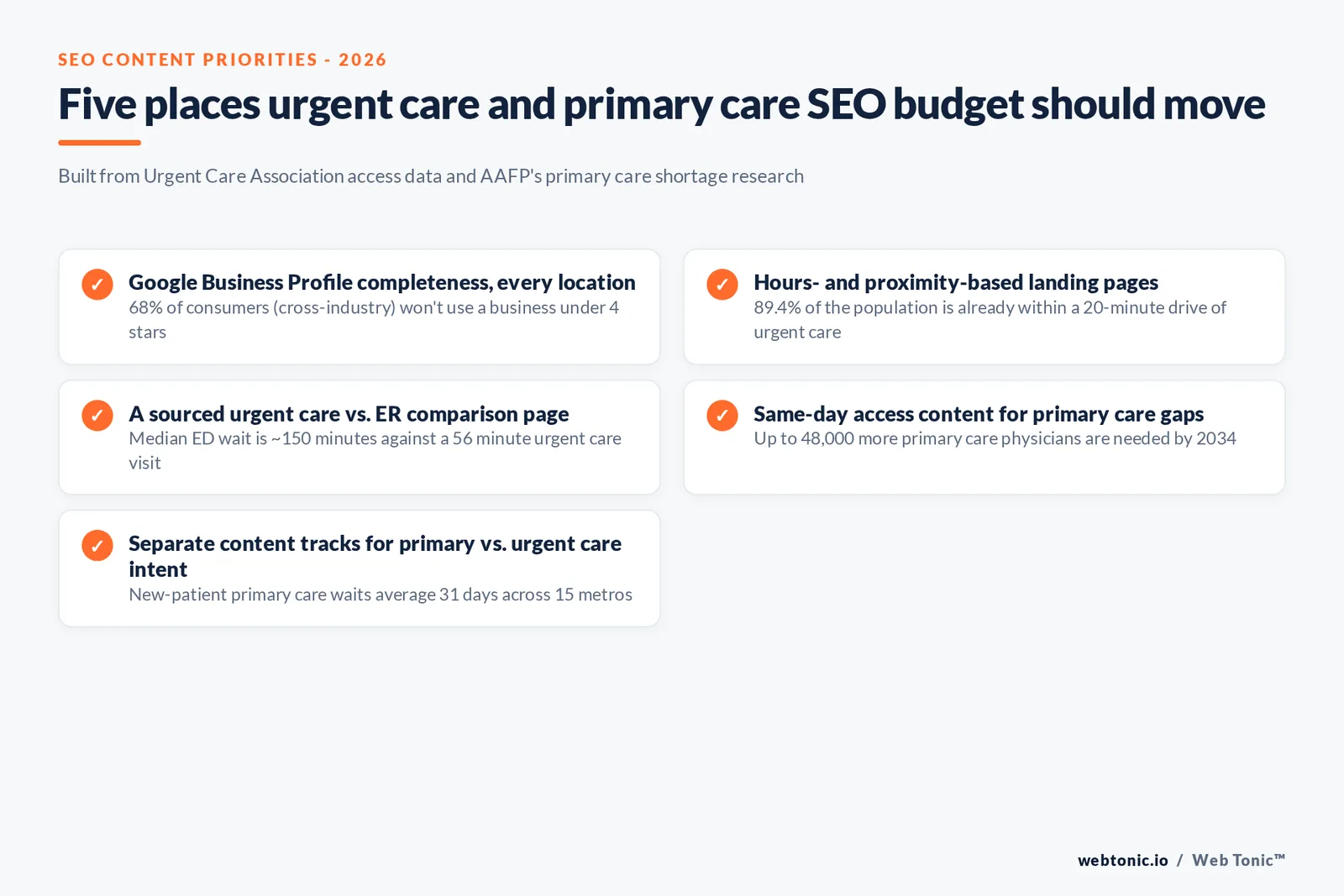
The defensible SEO priority order for this category, given the data above, is: (1) Google Business Profile completeness and review generation for every location, since that decides the click before the website is reached; (2) hours- and proximity-based landing pages ("open now near me," "walk-in no appointment") rather than broad condition pages that duplicate what hospital systems and WebMD already rank for; (3) a sourced "urgent care vs. ER" comparison page using UCA's own wait-time data; and (4) primary care continuity content that acknowledges the shortage directly rather than pretending appointment availability isn't a constraint.
Our growth marketing team builds that kind of priority order from a location's own search and review data rather than a generic template, and our team page has more on how we structure local healthcare SEO work. Get in touch if your current content plan is still organized around conditions instead of access.
Primary care and urgent care are two different searches
The two categories should not share a content strategy even though they share a shortage. A patient searching for primary care is usually trying to establish or keep a regular doctor — insurance-network questions, continuity of chronic-condition management, annual physical scheduling. A patient searching for urgent care is solving an immediate, unscheduled problem — an injury, an illness that can't wait weeks for the next open primary care slot. Content that blends the two into one "healthcare near me" page under-serves both search intents and typically ranks for neither as well as a split structure would.
| Search intent | What the page should answer | What it should avoid |
|---|---|---|
| Primary care | Insurance accepted, new-patient availability, chronic care continuity | Same-day/urgent framing |
| Urgent care | Hours, walk-in policy, conditions treated, wait estimate | Long-term relationship messaging |
What the content plan should prioritize first
Given the access data above, the practical build order is: complete and actively manage the Google Business Profile for every location first, since BrightLocal's review-threshold data shows that decision is often made before the website ever loads; then build hours- and proximity-focused landing pages ahead of broad condition pages; then add one well-sourced comparison page addressing the urgent-care-versus-ER decision directly; and only then invest in primary care continuity content that acknowledges the shortage honestly rather than promising availability the practice can't deliver.
Frequently Asked Questions
Where are urgent care and primary care SEO budgets actually headed?
Toward proximity and access content, not general brand pages. The Urgent Care Association reports 89.4% of the U.S. population is within a 20-minute drive of an urgent care center, and the practical SEO fight is winning the local pack for "urgent care near me" and hours-based queries, not competing on broad informational content that a hospital system's content team can outspend. AAFP's finding that the country will need up to 48,000 more primary care physicians by 2034 is pushing the same budget toward content that helps patients find same-day access anywhere they can get it, urgent care included.
Does the primary care physician shortage actually change search behavior?
It changes what people search for. AAFP's workforce research points to patient panels growing faster than physician supply, and KFF's Health Professional Shortage Area data confirms shortage designations covering large stretches of the country as of late 2025. When a primary care appointment is weeks out, "same day doctor near me" and "walk in clinic open now" become the real competing queries, and urgent care SEO content built around wait time and access, not just condition pages, is what actually intercepts that search.
How much does the local pack and reviews actually matter for this category?
Enough to be the deciding factor before a click ever reaches the website. BrightLocal's 2026 survey (cross-industry, not urgent-care specific) found 68% of consumers won't consider a business rated below 4 stars and 31% require 4.5 stars or higher, up sharply from 17% a year earlier. For a same-day care decision, the Google Business Profile and its review count function as the landing page most searchers actually evaluate, which makes review generation and GBP completeness a bigger lever than most on-page SEO work for this category.
What does the emergency department wait-time gap have to do with SEO content?
It is the strongest access-based argument urgent care SEO content can make honestly. UCA's own data cites a median emergency department wait of about 150 minutes against an average urgent care visit time of 56 minutes, and estimates more than a third of ED presentations were inappropriate for that setting. Content built around "urgent care vs. ER: what to choose" answers a real decision point with sourced numbers, rather than competing on symptom-checker pages that hospital systems and WebMD already dominate.
Is this the same story for urgent care and primary care, or two different searches?
Two different searches feeding the same shortage. Primary care search intent is largely about getting or keeping a regular doctor amid the shortage AAFP describes; urgent care search intent is about immediate, unscheduled access when that regular doctor isn't available same-day. SEO content for the two should not be merged: primary care pages should target continuity-of-care and insurance questions, while urgent care pages should target proximity, hours and condition-triage queries.
Sources
Urgent Care Association - Urgent Care Data page, 2026
AAFP - Understanding the primary care physician shortage crisis
AAFP - 2026 Match sets records for family medicine positions offered and filled
American Board of Family Medicine - Family Medicine Factbook 2.0
KFF - Primary Care Health Professional Shortage Areas (HPSAs)
MGMA Stat - New-patient wait times largely hold flat in 2026
LocaliQ - Healthcare Search Ads Benchmarks for 16 Specialties, 2026
Journal of Urgent Care Medicine - The 2026 Urgent Care Top 100 By Number Of Locations
BrightLocal - Local Consumer Review Survey 2026