Table of contents
Urgent care and primary care compete for the same local search real estate - the Map Pack, the Business Profile, the review snippet - but the searcher behind each query is making a different kind of decision. One is deciding in minutes where to walk in today; the other is deciding, over days or weeks, who to trust with an ongoing relationship. The data below, from BrightLocal's 2025 survey and CDC's usual-source-of-care research, breaks down where that difference actually shows up in local search behavior.
Key Takeaways
- Only 42% of consumers trust online reviews as much as personal recommendations in 2025, per BrightLocal - down from 79% in 2020.
- Half of Americans who see a doctor each year check a review site first, per Healthgrades data cited in BrightLocal's 2025 report.
- 27% of American adults avoided some form of medical treatment over cost in 2023, the fourth-highest year on record per that same report.
- 82.2% of women and 72.6% of men name a doctor's office or health center as their usual source of care, per CDC's 2024 data.
- The share naming an urgent care center or retail clinic as usual source of care declines with age, per the same CDC survey.
- 93.3% of women and 87.1% of men reported having any usual source of care in 2024.
- Urgent care locations grew from 9,000 to 15,000 between 2016 and 2024, per the Urgent Care Association.
- Average daily visit volume per urgent care center hit 33.96 in 2025.
- KFF counted 8,467 primary care shortage-area designations covering more than 92 million people.
- 15,604 additional practitioners would be needed to clear every current primary care shortage designation, per KFF.
- The AAFP reports the US needs up to 48,000 more primary care physicians by 2034.
- Family medicine residency programs filled at an 85% rate in the 2025 Match.
- Google's own 2022 retail research measured "open now near me" searches growing over 400% year over year - the query pattern urgent care local pages compete on.
Two different searches, one shared ranking system
Google Business Profile, the Map Pack and review platforms treat an urgent care clinic and a primary care practice by the same ranking mechanics - proximity, relevance and prominence. What differs is the query pattern feeding those mechanics. Google's own 2022 retail marketing research quantified "open now near me" searches growing more than 400% year over year in the period it measured - a pattern that maps far more closely to an urgent care decision than a primary care one, where the underlying query looks more like "[condition] doctor near me accepting new patients."
Local SEO work built for one pattern does not automatically transfer to the other, even though both live inside the same Business Profile and Map Pack infrastructure.
What the review-trust decline means for both categories
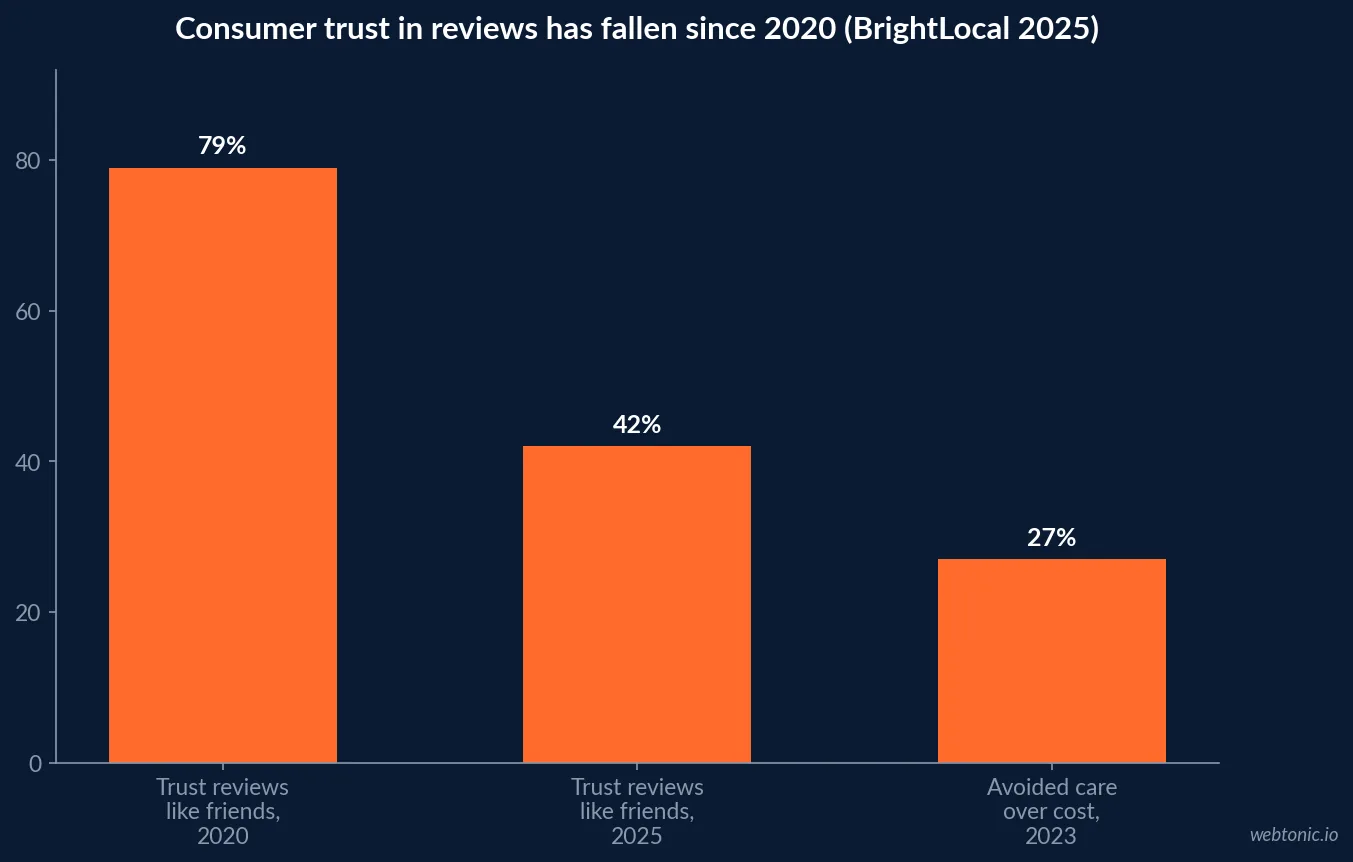
BrightLocal's 2025 Local Consumer Review Survey found that only 42% of consumers now say they trust online reviews as much as personal recommendations from friends and family, down sharply from 79% in 2020. The same report cites Healthgrades data showing half of Americans who see a doctor each year check a review site beforehand - and separately notes that 27% of American adults avoided some form of medical treatment due to cost in 2023, the fourth-highest such year on record.
A falling trust score does not mean reviews stopped mattering; it means a thin or generic review profile now reads as more suspicious than it used to, and specific, recent, detailed reviews carry proportionally more weight than the star average by itself.
| BrightLocal 2025 metric | Figure | What it implies for a clinic page |
|---|---|---|
| Consumers trusting reviews like personal recommendations | 42% (down from 79% in 2020) | Volume and recency now matter more than the star average alone |
| Share checking a review site before a doctor visit (Healthgrades) | ~50% | Primary care pages need a visible, current review widget |
| Adults who avoided treatment over cost in 2023 | 27% | Price transparency content can capture hesitant searchers |
Who is actually behind each query
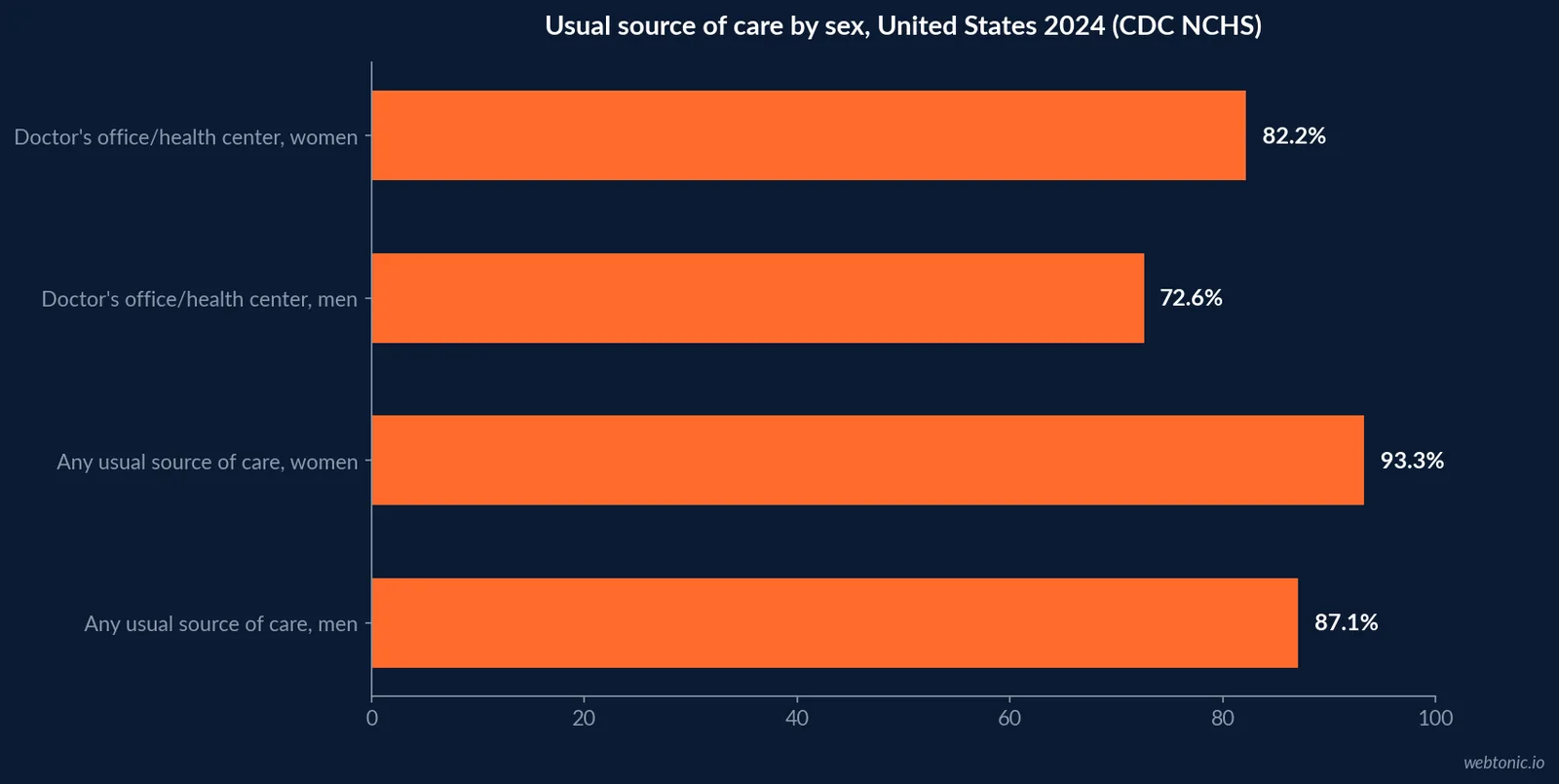
CDC's 2024 Source of Usual Health Care survey found 93.3% of women and 87.1% of men report having a usual source of care at all, with 82.2% of women and 72.6% of men naming a doctor's office or health center specifically. The same survey reports that the share naming an urgent care center or a clinic located in a drug store or grocery store as their usual source of care declines with age - meaning the urgent care searcher skews younger than the primary care searcher, a fact that should shape which local landing pages target which age-based ad and content angles.
| CDC 2024 usual source of care | Women | Men |
|---|---|---|
| Any usual source of care | 93.3% | 87.1% |
| Doctor's office or health center | 82.2% | 72.6% |
| Hospital emergency room | 1.5% | 2.0% |
| Urgent care / retail clinic (trend) | Declines with age | Declines with age |
The multi-location reality behind urgent care local SEO
The Urgent Care Association counted the national footprint growing from 9,000 to 15,000 centers between 2016 and 2024, with average daily visit volume reaching 33.96 patients per center in 2025. That growth means urgent care local SEO is now overwhelmingly a multi-location problem: consistent NAP data, a Business Profile per site, and a review-generation workflow that scales across dozens of locations rather than one flagship clinic.
Primary care sits at the opposite end of that structural spectrum in shortage areas. KFF counted 8,467 designated primary care shortage areas covering more than 92 million people, with 15,604 additional practitioners needed to clear every current designation. In those markets, a single well-optimized, accurately categorized Business Profile can outrank a thinner national competitor simply because there is so little competing local content.
| Structural fact | Figure | Source | Local SEO implication |
|---|---|---|---|
| Urgent care centers, US | 9,000 -> 15,000 (2016-2024) | Urgent Care Association | Multi-location NAP and review workflow needed |
| Avg. daily visits per urgent care center, 2025 | 33.96 | Urgent Care Association | Review-request volume per site is high |
| Primary care shortage-area designations | 8,467 | KFF | Lower local competition in many markets |
| People covered by those designations | 92,285,375 | KFF | Large under-served searcher population |
| Additional PCPs needed nationally | 48,000 by 2034 | AAFP | Demand will keep outpacing new local listings |
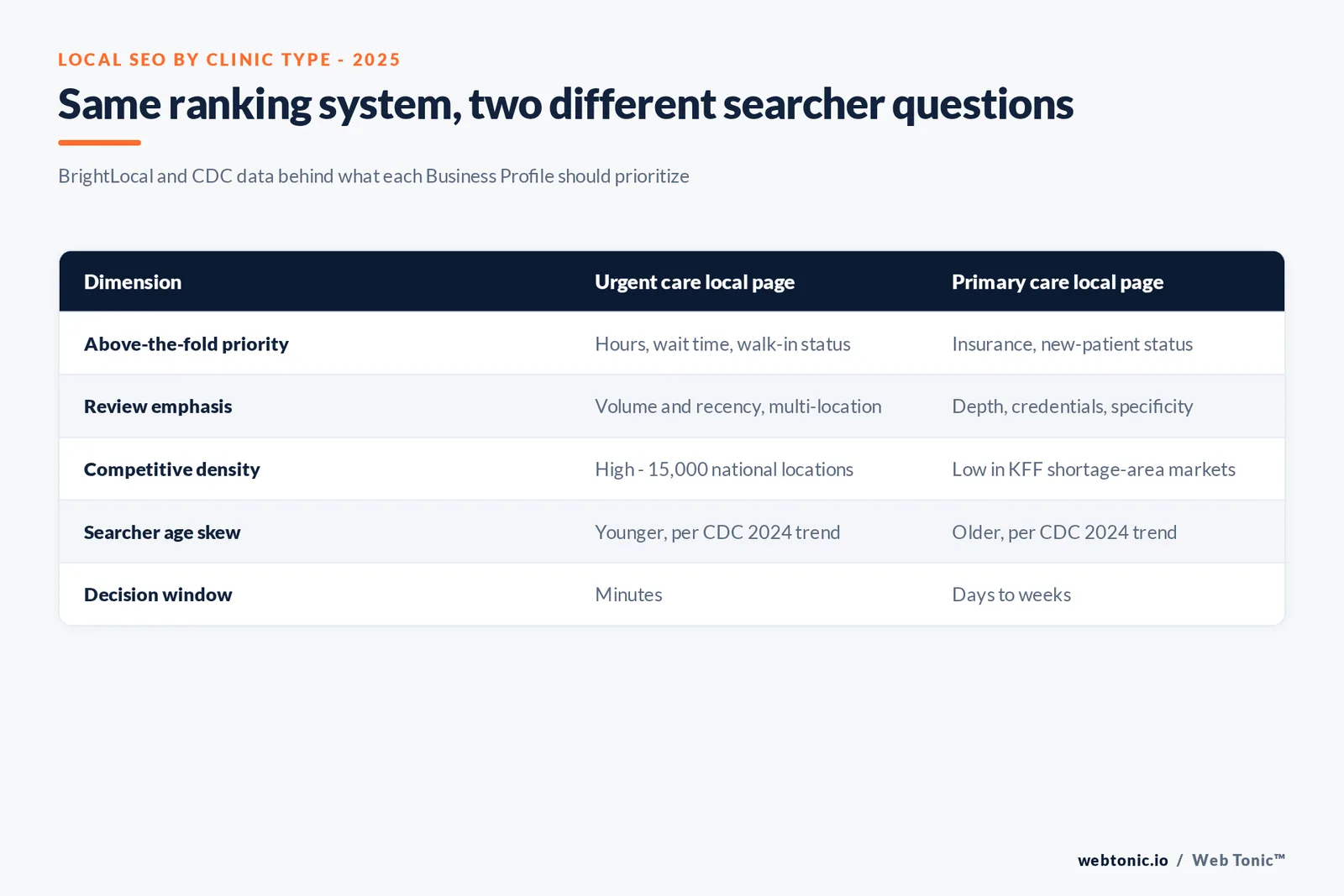
What an urgent care local page should prioritize
Given the "open now near me" query pattern and the younger, faster-deciding searcher CDC data implies, an urgent care location page should lead with hours, wait-time indication, walk-in status and distance-relevant information above the fold. Review strategy should focus on volume and recency across every location rather than depth on a single flagship site, since the 42% trust-in-reviews figure means a stale review set reads as a red flag on a decision made in minutes.
What a primary care local page should prioritize
A primary care page is answering a slower, higher-stakes question, so it should lead with accepted insurance, "accepting new patients" status, provider credentials and a visible review widget - the exact signal half of Americans check before a doctor visit, according to the Healthgrades data BrightLocal cites. In the 8,467 shortage areas KFF has designated, category accuracy and profile completeness on Google Business Profile can matter more than review count, simply because there is less competing local content to outrank.
The Business Profile fields that actually move each category
Both clinic types fill in the same Google Business Profile form, but the fields that move the needle differ. Urgent care listings live or die on accurate, real-time hours and a correctly set "urgent care" or "walk-in clinic" primary category rather than a generic "medical clinic" label, since category mismatch is one of the most common reasons a location fails to surface for "urgent care near me" queries. Primary care listings gain more from the services and insurance attributes Google exposes on the profile, since that is the information a slower, more deliberate searcher is filtering on before ever reading a review.
| Business Profile field | Urgent care priority | Primary care priority |
|---|---|---|
| Primary category | "Urgent care center" - exact match | "Family practice physician" or specialty |
| Hours | Real-time, holiday-accurate | Standard, appointment-note friendly |
| Attributes | Walk-ins welcome, wait time if available | Insurance accepted, new-patient status |
| Photos | Waiting room, exterior signage | Provider headshots, credentials |
| Q&A section | "Do I need an appointment?" | "Are you accepting new patients?" |
Citation consistency at very different scales
NAP (name, address, phone) consistency across directories matters for both categories, but the scale of the problem is not the same. With the Urgent Care Association's count of 15,000 national locations, a single chain can be managing citation consistency across hundreds of listings at once, where a single inconsistent phone number or suite address can quietly suppress a location's Map Pack visibility. A primary care practice in one of the 8,467 KFF-designated shortage areas is usually managing a handful of listings, where the bigger risk is an incomplete profile rather than an inconsistent one.
Where the two categories should not share a playbook
Running one templated local SEO checklist across both clinic types wastes effort in both directions - urgent care does not need deep credential content, and primary care does not need wait-time widgets. The categories share the same ranking system but not the same searcher question, and the page has to answer the question that is actually being asked.
| Dimension | Urgent care local page | Primary care local page |
|---|---|---|
| Above-the-fold priority | Hours, wait time, walk-in status | Insurance, new-patient status |
| Review emphasis | Volume and recency, multi-location | Depth, credentials, specificity |
| Competitive density | High, 15,000 national locations | Low in shortage-area markets |
| Searcher age skew | Younger, per CDC trend | Older, per CDC trend |
| Decision window | Minutes | Days to weeks |
Building the local presence around the right question
Neither category benefits from a generic "healthcare local SEO" template built around the all- industry review-trust average. Our growth marketing team builds the Business Profile, review-request cadence and location-page content around the specific decision each clinic type is answering, and our data and analytics practice tracks whether the Map Pack traffic is converting into the right kind of visit for that clinic.
For the paid-search side of the same comparison, see our breakdown of building a Google Ads strategy, or benchmark general lead costs with our cost-per-lead by industry data before setting a local SEO budget. Talk to us about the clinic-specific version.
Frequently Asked Questions
Do reviews matter more for urgent care or primary care?
The evidence points to primary care needing the deeper trust signal. Healthgrades data cited in BrightLocal's 2025 Local Consumer Review Survey shows half of Americans who see a doctor each year check a review site first - a relationship decision people research before committing to. Urgent care searches skew toward speed and distance, so a business with an adequate rating and a short drive time competes even against a primary care practice with a stronger review profile.
Has trust in online reviews changed recently?
Yes, and the direction matters for both categories. BrightLocal's 2025 survey found only 42% of consumers now say they trust reviews as much as personal recommendations from friends and family, down from 79% in 2020. That decline pushes more weight onto review volume, recency and specificity rather than the star average alone - a thin, dated review profile now reads as a bigger red flag than it did five years ago.
Why would a primary care practice's local SEO look different from an urgent care center's?
Because the underlying CDC data shows a different population searching. CDC's 2024 usual-source-of-care survey found 82.2% of women and 72.6% of men name a doctor's office or health center as their usual source of care, while the share naming an urgent care center or a retail-clinic declines with age. A primary care local page should be built for a repeat, longer-tenure searcher; an urgent care page should be built for a first-time, decision-in-minutes searcher.
Does having more locations help urgent care's local SEO?
It helps scale but does not replace the fundamentals. The Urgent Care Association counted the national footprint growing from 9,000 to 15,000 centers between 2016 and 2024, which means most urgent care local SEO work is now multi-location - one Business Profile, one review strategy and one NAP-consistency check per site, not a single flagship location.
What single local SEO fix matters most for a primary care practice under-served by providers?
Category and completeness on the Business Profile, ahead of review volume. KFF counted 8,467 designated primary care shortage areas covering more than 92 million people; in a market with few competing practices, a complete, correctly categorized profile can outrank a national chain's thinner local presence even before the review count catches up.
Sources
BrightLocal - Local Consumer Review Survey 2025
CDC NCHS - Source of Usual Health Care for Adults, United States 2024
Urgent Care Association - Urgent care industry data
KFF - Primary Care Health Professional Shortage Areas
American Academy of Family Physicians - Match Day 2025
Think with Google - 2022 Retail Marketing Guide