Table of contents

No Meta benchmark study names urgent care or primary care as its own category, so the honest starting point is the closest tracked proxy - WordStream's "Physicians and Surgeons" line from its 2025 Facebook Ads Benchmarks report - stated plainly as a proxy, not dressed up as an exact match. Layered on top of that cost data are the Meta ad-policy and HIPAA tracking-technology limits that actually decide what a clinic can target and measure.
Key Takeaways
- Physicians and Surgeons had the lowest Facebook traffic CTR of any tracked industry, at 0.83% in WordStream's 2025 report.
- The same category's leads-objective CTR was 3.02%, the third-highest of any industry tracked.
- Its leads conversion rate was 4.51%, against a 7.72% all-industry average.
- All-industry Facebook leads CPC averaged USD 1.92 in 2025.
- All-industry Facebook cost per lead averaged USD 27.66, up from USD 22.87 the prior year.
- Urgent care centers grew from 9,000 to 15,000 locations between 2016 and 2024, per the Urgent Care Association.
- Average daily visit volume per urgent care center reached 33.96 in 2025.
- The US needs up to 48,000 more primary care physicians by 2034, per the AAFP.
- Family medicine residency programs filled at an 85% rate in the 2025 Match.
- KFF counted 8,467 primary care shortage-area designations as of late 2025, covering more than 92 million people.
- Meta requires health and wellness ads to target adults 18 and older under its Health and Wellness ad standard.
- Meta's privacy-violations policy bars ads that assert a health condition about a specific person or their family.
- HHS OCR's bulletin treats identifiable Pixel/CAPI data from a booking page as a potential HIPAA disclosure.
- 93.3% of women and 87.1% of men reported a usual source of care in 2024, per CDC NHIS data - the demand pool Meta campaigns compete for.
- Dentists and Dental Services carried the single highest Facebook leads CPL, at USD 76.71, the ceiling healthcare-adjacent categories can hit.
Why there is no clean Meta benchmark for this pair
Ad-platform benchmark reports are built around the industry categories advertisers self-select at account setup, and Meta's own category list does not carve out "urgent care" or "primary care" as distinct verticals. The nearest published match is WordStream's 2025 Facebook Ads Benchmarks report, built from over 1,000 campaigns, which tracks "Physicians and Surgeons" - a category that also absorbs specialists, so it runs broader than either urgent care or primary care alone.
That is not a reason to skip the data. It is a reason to say clearly, every time a figure is used, that it describes physicians and surgeons in general and not a clinic's specific category.
What the proxy category actually costs and converts
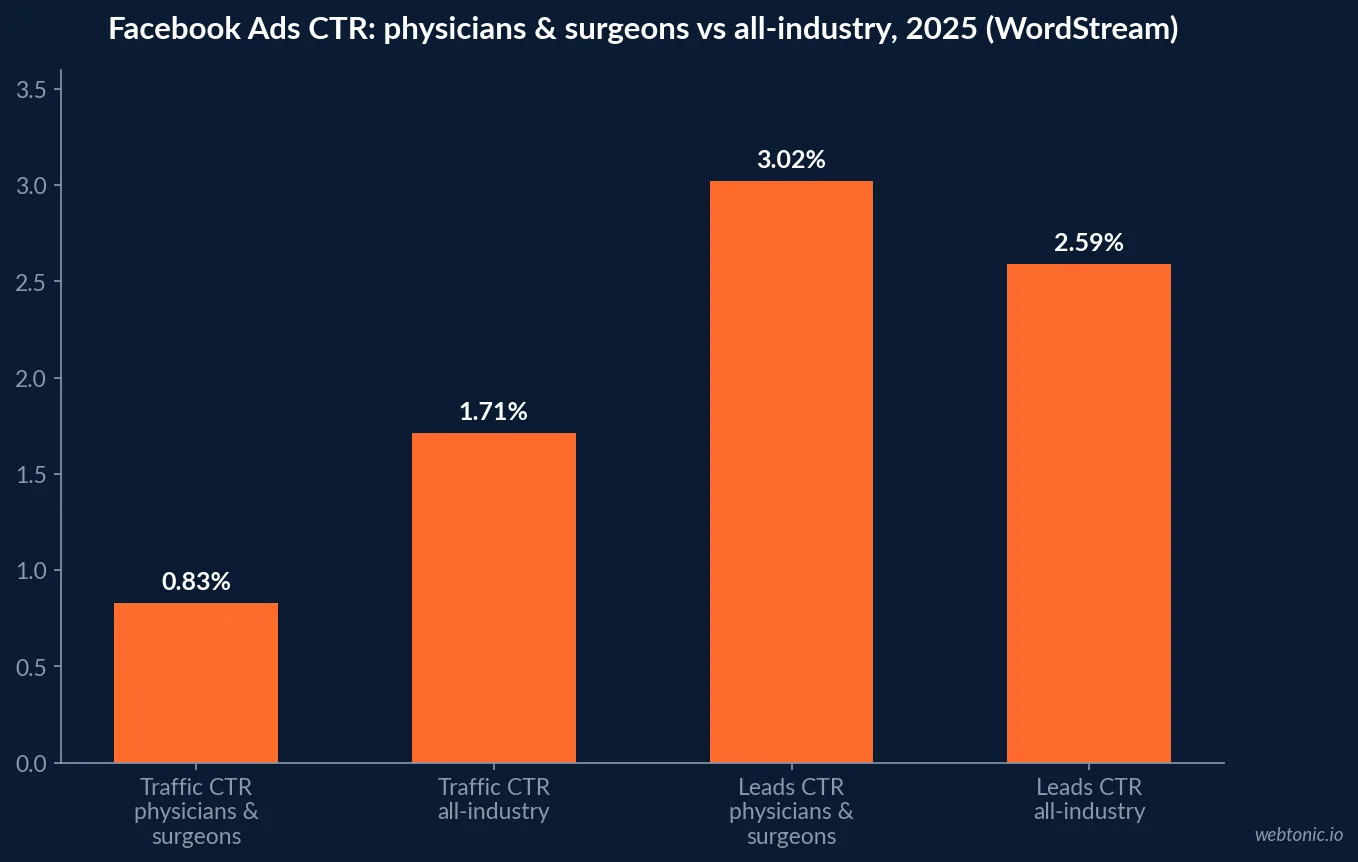
On the traffic objective, Physicians and Surgeons posted the lowest click-through rate of any industry WordStream tracked in 2025, at 0.83%, against an all-industry average of 1.71%. On the leads objective the picture flips: the category's 3.02% CTR ranked third-highest of any industry, behind only Arts and Entertainment and Real Estate, suggesting healthcare imagery works better once the ask is a form fill rather than a click-through visit.
Conversion tells a more cautious story. Physicians and Surgeons converted leads at 4.51%, the second-lowest rate WordStream measured, against a 7.72% all-industry average. All-industry leads CPC ran USD 1.92 and CPL averaged USD 27.66; applying the category's lower conversion rate to that CPC implies an effective cost per lead noticeably above the blended average.
| 2025 Facebook Ads metric | Physicians & Surgeons | All-industry average | Source |
|---|---|---|---|
| Traffic CTR | 0.83% (lowest tracked) | 1.71% | WordStream 2025 |
| Leads CTR | 3.02% (3rd highest) | 2.59% | WordStream 2025 |
| Leads conversion rate | 4.51% | 7.72% | WordStream 2025 |
| Leads CPC | Not broken out | USD 1.92 | WordStream 2025 |
| Leads CPL | Not broken out | USD 27.66 | WordStream 2025 |
The demand pool behind the click
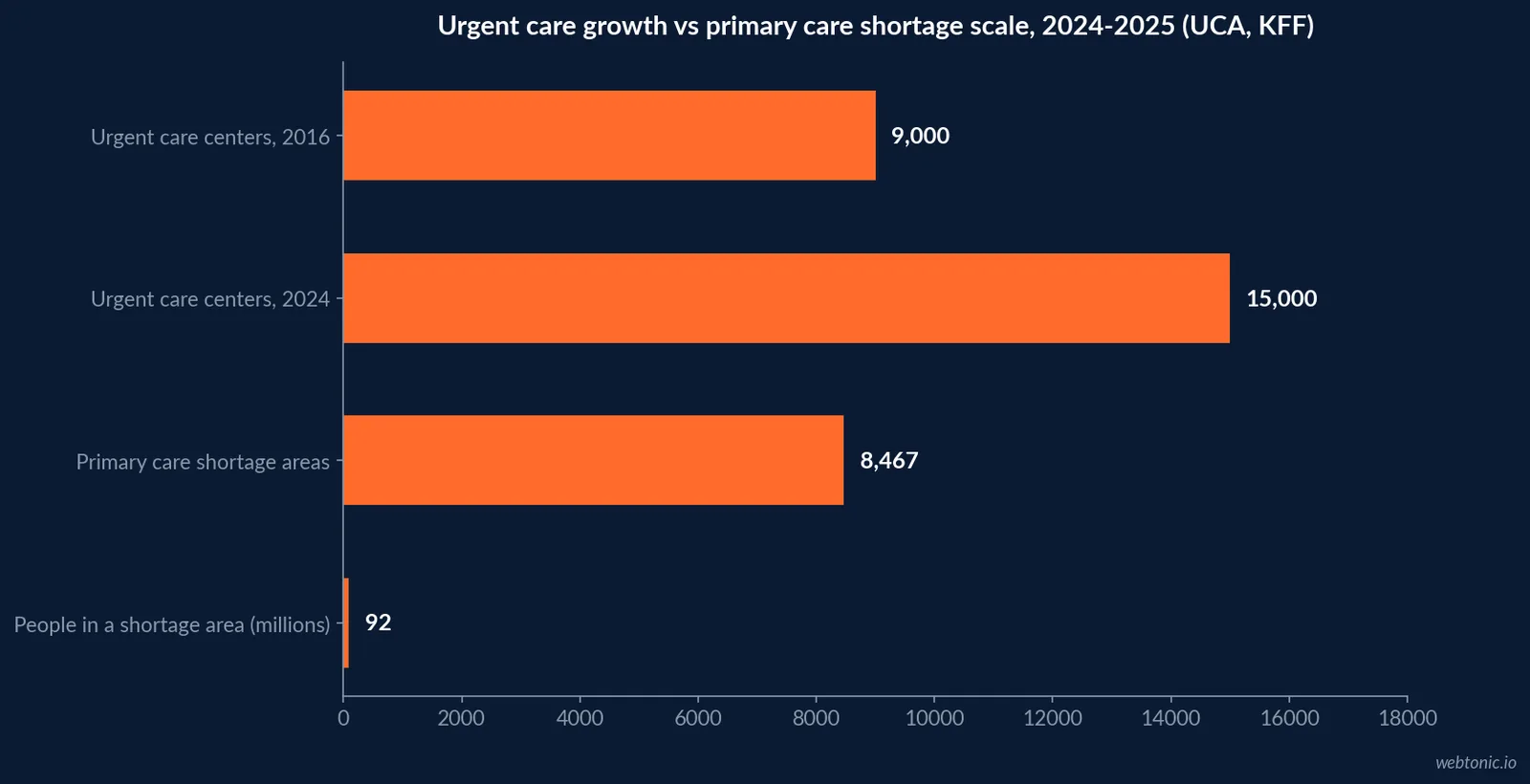
The cost data means little without the volume it is buying against. The Urgent Care Association counted urgent care locations growing from 9,000 to 15,000 centers between 2016 and 2024, with average daily visit volume reaching 33.96 patients per center in 2025. On the primary care side, the AAFP's 2025 Match Day report put family medicine's residency fill rate at 85% while warning the country still needs up to 48,000 more primary care physicians by 2034.
KFF's state health facts counted 8,467 designated primary care shortage areas covering more than 92 million people as of the most recent 2025 data, and 15,604 additional practitioners would be needed to lift every one of those designations. That is a demand pool actively searching for a provider, which is exactly the audience a Meta lead ad is built to intercept.
| Demand signal (2024-2025) | Figure | Source |
|---|---|---|
| Urgent care centers, US | 9,000 -> 15,000 (2016-2024) | Urgent Care Association |
| Avg. daily visits per urgent care center, 2025 | 33.96 | Urgent Care Association |
| Family medicine Match fill rate, 2025 | 85% | AAFP |
| Additional PCPs needed by 2034 | Up to 48,000 | AAFP |
| Primary care shortage-area designations | 8,467 | KFF |
| People in a shortage area | 92,285,375 | KFF |
The compliance layer Meta campaigns run inside
Cost and conversion numbers only describe what a campaign can do if it is allowed to run as designed. Meta's own Health and Wellness advertising standard requires health campaigns to target people 18 years or older and restricts specific health claims, while its separate privacy-violations policy bars ads that assert or imply someone has a specific health condition.
Above the platform's own rules sits federal privacy law. HHS OCR's bulletin on online tracking technologies treats a Meta Pixel or Conversions API event fired from a booking or symptom-intake page as a potential HIPAA disclosure once it can be connected to an individual - the reason a growing number of health advertisers had custom audiences and conversion events disabled after Meta's 2025 healthcare policy changes. A clinic's Meta strategy has to be built around named-condition-free creative and de-identified conversion events from the start, not patched in after a disapproval.
| Rule | Issuing body | What it restricts for these clinics |
|---|---|---|
| Health and Wellness ad standard | Meta Transparency Center | 18+ targeting; limits on specific health claims in creative |
| Privacy violations & personal attributes | Meta Transparency Center | No implying a named person has a health condition |
| Online tracking technologies bulletin | HHS OCR | Pixel/CAPI events from booking pages can be a HIPAA disclosure |
| FTC Health Products Compliance Guidance | Federal Trade Commission | Patient testimonials need a typical-results disclosure, not a disclaimer alone |
What urgent care should actually run
Urgent care sells urgency, not a relationship, so the traffic objective's low 0.83% CTR is less of a problem than it looks - the message that wins is "open now" or "shorter wait than the ER," aimed at someone who has already decided to seek care today. Creative built around named symptoms or conditions risks tripping Meta's health-claims review, so the safer pattern is hours, location and wait-time messaging rather than a clinical pitch.
Given the category's 15,000-center national footprint, hyper-local radius targeting around each location outperforms a broad metro buy - the competitive set is the handful of urgent care and ER options within a ten-minute drive, not every healthcare advertiser in the city.
What primary care should actually run
Primary care is selling a years-long relationship, which is why the lead objective's 3.02% CTR and higher relative cost per lead can still pencil out: a new-patient acquisition has a much longer revenue tail than a single urgent care visit. Lead ads built around a "accepting new patients" or "same-week appointment" offer convert better than awareness creative, and retargeting has to be built on de-identified events given the HIPAA constraint above.
With 8,467 shortage-area designations covering 92 million people, primary care practices in under-served ZIP codes are often competing for attention against very few other paid advertisers - a structural advantage a well-targeted Meta campaign can exploit before national chains catch up.
Reading the two categories side by side
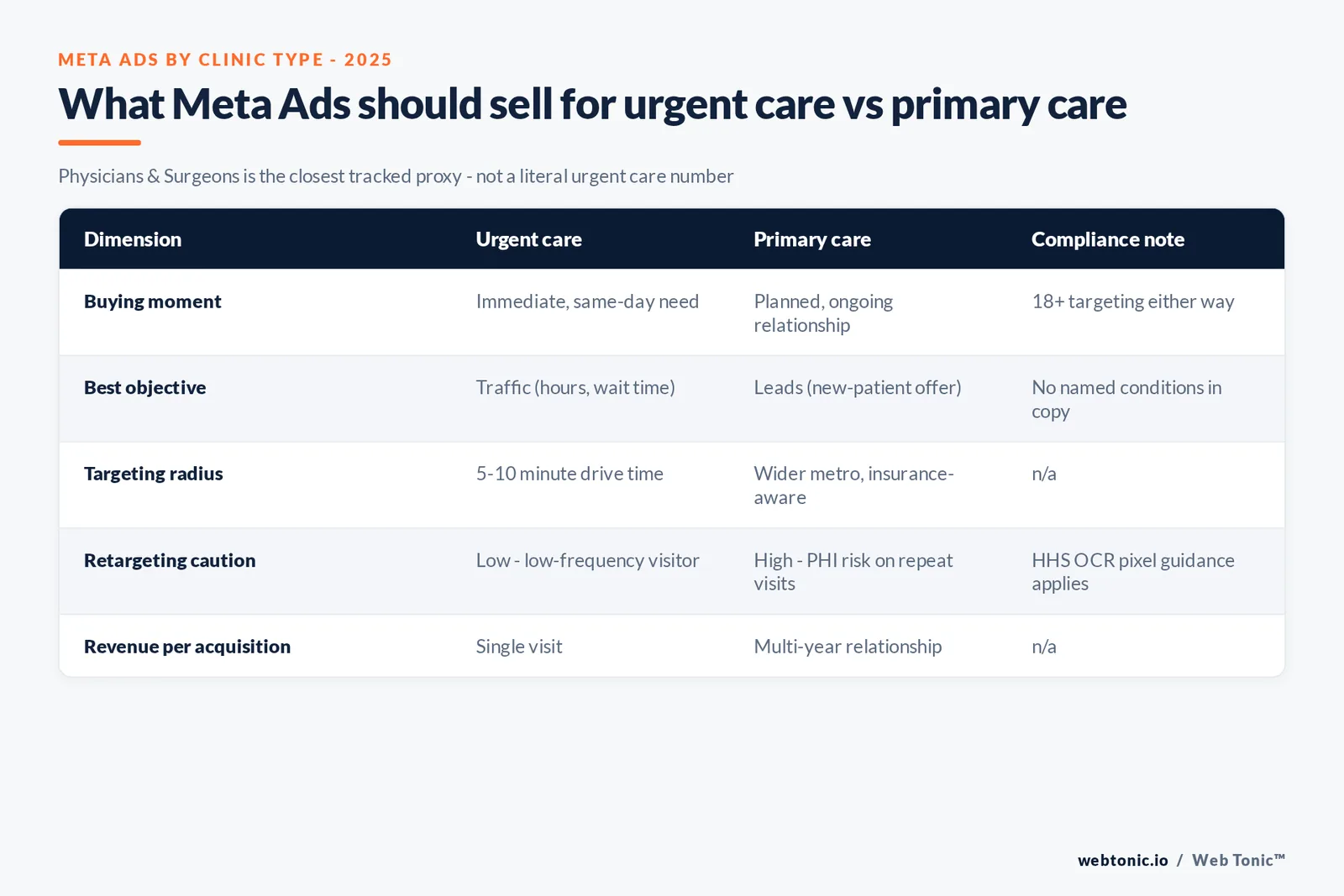
The Physicians and Surgeons data blends both patterns into one number, which is exactly why neither clinic type should copy it verbatim. Urgent care buys attention at the moment of need; primary care buys a multi-year relationship. Treating both as "healthcare Meta ads" produces a campaign that undersells one of the two.
| Dimension | Urgent care | Primary care |
|---|---|---|
| Buying moment | Immediate, same-day need | Planned, ongoing relationship |
| Best objective | Traffic (location, hours, wait time) | Leads (new-patient offer) |
| Targeting radius | Tight, 5-10 minute drive time | Wider metro, insurance-network aware |
| Retargeting caution | Low - low-frequency visitor | High - repeat visitor, PHI risk |
| Revenue per acquisition | Single visit | Multi-year patient relationship |
Creative that clears review versus creative that gets flagged
The single biggest source of avoidable disapprovals on healthcare Meta accounts is creative copy that names a condition ("worried about strep throat?") instead of describing a service ("same-day sick visits"). Meta's review systems key on condition language far more than on the landing page, so the fix is almost always in the ad text, not the destination URL.
| Creative pattern | Urgent care use | Primary care use | Compliance note |
|---|---|---|---|
| Service, not condition | "Same-day sick visits" not "flu symptoms" | "New-patient physicals" not "diabetes care" | Avoids Meta's health-claims review |
| Location and hours | Address, hours, wait indicator | Address, insurance accepted | Low-risk, high-relevance |
| Testimonial | General satisfaction quote | General satisfaction quote | Needs FTC typical-results disclosure |
| Age gate | 18+ required by Meta policy | 18+ required by Meta policy | Set at campaign level |
| Conversion event | Location visit / call | De-identified lead form submit | Server-side, no PHI in the payload |
Where the budget should go first
For urgent care, put the first dollars into traffic-objective ads around each individual location, refreshed with hours and current wait messaging rather than brand-level creative. For primary care, put the first dollars into lead ads carrying a specific new-patient offer, paired with a de-identified server-side conversion event so the campaign survives Meta's ongoing health-advertiser reviews. Our growth marketing team builds both patterns from the same account without letting one dilute the other, and our data and analytics practice sets up the de-identified event pipeline before the first ad goes live.
If search is a bigger piece of the plan than social, our breakdown of what Google Ads actually costs and our Facebook ads ROI analysis cover the channel-mix decision in more depth, or talk to us about the clinic-specific version.
The takeaway
There is no shortcut benchmark for "urgent care Meta ads" or "primary care Meta ads." The defensible move is to use the Physicians and Surgeons proxy as a cost floor, name it as a proxy every time it appears in a report, and let the buying moment - urgent versus planned - decide the objective, the radius and the creative, not a borrowed industry average.
Frequently Asked Questions
Does Meta publish urgent care or primary care ad benchmarks?
No. WordStream's 2025 Facebook Ads Benchmarks report, built from over 1,000 campaigns, tracks "Physicians and Surgeons" as its closest healthcare-provider category - it does not break out urgent care or primary care separately. Every figure on this page attributed to that category is a proxy, not a literal urgent care number, and we say so rather than dress it up as one.
What does a Meta lead ad actually cost a clinic?
Across all industries, WordStream's 2025 data puts the average Facebook leads-objective cost per click at USD 1.92 and the average cost per lead at USD 27.66. Physicians and Surgeons converts leads at 4.51%, below the 7.72% all-industry average, so a clinic paying the all-industry CPL should expect its actual cost per lead to run higher once that lower conversion rate is applied.
Can a clinic run retargeting ads based on who visited its website?
Only with real caution. Meta's Health and Wellness ad standard requires health-related campaigns to target adults 18 and older and bars ads that assert or imply a person has a health condition, and its privacy-violations policy separately bars ads that infer a health attribute about someone. Layered on top, HHS OCR's bulletin on tracking technologies treats a Meta Pixel or CAPI event fired from an appointment-request page as a potential HIPAA disclosure if it can be tied to an individual - which is why several ad accounts had custom audiences and conversion events disabled after Meta's 2025 healthcare policy tightening.
Is Meta worth it if primary care converts worse than the average?
The conversion math argues for narrower use, not for skipping the channel. A 4.51% conversion rate against a USD 1.92 CPC is still a defensible cost per appointment request for a clinic with strong average patient value, especially set against Urgent Care Association data showing an average of 33.96 patient visits a day per center in 2025 - volume a single well-targeted campaign can move.
Should urgent care and primary care run the same Meta strategy?
No. Urgent care sells an immediate, same-day need, which favors traffic-objective ads pointed at a wait-time or walk-in message; primary care sells an ongoing relationship, which favors lead ads built around a first-visit or new-patient offer. Using one creative playbook for both wastes the budget on the wrong objective for at least one of the two.
Sources
WordStream - Facebook Ads Benchmarks 2025
Urgent Care Association - Urgent care industry data
American Academy of Family Physicians - Match Day 2025
KFF - Primary Care Health Professional Shortage Areas
Meta Transparency Center - Health and Wellness ad standard
Meta Transparency Center - Privacy violations and personal attributes
HHS Office for Civil Rights - Online tracking technologies bulletin
Federal Trade Commission - Health Products Compliance Guidance
CDC NCHS - Source of Usual Health Care for Adults, United States 2024