Table of contents
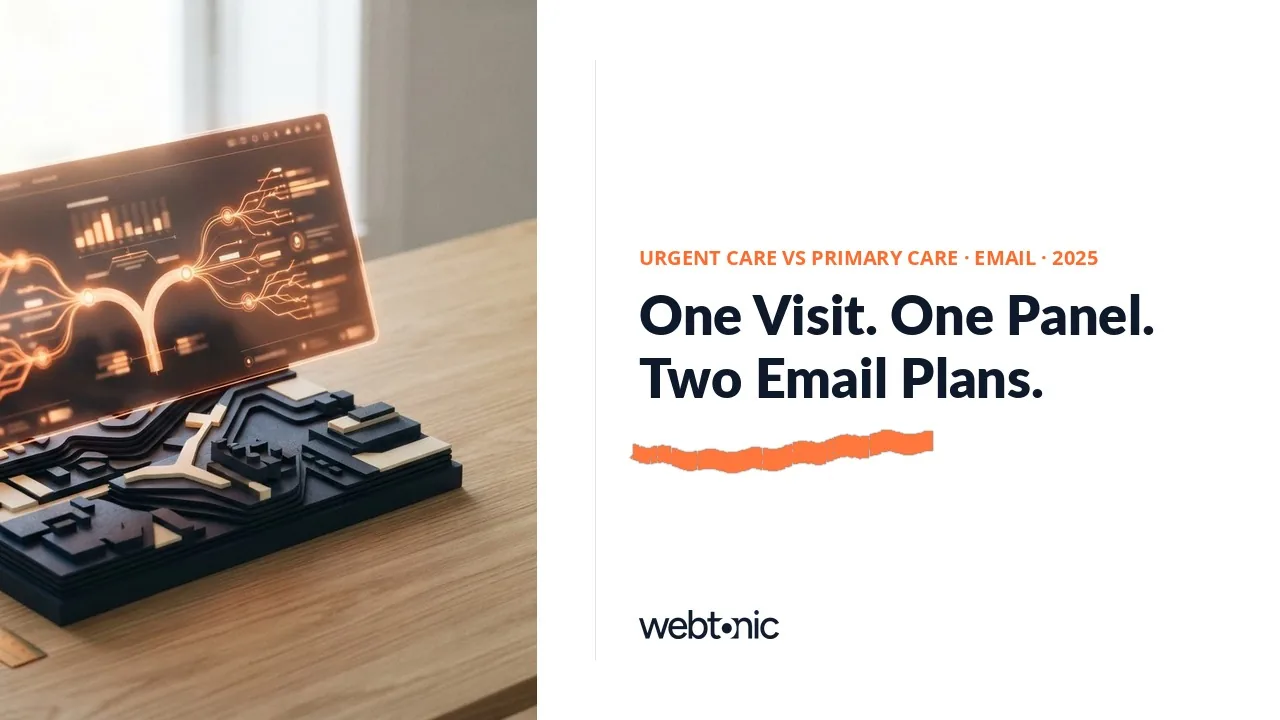
Urgent care and primary care start an email program from opposite positions: one has almost no repeat-visit relationship to nurture, the other runs its entire patient panel on recurring contact. This page uses Constant Contact's and Benchmark Email's own published industry data, layered with CDC visit-pattern research, to show what each clinic type can realistically send - and what the HIPAA rules around email actually restrict.
Key Takeaways
- Constant Contact's own research put medical services open rates around 32%, behind only religious organizations at 38% among its top industries by volume.
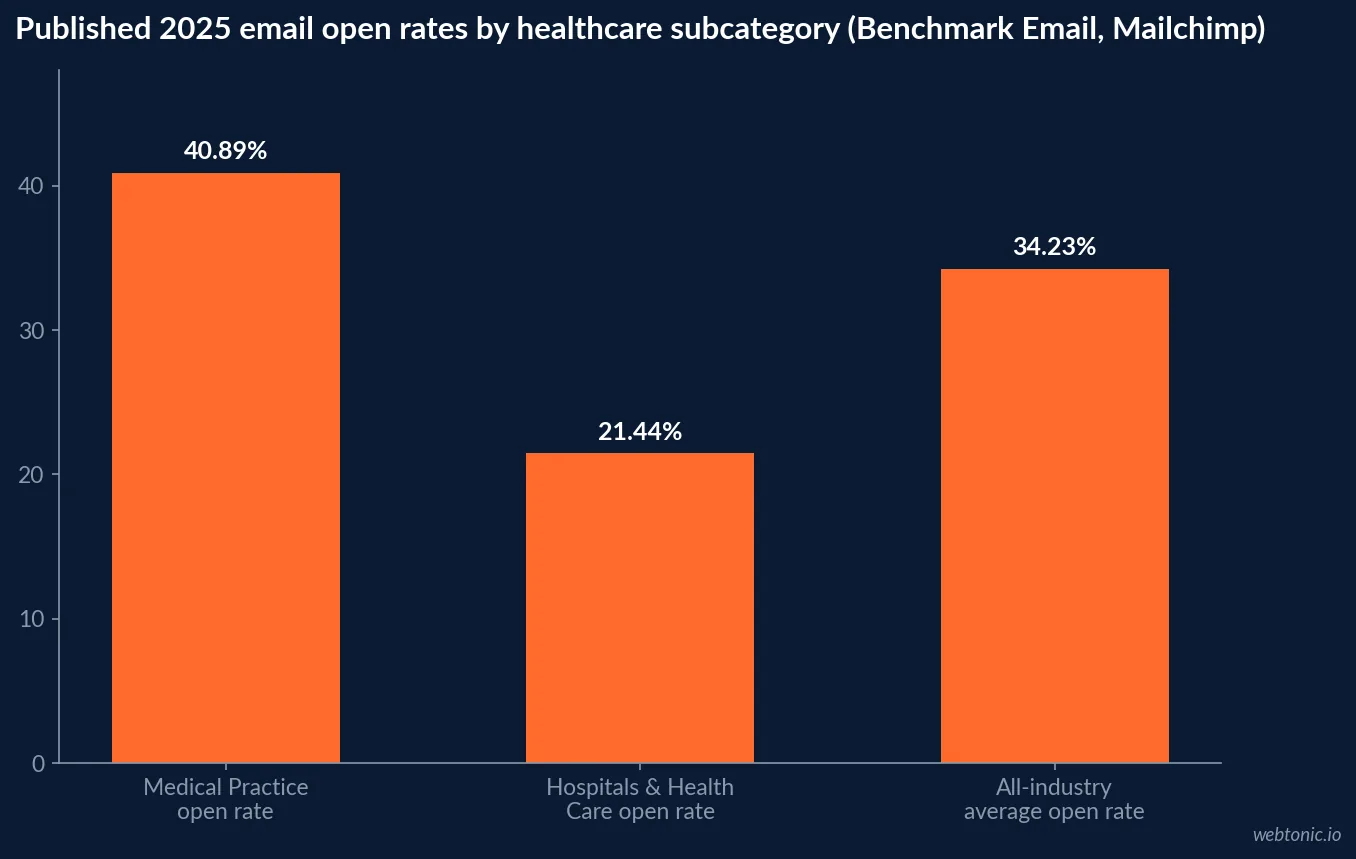
- Benchmark Email's platform data separately shows Medical Practice at 40.89% open and 0.92% click.
- The same dataset puts Hospitals and Health Care at 21.44% open and 1.45% click - nearly double the click rate at half the open rate of Medical Practice.
- Mailchimp's own benchmark page states an overall 34.23% average open rate across all industries it tracks.
- 93.3% of women and 87.1% of men report a usual source of care, the panel a primary care recall email is built to retain.
- The share of adults naming urgent care as a usual source of care declines with age, per CDC - a weak base for a repeat-visit nurture sequence.
- Urgent care locations grew from 9,000 to 15,000 between 2016 and 2024, a chain-level, not patient-level, email opportunity.
- The AAFP reports up to 48,000 more primary care physicians are needed by 2034 - a capacity gap that favors recall email over acquisition email.
- KFF counted 8,467 primary care shortage-area designations covering more than 92 million people who may lack a recall-ready practice at all.
- Family medicine residency programs filled at an 85% rate in the 2025 Match.
- HHS OCR's online tracking guidance extends HIPAA obligations to tracking pixels embedded in patient-facing emails and pages, not just the clinical record.
Why the two categories start from opposite positions
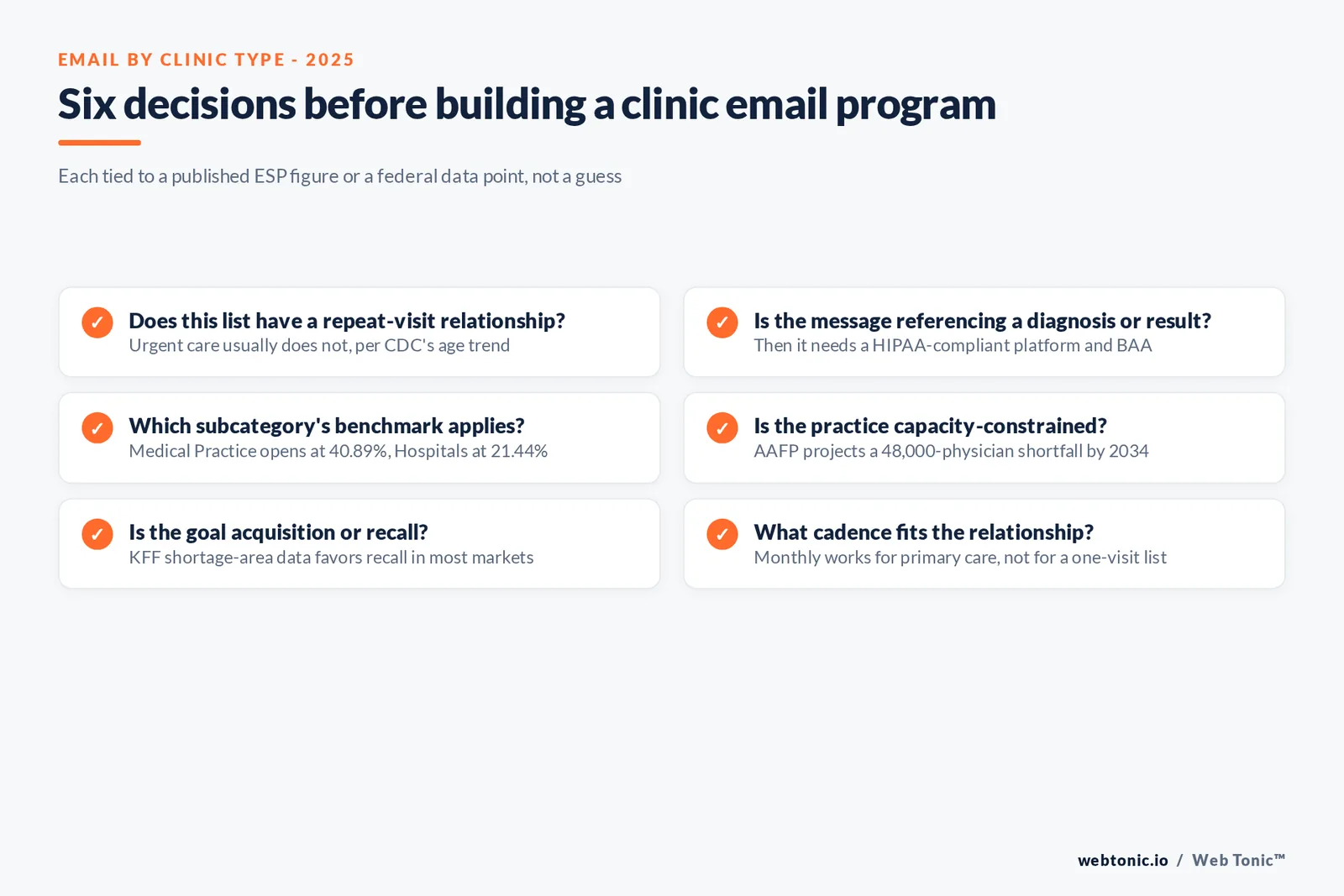
Email marketing works best against a list that expects to hear from a sender again. CDC's 2024 usual source of care survey found that the share of adults naming an urgent care center or a retail-clinic as their usual source of care declines with age, and the dominant pattern nationally is a doctor's office or health center, named by 82.2% of women and 72.6% of men. In plain terms: most people do not have an ongoing urgent care relationship, which is exactly the ingredient a nurture email sequence needs.
Primary care sits on the other side of that line entirely - the whole model is a recurring panel of patients a practice is expected to see repeatedly over years, which is precisely what recall and reminder email is built for.
What the published benchmarks actually say
Constant Contact's own industry-deviations research names medical services among its stronger performers, averaging around 32% open rates among the top industries by email volume, trailing only religious organizations at 38%. Separately, Benchmark Email's own published platform data breaks the category further: Medical Practice shows a 40.89% open rate but only 0.92% click rate, while Hospitals and Health Care shows a lower 21.44% open rate but a higher 1.45% click rate. That spread is the real lesson: a single quoted "healthcare open rate" hides two very different subcategories behaving in opposite directions.
Mailchimp's own resource page states an overall average open rate of 34.23% across every industry it tracks, which both healthcare figures above sit close to or below - a reminder that healthcare email is not automatically an above-average category, subcategory choice matters.
| Source (own published data) | Category | Open rate | Click rate |
|---|---|---|---|
| Constant Contact | Medical services (top-15 by volume) | ~32% | Not disclosed |
| Benchmark Email | Medical Practice | 40.89% | 0.92% |
| Benchmark Email | Hospitals and Health Care | 21.44% | 1.45% |
| Benchmark Email | Medical Devices | 22.58% | 1.94% |
| Mailchimp | All-industry average | 34.23% | 2.66% (avg CTR) |

The demand backdrop that changes what email should sell
The AAFP's 2025 Match Day report put family medicine's residency fill rate at 85% while warning the country needs up to 48,000 more primary care physicians by 2034. KFF separately counted 8,467 primary care shortage-area designations covering more than 92 million people.
Put together, most primary care practices are already capacity-constrained rather than patient-starved. That flips the usual email-marketing priority: the highest-leverage message is not a new-patient acquisition campaign, it is a well-timed recall or overdue-visit reminder that fills a cancellation or re-engages a lapsed patient inside a panel that already exists.
| Email type | Best fit | Why |
|---|---|---|
| Post-visit review request | Urgent care | Single touchpoint, no ongoing relationship needed |
| Recall / overdue-visit reminder | Primary care | Retains an existing, capacity-constrained panel |
| Seasonal illness / new-location update | Urgent care (chain level) | Brand awareness, not patient-level |
| Chronic-condition nurture sequence | Primary care | Matches the multi-year relationship model |
| New-patient acquisition drip | Primary care, selectively | Useful mainly outside shortage areas |
What HIPAA actually restricts in a clinic email
HIPAA does not ban email marketing, but it does change what a message can contain and which platform can send it. HHS OCR's guidance on online tracking technologies extends HIPAA's reach to tracking pixels and analytics embedded in patient-facing pages and emails, not only the clinical record itself. Any message referencing a specific diagnosis, treatment or lab result is protected health information and needs a HIPAA-compliant email platform under a signed business associate agreement - a general-purpose consumer ESP account is not built for that obligation by default.
Practical messages like appointment reminders, general wellness newsletters and review requests can typically run on standard marketing email infrastructure as long as they avoid naming a specific condition or result; anything more clinical needs the compliant layer.
| Message type | PHI risk | Platform requirement |
|---|---|---|
| General appointment reminder | Low, if no condition named | Standard ESP acceptable |
| Lab result or diagnosis-specific note | High | HIPAA-compliant platform + BAA required |
| Post-visit review request | Low | Standard ESP acceptable |
| Chronic-condition nurture content | Medium to high | HIPAA-compliant platform recommended |
| Newsletter / seasonal content | Low | Standard ESP acceptable |
Segmentation that actually reflects the two audiences
Most clinic email programs fail on segmentation before they fail on copy. Urgent care's list should be segmented by location and visit recency only - there is little value in behavioral or condition-based segments when most contacts have a single interaction. Primary care's list should be segmented by care-gap status - overdue for an annual physical, due for a screening, or recently referred out - because that segmentation is what turns a generic newsletter into a recall email with a measurable return.
| Segment type | Urgent care value | Primary care value |
|---|---|---|
| By location | High - drives the seasonal/chain update | Low - most patients have one location |
| By visit recency | Medium - review-request timing | High - recall timing |
| By care-gap / overdue status | Not applicable | Highest-value segment available |
| By age band | Low | Medium - screening schedules vary by age |
| By referral source | Low | Medium - informs which channel to reinforce |
Measuring what actually matters
Open and click rates are a proxy, not the goal, for either category. For urgent care, the metric that matters is review-request completion rate off the post-visit email, not the open rate itself. For primary care, the metric that matters is the recall conversion rate - the share of overdue-status contacts who actually book after the reminder - since that is the number that ties the email program back to filled appointment slots in a capacity- constrained panel.
What urgent care should actually build
Given the weak repeat-visit base CDC's data implies, urgent care's realistic email program is short: a single post-visit message asking for a review and, at the chain level, an occasional seasonal-illness or new-location update. Building a multi-email nurture sequence against a list that mostly visited once is effort spent chasing an open rate that will decay fast, since there is little reason for that recipient to open a second or third message.
What primary care should actually build
Primary care's email program should center on the recall and reminder cadence, not acquisition, given how capacity-constrained the category already is per AAFP and KFF data. Benchmark against the practice's own subcategory rather than a single quoted healthcare number - the gap between Medical Practice's 40.89% open rate and Hospitals and Health Care's 21.44% shows how much that number can move depending on how the sender is classified.
Send frequency: the variable most clinics get wrong
Frequency should follow the relationship, not a marketing calendar. An urgent care list that receives more than one or two emails a year from a single visit will see unsubscribe and spam- complaint rates climb quickly, since the recipient never agreed to an ongoing relationship in the first place. A primary care list, by contrast, can sustain a monthly newsletter and individually-timed recall messages without fatigue, because the underlying relationship is already annual or more frequent - the email is simply matching an expectation the patient already has.
| Cadence question | Urgent care answer | Primary care answer |
|---|---|---|
| Post-visit follow-up | Once, within 48-72 hours | Optional, low priority |
| Recurring newsletter | Chain-level only, quarterly at most | Monthly is sustainable |
| Recall / reminder cadence | Not applicable | Tied to screening and visit schedule |
| Re-engagement after inactivity | Not applicable - one-time visitor | Key lever for a lapsed patient |
Building the right list for each
Our growth marketing team builds the recall and reminder cadence primary care practices need against their actual capacity constraints, and our data and analytics practice sets up HIPAA-appropriate tracking so a clinic's email metrics survive a compliance review. For the broader email-industry picture beyond healthcare, see our email marketing statistics roundup, or talk to us about the clinic-specific build.
Frequently Asked Questions
Is email marketing worth building for an urgent care clinic?
Only in a narrow lane. CDC's 2024 usual-source-of-care data shows the share of adults naming an urgent care center as their usual source of care declines with age and is not the primary pattern for most adults - most people visit urgent care once for an acute need, not repeatedly. That makes a large nurture sequence low-value; the realistic email use case is a single post-visit satisfaction and review-request message, not an ongoing newsletter.
What open rates should a primary care practice expect?
Constant Contact's own published industry research names medical services among its higher-performing categories, averaging around 32% open rates against a religious-organization high of 38% and roughly 20-23% B2C/B2B averages in the same dataset. Benchmark Email's own platform data separately puts Hospitals and Health Care at 21.44% open and Medical Practice at 40.89% open - the spread shows why a clinic should benchmark against its own list, not a single quoted percentage.
What does HIPAA change about a clinic's email program?
It changes what can go in the message, not whether email can be used. HHS OCR's guidance on online tracking technologies and the broader HIPAA Privacy Rule mean appointment reminders, lab-result notices and any message referencing a specific diagnosis or treatment need a HIPAA-compliant email platform with a signed business associate agreement - a consumer ESP account alone is not sufficient once the content becomes protected health information.
Should urgent care ever send a recurring newsletter?
Multi-location chains can, but the audience is the community, not the individual patient. With the Urgent Care Association counting the sector's footprint at 15,000 centers in 2024, a chain-level newsletter about seasonal illness trends or new locations can work as a low-frequency brand-awareness tool - it should not be built or measured like a primary care patient nurture sequence.
What is the single highest-leverage email a primary care practice can send?
The recall or overdue-visit reminder. AAFP's 2025 Match Day data shows the country still needs up to 48,000 more primary care physicians by 2034, which means most practices already have more demand than capacity - the highest-value email is not acquisition, it is a well-timed recall message that fills a cancellation or brings a lapsed patient back into an existing panel.
Sources
Constant Contact - Industry deviations in email open rates
Benchmark Email - Email Marketing Benchmarks by Industry
Mailchimp - Email Marketing Benchmarks
CDC NCHS - Source of Usual Health Care for Adults, United States 2024
American Academy of Family Physicians - Match Day 2025
KFF - Primary Care Health Professional Shortage Areas
Urgent Care Association - Urgent care industry data
HHS Office for Civil Rights - Online tracking technologies bulletin