Table of contents
No publisher tracks a trucking-specific TikTok ad benchmark, and the honest first fact about this channel is who is actually on it: driver candidates and owner-operator communities, not shippers. This page prices a driver-recruiting TikTok budget from the closest verified cross-industry paid-social data, and separates that from the organic #trucktok activity that most trade coverage of trucking-on-TikTok is actually describing.
Key Takeaways
- No trucking-specific TikTok ad benchmark is published by TikTok or any trade body.
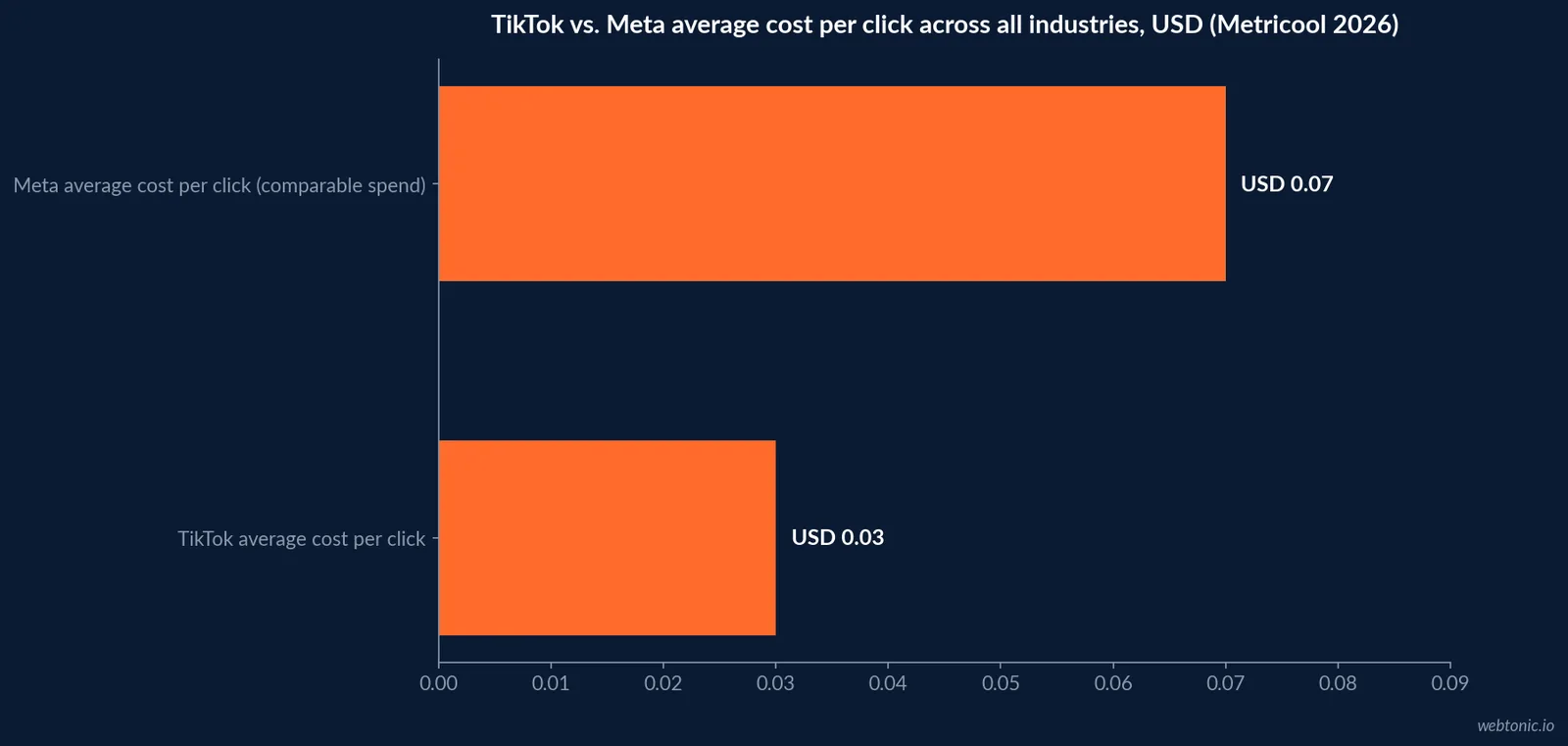
- TikTok clicks averaged $0.03 in a 2026 cross-industry study, less than half Meta's cost per click.
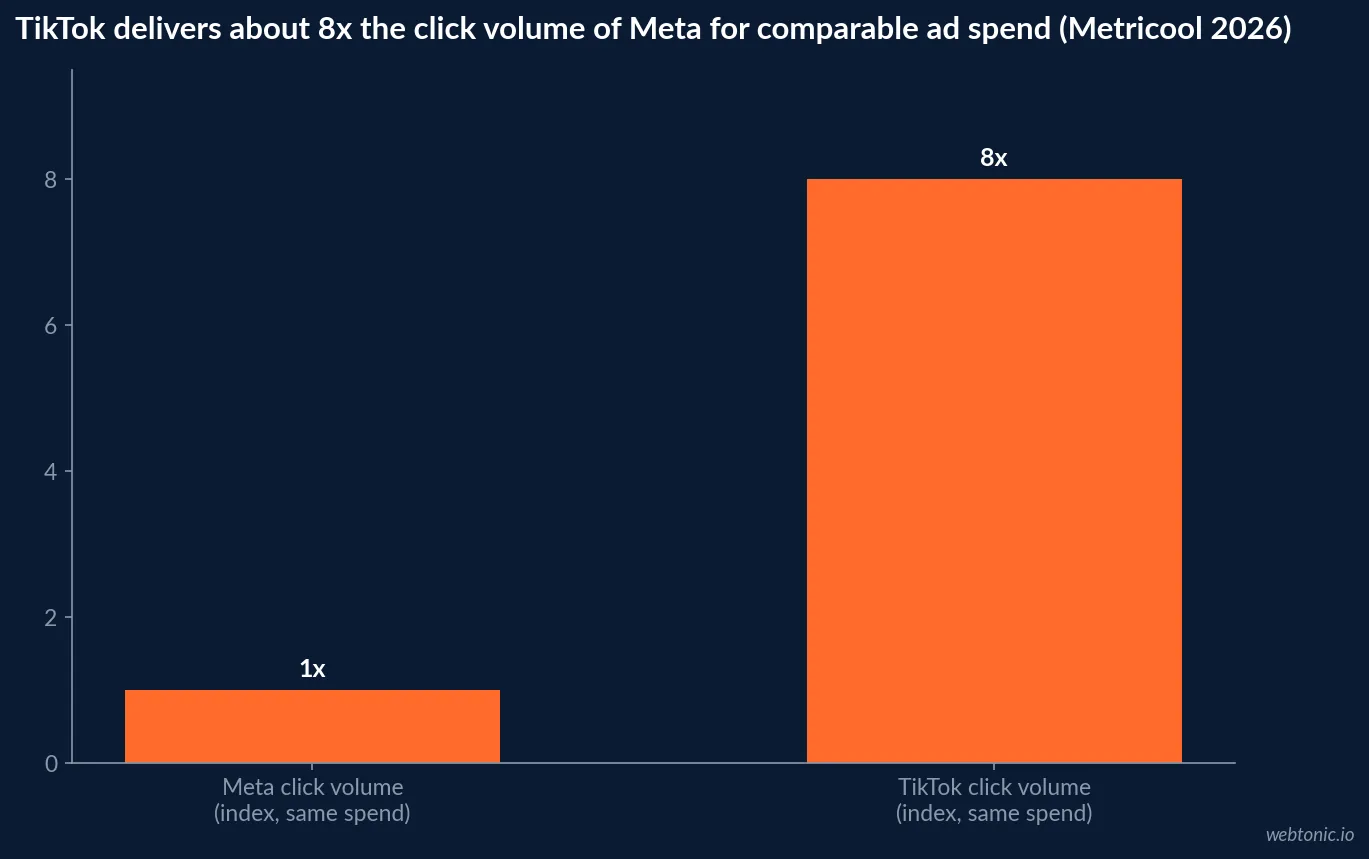
- The same TikTok spend brought in roughly 8 times the clicks as a comparable Meta campaign, per that study.
- 91% of advertisers in that dataset ran paid social on Meta alone, never testing TikTok.
- The study covered 628,969 campaigns from 44,355 advertisers, worth $471 million in spend.
- The average U.S. brand earned $2.42 per dollar on sales-objective ads in that data, below the $4.57 study average.
- #trucktok is organic content, distinct from any paid trucking presence on the platform.
- TikTok is the buying audience for driver candidates, not for shippers or freight brokers, per every documented trucking use case found.
- ATA's last published driver shortage estimate is 80,000, projected toward 160,000 by 2030.
- Combined driver wages and benefits reached $1.028 a mile in 2025, the first year above a dollar.
- Median heavy/tractor-trailer driver pay is $28.19 an hour, per 2025 wage data.
- 70% of tracked social ad budget in 2026 chased bottom-of-funnel sales, not awareness - relevant to how a recruiting budget should split.
- A driver-influencer program built on "a small budget" won a 2023 industry recognition, evidence organic can move recruiting before paid spend does.
Who is actually on the other end of a trucking TikTok ad
The single most important framing for this channel is audience, not cost. A shipper deciding which carrier to book freight with is not making that decision on TikTok - that buying journey runs through load boards, broker relationships and increasingly LinkedIn (covered separately). Every documented trucking use of TikTok in the available trade coverage is a recruiting or employer-brand play aimed at CDL drivers and owner-operators, built around short-form content about life on the road, pay, equipment and home time.
That reframes the entire budget question: this is not a freight lead-gen channel with disappointing benchmarks, it is a recruiting channel that happens to run on TikTok's ad infrastructure and pricing.
| Buyer TikTok is actually reaching | What they respond to | What TikTok is not for |
|---|---|---|
| CDL driver candidates | Pay transparency, day-in-the-life footage, equipment | Freight quote requests |
| Owner-operators | Lane availability, load-board tips, community content | Broker relationship building |
| Existing drivers (retention/referral) | Culture, recognition, driver-influencer content | Shipper procurement decisions |
Why there is no trucking-specific TikTok benchmark
TikTok's own advertising research and third-party benchmark studies segment by broad category - ecommerce, B2B, finance, education - and trucking recruiting does not appear as its own line anywhere in the published data reviewed for this page. That leaves cross-industry, all-advertiser data as the only honest anchor, clearly labeled as such rather than presented as trucking-specific.
Metricool's 2026 Social Ads Report - built from 628,969 campaigns run by 44,355 advertisers, worth $471 million in spend, comparing the same six months of 2025 and 2026 - found TikTok clicks averaging $0.03, less than half what the same click costs on Meta, with the same budget bringing in almost eight times the clicks. The same study found 91% of advertisers ran paid social on Meta alone, meaning most brands have never tested the cheaper platform at all.
| Metric (Metricool 2026 Social Ads Report, all industries) | Figure |
|---|---|
| Average TikTok cost per click | $0.03 |
| TikTok cost per click vs. Meta | Less than half |
| Click volume vs. Meta for comparable spend | ~8x more clicks |
| Advertisers running paid social on Meta only | 91% |
| Average return per dollar, sales-objective ads (US) | $2.42 (study average: $4.57) |
| Share of tracked ad budget aimed at bottom of funnel | 70% |
Organic #trucktok versus paid TikTok ads - not the same thing
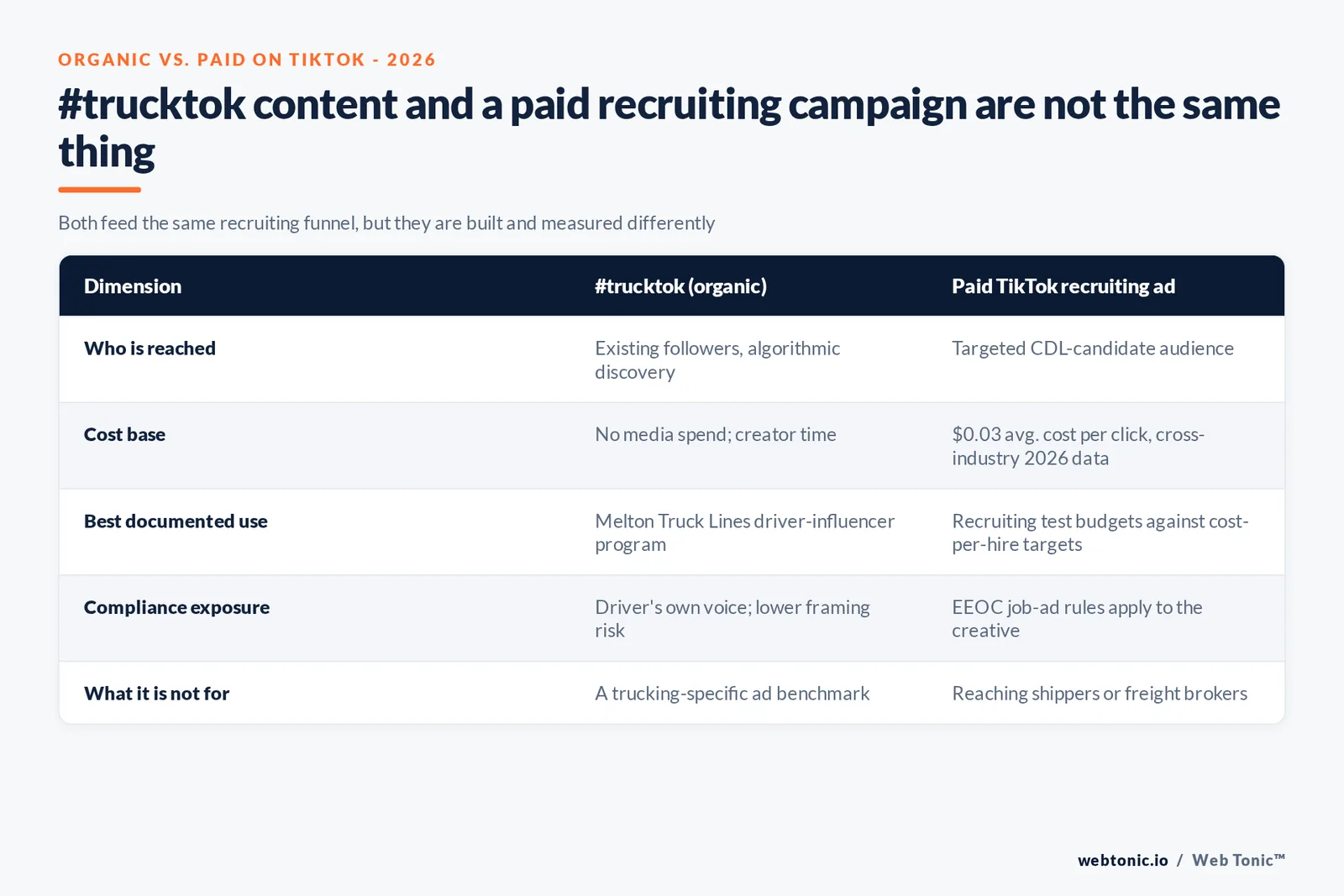
Most of what trade press describes as "trucking on TikTok" is organic, not paid. #trucktok content - drivers and owner-operators posting about routes, rigs and life on the road - predates any carrier's paid presence on the platform, and it is the reason TikTok became a recruiting conversation for this industry in the first place. Commercial Carrier Journal recognized Melton Truck Lines' driver-influencer program as a 2023 innovator specifically for building recruiting reach on a small budget through organic content, not a paid-media buy.
A paid TikTok ad campaign for driver recruiting sits on top of that organic activity - it does not replace it, and a carrier with no organic presence is starting a paid campaign into a feed where its competitors already have driver-made content circulating for free.
| Activity | Organic or paid | What it requires | What it is judged on |
|---|---|---|---|
| #trucktok driver posts | Organic | A driver willing to post, or an influencer partnership | Views, follows, application mentions |
| Driver-influencer program (e.g. Melton Truck Lines) | Organic, sometimes lightly resourced | A program to identify and support driver creators | Recruiting reach relative to spend |
| TikTok recruiting ad campaign | Paid | Ad account, creative, targeting, budget | Cost per applicant, cost per hire |
The recruiting math a TikTok test budget sits inside
American Trucking Associations' last publicly updated driver-shortage estimate is 80,000, from an October 2021 release, with a projected shortfall that could reach 160,000 by 2030. On the pay side, ATRI's 2026 operating-cost update, reported by Heavy Duty Trucking, found combined driver wages and benefits reached $1.028 a mile in 2025 - the first year that figure passed a dollar - while O*NET's mirror of BLS wage data puts the median heavy/tractor-trailer driver wage at $28.19 an hour. Any recruiting channel gets judged against that backdrop: is the offer competitive, and did the ad get it in front of a candidate cheaply enough to matter.
| Recruiting backdrop fact (verified year) | Figure | Source |
|---|---|---|
| ATA's last published driver shortage estimate | 80,000 (Oct. 2021) | American Trucking Associations |
| Projected shortage by 2030 (2021 estimate) | Up to 160,000 | American Trucking Associations |
| Combined driver wages + benefits, per mile | $1.028 (2025) | ATRI, reported by Heavy Duty Trucking |
| Median heavy/tractor-trailer driver wage | $28.19/hr (2025) | O*NET (BLS OEWS data) |
How TikTok recruiting compares to the rest of the paid-social mix
A recruiting budget rarely sits on one platform alone, so the honest comparison is TikTok against the other channels a driver-recruiting campaign typically runs on - Facebook/Instagram and YouTube pre-roll - using the same cross-industry data rather than trucking-specific numbers that do not exist for any of the three.
| Channel | What the 2026 cross-industry data shows | Best documented trucking use |
|---|---|---|
| TikTok (paid) | Avg. $0.03/click, ~8x the click volume of Meta for the same spend | Recruiting test budgets, driver-influencer amplification |
| Meta (Facebook/Instagram, paid) | Higher cost per click than TikTok in the same 2026 study | Long-running recruiting ad accounts, most carriers' default |
| YouTube (targeted recruiting video) | $0.05-$0.15 per view per vendor-reported CDL campaign data | Walkaround content and recruiting pre-roll |
| #trucktok (organic) | No ad spend; reach depends on driver-creator participation | Driver-influencer programs, e.g. Melton Truck Lines |
A compliance note before the creative goes live
A TikTok recruiting ad is still a job ad, and job ads carry EEOC anti-discrimination exposure regardless of platform. The EEOC's 2025 suit against a Class A carrier over an age-based hiring policy is a live example: short-form video that leans on "young," "energetic" or similar framing, or that implies a physical standard not tied to the job itself, gets the same legal review as a written posting. TikTok's short format and casual tone make it easy to skip that review; it should not be skipped.
What a first TikTok recruiting test should track
- Cost per applicant against the carrier's existing recruiting channels, not against the $0.03 cross-industry click price.
- Application completion rate, since TikTok's audience skews toward shorter attention spans and a long application form will lose candidates a click already paid for.
- Overlap with organic #trucktok reach, to see whether paid spend is amplifying existing driver-creator content or starting from zero.
- Time to hire, compared against the recruiting channels already in place.
How to set a test budget honestly
Given the absence of a trucking-specific benchmark, the defensible approach is a bounded test measured against the carrier's own existing cost per applicant - not against the $0.03 cross-industry click price as a promise, and not against zero. Run TikTok recruiting ads at a fixed test budget for a fixed period, track applicants through to hire the same way the existing recruiting channels are tracked, and compare cost per hire against the channels already in use rather than against a platform-wide average that was never trucking data to begin with.
Why this is a recruiting decision, not a marketing-fashion decision
Carriers considering TikTok often frame it as chasing a trend. The more useful frame is capacity: a channel that reliably reaches driver candidates at a lower cost per click is a hiring-capacity tool in a market where American Trucking Associations' own most recent published estimate puts the shortage at 80,000 drivers. Treated that way, the decision belongs with the recruiting budget, not the brand-marketing budget, and it should be sized and reported the same way any other cost-per-hire channel is.
What this means for a trucking marketing budget
Run TikTok as a recruiting channel with its own cost-per-applicant target, not as a freight lead-gen channel judged against shipper conversion numbers - it will fail that test every time because it is not built to pass it. Support any paid test with the organic #trucktok activity a carrier can realistically produce, since the two feed the same recruiting funnel. Our cost-per-lead research by industry is a useful cross-check before setting a target. If the current setup has no driver-facing content strategy at all, our content team can help build one before the paid budget goes live, or talk to us about scoping a bounded test.
Frequently Asked Questions
Should a trucking company run TikTok ads to reach shippers?
No - and treating TikTok as a shipper-acquisition channel is the most common mistake in this category. TikTok's audience for a carrier or fleet is drivers and owner-operators, not freight brokers or supply chain buyers looking to book a load; that buying decision runs through LinkedIn, load boards and direct broker relationships instead. Every documented trucking use of TikTok in the available research is a recruiting or employer-brand play, not a lead-gen channel for freight.
Is there a trucking-specific TikTok ad benchmark?
No. Neither TikTok's own reporting nor any trade press source publishes CPC, CPM or CTR broken out for the trucking or logistics industry specifically. The closest verified figures are cross-platform paid-social studies covering all advertisers - Metricool's 2026 Social Ads Report, built from 628,969 campaigns and 44,355 advertisers - which found TikTok clicks averaging $0.03, less than half Meta's cost per click, with roughly eight times the click volume for the same spend. That is a platform-wide number, not a trucking number, and this page treats it as such.
What is #trucktok, and is it the same thing as paid TikTok ads?
No - #trucktok is organic content, mostly drivers and owner-operators posting about life on the road, and it predates any paid trucking presence on the platform. Trade press has documented individual carriers building recruiting reach through organic driver-influencer content - Melton Truck Lines was recognized by Commercial Carrier Journal for a driver-influencer program built on a small budget. That is a distinct discipline from buying TikTok ads, and conflating the two overstates what a paid budget alone will do.
Why would a carrier spend on TikTok instead of putting the whole budget into Meta or Google?
The honest reason, based on the cross-industry data available, is cost efficiency on the awareness side of recruiting, not a proven trucking-specific advantage. Metricool's 2026 study found 91% of advertisers in its dataset run paid social on Meta alone, meaning most brands - trucking companies included - have never tested the cheaper-click platform at all. That is a gap worth testing against a real cost-per-applicant target, not a reason to shift a whole recruiting budget on a platform-wide average.
How does the driver shortage change the TikTok ad math?
It raises the cost of not testing every channel that can reach a driver candidate. American Trucking Associations' last published estimate put the shortage at 80,000 drivers, projected toward 160,000 by 2030, and ATRI's 2026 operating-cost data shows combined driver compensation just passed $1.028 a mile - meaning carriers are already competing on pay. A cheaper-per-click platform for reaching driver candidates is worth a test budget against that backdrop, even without a trucking-specific case study to point to yet.
Sources
Metricool - 2026 Social Ads Report
American Trucking Associations - Driver shortage estimate, October 2021
Heavy Duty Trucking - ATRI 2026 operating cost update
O*NET Online - Heavy and Tractor-Trailer Truck Drivers (BLS OEWS data)
Commercial Carrier Journal - Melton Truck Lines driver-influencer program