Table of contents

No study measures social media's exact share of freight leads, so the honest version of this page's title is narrower than the headline: the channels brokers say actually produce loads do not include social media at all, and cross-industry B2B data ranks organic social last among twelve tracked lead sources. What social does reliably reach in this industry is drivers, not shippers, and this page treats that distinction as the real finding.
Key Takeaways
- Freight brokers report finding loads through referrals, cold outreach, shipper lists, warm leads and load-board technology, a five-channel list that does not include social media (FreightWaves).
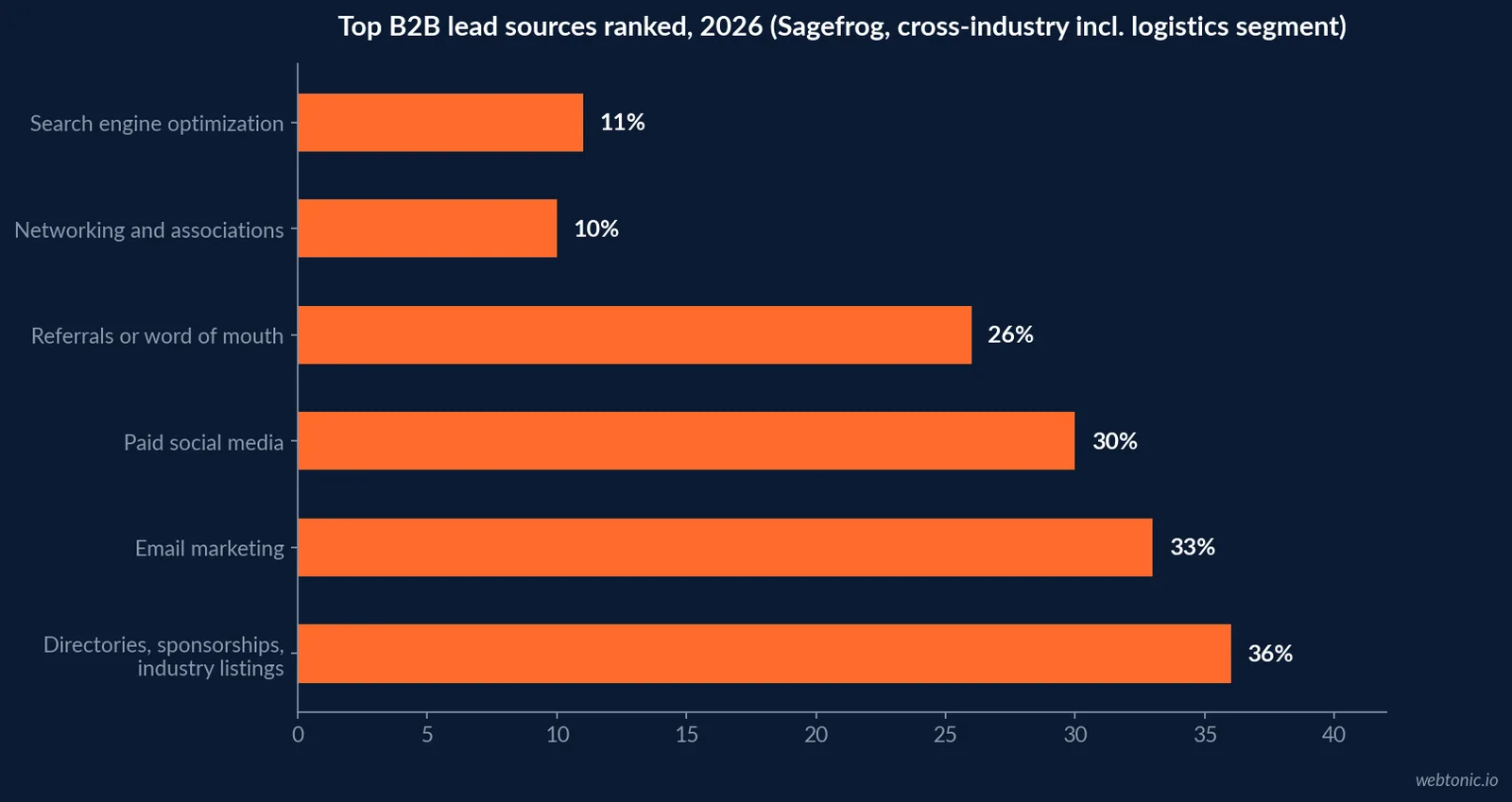
- Organic search engine optimization ranks last of 12 tracked B2B lead sources, at 11% (Sagefrog 2026, cross-industry).
- Paid social media ranks mid-pack among B2B lead sources, at 30% (Sagefrog, cross-industry).
- Content syndication/partner networks and directories/sponsorships tie for the top lead source, both at 36% (Sagefrog).
- Email marketing ranks third among B2B lead sources, at 33% (Sagefrog).
- Logistics, Transportation and Supply Chain made up 8% of Sagefrog's roughly 500 respondents, so the survey includes this industry without breaking channel data out by vertical.
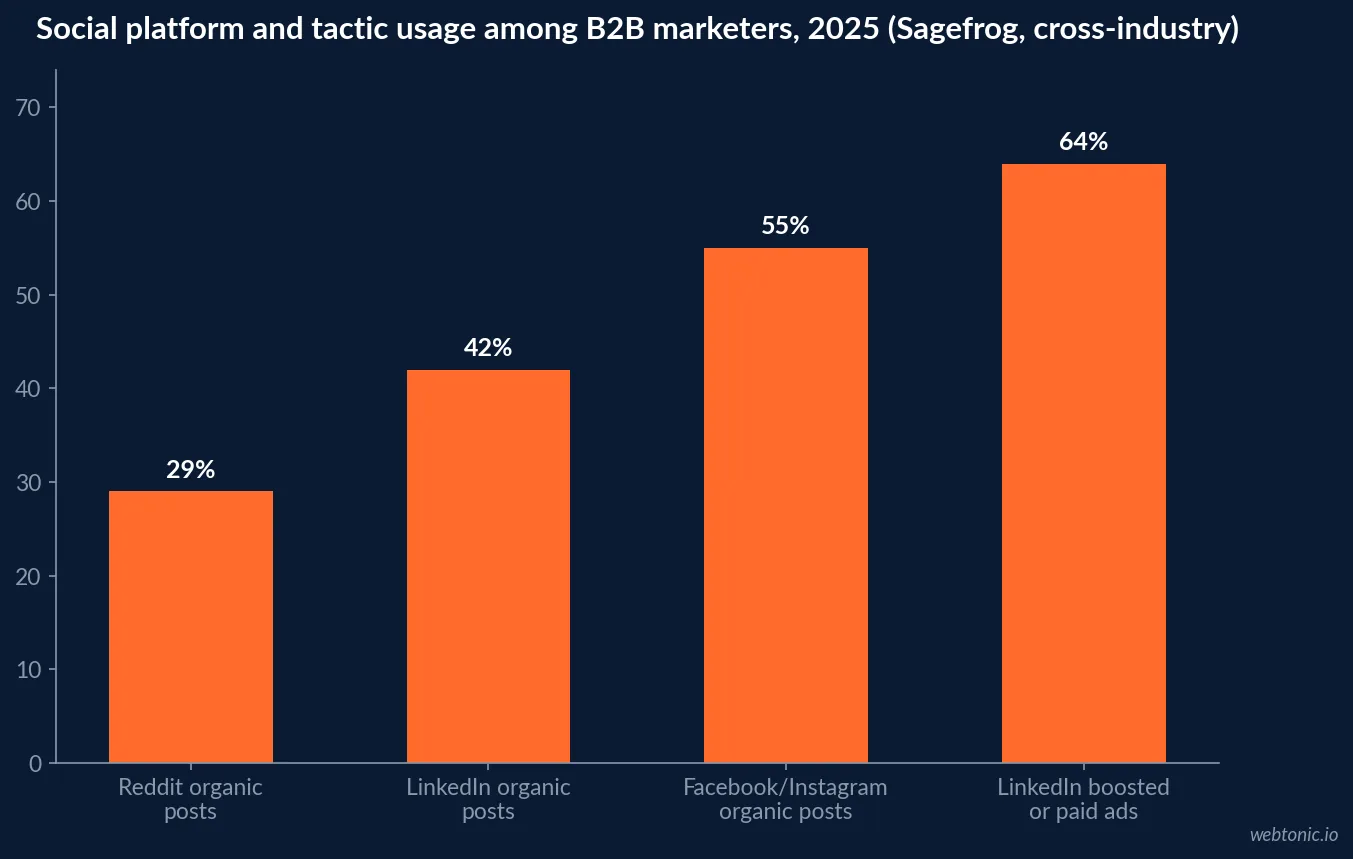
- LinkedIn boosted or paid ads are used by 64% of B2B marketers surveyed, the single most-used paid social tactic (Sagefrog).
- Facebook and Instagram organic posts are used by 55%, ahead of LinkedIn organic at 42% (Sagefrog).
- 67% of shippers name service level and reliability as the top factor in choosing a freight partner (Denim/Peerless Research Group, 2025).
- 30% of shippers cite unrecognized third-party contact as a top frustration (Denim).
- Trucking is a USD 906 billion industry in which over 99% of carriers run 100 trucks or fewer (ATA, 2026), which caps how many operators can run any always-on B2B social program at all.
- Trucks moved 72.7% of the nation's freight by weight in 2024 (ATA).
- The industry is in its third straight year of a freight recession, with operating costs up 3.4% to a record USD 2.336 a mile in 2025 (ATRI).
What "zero fleet leads" can and cannot mean
No published study measures social media's exact contribution to freight-lead generation for trucking and logistics specifically, and this page will not manufacture a number to fit the claim. What exists instead is two honest proxies: a description of the channels that actually produce freight leads, in which social does not appear, and cross-industry B2B lead-source data in which organic social finishes last. Both point the same direction; neither is a trucking-specific "0%."
| Evidence type | What it shows | Source |
|---|---|---|
| Named channels that produce freight leads | Referrals, cold outreach, shipper lists, warm leads, load boards; no social | FreightWaves |
| Cross-industry organic social/SEO lead-source ranking | 11%, last of 12 tracked sources | Sagefrog 2026 (cross-industry) |
| Cross-industry paid social lead-source ranking | 30%, mid-pack of 12 tracked sources | Sagefrog 2026 (cross-industry) |
| Shipper-stated buying criteria | 67% cite service/reliability as the top factor, not marketing presence | Denim/Peerless, 2025 |
The channels that actually move freight, by the industry's own account
Industry commentary on how brokers find loads points to five working channels: asking existing clients for referrals, cold outreach to shipper lists, warm leads from inbound inquiries, re-engaging former accounts, and load-board technology. Social media is not among them, in an article whose entire purpose is cataloguing what works.
That absence lines up with what Denim's 2025 shipper survey, run with Peerless Research Group across nearly 100 shippers, found buyers actually weigh: 67% name service level and reliability as the top factor, while 30% flag unrecognized third-party contact and 27% flag unprofessional tone as top frustrations. A shipper is not discovering or qualifying a carrier through an Instagram post.
| Denim 2025 shipper-survey finding | Share of shippers |
|---|---|
| Service level and reliability is the top selection factor | 67% |
| Unrecognized third-party contact is a top frustration | 30% |
| Unprofessional tone is a top frustration | 27% |
| Factoring use is unknown or considered irrelevant to the decision | 54% |
Where social ranks in cross-industry B2B lead generation
Sagefrog's 2026 B2B Marketing Mix Report, its 19th edition, surveyed nearly 500 B2B marketers across healthcare, technology, industrial and business-services sectors, with Logistics, Transportation and Supply Chain making up 8% of respondents. Ranked by share naming each as a top lead source: content syndication and partner networks and directories, sponsorships or industry listings tie for first at 36% each, followed by email marketing at 33% and paid social media at 30%. Organic search engine optimization ranks dead last of twelve tracked sources, at 11%.
That is the honest, labeled cross-industry evidence behind this page's title: it is not that social produces zero leads everywhere, it is that the organic version of it is the single worst-performing lead source B2B marketers reported, and logistics marketers are represented in that sample without a vertical-specific breakout available.
What social actually reaches in this industry: drivers, not shippers
The reframe this data supports is not that social is useless in trucking, it is that its real audience is misidentified by the title's shipper-facing framing. The American Trucking Associations puts trucking at a USD 906 billion industry in which over 99% of carriers run 100 trucks or fewer, which is exactly the kind of operator that cannot fund an always-on B2B social program aimed at shippers, but can and often does run recruiting-focused pages and paid posts aimed at drivers and owner-operators.
Drivers and owner-operators are an audience that actually lives in the feed, follows recruiting pages and industry groups, and responds to social posts the way any consumer audience does. Shippers, per the Denim and FreightWaves evidence above, are evaluating on service and relationships instead. Running one social strategy for both audiences is the mistake this page is built to correct.
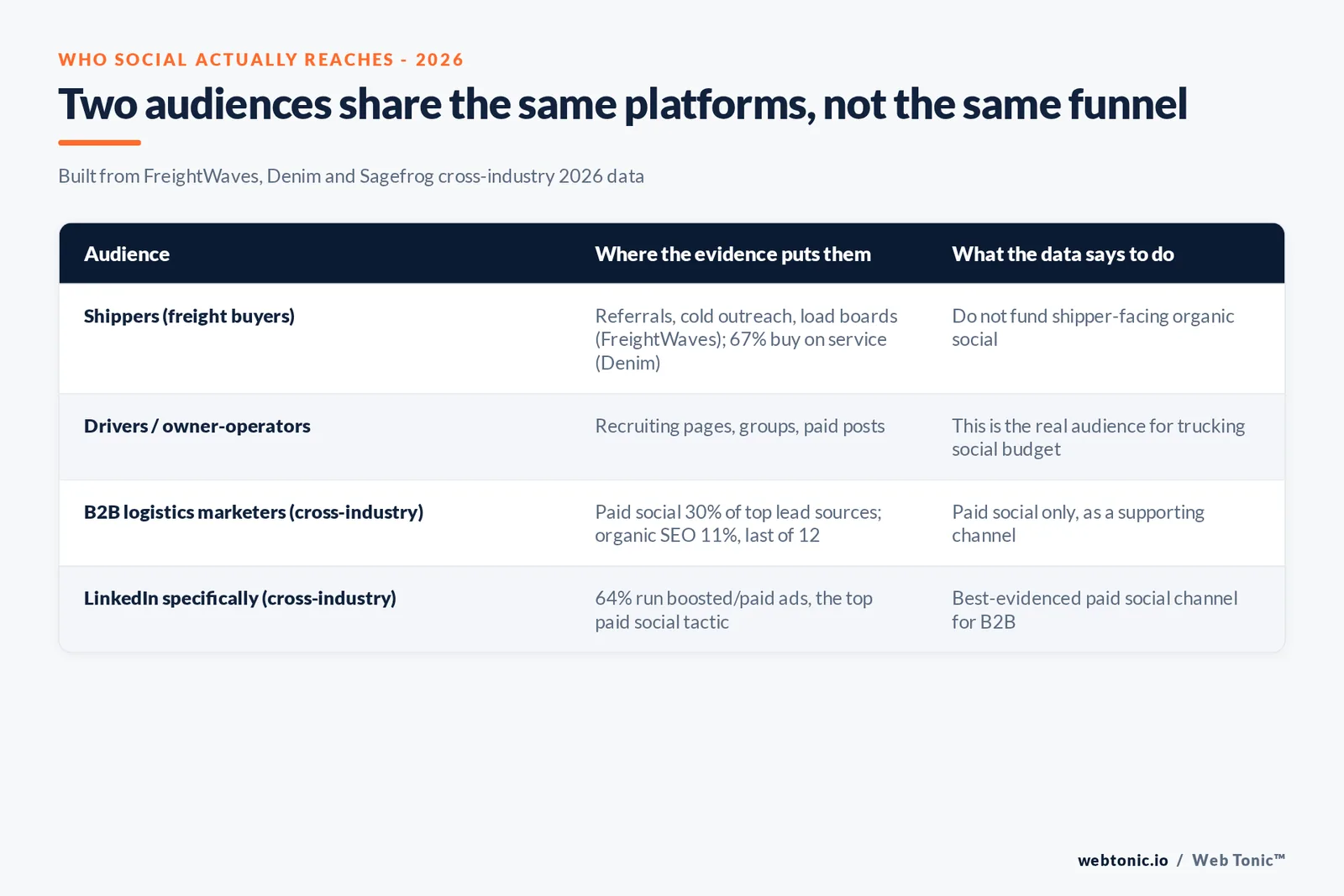
| Audience | Where they actually are found | What the evidence says to do |
|---|---|---|
| Shippers (freight buyers) | Referrals, cold outreach, load boards (FreightWaves) | Do not budget shipper-facing organic social |
| Drivers / owner-operators | Recruiting-focused social pages, groups, paid posts | This is the real audience for trucking social spend |
| B2B logistics marketers generally (cross-industry) | Paid social at 30% of top lead sources | Treat as a supporting, paid-only channel, not a primary one |
Why organic reach specifically is a losing bet everywhere, not just here
The "11%" ranking above is not an isolated data point. Socialinsider's 2026 analysis of 872,075 brand-page posts puts average Facebook organic reach at just 1.25% of followers as of August 2026, with small pages under 5,000 followers averaging 4.35% and pages over 100,000 followers averaging as little as 0.50%. Our own cross-referenced breakdown of 2026 social reach benchmarks covers this decline in full across platforms; the short version is that organic reach has fallen from roughly 16% of followers in 2012 to about 1.25% today.
Read against that backdrop, an 11% organic-lead-source ranking for B2B marketers generally is not surprising, it is consistent. A trucking company posting organically to a shipper audience is fighting the same single-digit reach ceiling every other industry is fighting, with none of the driver-recruiting audience advantage that makes the platform worth the effort in the first place.
| Organic reach benchmark, 2026 | Figure | Source |
|---|---|---|
| Average Facebook Page organic reach | 1.25% of followers | Socialinsider (872,075 posts analyzed) |
| Small Pages (1-5K followers) | 4.35% average reach | Socialinsider |
| Large Pages (100K-1M followers) | 0.50% average reach | Socialinsider |
| Organic reach in 2012, for comparison | ~16% of followers | Industry-wide historical estimate |
Why most carriers can't run a real B2B social program in the first place
Budget, not strategy, is often the real reason shipper-facing social underperforms. The American Trucking Associations puts trucking at a USD 906 billion industry in which over 99% of carriers run 100 trucks or fewer, and the industry is in its third straight year of a freight recession, with average operating costs hitting a record USD 2.336 a mile in 2025, according to ATRI's 2026 Update. A one-truck operator running on that margin is never going to fund a content team, whatever the channel data says.
That is a structural reason the "zero fleet leads" framing survives scrutiny: most of the industry's operators are simply too thin-margined to run any always-on social presence, shipper- facing or otherwise, which is a budget constraint the channel-ranking data above cannot capture.
| Industry constraint (2026) | Figure | Source |
|---|---|---|
| Carriers at 100 trucks or fewer | Over 99% | American Trucking Associations |
| Average operating cost per mile | USD 2.336, up 3.4% YoY | ATRI |
| Consecutive years of freight recession | 3 | ATRI / Transport Topics |
| Median driver pay (context for what a social hire competes against) | USD 58,640/year | BLS OEWS via O*NET Online |
Where paid recruiting social does carry real numbers
The one place this page can point to actual trucking-specific paid social data is driver recruiting, covered in full in our companion piece on Meta ad budgets. Using Career and Employment as the closest tracked proxy, WordStream's 2025 benchmarks found that category's click-through rate rose 34% year over year, one of the largest gains of any industry tracked. That is a genuinely strong, verifiable number, and it belongs to the driver audience, not the shipper one.
LinkedIn is also making an explicit institutional bet on reaching B2B audiences through creators and video rather than static company-page posts, according to LinkedIn's own 2026 newsroom announcement, which is worth watching for freight-B2B marketers even though it is not, at this point, a trucking-specific finding.
What "8% of the sample" means for how much to trust this data
Honesty about the evidence also means being honest about its limits. Sagefrog's 8% Logistics, Transportation and Supply Chain share of roughly 500 respondents is enough to include the industry in the survey; it is not enough for Sagefrog to publish a vertical-specific channel breakdown, and none is available. Every ranking cited above is the cross-industry aggregate, applied here as the best available proxy, not a logistics-only finding.
That caveat cuts both ways: it means the 11% organic-SEO figure could be somewhat better or worse for logistics specifically than for the aggregate, but there is no published number that says which, and no honest version of this page pretends otherwise.
What a shipper-facing social budget should actually fund
If a freight-B2B marketer keeps any shipper-facing social spend at all, the evidence above argues for funding LinkedIn paid specifically, at the 30% paid-social and 64% LinkedIn-paid-ads levels Sagefrog reports, rather than organic company-page posting on any platform. Content syndication, directories and email, all ranked above paid social in the same data, deserve the marginal budget dollar before a fourth or fifth organic social post does.
How to spend the social budget honestly
Stop measuring shipper-facing organic social against a lead-generation goal it is not built to hit; the industry's own channel list and the cross-industry 11% ranking both say it will underperform there. Redirect organic social effort toward driver and owner-operator recruiting, where the audience genuinely is, and treat paid social, LinkedIn specifically, as a small, measured supporting channel for shipper-side B2B rather than a primary lead source.
For the channel that the evidence above shows shippers actually respond to, our growth marketing practice builds referral and relationship programs first; for the driver-recruiting side of the same budget, see our note on what paid social actually costs before setting a recruiting budget.
Frequently Asked Questions
Is it literally true that social media generates zero fleet leads?
No study measures that number directly, and this page does not claim one does. What the evidence shows is narrower and still damning for shipper-facing social: FreightWaves' own reporting on how brokers find loads lists referrals, cold outreach, shipper lists, warm leads and load-board technology as the working channels, and social media appears on none of them. Organic social specifically also ranks last among 12 tracked B2B lead sources in cross-industry data, at 11%, which is the closest verifiable proxy for "drives close to zero."
Does paid social do better than organic for B2B logistics buyers?
Directionally, yes, though this is cross-industry data, not trucking-specific. Sagefrog's 2026 B2B Marketing Mix Report, surveying nearly 500 B2B marketers including a Logistics, Transportation and Supply Chain segment, ranks paid social media as a top lead source for 30% of respondents, well above organic search engine optimization at 11%. Paid and organic social are not the same channel and should not be judged by the same number.
If not shippers, who does social media actually reach in this industry?
Drivers and owner-operators. The industry's own economics explain why: the American Trucking Associations puts trucking at a USD 906 billion industry in which over 99% of carriers run 100 trucks or fewer, meaning most operators cannot fund an always-on B2B social program but can and do run recruiting-focused pages, groups and paid posts aimed at drivers, which is a fundamentally different use of the same platforms.
What do shippers say actually earns their business, if not social presence?
Service and reliability. Denim's 2025 survey of nearly 100 shippers, run with Peerless Research Group, found 67% name service level and reliability as the top factor in choosing a freight partner. Unrecognized third-party contact, cited by 30% as a top frustration, is a bigger risk to winning business than any social media visibility gap.
Which social platforms matter most for B2B logistics marketing, even at the margins?
LinkedIn, by a wide margin, according to the same Sagefrog cross-industry data: LinkedIn boosted or paid ads are used by 64% of B2B marketers surveyed, ahead of Facebook and Instagram organic posts at 55% and LinkedIn organic posts at 42%. That ranking reflects B2B marketing broadly; it is presented here as the closest available proxy, not a trucking-specific finding.
Sources
Sagefrog Marketing Group - 2026 B2B Marketing Mix Report
Socialinsider - Social Media Reach Statistics 2026
American Transportation Research Institute - Operational Costs of Trucking, 2026 Update
O*NET Online (sourcing BLS OEWS) - Heavy and Tractor-Trailer Truck Drivers wages
WordStream - Facebook Ads Benchmarks 2025
LinkedIn - How LinkedIn is helping B2B marketers reach audiences at scale, 2026
Denim (with Peerless Research Group) - 2025 shipper survey
American Trucking Associations - Navigate the Challenges of 2026
American Trucking Associations - Economics and Industry Data
American Transportation Research Institute - Operational Costs of Trucking, 2026 Update