Table of contents
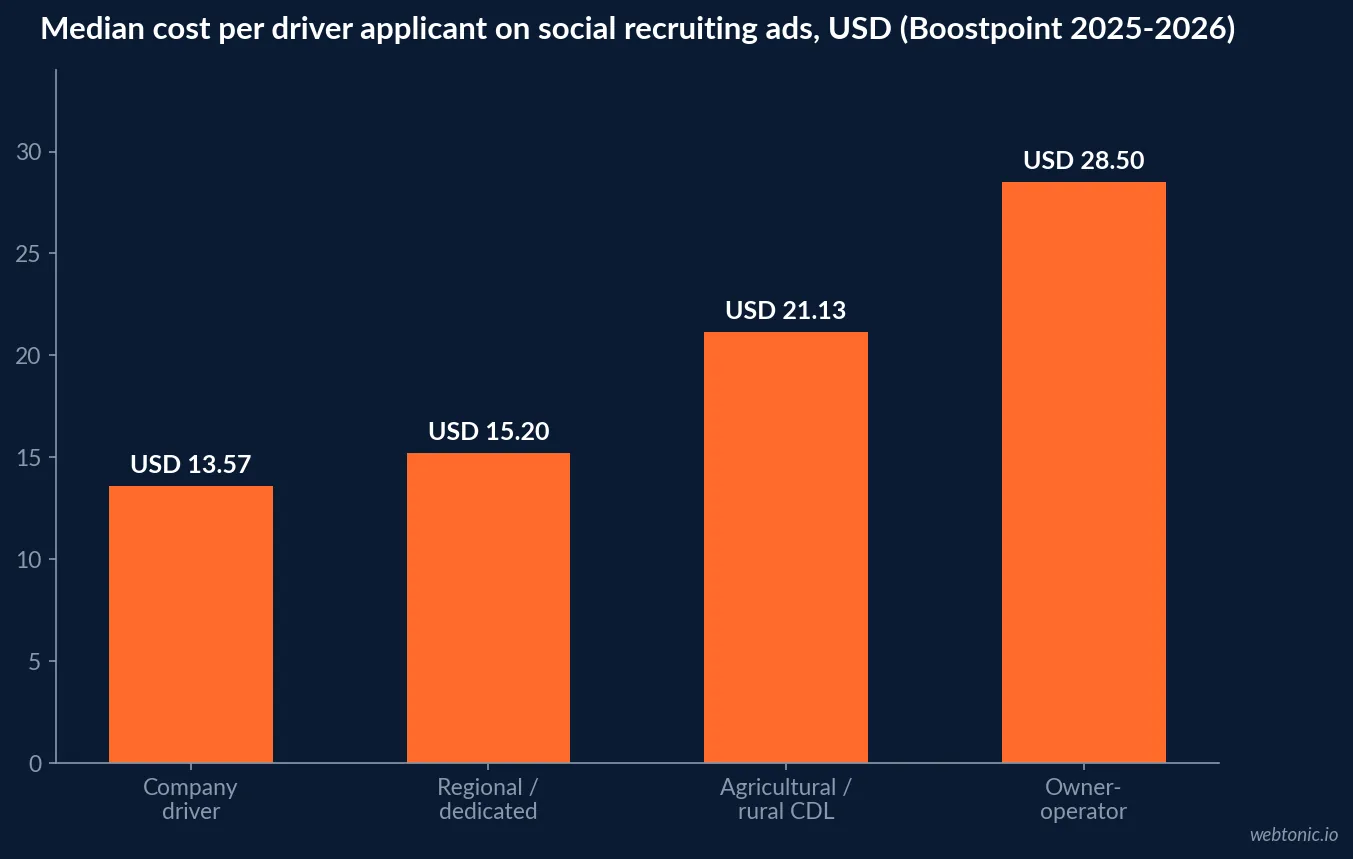
Owner-operator recruiting costs USD 28.50 per applicant against USD 13.57 for a general company driver on the same social platforms - more than double, for a smaller, harder-to-reach audience. That gap is the clearest evidence that "trucking ad creative" is not one job. It is at least two: convincing a shipper's logistics team the network is reliable, and convincing a driver candidate the job and the money are real.
Key Takeaways
- Owner-operator recruiting costs USD 28.50 per applicant, the highest of any driver segment (Boostpoint).
- Company driver recruiting runs USD 13.57 per applicant on targeted social campaigns.
- Agricultural/rural CDL recruiting costs USD 21.13 per applicant, mid-pack.
- A national "CDL recruiting" search click costs USD 25.42, nearly 2x a social applicant.
- The average driver-job-ad click costs USD 0.87 nationally (Joveo).
- The median advertised truck driver salary is about USD 64,000 as of December 2025.
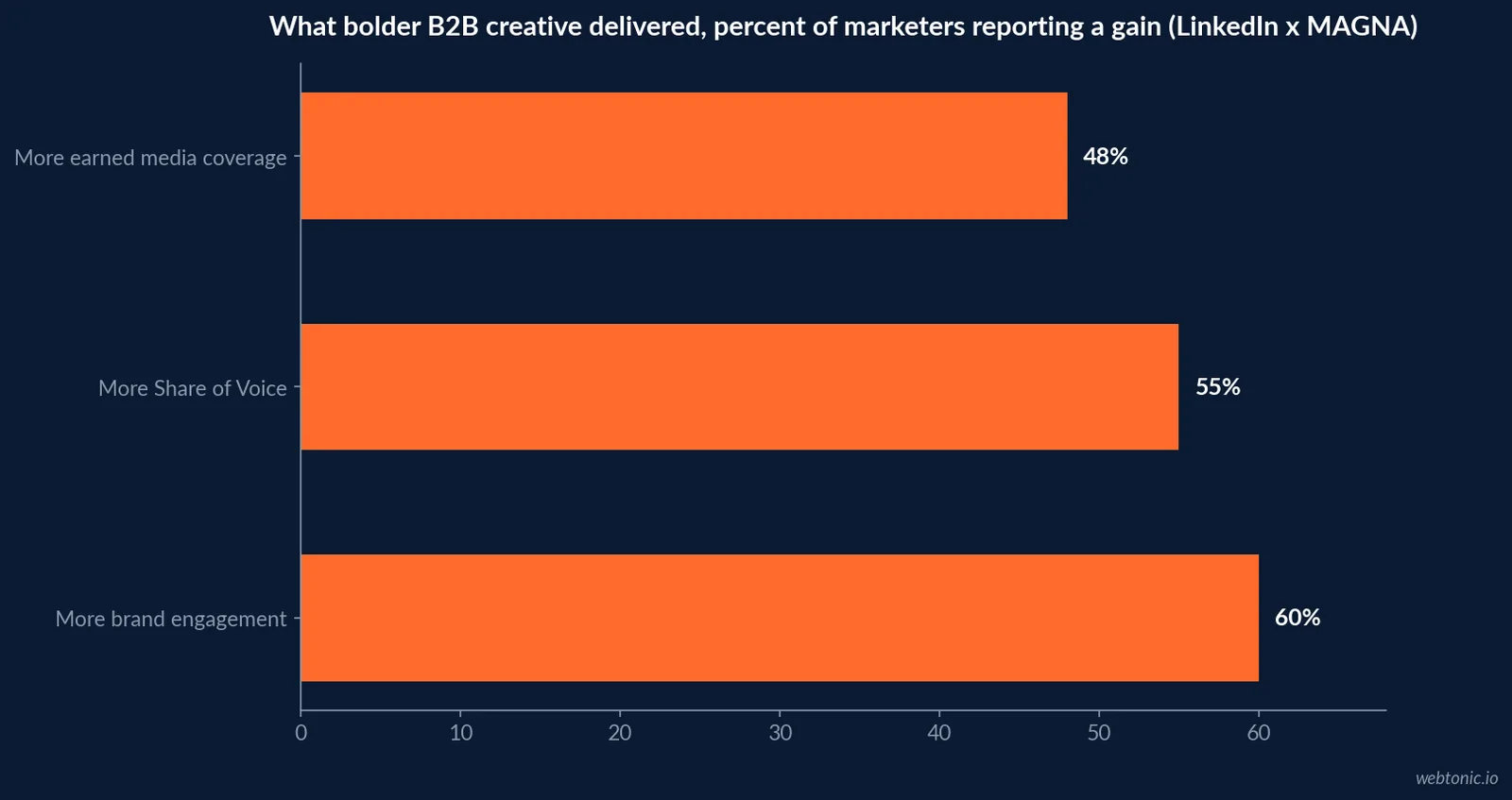
- 90% of B2B CMOs are pushing for bolder, more creative campaigns (LinkedIn x Ipsos, 2024).
- 67% of those CMOs are raising brand-building budgets to support it.
- 60% link stronger creative to more brand engagement, 55% to more Share of Voice.
- 48% report more earned media coverage from bolder B2B creative.
- Industrial and Commercial lead-ad CTR grew 32% year-over-year on Meta (WordStream 2025).
- Uber Freight cites USD 17 billion-plus in freight under management in its own 2026 reporting.
- C.H. Robinson reports up to 23% faster speed to market from its own AI-driven network data.
- 74% of B2B buyers finish their vendor research inside 12 weeks (Google x NRG, Oct. 2025).
- The FTC's fake-review ban took effect October 21, 2024 and covers testimonial ads directly.
Two audiences, two creative jobs
A freight brokerage's marketing team usually runs both campaigns from the same budget line, which is how the two audiences end up with the same creative. Shippers are evaluating operational risk over a multi-week sales cycle; driver candidates are making a faster, personal decision about pay and lifestyle. Pricing the two audiences separately - which the data below already does - is the first fix.
| Driver recruiting segment | Median cost per applicant | Notes |
|---|---|---|
| Company driver (general) | USD 13.57 | Largest, most liquid candidate pool |
| Regional/dedicated fleet driver | USD 15.20 | Home-time messaging performs here |
| Agricultural/rural CDL driver | USD 21.13 | Smaller geographic pool |
| Owner-operator | USD 28.50 | Recruiting a small-business owner, not an employee |
Why owner-operator creative has to work harder
Boostpoint's own 2025-2026 CDL campaign data - the company's proprietary transportation job-advertising benchmark - explains the gap: an owner-operator is a small-business owner deciding whether to lease a truck into a network, not an employee filling out an application. That is a business-development pitch, not a job posting, and creative that treats it as the latter under-converts. The practical fix is separating owner-operator ads from company-driver ads entirely, with different landing pages and different proof points (equipment financing terms, lane consistency, settlement speed) rather than one generic "drivers wanted" creative.
What convinces a shipper: named numbers, not brand claims
On the freight-buyer side, the winning creative pattern is a specific, sourced number attached to a named network - not a slogan. C.H. Robinson's own account of its AI truckload optimization states up to 23% faster speed to market, up to 35% more on-time pickups and loads booked up to 4x faster - all scoped explicitly to production shipments inside its Managed Transportation network. Uber Freight's Q3 2026 Market Update uses the same pattern at a different scale: USD 17 billion-plus in freight under management, 125,000-plus truckload carriers and 1 in 3 Fortune 500 shippers in its network. Both are vendor-published, both name their own scope - which is exactly what makes them usable creative claims rather than unverifiable marketing copy.
| Freight-facing proof point | Value | Source | Scope stated |
|---|---|---|---|
| Speed to market improvement | up to 23% | C.H. Robinson | Production shipments, Managed Transportation network |
| On-time pickup improvement | up to 35% | C.H. Robinson | Same network |
| Faster load booking | up to 4x | C.H. Robinson | AI-recommended carrier matching |
| Freight under management | USD 17B+ | Uber Freight, Q3 2026 | Multi-shipper network |
| Truckload carriers in network | 125,000+ | Uber Freight, Q3 2026 | Multi-shipper network |
Why bolder B2B creative is winning budget
Freight and logistics buying is B2B buying, and the B2B creative research applies directly. LinkedIn's controlled test with MAGNA Media Trials, run across 67 Sponsored Content ads and validated against its 2024 B2B Marketing Benchmark report with Ipsos, found that just under 90% of CMOs are pushing for bolder, more creative campaigns and 67% are increasing brand-building budgets to support it - with roughly six in ten reporting more brand engagement, 55% more Share of Voice and 48% more earned media coverage as a result. This is cross-industry B2B evidence, not a freight-specific study, but it is the closest sourced read on why "more emotional, less functional" trucking creative is gaining ground over spec-sheet ad copy.
The cross-industry benchmark: Meta ad performance for Industrial and Commercial
No study breaks Meta ad benchmarks out specifically for trucking and logistics, so the closest labeled figure is WordStream's "Industrial and Commercial" category from its 2025 Facebook Ads Benchmarks report (1,180 campaigns, April 2024-June 2025) - the nearest proxy for B2B freight and fleet advertisers running lead campaigns on Meta. That category's click-through rate on lead campaigns grew 32% year-over-year, one of the three fastest-growing categories WordStream tracked, alongside Restaurants and Food and Career and Employment. Read this as a directional industry trend, not a trucking-specific number.
| B2B buyer behavior (Google x NRG, Oct. 2025) | Value |
|---|---|
| Buyers who finish vendor research in 12 weeks or less | ~74% |
| Buyers who use AI tools (ChatGPT, Gemini) to shortlist vendors | ~60% |
| Buyers who say AI tools speed up their research | 84% |
| Survey base | 2,063 senior US buyers, enterprise/SaaS/web services/retail |
This is a general B2B buyer study - not a freight or logistics-specific one - but it is directly relevant to freight-tech and 3PL creative: buyers increasingly arrive at a vendor's site already having used AI tools to shortlist it, meaning the ad's job is increasingly to earn a click that gets validated by an AI summary or a Google search minutes later, not to close the sale on its own.
The compliance layer creative teams skip
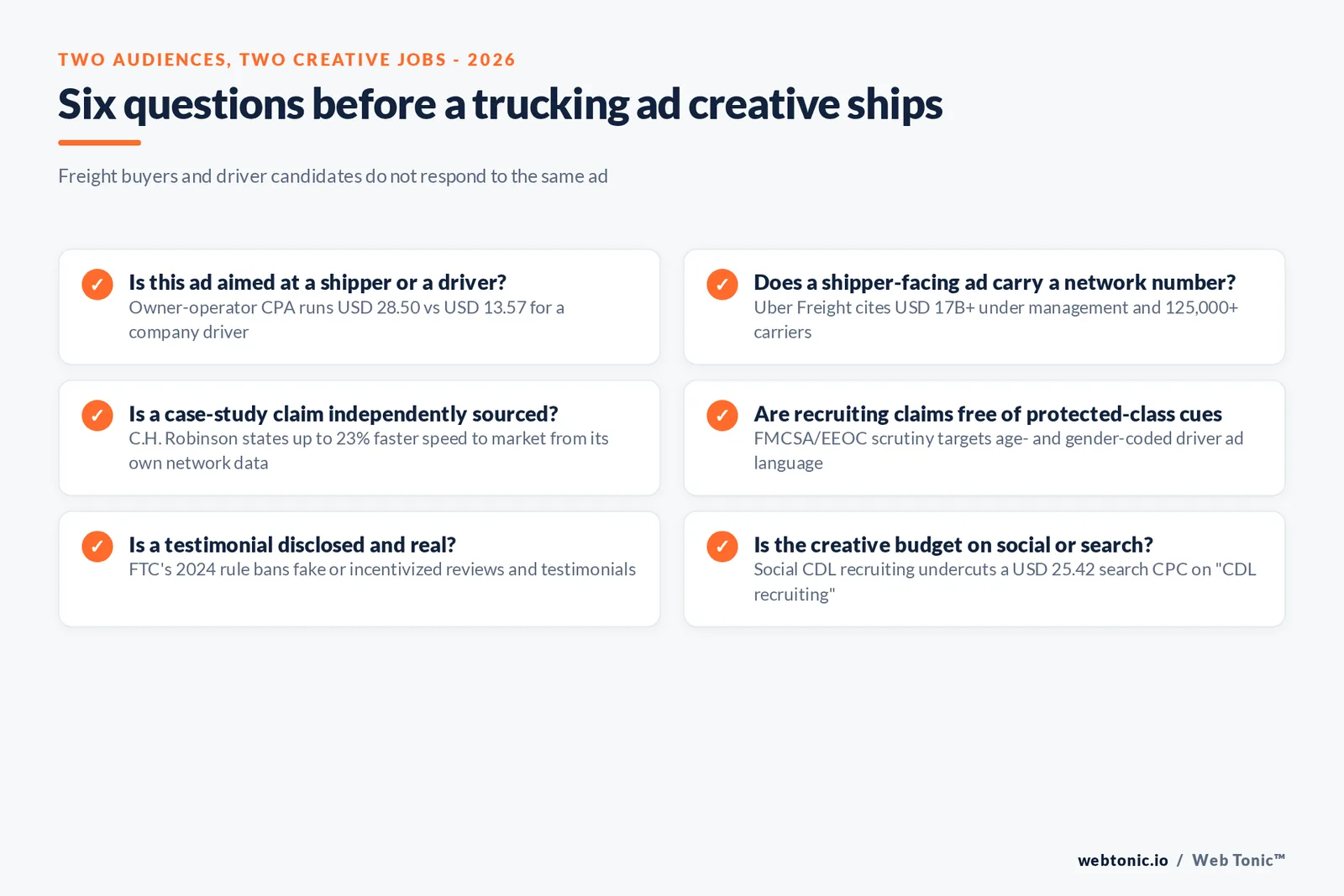
Two rules bind trucking ad creative more than most industries. First, driver-recruiting ads are subject to standard EEOC protections against age and sex discrimination on top of FMCSA's own driver-qualification standards, so creative that implies a preferred driver "type" - age bracket, build, gender-coded imagery - carries more legal exposure than an equivalent ad in most B2C categories. Second, the FTC's Trade Regulation Rule on Consumer Reviews and Testimonials, effective October 21, 2024, directly bans fake or incentivized reviews, undisclosed insider testimonials, and company-run sites that pose as independent review platforms - all shortcuts that show up in both driver recruiting ("real driver" testimonials that are staff) and shipper-facing case studies (unverified savings claims). Both a driver testimonial and a shipper case study now need a disclosed, real relationship behind them to run safely.
What a "thin" channel for trucking actually means
Some channels get recommended for trucking creative that do not fit either audience well. TikTok and general social feeds reach almost no freight-buying decision makers directly - those buyers research on Google, on vendor sites, and increasingly through AI-assisted shortlisting, per the Google x NRG data above - so organic trucking content on those platforms works as a recruiting and employer-brand play, not a freight-lead channel. The honest framing: if a piece of trucking creative is aimed at drivers or owner-operators, judge it against the Boostpoint cost-per-applicant numbers; if it's aimed at shippers, judge it against a named, sourced operational claim like C.H. Robinson's or Uber Freight's. A single creative asset trying to do both jobs at once is usually the one underperforming on both metrics.
What this means for a freight brand's creative budget
Split the budget by audience before splitting it by platform. Owner-operator and specialty-CDL recruiting justify a higher cost-per-lead because the audience is smaller and the lifetime value is higher; company-driver recruiting should hold the line near the USD 13-15 range Boostpoint reports rather than drifting toward search CPCs above USD 25. Shipper-facing creative should lead with a named, sourced operational number - the C.H. Robinson and Uber Freight pattern - rather than a brand tagline, because that is what a B2B buyer who has already run an AI-assisted vendor shortlist is actually scanning for.
Frequently Asked Questions
Do the same trucking ad creatives work for shippers and for drivers?
No, and treating them as one audience is the most common mistake. Shipper-facing creative has to prove network scale and reliability - Uber Freight's own reporting leans on figures like USD 17 billion or more in freight under management and 125,000-plus carriers to do that. Driver-recruiting creative is a direct-response job priced per applicant, where Boostpoint's 2025-2026 data shows owner-operator recruiting costing USD 28.50 per applicant against USD 13.57 for a general company driver. Different buyer, different proof, different budget.
What actually convinces a freight shipper to click?
Verifiable operational numbers, not brand language. C.H. Robinson's own account of its AI-driven truckload optimization cites up to 23% faster speed to market, up to 35% more on-time pickups and loads booked up to 4x faster inside its own managed network - the kind of stated-method claim that survives scrutiny because it names the network it came from. Creative that borrows this pattern (a real number, a named data source, a stated scope) outperforms generic trust-badge copy for a B2B logistics buyer.
Is social media actually the cheaper channel for driver recruiting?
For company drivers, the data says yes. Boostpoint's transportation campaign data puts a targeted social cost per applicant at USD 13.57 for a general Class A company driver, while Joveo reports a national average cost per click of USD 0.87 for driver job ads and a nationwide CDL-recruiting keyword CPC as high as USD 25.42 on search. Passive social reaches drivers off-duty at a fraction of the cost of bidding on search terms drivers rarely type.
What can't a trucking ad creative legally say about drivers?
Driver-recruiting ads sit inside standard EEOC anti-discrimination rules on age, sex and other protected classes, on top of FMCSA's own driver-qualification standards - so creative built around phrases that imply a preferred age bracket or physical stereotype invites regulatory exposure, not just brand risk. The safer creative pattern names the job requirement (a valid CDL, a clean record, home-time cadence) instead of a type of person.
Are testimonials still usable in freight and driver-recruiting ads?
Yes, but the bar changed. The FTC's 2024 Trade Regulation Rule on Consumer Reviews and Testimonials, effective October 21, 2024, bans fake or incentivized reviews, undisclosed insider testimonials and company-run sites that pose as independent - all common shortcuts in trucking recruiting and freight marketing. A named driver or named shipper, on camera, with a disclosed relationship, is now the compliant version of the same tactic.
Sources
Boostpoint - CDL Driver Recruiting: Costs, Channels & 2026 Benchmarks
Joveo - Recruiting Truck Drivers: Talent Sourcing and Recruitment Advertising Benchmarks
C.H. Robinson - Using AI to Optimize National Truckload Networks
Uber Freight - Q3 2026 Market Update Report
LinkedIn x MAGNA Media Trials - The Creative Tactics that Drive Better B2B Ad Performance
WordStream by LocaliQ - Facebook Ads Benchmarks 2025
Google x National Research Group - B2B Buyer Journey Whitepaper, October 2025
Federal Trade Commission - Trade Regulation Rule on Consumer Reviews and Testimonials
Web Tonic's performance creative team builds separated shipper and driver-recruiting campaigns end to end, including Meta ads management for B2B logistics brands. Compare results against other agencies running Facebook ads, or talk to the team about a freight or fleet creative audit.