



Table of contents
How we vet every listicle
Every agency featured on Web Tonic passes our 84-point editorial review before a single listicle goes live. This is how we vet each pick:
Verified client outcomes: We require real case studies with measurable KPIs — revenue, ROAS, CPA, retention — tied to the exact category being ranked. No cherry-picked wins, no unverifiable numbers.
Independent reputation: We cross-check Clutch, Google, G2, and Trustpilot ratings, and screen for review-bombing or suspicious patterns. Only operators with a consistent, verifiable track record make the cut.
Beyond that, every listing goes through a quarterly re-audit. We check 84 criteria across 6 pillars to make sure it still holds up — here are some of the checks we run:
Key Takeaways
- Technical SEO addresses foundational website issues that determine whether search engines can find, crawl, and index your content. This makes it prerequisite to any content or link-building investment.
- Core Web Vitals have become increasingly important as ranking signals, with less than 55% of websites currently meeting thresholds. This creates real competitive advantages for optimized sites.
- The best technical SEO agencies demonstrate expertise through documented case studies with specific methodology, measurable outcomes, and business impact beyond just traffic metrics.
- Technical SEO requires ongoing maintenance rather than one-time fixes. Algorithm changes, platform updates, and content additions continuously introduce new issues.
- Organizations facing complex technical challenges (site migrations, JavaScript rendering issues, unexplained traffic declines, or enterprise-scale crawlability problems) benefit most from specialized technical SEO expertise.
What Is Technical SEO?
Technical SEO encompasses the optimization of website infrastructure, server configurations, and code architecture to help search engines efficiently crawl, index, and understand web content. It addresses the foundational elements that determine whether a website can be discovered and properly evaluated by search engine algorithms.
Content strategy matters in social media marketing, but none of it works if Google can't find your pages in the first place.
According to Gartner's definition, search engine optimization platforms must include comprehensive on-site, off-site, and technical SEO capabilities (traffic analysis, competitor insight, link building, and content evaluation). This recognition from a leading analyst firm confirms that technical optimization sits at the center of enterprise digital strategy, not on the periphery.
Here's the thing: for mid-market and enterprise organizations, technical SEO issues often block organic visibility entirely. Research from industry analyses consistently shows that a significant percentage of pages on enterprise websites are never indexed by Google. That means exceptional content fails to reach potential customers. Not because the content is bad, but because search engines literally cannot access it. Technical SEO agencies address these foundational problems (crawl budget optimization, JavaScript rendering, site architecture, and Core Web Vitals) that determine whether search engines can access and evaluate your content effectively.
Why Technical SEO Agencies Matter for Business Growth
Technical SEO has evolved from a niche specialty into a critical business investment. The SEO services market research indicates that effective keyword research and on-page SEO anchored 41.80% of 2025 revenue, confirming that technical elements like tags, internal link logic, and crawl equity drive substantial market value.
The Business Case for Technical Investment
Organizations that invest in technical SEO see measurable returns across multiple dimensions and improved organic rankings. Case studies from technical SEO agencies demonstrate outcomes including traffic increases of 12-20% after comprehensive Core Web Vitals optimization, conversion rate improvements of 15-30% for e-commerce sites achieving "good" technical thresholds, and significant revenue recovery for sites experiencing post-migration traffic declines.
The technical complexity of modern websites makes specialized expertise increasingly valuable. Google released 4,725 algorithm tweaks in 2022 alone. That's nearly 13 per day. This pace forces digital marketing agencies into perpetual monitoring cycles that raise labour and tooling costs, and organizations without dedicated technical expertise struggle to maintain the continuous optimization these frequent changes demand.
Technical SEO Service Categories
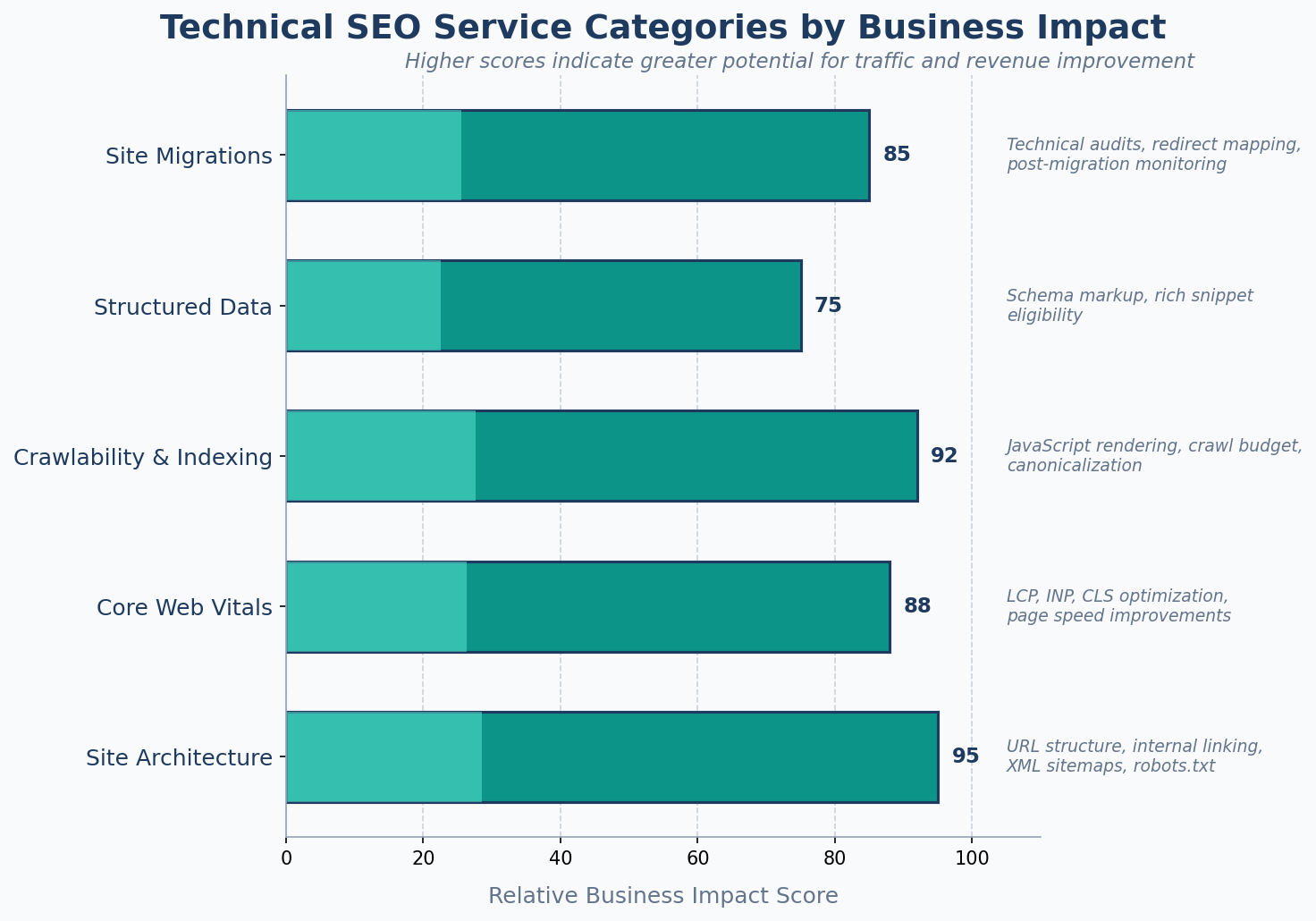
Technical SEO agencies, including eCommerce SEO specialists, typically offer services across several interconnected categories:
| Service Category | Key Components | Business Impact |
|---|---|---|
| Site Architecture | URL structure, internal linking, XML sitemaps, robots.txt optimization | Improved crawl efficiency and page authority distribution |
| Core Web Vitals | LCP, INP, and CLS optimization, page speed improvements, supported by years of experience | Better user experience, higher conversion rates, ranking advantages |
| Crawlability & Indexing | JavaScript rendering, crawl budget optimization, canonicalization | Ensures search engines can discover and index important content |
| Structured Data | Schema markup implementation, rich snippet eligibility | Enhanced SERP visibility and click-through rates |
| Site Migrations | Technical audits, redirect mapping, post-migration monitoring | Traffic preservation during platform or domain changes |
Top 10 Technical SEO Agencies for Website Optimization
The following agencies have demonstrated consistent expertise in technical SEO through documented case studies, industry recognition, and client outcomes. Selection criteria included depth of technical specialization, enterprise capabilities, transparency in reporting, and measurable results.
For most mid-market businesses, we'd prioritize agencies with strong case study documentation and clear technical-to-revenue attribution. The flashy agency websites matter less than the specificity of their problem-solving approach.
1. Onely
Onely specializes in JavaScript SEO, log file analysis, and site architecture diagnostics for mid-market to enterprise organizations. Their technical approach focuses on resolving complex rendering issues that prevent modern web applications from being properly indexed.
Technical Specialties: JavaScript SEO, AI search optimization, log file analysis, technical audits
Best For: B2B companies experiencing unexplained traffic declines despite strong traditional SEO metrics, or organizations seeing competitors appear in AI-powered search results
2. Siege Media
Siege Media integrates content strategy with technical infrastructure optimization, ensuring that content-heavy sites achieve optimal crawlability and indexation. Their data-driven methodology connects technical improvements to measurable business outcomes.
Technical Specialties: Content-integrated technical optimization, site architecture, crawl efficiency
Best For: Brands prioritizing content marketing alongside technical improvements who want integrated strategy
3. Victorious
Victorious provides documented case studies and industry validation that satisfy enterprise requirements for demonstrable ROI. Their approach emphasizes connecting technical fixes to revenue metrics and providing transparent reporting.
Technical Specialties: Technical audits, site speed optimization, structured data implementation
Best For: Organizations needing to justify SEO budget to leadership with validated case studies
4. Single Grain
Single Grain connects technical SEO fixes directly to revenue metrics. This makes them particularly valuable for e-commerce organizations focused on conversion rate optimization. Their approach proves ROI through business outcomes rather than just traffic metrics.
Technical Specialties: E-commerce optimization, Core Web Vitals, technical-to-revenue attribution
Best For: E-commerce businesses with conversion rate concerns seeking technical solutions tied to revenue
5. LinkGraph
LinkGraph's proprietary SearchAtlas platform provides technical analysis capabilities that differentiate their diagnostic approach. Their tools enable deeper site architecture analysis and issue identification.
Technical Specialties: Proprietary diagnostic tools, site audits, competitive technical analysis
Best For: Organizations wanting deep diagnostics and access to proprietary analysis platforms
6. WebFX
WebFX offers enterprise-scale technical SEO with one of the largest dedicated teams in the industry. Their RevenueCloudFX analytics platform ties technical improvements directly to pipeline impact.
Technical Specialties: On-page SEO, technical optimization, conversion rate optimization, enterprise-scale implementations
Best For: Large organizations requiring agency scale and advanced technology integration
7. Skale
Skale provides forecast-backed roadmaps combined with rigorous technical audits. This structured approach helps organizations plan technical investments with predictable outcomes.
Technical Specialties: Technical audits, fractional tech support, page speed audits, schema markup
Best For: Growth-stage SaaS companies needing forecast-backed technical roadmaps
8. SmartSites
SmartSites combines creative strategy with technical implementation, typically doubling organic traffic within six months. Their in-house team handles all technical work without subcontracting.
Technical Specialties: Website audits, crawlability optimization, page speed, schema markup
Best For: Mid-market businesses seeking integrated creative and technical optimization
9. Inflow
Inflow focuses on e-commerce technical SEO with particular expertise in large-scale website migrations and algorithm recovery. Their technical audit process has documented results including 118% revenue increases from targeted fixes.
The agency that often gets overlooked? Inflow. They don't have the brand recognition of larger players, but their e-commerce migration expertise is genuinely deep.
Technical Specialties: E-commerce platform optimization, site migrations, post-algorithm recovery
Best For: E-commerce businesses navigating platform migrations or recovering from algorithm updates
10. Pearl Lemon
Pearl Lemon specializes in technical SEO services focused on resolving indexing issues and improving site rankings through systematic technical optimization.
Technical Specialties: Technical audits, website migration support, page speed optimization, local SEO
Best For: Businesses seeking comprehensive technical optimization with international capabilities
Core Web Vitals: The Technical Foundation
Google introduced Core Web Vitals as ranking signals in 2021, and their importance has only grown. These three metrics quantify user experience in ways that directly influence search rankings:
Largest Contentful Paint (LCP) measures loading performance, specifically how long the largest content element takes to render. Good scores require LCP under 2.5 seconds.
Interaction to Next Paint (INP) evaluates responsiveness throughout the entire page lifecycle, replacing First Input Delay in March 2024. Good scores require INP under 200 milliseconds.
Cumulative Layout Shift (CLS) tracks visual stability by measuring unexpected content shifts during loading. Good scores require CLS below 0.1.
According to the Chrome UX Report from November 2025, only 54.6% of websites meet overall Core Web Vitals thresholds.
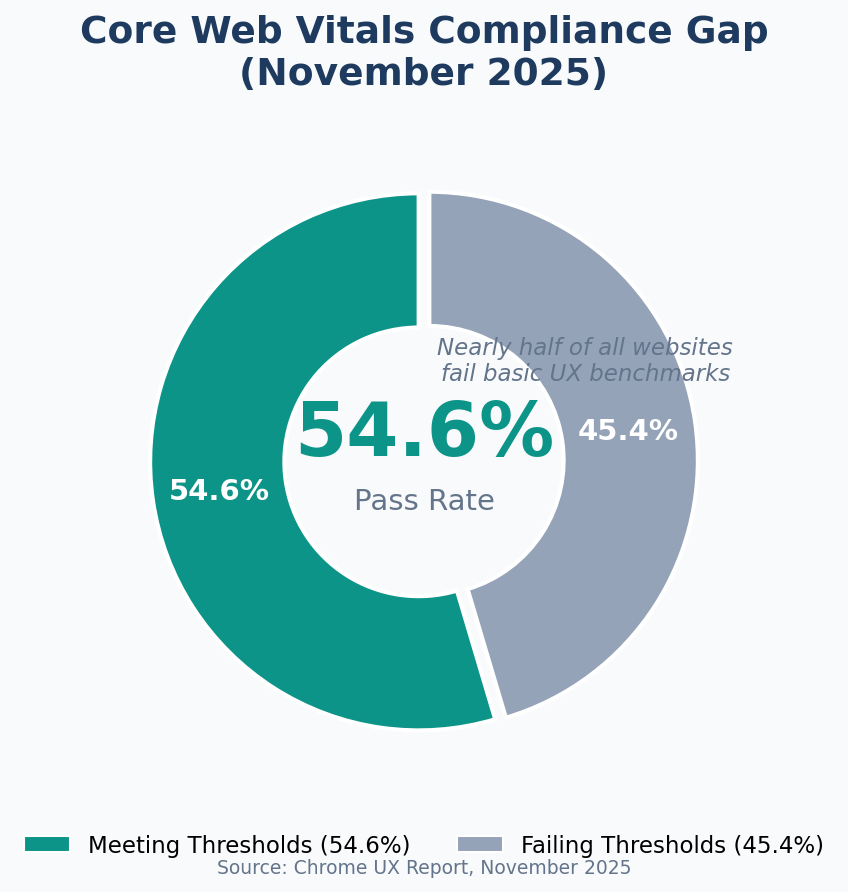
That number should get your attention.
It means nearly half of all websites are failing these basic user experience benchmarks, creating real competitive opportunity for organizations that prioritize technical optimization.
Core Web Vitals function as a tiebreaker in competitive niches. When multiple pages offer similar content quality and authority, the site delivering superior user experience gains the decisive advantage. And the numbers back this up: pages loading within 2 seconds have approximately 9% bounce rates, while those taking 5 seconds see rates increase to 38%.
Common Misconceptions About Technical SEO
Misconception 1: Technical SEO Is a One-Time Project
Many organizations treat technical SEO as a checklist item rather than an ongoing discipline. But websites continuously accumulate technical debt through content additions, platform updates, third-party script changes, and algorithm evolution. The most successful technical SEO programs include continuous monitoring, regular audits, and systematic maintenance protocols.
Industry analysis shows that 28% of marketers believe technical debt is the biggest threat to their SEO success. This indicates how many legacy issues quietly drag down performance without obvious symptoms until traffic begins declining.
Misconception 2: Good Content Overcomes Technical Problems
Content quality remains essential. But it cannot compensate for fundamental crawling and indexing failures. If search engines cannot access, render, or understand your pages, exceptional content provides no ranking benefit. Technical SEO ensures that content investments can actually reach their intended audience.
As one industry analysis notes, "the most elegant content strategy in the world is only as effective as the technical foundation it sits upon."
Misconception 3: Core Web Vitals Are the Primary Ranking Factor
Core Web Vitals influence rankings, but content relevance and quality remain substantially more important for achieving high rankings in organic search results. Google's John Mueller has emphasized that faster page speed doesn't automatically guarantee top rankings over pages with better content relevance.
But this doesn't diminish the importance of technical optimization. Core Web Vitals create compounding benefits: better rankings lead to more traffic, while higher conversion rates from that traffic multiply revenue impact. The practical difference between ranking third and eighth, combined with improved on-site conversion, can easily double or triple business outcomes.
Real-World Examples and Case Studies
Visit Seattle: 850% Health Score Improvement
Visit Seattle, a nonprofit connecting tourists with over 750 local businesses, approached Gravitate Design and their SEO experts after experiencing a 53.47% drop in organic traffic following Google's August Core Update. Technical audits revealed 58,785 errors across the site, including 1,611 duplicate member pages that created ranking conflicts.
The technical team consolidated 29 bloated sitemaps, removed thin and outdated pages, and fixed critical crawling barriers to enhance search engine visibility. Results included an 850% improvement in site health scores and restored organic visibility for high-value tourism keywords.
Quality Woven Labels: 118% Revenue Increase
Following a site migration, Quality Woven Labels experienced a 33% decrease in sessions and a 40% decrease in users. Inflow's technical audit identified four primary issues: crawlability problems, indexation errors, crawl errors, broken internal links, and sitemap inconsistencies.
After implementing targeted fixes, the e-commerce company saw a 118% increase in organic revenue and 18% increase in traffic and users, achieving real results. All within the first month post-fix compared to pre-audit performance. The speed of recovery demonstrates how quickly technical fixes can translate to business results when the diagnosis is accurate.
Fortune 500 Enterprise: 50,000+ Page Optimization
A Fortune 500 company with over 50,000 pages engaged MonsterClaw to address complex technical challenges. The audit analyzed 60+ technical SEO elements, identifying issues including broken internal links, improper indexation directives, duplicate content problems, and crawl budget waste from linking indexed pages to no-index pages.
Systematic resolution of these issues improved internal linking structure, keyword rankings, visitor time on site, and overall crawl efficiency, ultimately boosting online visibility. This case demonstrates how technical optimization scales across enterprise-level implementations where the sheer volume of pages makes manual oversight impossible.
Frequently Asked Questions
How much do technical SEO agencies typically charge?
Technical SEO agency pricing varies significantly based on scope and complexity. According to industry surveys, the average cost of SEO companies services falls between $25 and $199 per hour, with $150 being the most common rate. Project-based engagements typically range from $2,501 to $5,000. Enterprise-level technical audits from specialized SEO companies often start at $4,000 to $15,000 per month, with some offering fixed packages at $5,000 or $15,000 for comprehensive assessments.
How long does it take to see results from technical SEO improvements?
Results from technical SEO improvements can appear within weeks for issues like crawlability fixes that allow new pages to be indexed and enhance search visibility. More comprehensive improvements typically show measurable impact within 3-6 months, as search engines recrawl and reevaluate updated pages. Core Web Vitals improvements may reflect in rankings more quickly, as Google continuously monitors these real-user metrics.
Should I hire a specialized technical SEO agency or a full-service agency?
The decision depends on your organization's primary challenges. Specialized technical SEO agencies, such as the right technical SEO agency for your needs, excel at complex problems like JavaScript rendering, large-scale migrations, and crawl budget optimization for enterprise sites. Full-service agencies work better when technical issues are less severe and you need integrated content and technical strategy. For organizations with significant technical debt or unexplained traffic declines, specialized expertise often delivers faster and more comprehensive resolution.
What should I look for in a technical SEO agency's case studies?
Effective case studies should document specific technical problems identified, methodology used for diagnosis, concrete fixes implemented, and measurable outcomes including traffic changes, revenue impact, and timeline to results. Be cautious of case studies showing only ranking improvements without business context, or those lacking specificity about what technical issues were actually resolved.
Can I handle technical SEO in-house instead of hiring an agency?
In-house technical SEO is feasible with the right expertise, but presents challenges related to content optimization. Research indicates that 57% of enterprise brands identify limited in-house SEO skills as their biggest obstacle to success, while over 54% outsource their SEO campaigns. In-house teams may lack specialized tools, cross-industry experience, and dedicated focus that agencies provide. A hybrid approach (using agencies for audits and complex projects while building internal capabilities for ongoing maintenance) often balances cost and effectiveness.


