Table of contents

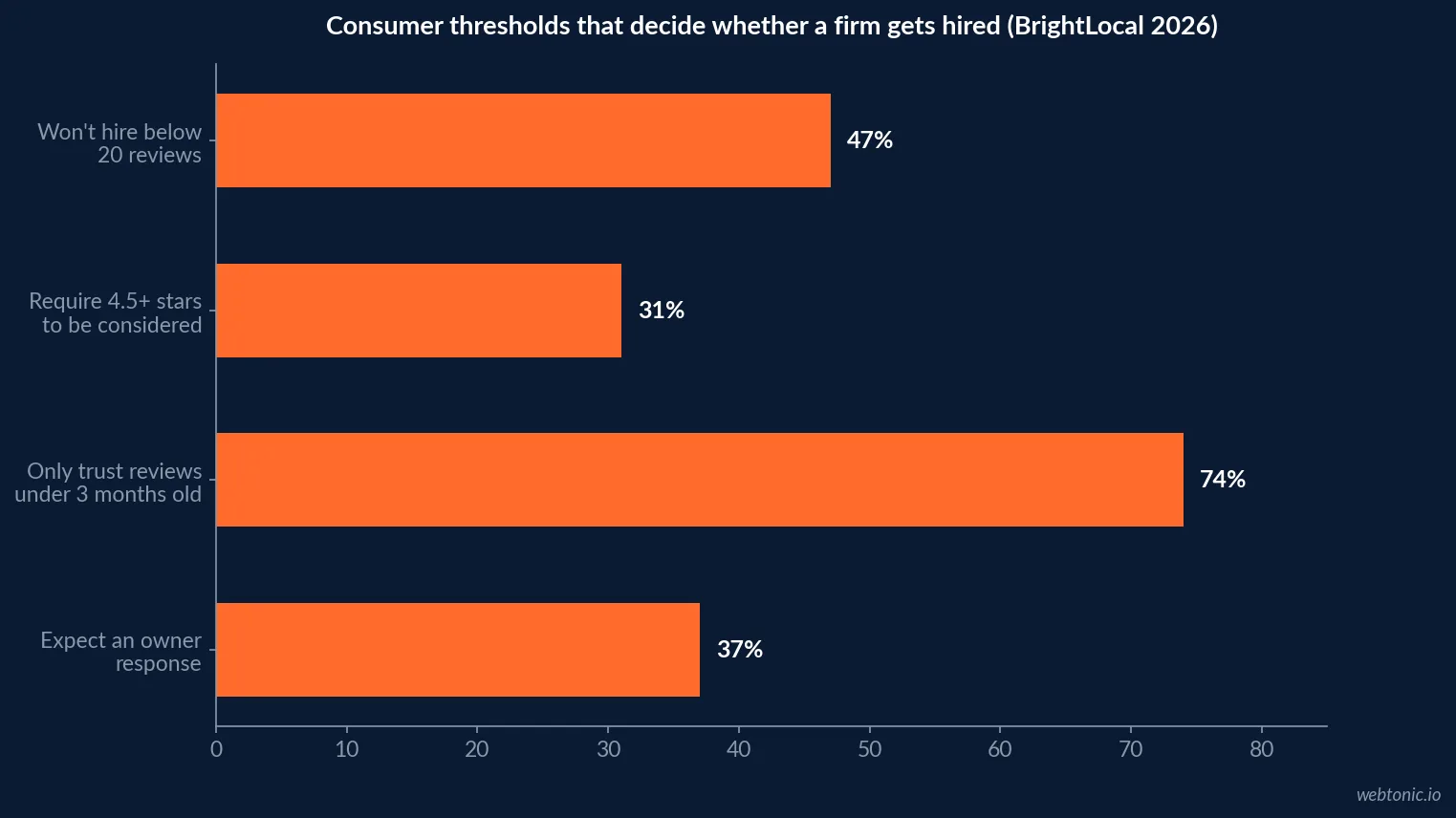
Tax and accounting firms are judged by the same review thresholds as every other local service business, but they are also the only local vertical where the ad itself is regulated by a federal solicitation rule. BrightLocal's February 2026 Local Consumer Review Survey found 47% of consumers won't use a business with fewer than 20 reviews and 31% require 4.5 stars or higher - and IRS Circular 230 Section 10.30 sits directly on top of whatever a firm says in response to a review.
Key Takeaways
- 97% of consumers read online reviews before choosing a local business (BrightLocal 2026).
- 41% now "always" read reviews, up from 29% a year earlier.
- 47% won't hire a business with fewer than 20 reviews.
- 31% require a 4.5-star rating or higher before they'll call.
- 74% only trust reviews written in the last three months.
- 37% weigh whether the owner responded to the review at all.
- Whitespark's 2026 panel scores Google Business Profile signals at roughly 32% of local ranking weight and review signals at 16-20%.
- 57% of new tax and accounting clients start with a peer referral; only 3% start from an ad.
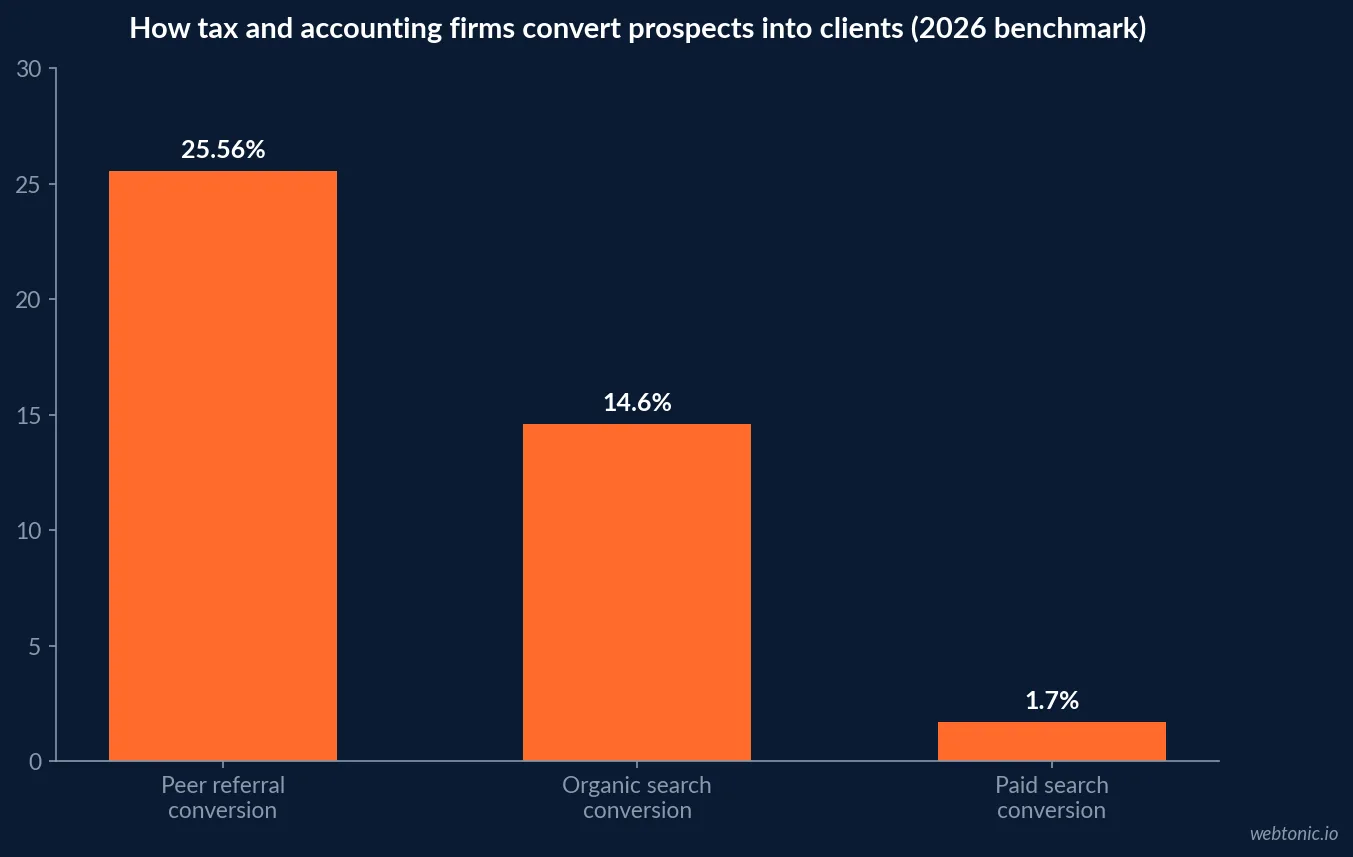
- Referral relationships convert at 25.56% versus 14.6% organic and 1.7% paid search.
- Tax season (January-April) still drives 60%-plus of annual client acquisition.
- 88-92% client retention is the normal band for an established practice.
- Net Promoter Score for the industry runs around +39.
- Generative-AI tool use among practitioners jumped from 8% to 21% in a year (Thomson Reuters).
- 69% of firms still say they rely mainly on word of mouth, not a review programme.
- 96% of CPA firms are effectively invisible when asked about directly inside ChatGPT, Perplexity or Claude.
- The FTC's fake-review rule (16 CFR Part 465, final August 2024) allows civil penalties against knowing violators.
- Google can block a profile from new reviews for a set period under its Fake Engagement policy.
The 2026 benchmarks at a glance
Two surveys anchor this page: BrightLocal's 2026 Local Consumer Review Survey (a representative panel of 1,002 US adults, published February 2026) for consumer behaviour, and Whitespark's 2026 Local Search Ranking Factors report (47 local-search practitioners scoring 187 factors) for how those reviews translate into visibility. Neither was fielded on accounting clients specifically, and this page says so wherever a figure is cross-industry rather than sector-specific.
| Metric (2026) | Figure | Source | What it means for a firm |
|---|---|---|---|
| Consumers who read reviews at all | 97% | BrightLocal LCRS 2026 | A review profile is not optional marketing |
| Consumers who “always” read reviews | 41% (was 29%) | BrightLocal LCRS 2026 | Casual browsing is being replaced by default checking |
| Minimum review count to be considered | 20+ | BrightLocal LCRS 2026 | Under 20 reviews, 47% of prospects self-select out |
| Minimum star rating to be considered | 4.5+ | BrightLocal LCRS 2026 | 31% of prospects have a hard rating floor |
| Review recency window that still counts | Last 3 months | BrightLocal LCRS 2026 | 74% discount anything older |
| Weight of GBP signals in local ranking | ~32% | Whitespark 2026 | Profile completeness still outweighs reviews alone |
Referral still opens the door, reviews decide who walks through it
Industry benchmark data puts peer referral at 57% of how a new tax or accounting client first hears about a firm, against 3% from advertising. But discovery and conversion are different questions. AAM/Hinge benchmark tracking credits referral-sourced leads with a 25.56% conversion rate, ahead of 14.6% for organic search and 1.7% for paid search - and the gap is largely explained by what the prospect does between hearing the name and calling: they check the reviews.
That makes a thin or stale review profile a referral-conversion problem, not just a cold-lead problem. A recommended firm with 6 reviews from three years ago gives a skeptical prospect a reason to call a competitor instead, even after a trusted colleague named it first.
| Client acquisition metric (industry benchmark) | Figure | Source |
|---|---|---|
| Discovery via peer referral | 57% | Industry benchmark data, 2026 |
| Discovery via advertising | 3% | Industry benchmark data, 2026 |
| Cost per lead | USD 200-2,000 | Industry benchmark data, 2026 |
| Client retention, established firm | 88-92% | Industry benchmark data, 2026 |
| Net Promoter Score | +39 | Industry benchmark data, 2026 |
| Share of annual acquisition in Jan-Apr filing season | 60%+ | Industry benchmark data, 2026 |
What a review profile has to survive: IRS Circular 230
Every other local business advertises under the FTC's general truth-in-advertising standard. A tax practitioner advertises under that plus Circular 230. Section 10.30 (codified at 31 CFR 10.30) bars any public communication or private solicitation, in any form, that contains a false, fraudulent, coercive, misleading or deceptive statement or claim in connection with Internal Revenue Service matters. Enrolled agents are separately barred from calling their designation “certified” or implying an IRS employment relationship - the regulation gives the accepted phrasing directly: “enrolled to represent taxpayers before the Internal Revenue Service.”
Nothing in Circular 230 blocks a firm from displaying real client reviews. What it blocks is dressing a testimonial up with a claim the section already prohibits elsewhere - a guaranteed refund size, an implied IRS endorsement, or a coercive urgency pitch wrapped around a five-star quote.
The FTC's fake-review rule applies to accounting the same as any other business
The FTC's 16 CFR Part 465 Trade Regulation Rule on the Use of Consumer Reviews and Testimonials became final in August 2024. It prohibits businesses from creating, buying or selling reviews from people with no genuine experience of the firm; from conditioning compensation on a review expressing a particular sentiment, positive or negative; and from disseminating insider reviews (an officer's or employee's own review) without disclosing the connection. Violators face civil penalties. A firm running a “leave us five stars and get $10 off next year” incentive, without disclosing it, is inside the conduct the rule targets.
Google enforces a parallel Fake Engagement policy on Business Profiles. A profile found in violation can lose the ability to receive new reviews for a set period, have its existing reviews unpublished, and display a public warning that fake reviews were removed - three consequences that compound the exact problem a thin profile already has under the BrightLocal thresholds above.
| Rule | Issuer | What it restricts | Relevant to a firm's reviews |
|---|---|---|---|
| 16 CFR Part 465 | Federal Trade Commission (final Aug 2024) | Fake/bought/incentivized reviews, insider reviews | Civil penalties for knowing violations |
| 31 CFR 10.30 (Circular 230) | IRS | False, fraudulent, coercive or misleading solicitation | Applies to any public claim, including testimonials |
| Consumer Review Fairness Act | FTC (2016) | Contract clauses banning honest reviews | A firm cannot ask clients to waive review rights |
| Fake Engagement policy | Paid/incentivized/bulk-solicited reviews | Can suspend new reviews and unpublish existing ones |
Where reviews actually live for a firm
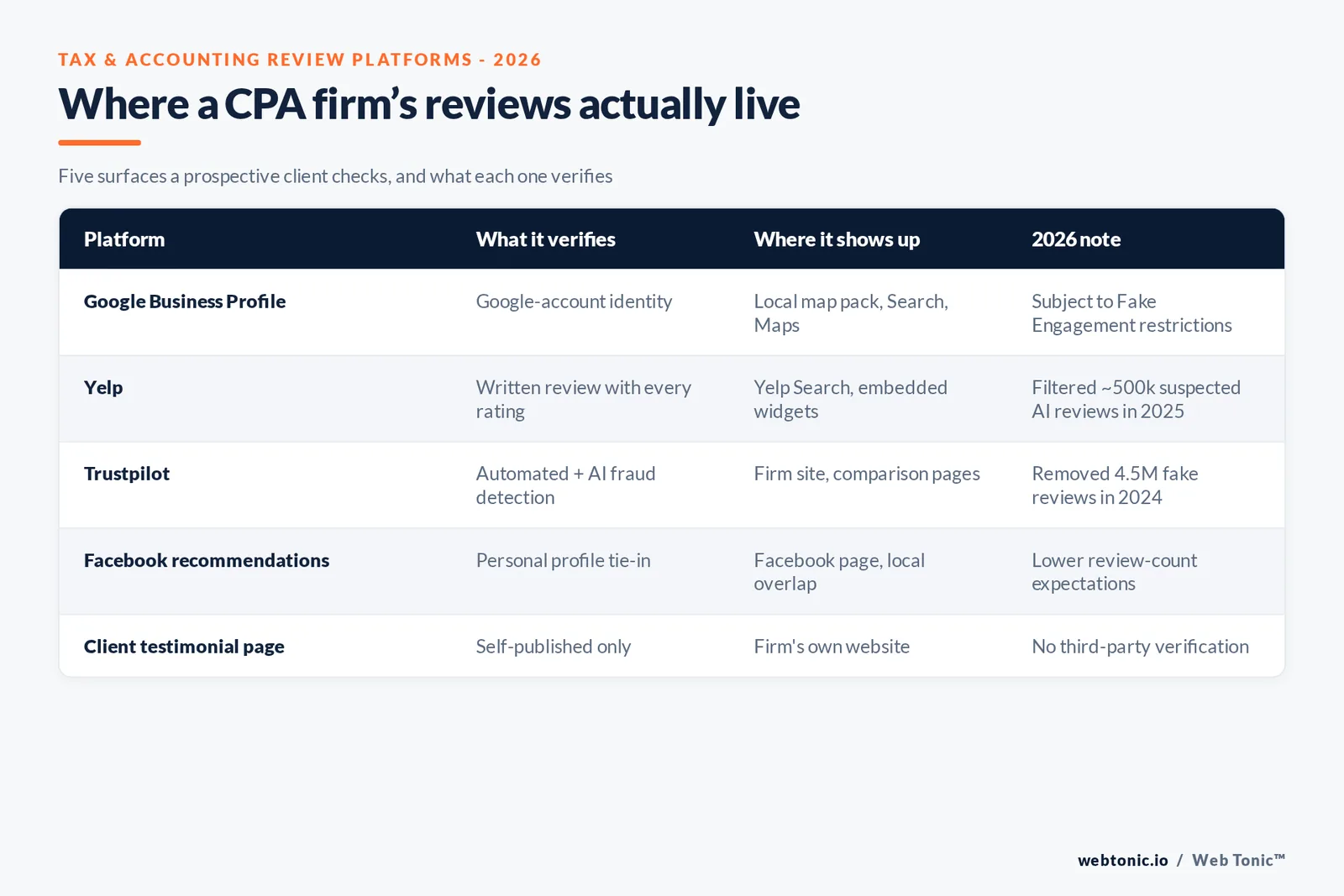
Google Business Profile carries the overwhelming majority of local review volume for professional services, but it is not the only surface a prospect checks, and the platform mix behaves differently for a regulated profession than for a retail business.
| Platform | What it verifies | Where a prospect sees it |
|---|---|---|
| Google Business Profile | Account tied to a Google identity; subject to Fake Engagement policy | Local map pack, Search, Maps |
| Yelp | Requires a written review with every star rating; filtered nearly half a million suspected AI-generated reviews in 2025 | Yelp Search, embedded widgets |
| Trustpilot | Automated + AI-assisted fraud detection; removed 4.5 million fake reviews in 2024 (7% of all posted) | Firm's own site, comparison sites |
| Facebook recommendations | Tied to a personal profile; lower review-count expectations | Facebook page, local search overlap |
| Client testimonial page | Self-published, zero third-party verification | Firm's own website only |
Why 96% of firms are invisible to the tools clients now use to shortlist
Generative-AI adoption inside practices jumped from 8% to 21% in a year, per Thomson Reuters tracking, while 96% of CPA firms remain effectively invisible when a prospect asks a chatbot like ChatGPT, Perplexity or Claude to recommend one. Reviews are part of what feeds those answers indirectly - AI recommendation engines lean on the same third-party review corpus (Google, Yelp, Trustpilot) that a human prospect reads, so a firm with 6 stale reviews is starved of the same signal in both channels at once.
69% of firms still say they rely mainly on word of mouth rather than a structured review-request programme, which is the single largest gap this page's numbers point to: referral already does the hard work of getting the name mentioned, and a thin review profile then throws part of that referral away.
Building a review-request programme that survives Circular 230
- Ask inside the engagement letter cycle, not only after tax season, since 74% of consumers discount anything older than three months.
- Ask every client, not only the happiest ones - selective solicitation is the conduct the FTC's 16 CFR 465 targets, and it also produces a rating that collapses the first time an unhappy client posts.
- Respond to every review, positive or negative, in plain, factual language with no outcome guarantees - 37% of consumers weight the response itself, and Circular 230's false-or- misleading standard applies to the reply as much as the original ad.
- Never condition a discount, gift card or fee waiver on a specific star rating - that is the exact incentive structure 16 CFR 465 prohibits.
- Keep the review count above 20 and the rating above 4.5 where realistically possible, since those are the two hard cutoffs in the BrightLocal data.
- Do not ask clients to waive their right to review you in an engagement letter - the Consumer Review Fairness Act makes that clause unenforceable.
What review-management software costs
Firms weighing a dedicated review-request tool against a manual process should route any specific quote through a vendor's own current pricing page rather than a marketing benchmark, since list prices change and vary by location count. As a category, review-management platforms are priced per location per month with tiers for review monitoring, request automation and multi-location reporting - budget the comparison against the cost of the client relationships a stale profile is already losing, not against a single flat number.
A quick self-audit before the next filing season
Most of the numbers on this page reduce to five questions a partner can answer without any software at all.
| Question | Why it matters | The 2026 benchmark it maps to |
|---|---|---|
| Do we have 20 or more reviews on Google? | 47% of prospects filter out below that line | BrightLocal LCRS 2026 |
| Is our rating 4.5 stars or higher? | 31% won't call a lower-rated firm | BrightLocal LCRS 2026 |
| Was our most recent review this quarter? | 74% discount anything older than 3 months | BrightLocal LCRS 2026 |
| Have we responded to our last 3 reviews? | 37% weigh a response directly | BrightLocal LCRS 2026 |
| Does every review ask go to every client? | Selective asking is what 16 CFR 465 targets | FTC final rule, Aug 2024 |
Where reputation work fits a firm's broader growth plan
A review programme rarely works in isolation from the channels that put a firm in front of a prospect in the first place. Firms already running a paid search programme should route a share of that spend toward branded and near-brand terms, where a strong review profile lifts click-through the same way it lifts local-pack clicks; firms building out a broader growth marketing plan should treat the review cadence above as one input into that plan, not a side project bolted onto it. Tax and accounting cost-per-lead benchmarks - see this site's cost-per-lead data by industry - move in the same direction as review count: firms with thinner profiles pay more per lead to compensate for lower trust at the point of click. Firms weighing whether to build this in-house or bring in outside help can start that conversation here.
Frequently Asked Questions
How many Google reviews does a tax or accounting firm need in 2026?
BrightLocal's 2026 Local Consumer Review Survey (1,002 US adults) found 47% of consumers won't use a business with fewer than 20 reviews, and 31% will only use one rated 4.5 stars or higher. Neither figure was collected inside accounting specifically, but firms compete in the same local results as every other service business, so the threshold applies. A firm sitting at 8 reviews and 4.2 stars is filtered out before a prospect reads a single word of copy.
Can a CPA firm ask clients for reviews after tax season?
Yes, and timing matters more than volume. 74% of consumers in the same BrightLocal survey say they only trust reviews written in the last three months, up sharply from prior years. A firm that collected fifty reviews during one strong filing season and then went quiet for nine months looks, by that data, no more trustworthy than a firm with five. The Federal Trade Commission's 16 CFR Part 465 rule (effective 2024) does not ban asking for reviews; it bans buying, faking, suppressing negative ones, or asking only satisfied clients while excluding dissatisfied ones systematically.
Does IRS Circular 230 restrict how a firm can advertise its reviews?
Circular 230 Section 10.30, at 31 CFR 10.30, prohibits any public communication containing a false, fraudulent, coercive, misleading or deceptive statement related to Internal Revenue Service matters. It does not name online reviews specifically, but a testimonial implying guaranteed refund outcomes or IRS endorsement would fall under the same false-or-misleading standard the section already applies to other advertising. Enrolled agents are separately barred from using the word "certified" to describe their designation.
What happens if a firm buys fake reviews or pays for only positive ones?
The FTC's Trade Regulation Rule on the Use of Consumer Reviews and Testimonials (16 CFR Part 465, final August 2024) prohibits creating, selling or buying reviews from someone with no real experience of the business, and prohibits conditioning compensation on a review expressing a particular sentiment. Google runs a parallel Fake Engagement policy: a Business Profile found in violation can be blocked from receiving new reviews, have existing ones unpublished, and carry a public warning label for a set period.
Where do most tax and accounting clients actually come from, reviews or referrals?
Referral still leads discovery: industry data puts peer referral at 57% of how a new client first hears about a firm versus 3% via advertising. But once a name surfaces, reviews decide whether that prospect calls. AAM/Hinge benchmark data credits referral relationships with a 25.56% conversion rate versus 14.6% for organic search and 1.7% for paid search, meaning a strong review profile is what a referral checks before booking, not a separate acquisition channel competing with it.
Sources
BrightLocal - Local Consumer Review Survey 2026
Whitespark - 2026 Local Search Ranking Factors
FTC - Final rule banning fake reviews and testimonials (16 CFR 465)
FTC - Consumer Review Fairness Act
eCFR - 31 CFR 10.30, Circular 230 Solicitation rule
Google Business Profile Help - restrictions for Fake Engagement policy violations
AICPA & CIMA - protecting firm reputation on social media
Trustpilot - Trust Report 2025
Yelp - 2025 Trust & Safety Report
New Jersey Society of CPAs
CPA Practice Advisor