Table of contents
Vendor list prices for Google Business Profile management software run USD 49 to USD 349 a month, and review-and-messaging platforms run USD 399 to USD 599 - but the ranking-driving factor behind the spend, per Whitespark's 2026 survey of local search practitioners, is a single field almost nobody prices separately: primary category selection.
Key Takeaways
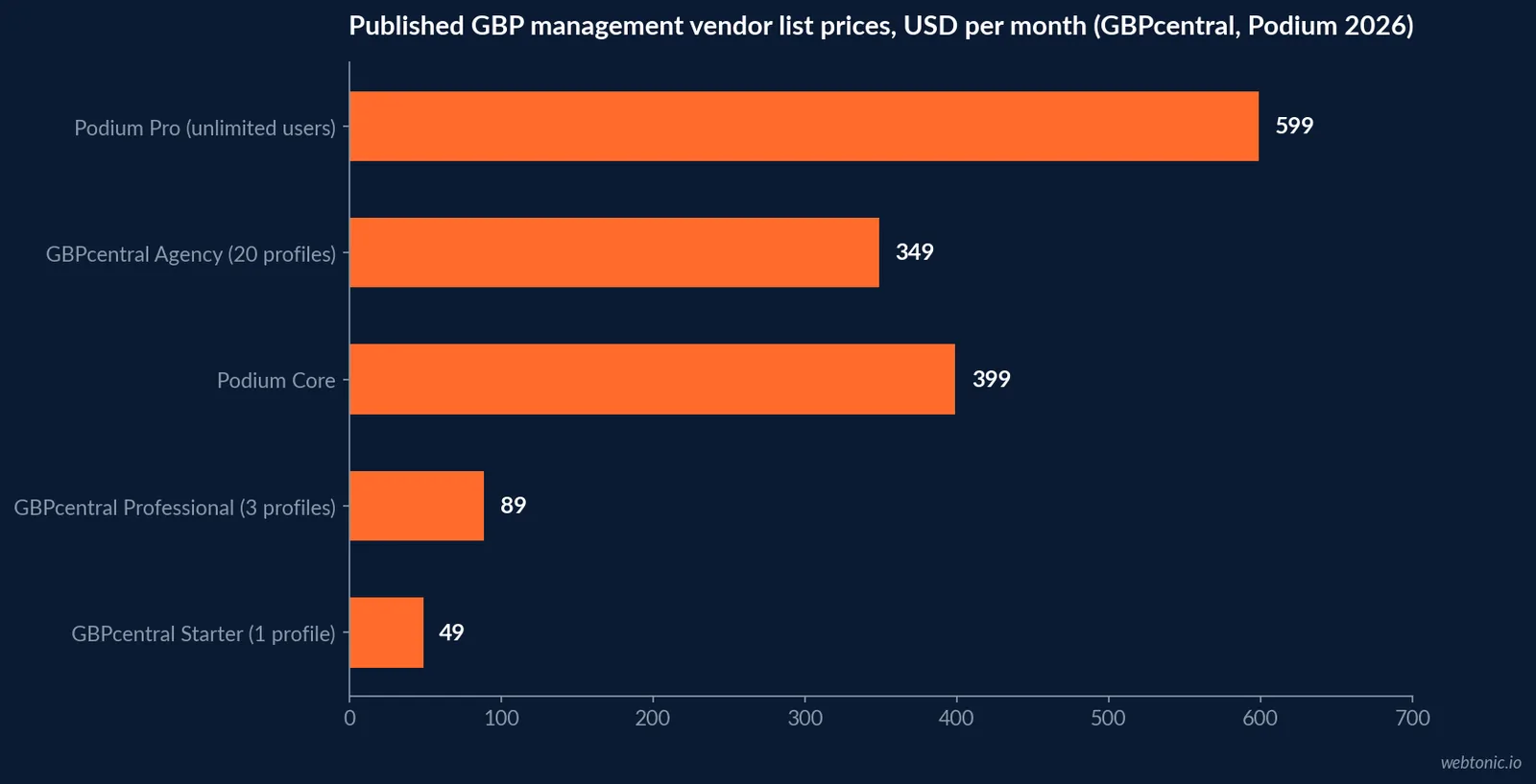
- GBPcentral's list prices run USD 49, USD 89 and USD 349 a month across three tiers.
- Podium's plans run USD 399 (Core) and USD 599 a month (Pro).
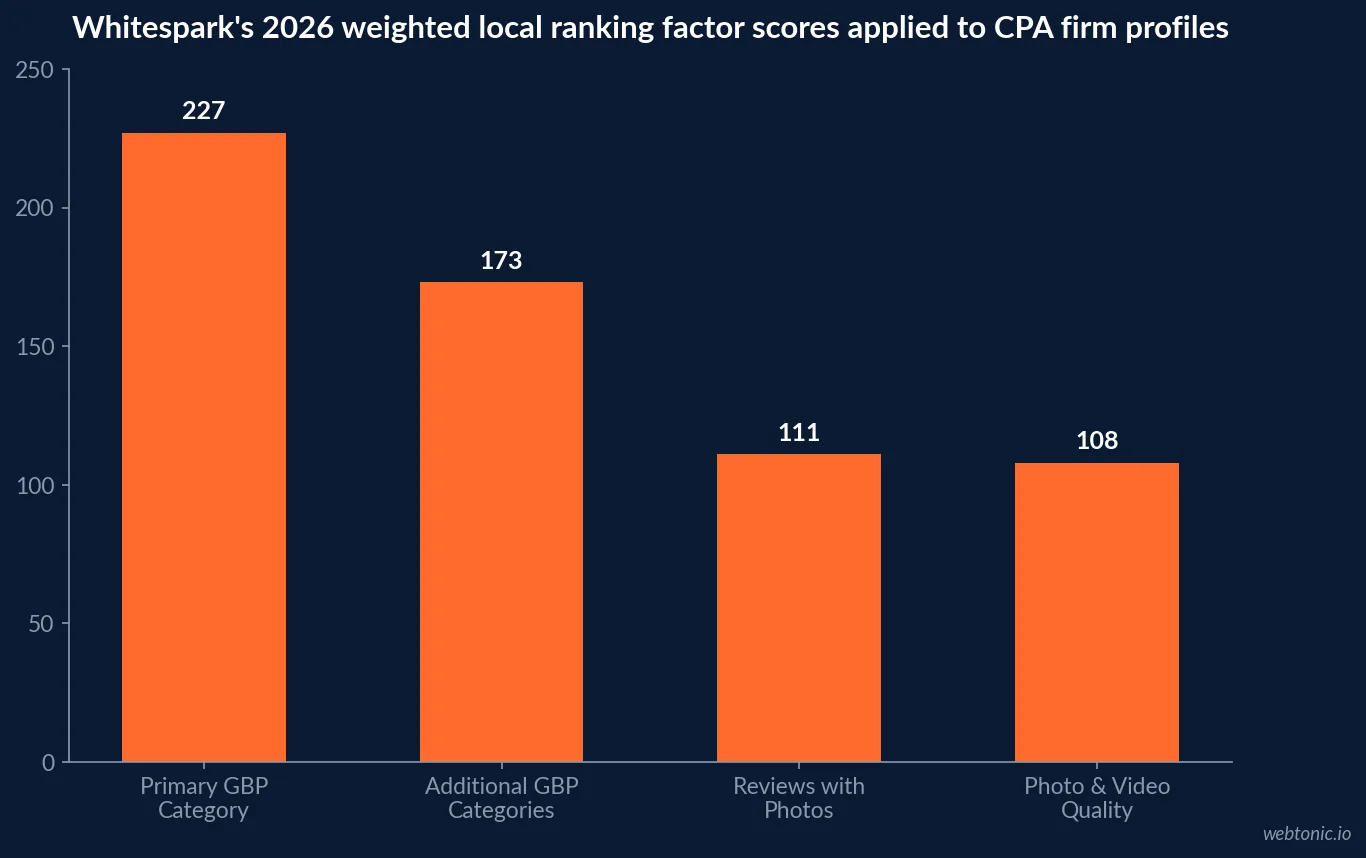
- Primary GBP Category is Whitespark's top-weighted local ranking factor at 227 points.
- Additional GBP Categories scores 173 points, the second-highest group.
- Quantity of Reviews with Photos scores 111; Photo and Video Quality scores 108.
- Keyword use in Google Posts scores only 49 on the same scale.
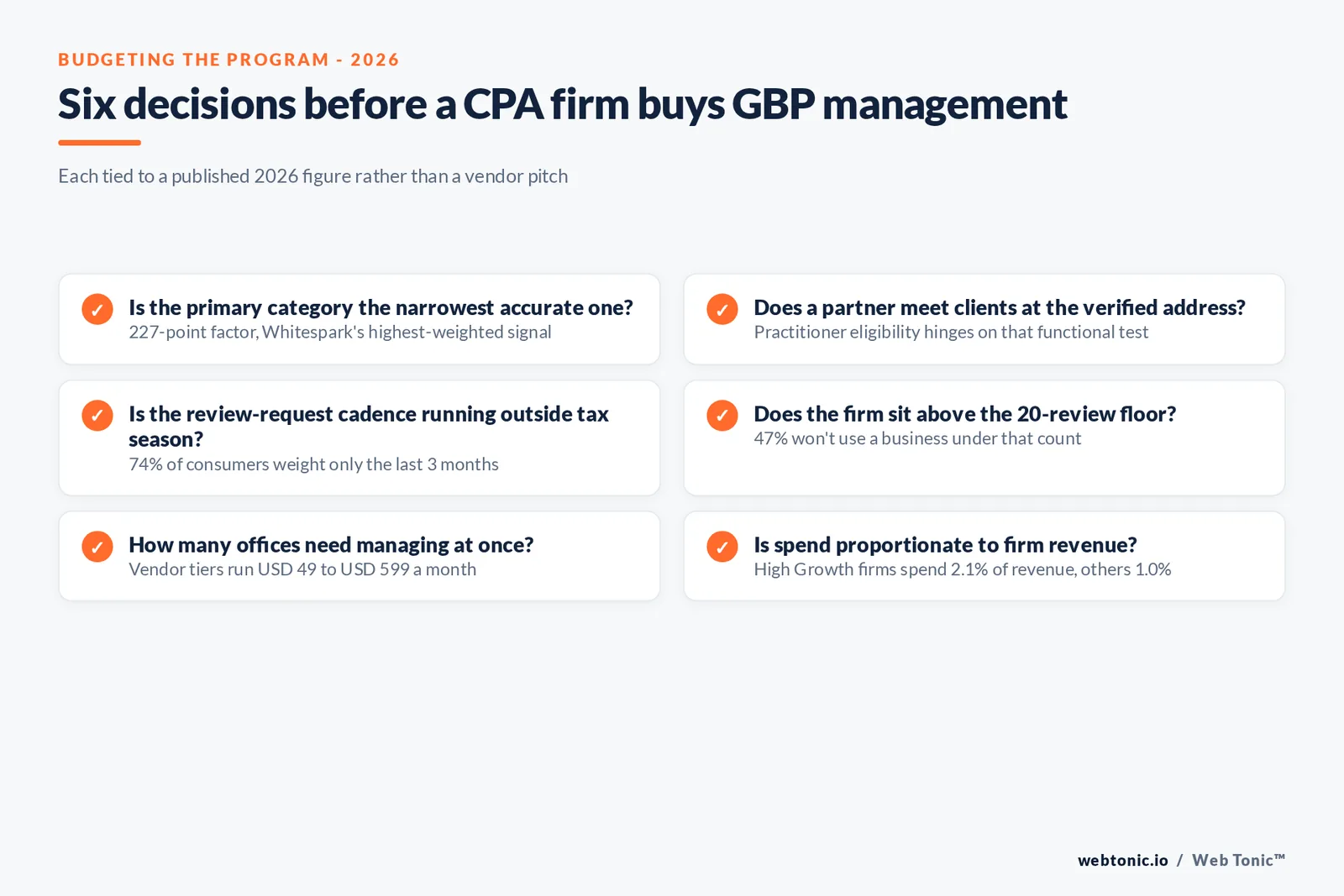
- 47% of consumers won't use a business with fewer than 20 reviews (BrightLocal 2026).
- 68% require at least 4 stars and 31% now require 4.5 or higher, up from 17% a year earlier.
- 74% only weight reviews from the last three months.
- High Growth accounting firms spend 2.1% of revenue on marketing against 1% for everyone else (AAM/Hinge).
- High Growth firms grew revenue 38.5% against that higher spend.
- The cross-industry CMO Survey 2026 benchmark is 9.0% of revenue - not accounting-specific.
- Accountants aren't on Google's named individual-practitioner list, unlike financial planners.
- Bulk verification applies at 10 or more locations under one account.
- Traffic to accounting firm sites splits roughly 48-54% organic, 26-28% direct, 8-18% paid.
- 96% of CPA firms have no citation share in ChatGPT, Perplexity or Claude answers, per prior industry benchmarking.
Why this became a budget line and not a checkbox
A Google Business Profile is free to claim, which is exactly why firms under-budget the work of keeping it competitive. The profile competes for a map-pack slot against every other accountant, tax preparer and bookkeeper within driving distance, and industry benchmarking already shows traffic to accounting firm sites split roughly 48-54% organic, 26-28% direct and 8-18% paid, with bounce running 51.3% overall. Local pack visibility sits inside that organic share, and it is not maintained by a profile claimed once in 2019 and left alone.
The honest budget question is not "should we manage it" but "in-house hours, software, or an agency retainer" - and each option has a published price a firm can compare against its own revenue.
| Benchmark (2026) | Figure | Source |
|---|---|---|
| GBPcentral, single profile | USD 49/month (USD 470/yr billed annually) | GBPcentral pricing page |
| GBPcentral, agency tier (20 profiles) | USD 349/month | GBPcentral pricing page |
| Podium Core plan | USD 399/month per location | Podium (podium.com) published pricing |
| Podium Pro plan | USD 599/month | Podium (podium.com) published pricing |
| High Growth firm marketing spend | 2.1% of revenue | AAM/Hinge 2025-26 benchmark study |
| All other firms' marketing spend | 1.0% of revenue | AAM/Hinge 2025-26 benchmark study |
Firm profile or practitioner profile: what Google's guidelines actually allow
Google's guidelines for representing a business name individual practitioners explicitly: "doctors, dentists, lawyers, financial planners, and insurance or real estate agents." Accountants and CPAs are not on that named list, which is a genuine gap in the guidance, not an oversight this article should paper over.
The eligibility test Google actually applies is functional: an individual practitioner is a "public-facing professional... who can be contacted directly at the verified location during stated hours," and support staff are explicitly excluded. A partner who meets clients personally at the firm's verified address plausibly clears that bar the same way a solo financial planner does; a back-office preparer who never takes client meetings does not. Google's separate business eligibility guidelines require in-person contact during stated hours for any profile at all, which is the harder constraint for firms that operate as fully remote tax-prep shops.
| Listing type | Who it fits | Google's stated rule | Risk if misapplied |
|---|---|---|---|
| Firm profile | The practice as a whole, one per office | Must show real in-person contact hours | Suspension if address is a mailbox |
| Practitioner profile (partner) | A named partner meeting clients directly | Not on Google's named example list, but meets the functional test | Rejected if support staff apply for one |
| Business group (multi-office firm) | Firms with several verified locations | Bulk verification available at 10+ locations | Duplicate/suspended profiles don't count toward the 10 |
| Service-area listing | Remote-only tax prep with no client-facing office | Must remove the address if no in-person contact happens there | Address left visible triggers guideline violations |
What the ranking algorithm is actually weighting
Whitespark's 2026 Local Search Ranking Factors report, a survey of 47 local search practitioners scoring 187 factors, puts Primary GBP Category at 227 points - the highest-scoring individual factor in the whole survey, ahead of proximity. Additional GBP Categories scores 173. Photo depth is next: Quantity of Reviews with Photos scores 111, Photo and Video Quality scores 108, and Quantity of Photos on the profile scores 84. Keyword use inside Google Posts scores a comparatively modest 49.
For a CPA firm that means the highest-leverage, zero-cost action is choosing "Tax preparation service," "Accountant" or "Bookkeeping service" precisely rather than defaulting to a generic "Accounting firm" category, and adding every accurate secondary category the firm actually practices in - before spending on software.
| Whitespark 2026 factor | Score | Practical action for a CPA firm |
|---|---|---|
| Primary GBP Category | 227 | Pick the narrowest accurate category, not the broadest |
| Additional GBP Categories | 173 | Add every service line the firm genuinely practices |
| Quantity of Reviews with Photos | 111 | Ask clients to attach a photo when leaving a review |
| Photo and Video Quality | 108 | Replace stock imagery with real office and staff photos |
| Quantity of Photos on GBP | 84 | Upload on a schedule, not once at setup |
| Keywords in Google Posts | 49 | Useful, but not a substitute for category and photo work |
The review bar clients now apply before they call
BrightLocal's 2026 Local Consumer Review Survey found 47% of consumers won't use a business with fewer than 20 reviews, and only 9% will consider one with five or fewer. 68% require at least 4 stars, and 31% now require 4.5 stars or higher - up sharply from 17% the year before. 74% weight only reviews written in the last three months, which punishes firms whose review flow is seasonal.
A CPA firm that stops asking for reviews after April 15 is functionally invisible to the 74% by the following winter, regardless of its lifetime star average. Review request cadence, not just review count, belongs in the budget conversation.
| Client expectation (BrightLocal 2026) | Share of consumers | What it forces the firm to do |
|---|---|---|
| Won't use a business with under 20 reviews | 47% | Clear a minimum volume before ad spend, not after |
| Requires 4+ stars minimum | 68% | Actively manage and respond to sub-4-star reviews |
| Requires 4.5+ stars minimum | 31% | Treat every 3-star review as a retention problem |
| Weights only the last three months | 74% | Keep asking for reviews outside of tax season |
Pricing the three ways a firm can buy this
Firms buy GBP management three ways: in-house partner time, software that automates posting/rank tracking/review requests, or an agency retainer that includes strategy. GBPcentral's published pricing lists a single-profile Starter plan at USD 49 a month (USD 470 billed annually), a Professional tier at USD 89 for three profiles, and an Agency tier at USD 349 for 20 profiles with white-label reporting. Podium's own published pricing runs USD 399 a month for its Core plan to USD 599 for Pro (unlimited users) and bundles review requests with messaging - a materially different, and pricier, product than pure GBP software.
Neither vendor prices "accounting firm" as a category; the tier a firm needs depends on how many offices and reviewers it has, not its industry.
| Buying model | Published cost range | Best fit | What it does not include |
|---|---|---|---|
| In-house, partner-managed | Opportunity cost of partner time only | One-office firms with light review flow | Rank tracking, systematic photo cadence |
| GBP software (GBPcentral tiers) | USD 49-349/month | Firms wanting automation without an agency | Strategy, category audits, content |
| Reputation platform (Podium tiers) | USD 399-599/month | Firms prioritizing review volume and messaging | Deep local-pack ranking strategy |
| Agency retainer | No standard published rate; scoped by hours | Multi-partner firms competing for map-pack slots | A fixed monthly number without a scope |
Sizing the number against what firms actually spend on marketing
The Association for Accounting Marketing's joint 2025-26 benchmark study with Hinge found High Growth firms - the fastest-growing quarter of participants - spend 2.1% of revenue on marketing (excluding compensation) against 1.0% for everyone else, and grew revenue 38.5% against that spend. The cross-industry CMO Survey 2026 benchmark of 9.0% of revenue is not an accounting-specific figure - most firms in the AAM/Hinge sample spend well under it, so treat it as a ceiling reference from a different universe of companies, not a target to hit.
Against either benchmark, a USD 49-349 monthly software line or a USD 399-599 reputation platform is a small fraction of a single partner's billable hour, which is the honest reason this spend keeps getting approved even at firms that are otherwise marketing-averse.
| Firm annual revenue | 1.0% baseline spend | 2.1% High Growth spend | GBP line as share of that |
|---|---|---|---|
| USD 1,000,000 | USD 10,000/year | USD 21,000/year | USD 588-4,188/year covers software alone |
| USD 3,000,000 | USD 30,000/year | USD 63,000/year | Comfortably covers software plus an agency retainer |
| USD 10,000,000 | USD 100,000/year | USD 210,000/year | GBP software is a rounding error at this scale |
Where verification and suspension risk actually sits for firms
Multi-office firms with 10 or more locations under one account are eligible for bulk verification, which speeds onboarding but does not exempt any location from Google's guidelines - duplicate, suspended or disabled profiles do not count toward that 10-location minimum, so a firm cannot pad its way to eligibility with dead listings. Firms should also confirm every location's address reflects real, in-person contact hours; Google's suspended-profile appeals process asks for business registration, licenses and utility bills as evidence, which is a slow and public way to recover a listing that a tighter setup would have avoided.
None of this requires the Advanced Verification process Google applies to locksmiths and garage-door services - accounting is not on that restricted list - but ordinary suspension risk from mismatched address or category data is still the most common failure mode firms report.
How to set the budget without overpaying
Start with the free action - correct category selection, per Whitespark's 227-point weighting - before paying for anything. Add a review-request cadence that survives outside tax season, since 74% of consumers only weight recent reviews. Then choose software or an agency based on office count and reviewer volume, not on a generic industry rate, because neither GBPcentral nor Podium prices by vertical. If the firm wants the category, review and posting work executed rather than just audited, our growth marketing team builds that alongside broader local visibility work; see our related breakdown of cost per lead by industry for how GBP-driven calls compare to paid channels. Firms unsure where their profile currently stands can also talk to us about a quick category and review audit before committing to a vendor.
Frequently Asked Questions
What should a CPA firm budget for Google Business Profile management?
There is no single published number, because GBP management is sold as software or as agency hours, not as a standardized product. Vendor list prices run from GBPcentral's USD 49 a month for one profile to USD 349 for an agency plan managing 20, while Podium's review-and-messaging platform runs USD 399 to USD 599 a month. A single-office firm buying only rank tracking and review requests sits at the low end; a multi-partner firm buying reputation management and posting cadence sits nearer the top.
Does Google let individual CPAs run their own listing, separate from the firm?
Google's own named examples of an eligible individual practitioner are doctors, dentists, lawyers, financial planners, and insurance or real estate agents - accountants are not named on that list. The eligibility test is functional, not job-title based: a public-facing professional who can be contacted directly at the verified location during stated hours. A partner who meets client at the same location the firm profile shows likely qualifies the same way a solo financial planner does; support staff and back-office preparers do not.
What actually moves a CPA firm's ranking inside the map pack?
According to Whitespark's 2026 Local Search Ranking Factors survey of 47 local search practitioners, Primary GBP Category is the single highest-weighted ranking factor surveyed, scoring 227 out of the factor set, ahead of proximity. Additional GBP Categories scores 173. Photo signals cluster next: Quantity of Reviews with Photos scores 111 and Photo and Video Quality scores 108. Google Posts keyword usage scores a comparatively low 49 - it helps, but category and review-photo depth carry more weight.
How many reviews does a firm need before it stops losing prospects?
BrightLocal's 2026 Local Consumer Review Survey puts the floor at 20: 47% of consumers won't use a business with fewer reviews than that. 68% require at least 4 stars and 31% now require 4.5 stars or higher, up from 17% a year earlier. 74% weight only the reviews written in the last three months, so a firm that stopped asking for reviews after tax season looks worse by August than its lifetime rating suggests.
Is this spend even a rounding error against what accounting firms already spend on marketing?
Only at High Growth firms. The Association for Accounting Marketing and Hinge's joint 2025-26 benchmark study found High Growth firms - the fastest-growing quarter of participants - spend 2.1% of revenue on marketing against 1% for everyone else, and grew revenue 38.5% against that spend. The CMO Survey's 2026 cross-industry benchmark of 9.0% of revenue is not an accounting-specific figure and sits well above what most firms in the AAM/Hinge study actually spend; treat it as a ceiling reference, not a target.
Sources
Google Business Profile Help - Guidelines for representing your business
Google Business Profile Help - Business eligibility and ownership guidelines
Google Business Profile Help - Verify Business Profiles in bulk
Google Business Profile Help - Fix suspended or disabled profiles
Whitespark - 2026 Local Search Ranking Factors report
BrightLocal - 2026 Local Consumer Review Survey
GBPcentral - GBP management software pricing
Podium - Podium's own published Core/Pro pricing
Hinge Marketing / AAM - 2025-26 High Growth Study
The CMO Survey - Highlights and Insights Report 2026