Table of contents

A tax and accounting firm's cold email program has to clear two constraints most B2B senders never think about: what Circular 230 and the AICPA's solicitation rule allow it to say, and whether anyone at the firm is free to answer a reply during the four months busy season eats every other priority. This page prices both against 2026 vendor benchmark data.
Key Takeaways
- 3.7% average reply rate across 53 million cold emails, Jan-Jun 2026 (Saleshandy).
- 3.43% average B2B reply rate reported by Instantly's 2026 benchmark.
- 1.5% median reply rate across 56,614 campaigns (Woodpecker).
- 0.45% average reply rate on a narrower 7.5 million-email dataset (Belkins).
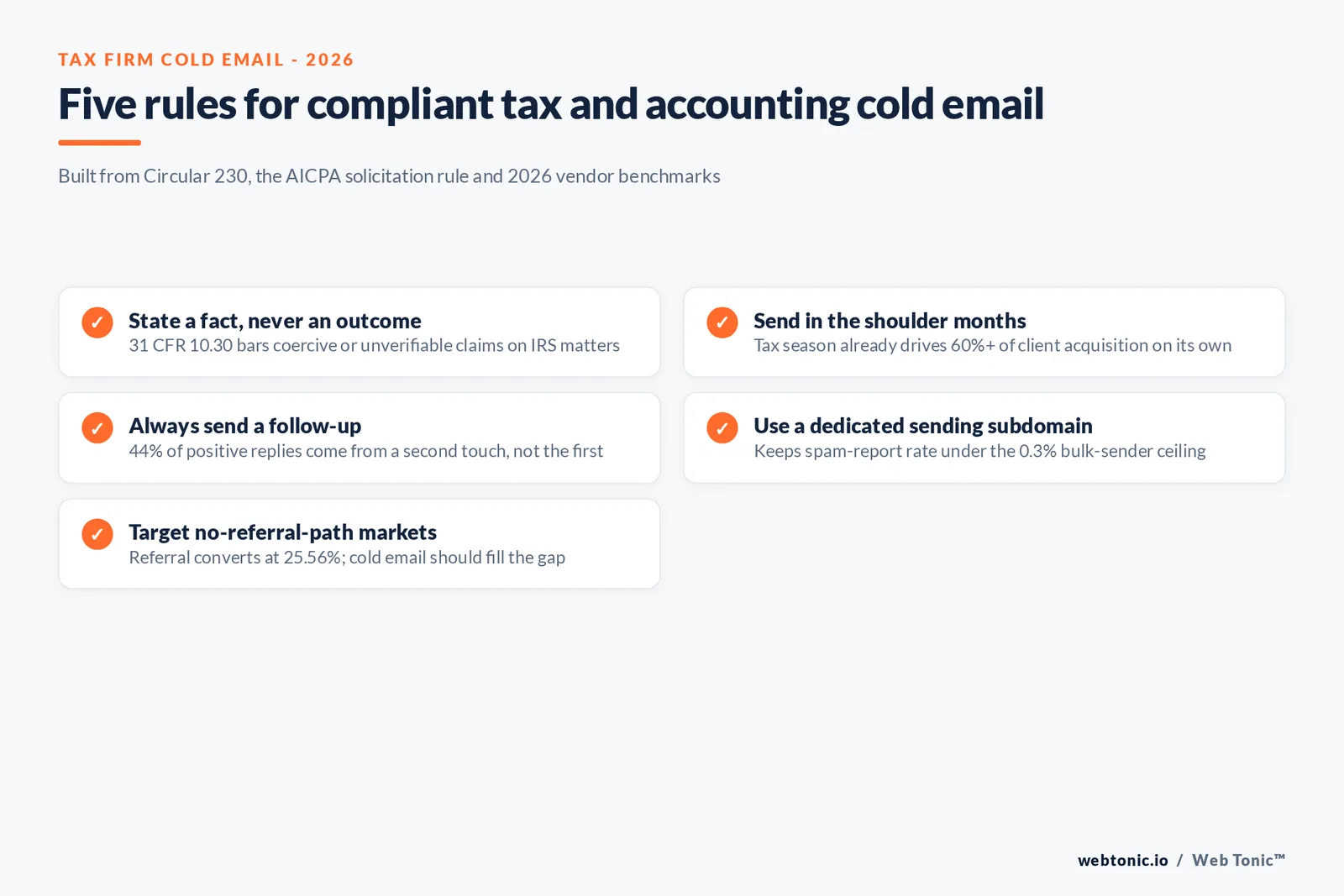
- 44% of positive replies come from a follow-up send, not the first email (Saleshandy).
- Tax season (Jan-Apr) is 60%+ of client acquisition and a 45% traffic spike industry-wide.
- Spam-report rate must stay under 0.3% under Google's and Yahoo's 2024 bulk-sender rules.
- 10-business-day opt-out window is the FTC's CAN-SPAM enforcement floor.
- 31 CFR 10.30 bars false, fraudulent or coercive solicitation on any IRS matter.
- 57% of accounting clients are found through peer referral, versus 3% through advertising, per CPA Practice Advisor’s 2025 SMB survey.
- 5.4% average cold-call connect rate, 13.3% top quartile, for comparison (Gong, 300M+ calls).
- Net income per partner rose 11.9%, from $225,725 (FY22) to $252,663 (FY24) (AICPA MAP Survey).
- Verified prospect lists bounce 40% less than unverified ones (Saleshandy).
The two rules that shape what a firm can write
31 CFR 10.30, the solicitation section of the IRS's Circular 230, bars a practitioner from any public communication or private solicitation carrying a false, fraudulent or coercive claim, or an unverifiable quality claim, on any matter before the IRS. The full Circular 230 text spells out the same standard for every form of outreach. The AICPA's Code of Professional Conduct carries a parallel Advertising and Other Forms of Solicitation Rule covering member firms specifically. Neither rule bans cold email; both ban the overstated-outcome language - guaranteed refunds, audit-proofing claims, insider IRS knowledge - that a generic B2B cold email template will happily generate if a firm does not edit it.
The reply-rate benchmarks, since none are tax-specific
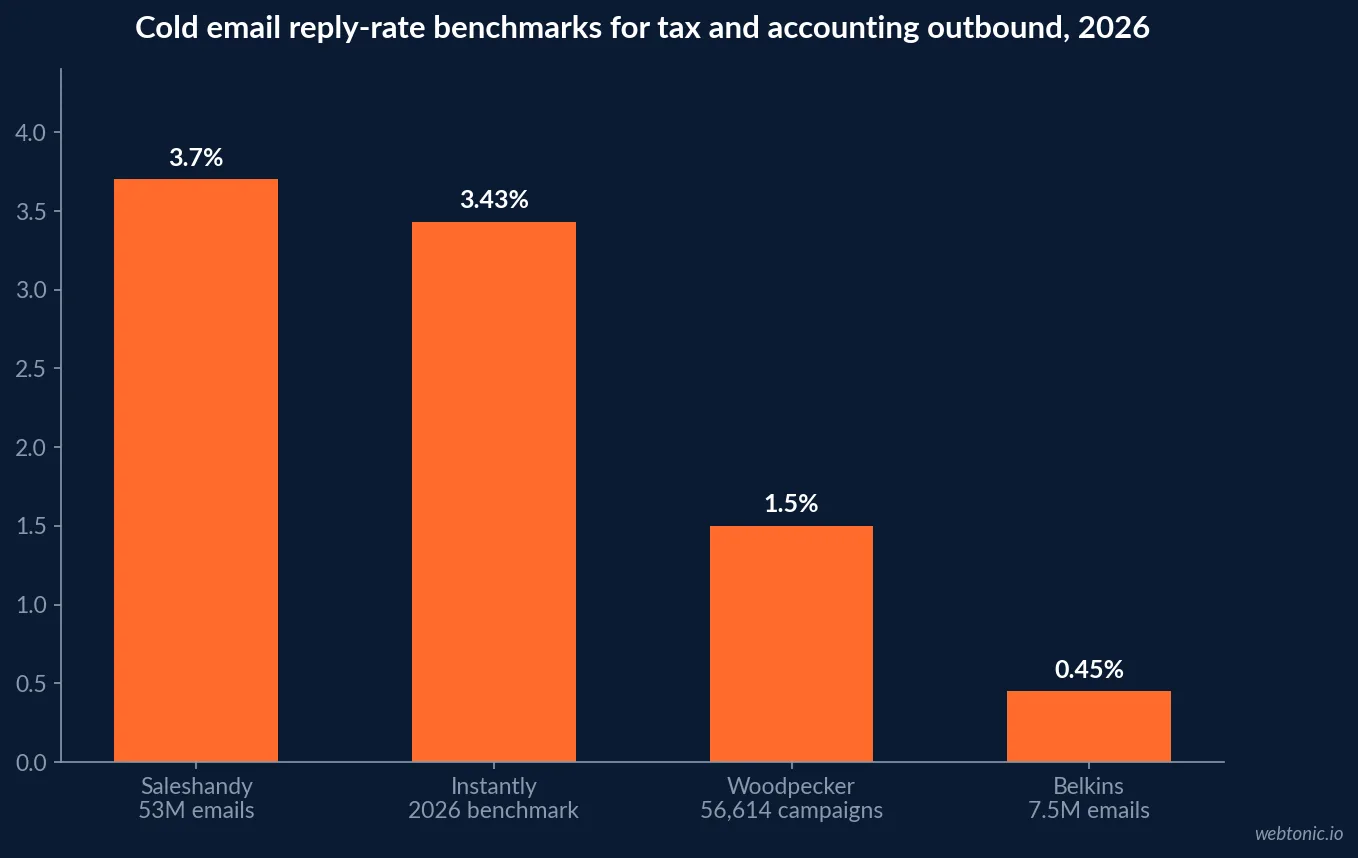
No major cold email vendor publishes a tax-and-accounting-specific reply rate, so a firm has to benchmark against the same cross-industry figures every other B2B sender uses. Saleshandy's analysis of 53 million emails sent January to June 2026 reports a 3.7% average reply rate. Instantly's 2026 benchmark reports 3.43%. Woodpecker's tool, from 56,614 campaigns, reports a 1.5% median. Belkins' narrower 7.5-million-email dataset reports 0.45%. A professional-services sender targeting business owners and CFOs, a relatively high-intent audience, should expect to land toward the upper half of that range if the list and offer are both business-specific.
| Vendor (2026 unless noted) | Metric reported | Sample | Applicability to accounting firms |
|---|---|---|---|
| Saleshandy | 3.7% average reply rate | 53M emails, Jan-Jun 2026 | Cross-industry, no accounting-specific split |
| Instantly | 3.43% average reply rate | 2026 benchmark report | Cross-industry, no accounting-specific split |
| Woodpecker | 1.5% median reply rate | 56,614 campaigns | Cross-industry, no accounting-specific split |
| Belkins | 0.45% average reply rate | 7.5M emails, 2025 | Cross-industry, no accounting-specific split |
| Gong | 5.4% avg / 13.3% top-quartile connect (calls) | 300M+ calls | Comparison channel, not email |
Why the calendar matters more here than in most industries
Firm-economics research on this trade puts tax season (January-April) at 60%+ of a typical firm's client acquisition with a 45% traffic increase industry-wide during that window. That means the partners and senior staff who would have to answer a cold email reply are the busiest they will be all year during exactly the months a generic outbound calendar would run a Q1 campaign. Saleshandy's data that 44% of positive replies come from a follow-up, not the first send, makes this worse inside busy season: a firm with no bandwidth to send a second-touch follow-up in March is leaving nearly half its reply volume unclaimed.
| Firm-calendar fact | Figure | Consequence for a cold email calendar |
|---|---|---|
| Tax season share of client acquisition | 60%+ | Staff are converting inbound demand, not chasing outbound |
| Tax-season traffic increase | +45% | Website and inbound channels already carry the volume |
| Share of positive replies from a follow-up | 44% | A firm with no follow-up bandwidth loses nearly half its replies |
| Recommended outbound window | May-December | Shoulder months when a reply can be worked properly |
Where cold email actually ranks against referral
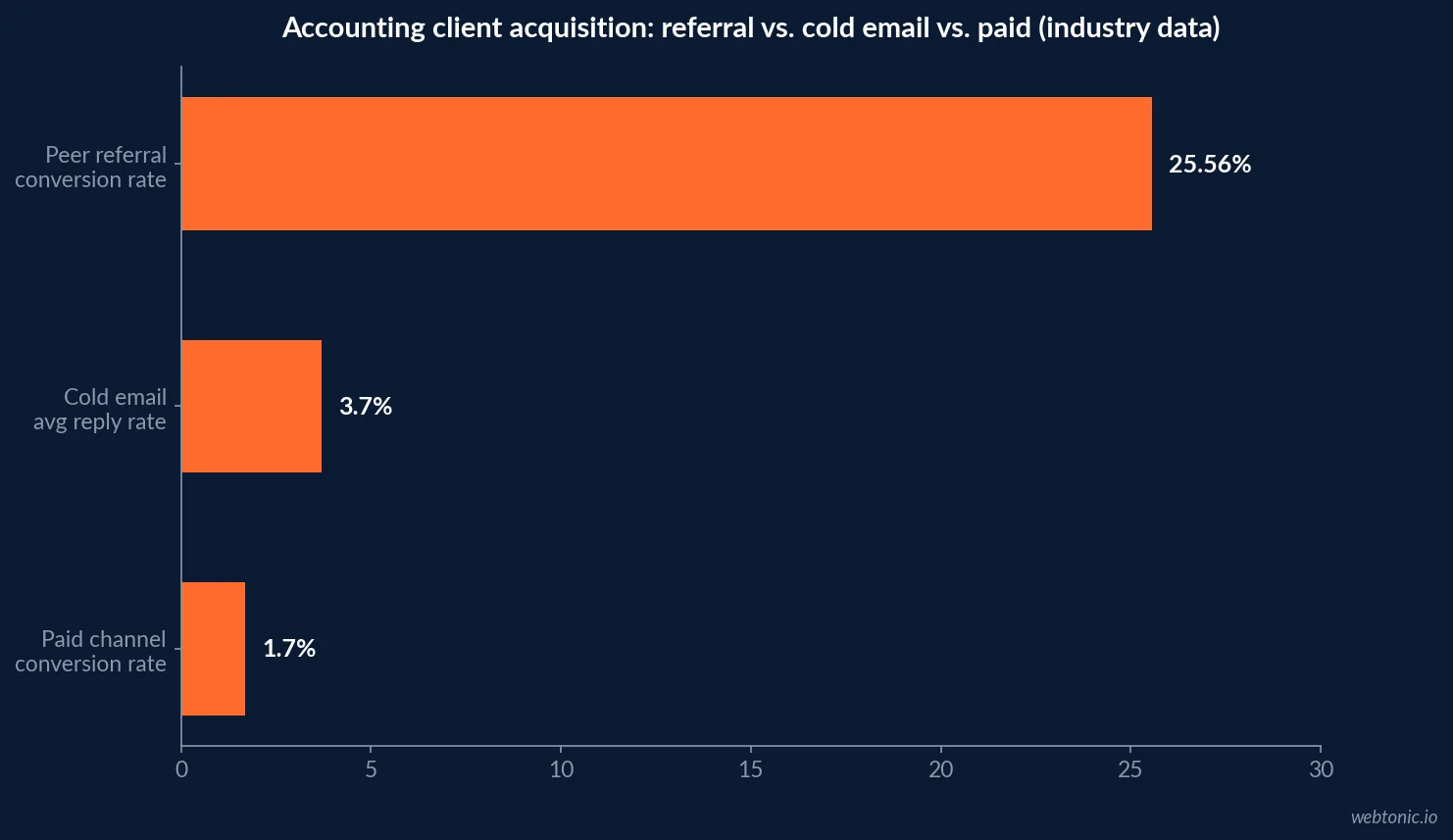
CPA Practice Advisor's survey of US small businesses found peer referral driving 57% of how firms are found against 3% for advertising, while an average cost per lead of $74.44 at a 9.83% conversion rate holds for finance-and-accounting paid search specifically. Cold email sits closer to the paid-channel end of that spectrum than to referral, which argues for using it to reach businesses with no existing referral path into the firm - new geographic markets, industries the firm wants to enter - rather than trying to replace the referral engine that already produces most new engagements.
| Client discovery channel | Share / conversion (industry data) | Where cold email fits |
|---|---|---|
| Peer referral | 57% of discovery (CPA Practice Advisor) | The channel cold email should not try to replace |
| Advertising (general) | 3% discovery | Cold email performs closer to this band |
| Paid search (finance & accounting) | $74.44 CPL, 9.83% CVR | Comparable acquisition cost to a cold email program |
| Cold email (this page) | 3.7% avg reply rate (Saleshandy) | Best for no-referral-path markets and new verticals |
Deliverability and compliance are the same floor as any other sender
Since 2024, Google's sender guidelines and the Yahoo Sender Hub require SPF, DKIM and DMARC authentication and a spam-report rate under 0.3% for bulk senders. On top of that, the FTC's CAN-SPAM guide and 16 CFR Part 316 require a truthful header, a real postal address and a working opt-out honored within 10 business days. None of that is tax-specific, but Circular 230's coercive-claim ban means the copy itself needs a second compliance pass a generic B2B template does not get.
What a compliant subject line and offer look like
The safest cold email hook for this trade states a service and a business fact, not an outcome claim: "Does your controller still close the books manually" clears Circular 230 and the AICPA rule because it makes no promise. "Save 20% on your tax bill, guaranteed" does not, on either standard. The same logic applies to case studies used in the body of the email - a specific, attributable client result with permission is fine; an aggregate "clients save an average of X%" claim without a stated basis is exactly the unverifiable quality claim Circular 230 targets.
| Cold email element | Compliant version | Non-compliant version | Rule it clears or breaks |
|---|---|---|---|
| Subject line | States a service or business fact | Implies an outcome or IRS risk | 31 CFR 10.30 coercive claim ban |
| Body claim | Named, attributable client result | Unattributed average savings figure | 31 CFR 10.30 unverifiable claim ban |
| Send domain | Dedicated subdomain, authenticated | Main firm domain, unauthenticated | Google/Yahoo 2024 sender rules |
| Opt-out | Working link, honored in 10 business days | No opt-out or a dead link | FTC CAN-SPAM / 16 CFR 316 |
| Timing | May-December send window | Q1 blast during tax season | Firm-calendar bandwidth, not a legal rule |
Sizing the program against what the firm actually needs
Net income per partner rose 11.9%, from $225,725 in fiscal 2022 to $252,663 in fiscal 2024, according to the AICPA's National MAP Survey - a firm-health backdrop that argues for a modest, compliance-checked cold email line aimed at new-market business prospects, run in the shoulder months, rather than a large Q1 campaign competing with the tax-season workload that already drives most new business. Our growth marketing practice builds that shoulder-season cadence directly into a firm's annual plan.
How this fits next to an account-based plan
Cold email finds a business with no existing referral relationship into the firm; it is not the right tool for deepening a relationship with an existing referral source or a large multi-owner prospect, which needs a named-account plan instead. Our companion piece on account-based marketing benchmarks covers that buying-committee approach; this page is strictly about the outbound channel mechanics for reaching a first contact.
Measuring the program against the firm's real calendar
A shoulder-season cold email program should be measured on booked discovery calls per month sent, not raw reply volume, and tracked against the same CRM the firm already uses for inbound tax-season leads so a business that replies in June is not treated as a cold lead again in December. Our data and analytics practice builds that shared view, and our team can help size a shoulder-season sequence against a specific firm's capacity.
| What to track | Why it beats a raw reply count | Cadence it should run on |
|---|---|---|
| Booked discovery calls per 100 sends | Ties the email to an actual sales action | Monthly, May-December |
| Reply rate by list segment (industry, size) | Finds which business segment responds best | Per-campaign |
| Bounce and spam-complaint rate | Protects the domain used for client communication | Weekly |
| Follow-up send rate | Captures the 44% of replies that need a second touch | Per-sequence |
Frequently Asked Questions
Can a CPA firm legally send cold email to prospective business clients?
Yes, with limits. 31 CFR 10.30, the IRS's Circular 230 solicitation rule, bars a practitioner from any public communication or private solicitation containing a false, fraudulent or coercive claim, or a claim about quality that cannot be verified. The AICPA's Code of Professional Conduct carries a parallel Advertising and Other Forms of Solicitation Rule. Neither bans cold email outright; both ban overstated promises about outcomes, refunds or savings, which is the exact language a badly written cold email tends to lead with.
What reply rate should a tax and accounting outbound program expect?
The same vendor benchmarks that apply to any B2B sender apply here, because none of the major cold email vendors publish a tax-and-accounting-specific figure. Saleshandy's analysis of 53 million cold emails sent January-June 2026 reports a 3.7% average reply rate. Instantly's 2026 benchmark report puts the average at 3.43%. Woodpecker's tool, drawn from 56,614 campaigns, reports a 1.5% median. Belkins' narrower 7.5-million-email 2025 dataset reports 0.45%. A firm-to-business sequence sitting inside that band is performing normally; a figure far below 0.45% usually means the list, not the copy, is the problem.
Does timing around tax season actually change reply rates?
The benchmark studies do not isolate tax-season timing directly, but the operational logic is clear from the firm-economics data: tax season (Jan-Apr) already accounts for 60%+ of a typical firm's client acquisition and a 45% traffic increase, which means the partners and staff who would answer a cold email reply are fully consumed by return work during exactly the months prospecting activity would spike on its own. The practical fix documented across outbound vendors is running the sequence in the shoulder months - May through December - when a reply can actually be worked.
What list-sourcing rule matters most for an accounting firm?
The FTC's CAN-SPAM compliance guide and its implementing rule at 16 CFR Part 316 require a truthful header, a real postal address and a working opt-out honored within 10 business days for every commercial email, tax firm or not. On top of that floor, Circular 230's solicitation rule specifically prohibits coercive or misleading claims about IRS matters, which rules out subject lines implying an audit risk, a refund guarantee, or an insider read on IRS enforcement - common cold-email hooks in other industries that become a compliance problem the moment a tax practitioner sends them.
How does cold email compare to referral for winning a new accounting client?
It is a distant second by the trade's own numbers. Referral already accounts for the majority of how accounting firms are found and converts far better than any paid or outbound channel once a prospect is measured through to a signed engagement, which is why every credible outbound plan for this trade treats cold email as a way to reach businesses with no existing referral relationship - new-market entrants, out-of-territory targets - rather than a replacement for the referral engine that already does most of the work.
Sources
Saleshandy - I Analyzed 53M Cold Emails: 13 Stats That Matter in 2026
Instantly - Cold Email Benchmark Report 2026
Woodpecker - Free cold email benchmarks tool
Belkins - B2B cold email response rates, 2025 study
Gong Labs - Does cold email even work any more?
eCFR - 31 CFR 10.30, Solicitation (Circular 230)
Google - Email sender guidelines
Yahoo Sender Hub - FAQs
Federal Trade Commission - CAN-SPAM Act Compliance Guide for Business
eCFR - 16 CFR Part 316, CAN-SPAM Rule
AICPA & CIMA - CPA firms report steady growth in revenue and profit, National MAP Survey
CPA Practice Advisor - Survey of SMBs Shows How They Choose and Evaluate Their Accounting Firm