Table of contents
A CPA firm can lose its license over the exact referral-fee mechanic that a tax-software affiliate program runs routinely, because the two sit under entirely different rulebooks. This page separates them: the AICPA's own Commissions and Referral Fees Rule and IRS Circular 230 for what a practitioner can accept, against the published affiliate commission rates that TurboTax and H&R Block actually pay for software referrals.
Key Takeaways
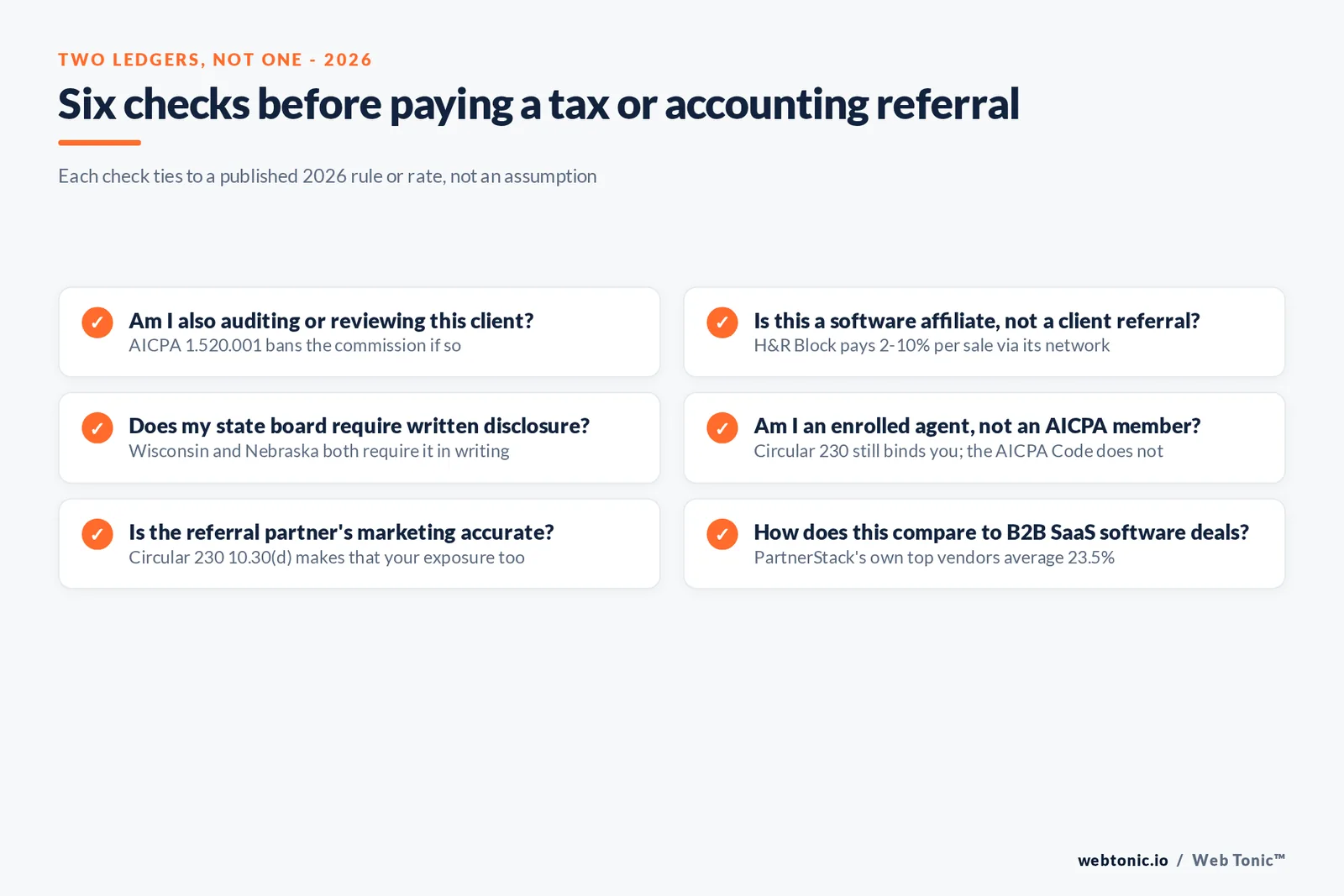
- AICPA Rule 1.520.001 bans a commission for a referral made while also auditing, reviewing or compiling for that same client.
- Permitted commissions still require client disclosure under the same rule.
- Referral fees must be disclosed to the client regardless of audit/review status.
- IRS Circular 230 §10.30(d) bars referrals built on deceptive advertising, making the practitioner responsible for a partner's marketing claims.
- Wisconsin's Accy 1.302 requires written disclosure of a referral fee's amount and reason at the time of referral.
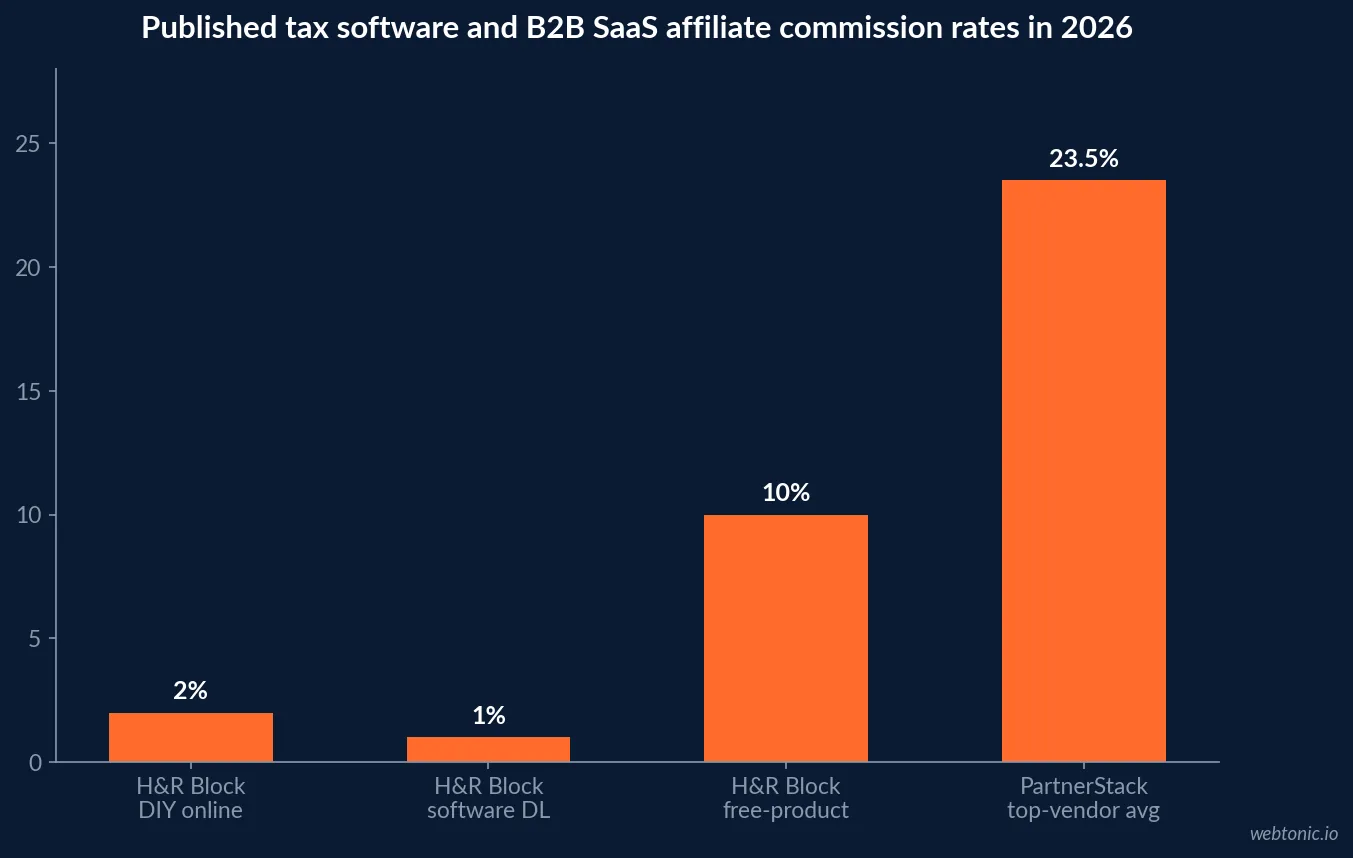
- H&R Block's listed affiliate program pays 2% per DIY online sale via the FlexOffers network.
- The same program pays 1% on software downloads and USD 2 per in-store lead.
- It pays 10% per sale on certain free-product conversions.
- TurboTax runs its own affiliate program directly through Intuit, not a single published flat rate.
- PartnerStack's own network data shows a 23.5% average commission for its top B2B SaaS vendors, the nearest software-partnership comparison point.
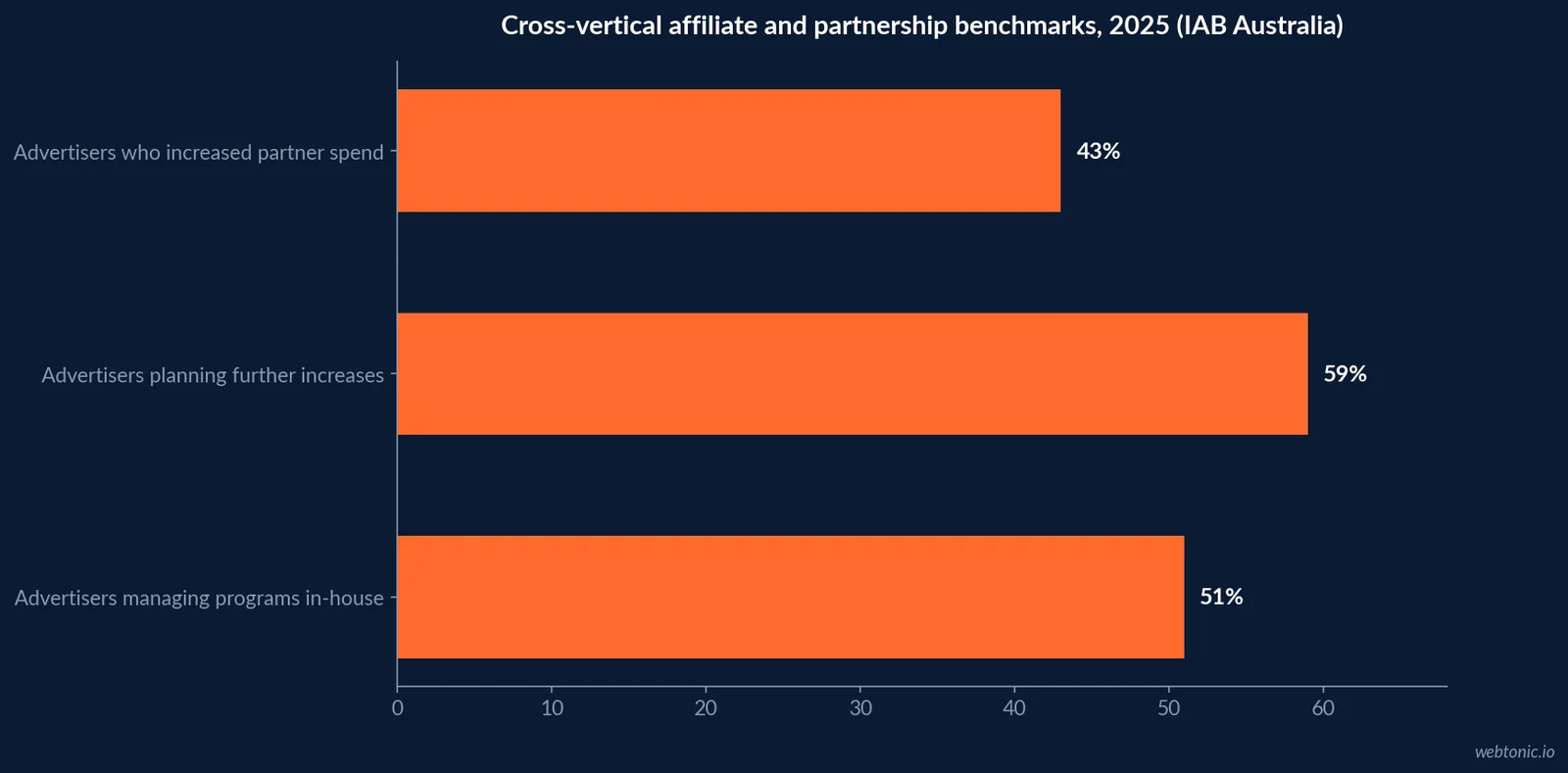
- 43% of advertisers increased partnership spend in the past year, cross-vertical (IAB Australia 2025).
- 59% plan to increase that spend further next year.
- 51% of advertisers manage programs in-house, ahead of agency (26%) and network (19%).
Two rulebooks, one budget line
"Affiliate and partnership marketing" in tax and accounting covers two different regulated relationships that get budgeted together and shouldn't be. One is a CPA or tax preparer's own professional-conduct exposure for accepting a commission or referral fee. The other is a straightforward software affiliate program - TurboTax or H&R Block paying a blogger or comparison site for a tracked sale. The first is bound by the AICPA Code and IRS Circular 230; the second runs on ordinary affiliate network terms. Confusing the two is how a firm ends up disclosing the wrong thing to the wrong regulator.
What the AICPA Code actually restricts
| Rule (AICPA Code of Professional Conduct, 2026) | What it restricts | Disclosure required? |
|---|---|---|
| 1.520.001(a) Prohibited commissions | Commission while performing audit/review for that client | N/A - prohibited outright |
| 1.520.001(b)-(c) | Same prohibition for compilations used by third parties, and prospective financial exams | N/A - prohibited outright |
| 1.520.001.03 Permitted commissions | Commission where no conflicting service is performed | Yes - to the client |
| 1.520.001.04 Referral fees | Paying or accepting a fee to obtain or refer a client | Yes - to the client |
What IRS Circular 230 adds on top
The IRS's own guidance on Circular 230 states a practitioner may not assist or accept assistance from any person or entity that obtains clients through false, fraudulent or coercive claims, or otherwise misleading or deceptive advertising, under section 10.30(d). That clause does not ban referral or affiliate relationships - it makes the practitioner accountable for how a paid partner represents the practice, which is a materially different exposure than the AICPA's commission rule and applies to enrolled agents and other non-CPA preparers who are not otherwise bound by the AICPA Code at all.
| Rule / statute | Applies to | Core restriction | Citation |
|---|---|---|---|
| AICPA 1.520.001 Commissions & Referral Fees | AICPA members in public practice | Ban when auditing/reviewing same client; disclosure otherwise | AICPA Code of Professional Conduct |
| IRS Circular 230 §10.30(d) | All practitioners before the IRS | Bars ties to deceptive/coercive advertising partners | irs.gov |
| Wisconsin Accy 1.302(5) | Wisconsin-licensed CPAs | Written disclosure of referral fee amount and reason | law.cornell.edu |
| Nebraska 288 NAC ch. 5 §007.02C | Nebraska-licensed CPAs | Written disclosure of referral fee acceptance/payment | law.cornell.edu |
What tax software affiliate programs actually pay
H&R Block's affiliate program, listed on the FlexOffers network, pays 2% per sale on DIY online filing, 1% on software downloads, a flat USD 2 per qualifying in-store purchase lead, and 10% per sale on certain free-product conversions. TurboTax's own affiliate and partner program page, run directly through Intuit, pays commissions on federal and state online tax return purchases generated through affiliate links, without publishing one flat headline rate the way H&R Block's network listing does. Both are ordinary e-commerce affiliate mechanics with no professional-conduct exposure attached, unlike a CPA-to-CPA referral fee.
| Program (network/vendor listing, 2026) | Published rate | Action rewarded |
|---|---|---|
| H&R Block DIY online filing | 2% per sale | Completed online tax return purchase |
| H&R Block software download | 1% per sale | Software download |
| H&R Block in-store lead | USD 2 flat | Qualifying in-store purchase lead |
| H&R Block free-product conversion | 10% per sale | Specific promotional SKU |
| TurboTax (Intuit, own program) | Commission, rate not published flat | Online federal/state return purchase |
Where accounting-adjacent software partnerships land, for comparison
No published study prices accounting-software partner commissions the way PartnerStack prices its own network. PartnerStack's own data shows its top-25 vendors paid an average commission of 23.5% in 2023, with top offers at 20%, 25% and 30%. That is the closest software-partnership comparison point available for accounting-adjacent SaaS tools, and it sits an order of magnitude above the 1-10% range H&R Block's own listed program pays for a tax-return sale.
Cross-vertical partnership spend, for context
No tax-and-accounting-specific affiliate spend survey exists, so the closest available benchmark is cross-vertical: IAB Australia's 2025 Affiliate & Partnership Marketing Industry Review found 43% of advertisers increased spend over the past year and 59% plan to increase it further, with 51% managing programs in-house versus 26% via agency and 19% via network. For a category where every referral fee needs a disclosure trail, in-house control over that documentation is the safer default.
Building a program that will not cost a license
The workable structure keeps the two programs on separate ledgers with separate approval steps: a software affiliate program for tax-prep tools, run like any other e-commerce affiliate relationship with standard FTC endorsement disclosure; and a professional referral-fee arrangement between practitioners, cleared against the AICPA Code, IRS Circular 230 and the specific state board rule before the first dollar changes hands. Our growth marketing practice builds the software-affiliate side of that split, and see our affiliate marketing statistics hub for the cross-industry commission structures this page compares tax software against. Talk to us about structuring a compliant partner program for a tax or accounting practice.
Enrolled agents and non-CPA preparers run under a different rulebook
The AICPA Code binds AICPA members only - it has no authority over enrolled agents, non-credentialed preparers or CPA firms that decline membership. Circular 230, by contrast, binds anyone practicing before the IRS regardless of AICPA membership, which makes it the wider net for referral-marketing exposure across the tax-prep industry as a whole. A firm mixing CPA and non-CPA preparers needs both rulebooks checked, not just one, before building a shared referral program across staff.
| Practitioner type | Bound by AICPA Code? | Bound by Circular 230? | Bound by state board rules? |
|---|---|---|---|
| CPA, AICPA member | Yes | Yes, if practicing before IRS | Yes, licensing state |
| CPA, non-AICPA-member | No | Yes, if practicing before IRS | Yes, licensing state |
| Enrolled agent | No | Yes | No CPA board, but state consumer-protection law may apply |
| Non-credentialed preparer | No | Limited (PTIN holders only) | Varies by state |
Disclosure formats are not uniform across states
Even among states that require written referral-fee disclosure, the format differs. Wisconsin's Accy 1.302(5) requires disclosure of the amount and reason for the fee at the time of referral. Nebraska's 288 NAC ch. 5 section 007.02C requires written disclosure of acceptance or payment of the fee, without the same explicit "reason" requirement. A firm operating across state lines needs its referral-disclosure template checked against each licensing state individually rather than assuming one federal-style form covers every board.
Frequently Asked Questions
Can a CPA firm run or join an affiliate program at all?
Yes, but the AICPA's own Commissions and Referral Fees Rule (1.520.001) draws a hard line: a member in public practice cannot accept a commission for recommending a product or service to a client, or for recommending a client's product, while also performing an audit, review or compilation (expected to be used by a third party) or an examination of prospective financial information for that same client. Where a commission is permitted, it must be disclosed to the client. State boards layer on their own version - Wisconsin's Accy 1.302, for instance, requires written disclosure of the amount and reason at the time of referral.
What does IRS Circular 230 say about referrals for tax preparers?
Circular 230 section 10.30(d) bars a practitioner from assisting or accepting assistance from anyone who obtains clients through false, fraudulent or coercive claims, or otherwise misleading or deceptive advertising. It does not ban referral relationships outright, but it makes the preparer responsible for how a referral partner markets on their behalf - a paid affiliate running deceptive ad copy becomes the practitioner's problem under this rule, not just the affiliate's.
What do tax software affiliate programs actually pay?
Where a network publishes the terms, H&R Block's own listed program (via the FlexOffers network) pays 2% per sale on DIY online filing, 1% on software downloads, a flat USD 2 per in-store purchase lead, and 10% per sale on certain free-product conversions. TurboTax runs its own affiliate and partner program directly through Intuit, paying commissions on federal and state online tax return purchases without a single published flat rate. Both differ sharply from the referral-fee mechanics a CPA firm operates under.
Is affiliate/partnership spend growing in professional services generally?
No tax-and-accounting-specific spend study exists, so the closest read is cross-vertical: IAB Australia's 2025 review found 43% of advertisers increased affiliate and partnership spend over the past year and 59% plan to increase it further, with 34% already spending USD 50,000-plus a month. Accounting and tax firms sit inside a much more rules-bound version of that same growth trend.
Should a solo CPA pay a referral fee to another professional for new clients?
Only with the paperwork done first. Beyond the AICPA rule and IRS Circular 230, several state boards - Wisconsin's Accy 1.302 and Nebraska's 288 NAC ch. 5 § 007 among them - separately require written disclosure to the client of any referral fee paid or received before the fee changes hands. Treat the AICPA rule as the floor and check the state board rule for the state the client is actually in, since the disclosure format is not uniform.
Sources
AICPA - Code of Professional Conduct, Commissions and Referral Fees Rule 1.520.001
IRS - Guidance to Practitioners Regarding Professional Obligations Under Circular 230
Cornell LII - Wisconsin Admin. Code Accy 1.302, Contingent fees, commissions and referral fees
Cornell LII - 288 Neb. Admin. Code ch. 5 section 007, Referral Fees
FlexOffers - H&R Block Affiliate Program listing
TurboTax (Intuit) - Official Affiliate and Partner Programs page
PartnerStack Research Lab - Top vendor average commission rate chart
IAB Australia - Affiliate & Partnership Marketing Industry Review 2025