Table of contents

An accounting firm's client decision is rarely made by one person, and referral, not advertising, already wins most new business - which means account-based marketing here has to target named prospect companies and named referral sources, not replace the referral engine. This page separates the buying-committee and budget case from the cold-email channel mechanics covered elsewhere.
Key Takeaways
- 13 to 17 stakeholders sit in a typical B2B buying group (Demandbase, 1,452 companies).
- 13 people on average are involved in a B2B buying decision (Forrester).
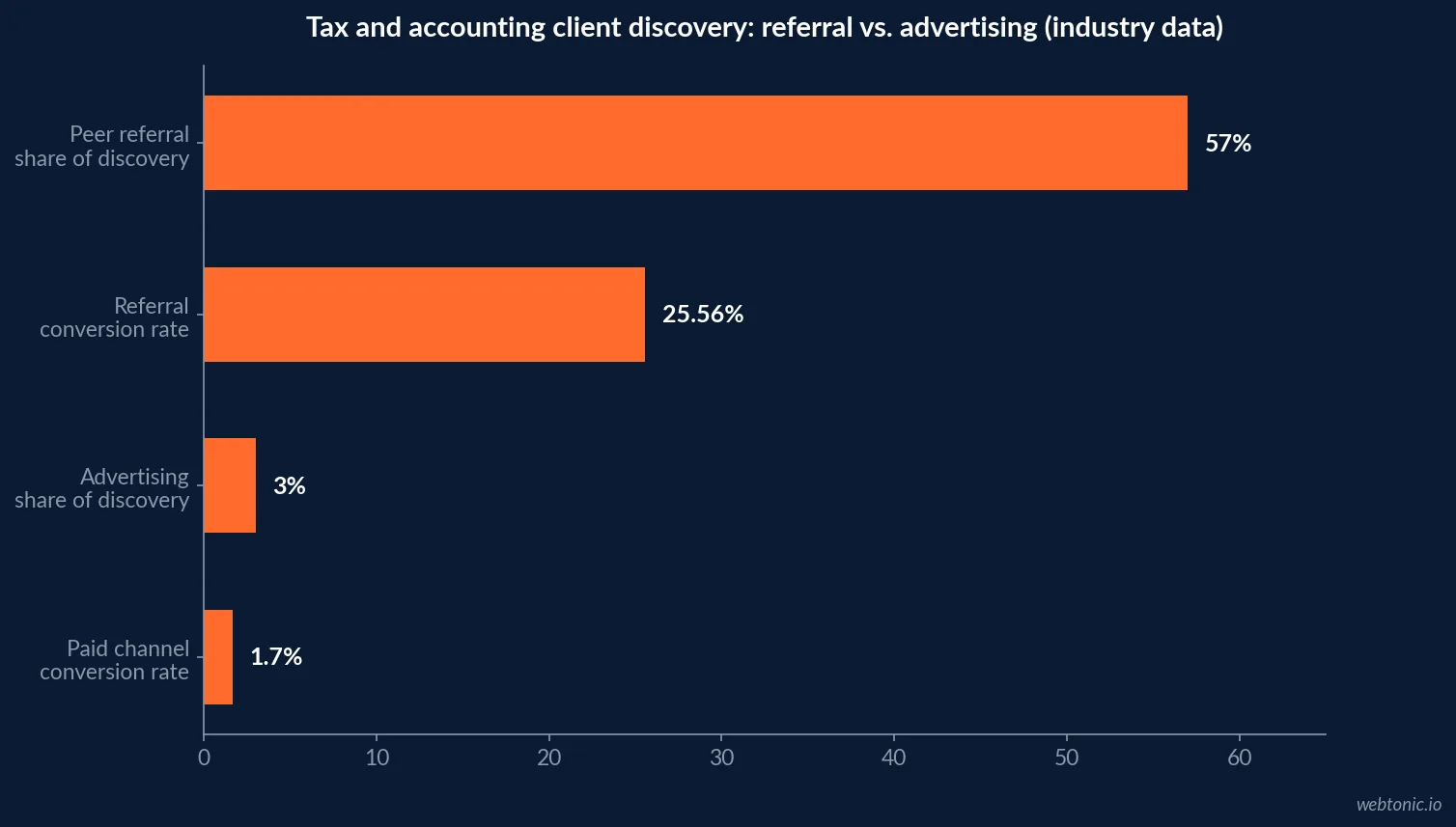
- 57% of accounting clients are found through peer referral, versus 3% through advertising, per CPA Practice Advisor’s 2025 SMB survey.
- 30% of marketing budget goes to ABM at companies running a program (Momentum ITSMA).
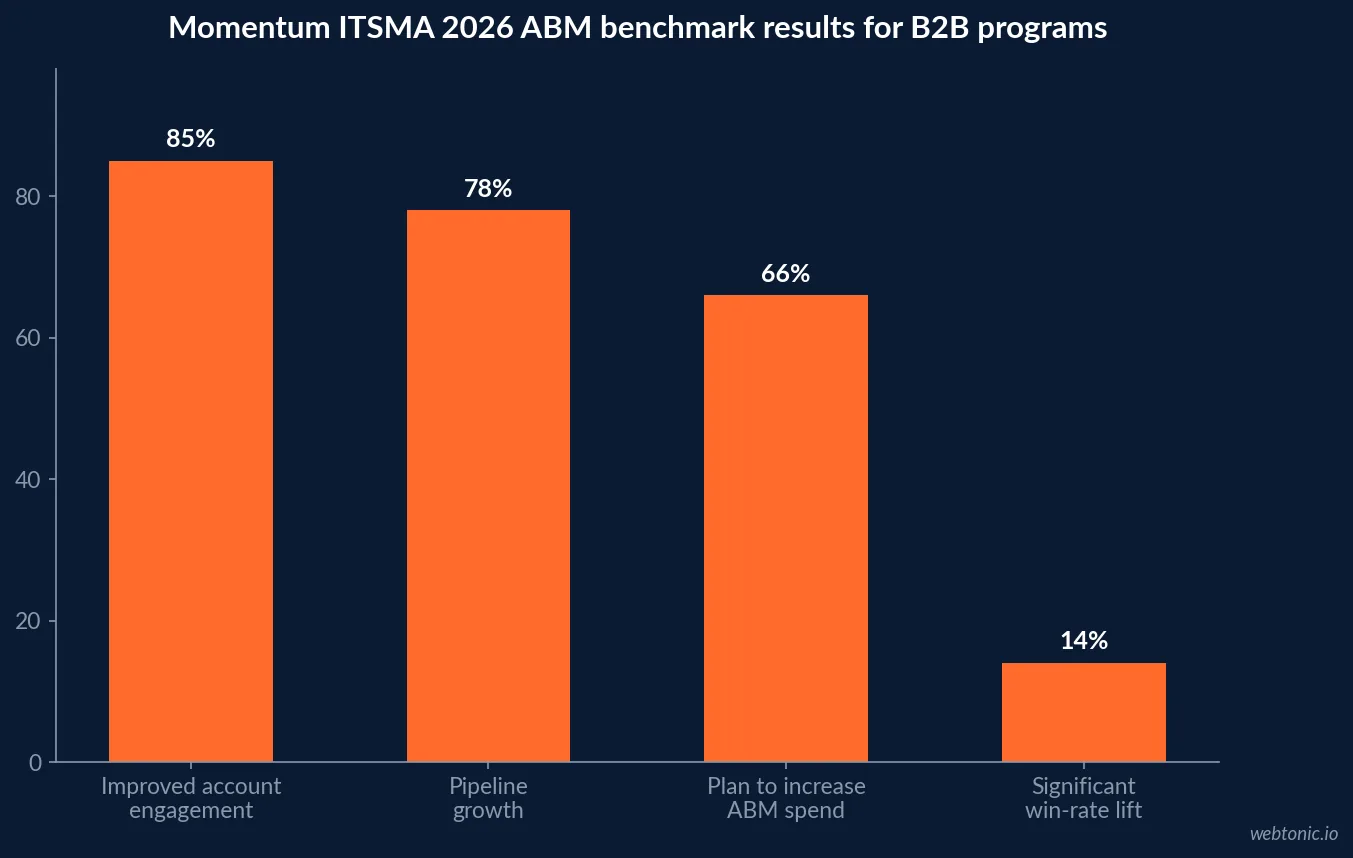
- 66% plan to increase ABM spend the following year (Momentum ITSMA).
- 85% report improved account engagement; 78% report pipeline growth from ABM (Momentum ITSMA).
- Only 14% report a significant win-rate lift above 10% (Momentum ITSMA).
- Buying-group-aligned teams win 2 to 3 times more than lead-centric teams (Demandbase).
- 58.7% win rate for accounts run with four advertising products, a 71% lift over zero (Demandbase).
- 22.33% MQA-to-pipeline conversion for integrated programs vs. 14.19% for the rest (Demandbase).
- Net income per partner rose 11.9%, $225,725 (FY22) to $252,663 (FY24) (AICPA MAP Survey).
- High-growth firms spend 2.1% of revenue on marketing, twice the rest, and grew 38.5%.
Why this is a buying-committee problem, not a lead-volume problem
A firm chasing more leads is solving the wrong problem if the actual bottleneck is getting every stakeholder in a prospective client's decision to agree. Demandbase's 2026 State of ABM report, analysing 1,452 company tenants and 9.7 million sales interactions, puts a typical B2B buying group at 13 to 17 stakeholders. Forrester separately reports an average of 13 people involved in a B2B buying decision. Neither figure is accounting-specific, but a mid-size business switching firms plausibly routes the decision through an owner, a controller, a CFO if one exists, and outside counsel or a board member - a committee, not a single signature.
What coordinated account engagement is worth, per the 2026 data
Demandbase's dataset reports organizations aligning marketing and sales around the buying group, instead of a single lead, achieve 2 to 3 times higher win rates. Win rates peak at 2 to 3 buying groups tracked per product, with diminishing returns past that range - a natural cap for a firm's partner-in-charge deciding how many named target companies to run a dedicated relationship plan against simultaneously. Firms connecting their CRM, marketing platform and predictive model report a 22.33% MQA-to-pipeline conversion rate against a 14.19% baseline, and companies running four coordinated engagement channels against a target account post a 58.7% win rate, a 71% lift over running none.
| Demandbase 2026 finding | Figure | What it implies for a firm's named-account plan |
|---|---|---|
| Typical B2B buying group size | 13-17 stakeholders | Map owner, controller, CFO and outside counsel, not one contact |
| Buying-group-aligned vs. lead-centric win rate | 2-3x higher | One plan per target company, not a generic newsletter |
| Optimal buying groups tracked per product | 2-3 | Cap the number of active named-account plans a partner runs |
| MQA-to-pipeline conversion, integrated systems | 22.33% vs 14.19% | Connect the firm's CRM before scaling the target list |
| Win rate, 4 engagement channels vs. zero | 58.7% vs. baseline, +71% lift | Combine referral, email, event and direct outreach on one account |
Referral sources deserve their own ABM tier
CPA Practice Advisor's survey of US small businesses found peer referral driving client discovery for this trade at 57% against 3% for advertising. Given that gap, the single highest-leverage ABM move for a firm is naming its best-performing referral sources - estate attorneys, commercial bankers, wealth managers, business brokers - as target accounts in their own right, and running the same coordinated, multi-touch plan against them that a B2B seller would run against a prospective buyer. That reframes ABM from "find more prospects" to "get more introductions from the sources that already convert best."
Two account tiers, two different plans
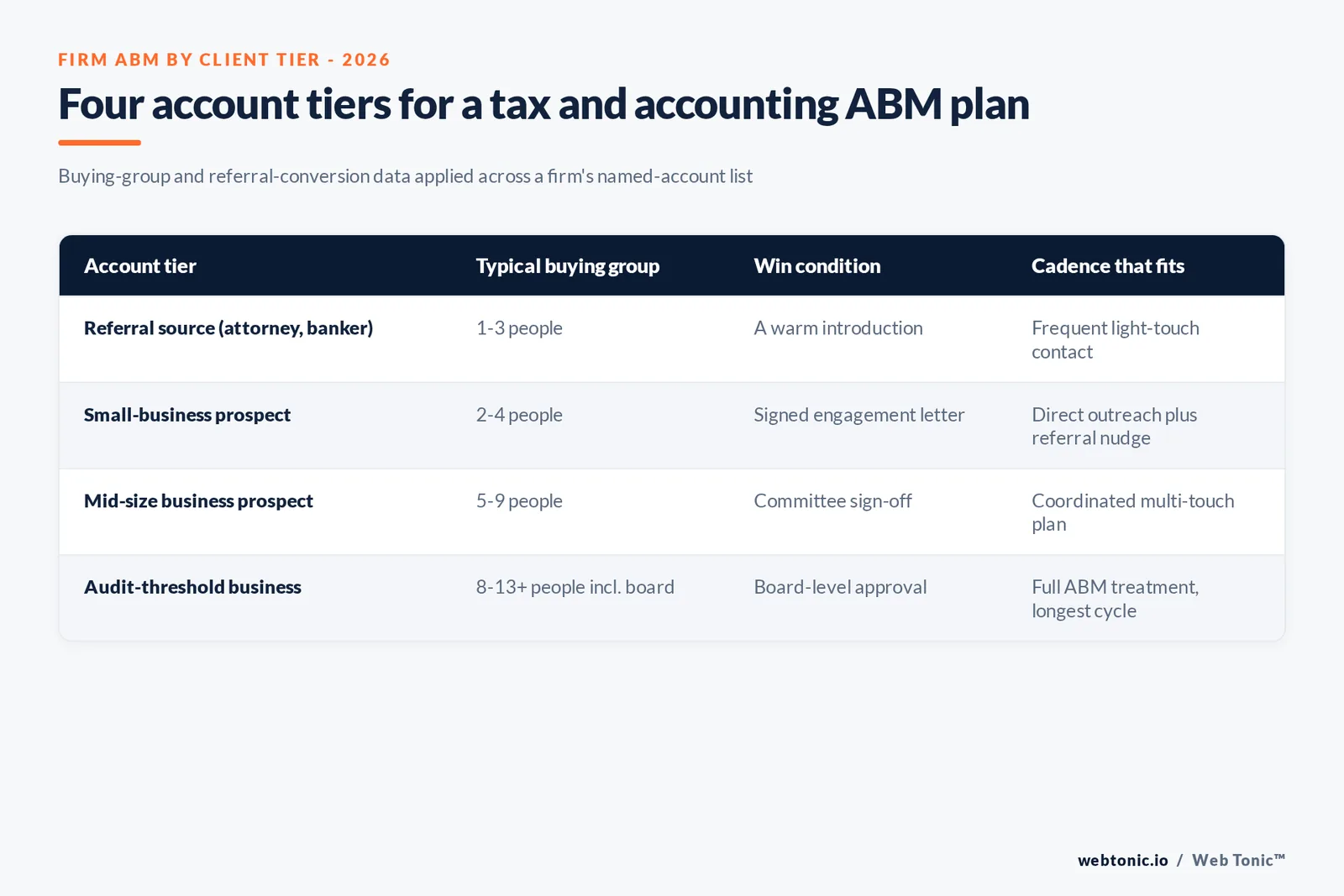
A firm running ABM well separates referral-source accounts from prospective-client accounts because the buying group and the win condition differ for each. A referral source's "win" is a warm introduction; a prospective client's win is a signed engagement letter after its own multi-stakeholder review. Treating both with the same cadence wastes effort on the smaller-committee, faster-cycle referral relationships and under-resources the larger-committee, slower-cycle prospect accounts.
| Account tier | Typical buying-group size | Win condition | Cadence that fits |
|---|---|---|---|
| Referral source (attorney, banker, advisor) | 1-3 people | A warm introduction to a client | Frequent, light-touch relationship contact |
| Small-business prospect | 2-4 people (owner, bookkeeper) | A signed engagement letter | Direct outreach plus a referral nudge |
| Mid-size business prospect | 5-9 people (owner, controller, CFO) | Committee sign-off on a switch | Coordinated multi-touch, named plan |
| Business approaching audit threshold | 8-13+ people incl. board/counsel | Board-level approval of a new firm | Full ABM treatment, longest cycle |
The budget case, sized against real firm economics
Momentum ITSMA's benchmark study reports companies running ABM devote 30% of marketing budget to it, with 66% planning to increase that spend, 85% reporting improved account engagement and 78% reporting pipeline growth - but only 14% report a significant win-rate lift above 10%. Net income per partner rose 11.9%, from $225,725 in fiscal 2022 to $252,663 in fiscal 2024, per the AICPA's National MAP Survey, and High Growth firms tracked by the Association for Accounting Marketing's benchmark study already spend 2.1% of revenue on marketing against 1% for other firms, while growing 38.5% - up to 7x faster than slower-growing peers. The honest budget line is a modest, named-account program layered on the referral engine, sized against that 2.1%-of-revenue high-growth benchmark rather than the B2B-wide 30% ABM-budget-share figure, which assumes ABM is close to the whole marketing motion.
Why visibility to AI search matters for this list
A named-account plan depends on the firm being findable when a buying-committee member researches it independently, and CPA firms broadly under-invest in the AI-search channel a controller now checks before a website. A controller or outside counsel doing diligence on a firm switch increasingly checks an AI answer before a website, which makes AI-search visibility a quiet prerequisite for any named-account program to convert once the target company starts its own research. Our growth marketing practice treats that visibility gap as part of account readiness, not a separate project.
| Budget fact | Figure | Source | What it argues for |
|---|---|---|---|
| ABM budget share, B2B-wide | 30% of marketing budget | Momentum ITSMA | Not the right ratio for a mostly-referral firm |
| High-growth firm marketing spend | 2.1% of revenue | Industry benchmark | A more realistic sizing anchor |
| High-growth firm revenue growth | 38.5% | Industry benchmark | The return that spend level is buying |
| Net income per partner, FY24 | $252,663, +11.9% vs FY22 | AICPA National MAP Survey | The economics funding the program |
How to start the named-account list
Rank the firm's existing referral sources by client value delivered over the last two years, name the top 20 to 30, and build a light relationship cadence for that tier first - it is the fastest payoff given how disproportionately referral drives discovery for this trade. Layer a second, smaller list of prospective clients approaching a genuine complexity threshold (a second location, an audit requirement, a first acquisition) where a multi-touch, multi-stakeholder plan actually matches how the decision gets made, rather than running the same newsletter at every business in the metro area.
How this fits next to a cold email program
ABM decides which named companies and referral sources deserve a dedicated plan; a cold email sequence is one of the tactics used to open a first conversation with a prospect that has no existing referral path in. Our companion piece on cold email outbound benchmarks covers that channel's reply-rate mechanics; this page covers which accounts are worth that outreach and how much of the budget they deserve.
Measuring a named-account plan against firm growth, not lead volume
A named-account program for a firm should be measured on engagement across every stakeholder on a target account and on referral-source relationship health, not on inbound form fills. Our data and analytics practice builds that account-level dashboard, and our team can help a firm rank its own referral sources and prospect list before committing budget to a named-account program.
| Account-level metric | Why it beats a lead-level metric | Benchmark it maps to |
|---|---|---|
| Stakeholders engaged per prospect account | Catches a stalled deal reaching only one contact | 13-17 stakeholder buying group |
| Referral-source relationship touches per quarter | Protects the channel driving most new-client discovery | 57% of discovery via peer referral |
| Active named accounts per partner | Flags when a partner has spread too thin | 2-3 buying groups is the win-rate peak |
| Account-level win rate | The number the budget case rests on | 58.7% at 4 engagement channels vs. baseline |
Frequently Asked Questions
What does ABM mean for a tax and accounting firm, specifically?
It means building a named list of target businesses and referral sources - attorneys, wealth managers, bankers who send client introductions - and running a coordinated plan against each one, rather than a generic ad set aimed at every small-business owner in a metro area. Because referral already drives most of how firms win new clients, ABM here often means targeting the referral sources themselves as named accounts, alongside a shorter list of high-value prospective clients such as businesses approaching a size threshold that needs audit or a more complex tax structure.
Are the ABM benchmarks below specific to accounting firms?
No. The Momentum ITSMA/ABM Leadership Alliance and Demandbase figures come from cross-industry B2B benchmark studies, mostly software and professional-services respondents, not from accounting-firm-only surveys. They are the best public evidence on how ABM performs in principle. An accounting firm selling a complex engagement to a multi-owner business is closer to that B2B buying pattern than a 1040 client is, but the numbers should be read as directional, not trade-specific.
How many people actually decide to switch accounting firms?
More than one, which is the entire argument for treating it as ABM rather than a single-contact sale. Demandbase's 2026 analysis of 1,452 company tenants and 9.7 million sales interactions puts a typical B2B buying group at 13 to 17 stakeholders; Forrester separately reports an average of 13 people involved in a B2B buying decision. For a mid-size business client, that plausibly includes the owner or CEO, the controller who does the day-to-day work with the firm, the CFO if one exists, and outside counsel or a board member who signs off on a professional-services change.
Should a firm treat referral sources as ABM targets?
Yes, and it is arguably the highest-leverage use of ABM in this trade. CPA Practice Advisor’s 2025 SMB survey found peer referral drives 57% of discovery against 3% for advertising. A firm that names its 20 to 30 best-performing referral sources - estate attorneys, commercial bankers, wealth managers - and runs a dedicated relationship plan against each one is applying ABM logic to the channel that already works best, rather than importing a B2B software company's target-account list model wholesale.
What does the ABM budget case look like against firm economics?
Momentum ITSMA's benchmark study reports companies running ABM devote an average of 30% of marketing budget to it and 66% plan to increase that spend, with 85% reporting improved account engagement and 78% reporting pipeline growth - but only 14% report a significant win-rate lift above 10%. Against a backdrop where net income per partner rose 11.9% (from $225,725 in FY22 to $252,663 in FY24, per the AICPA's National MAP Survey), the honest sizing is a modest, named-account program layered on top of the referral engine, not a budget swing that assumes ABM alone will move the growth number.
Sources
Demandbase - State of ABM 2026: Pipeline Benchmarks from 1,452 Companies
Forrester - Your Buyer Is A Group, Not A Person
Momentum ITSMA & ABM Leadership Alliance - Rethinking ABM Benchmark Study
ABM Leadership Alliance - Rethinking ABM: Outperforming the Market in the World of AI
AICPA & CIMA - CPA firms report steady growth in revenue and profit, National MAP Survey
CPA Practice Advisor - Survey of SMBs Shows How They Choose and Evaluate Their Accounting Firm
Association for Accounting Marketing - High Growth Firms Spend Twice as Much on Marketing