Table of contents

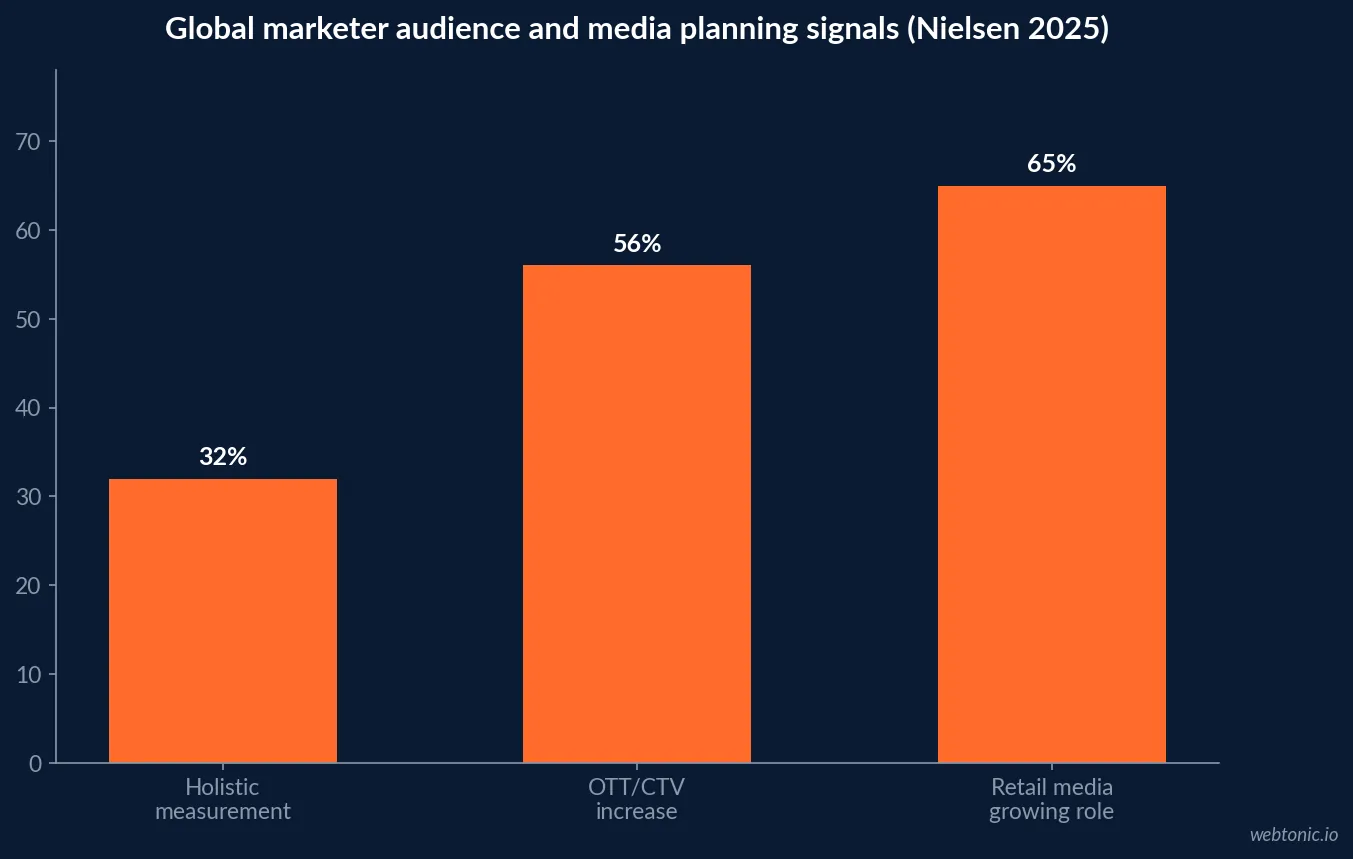
Audience statistics are useful only when they change a decision. Marketers should budget for a connected chain—research, data quality, activation and measurement—not for a segment count in isolation. In Nielsen’s 2025 global survey, only 32% of marketers said they measured media spending holistically across digital and traditional channels, a reminder that audience reach and outcome proof often sit in separate systems.
Key Takeaways
- 32% of marketers measured media holistically across digital and traditional channels in Nielsen’s 2025 survey.
- Nielsen surveyed 1,400 global marketing professionals in February and March 2025.
- 56% planned to increase OTT/CTV spending and 65% expected retail media to play a growing role in 2025 (Nielsen).
- HubSpot’s 2025 State of Marketing draws on 1,200 marketers and industry leaders.
- More than 70% planned to target Millennials in HubSpot’s 2025 research.
- 61% of marketing budgets are tied to enterprise revenue, budgets or prior spend in Deloitte Digital’s 2025 study of 1,395 US leaders.
- IAB’s 2025 Outlook Study surveyed 200 US buy-side decision-makers.
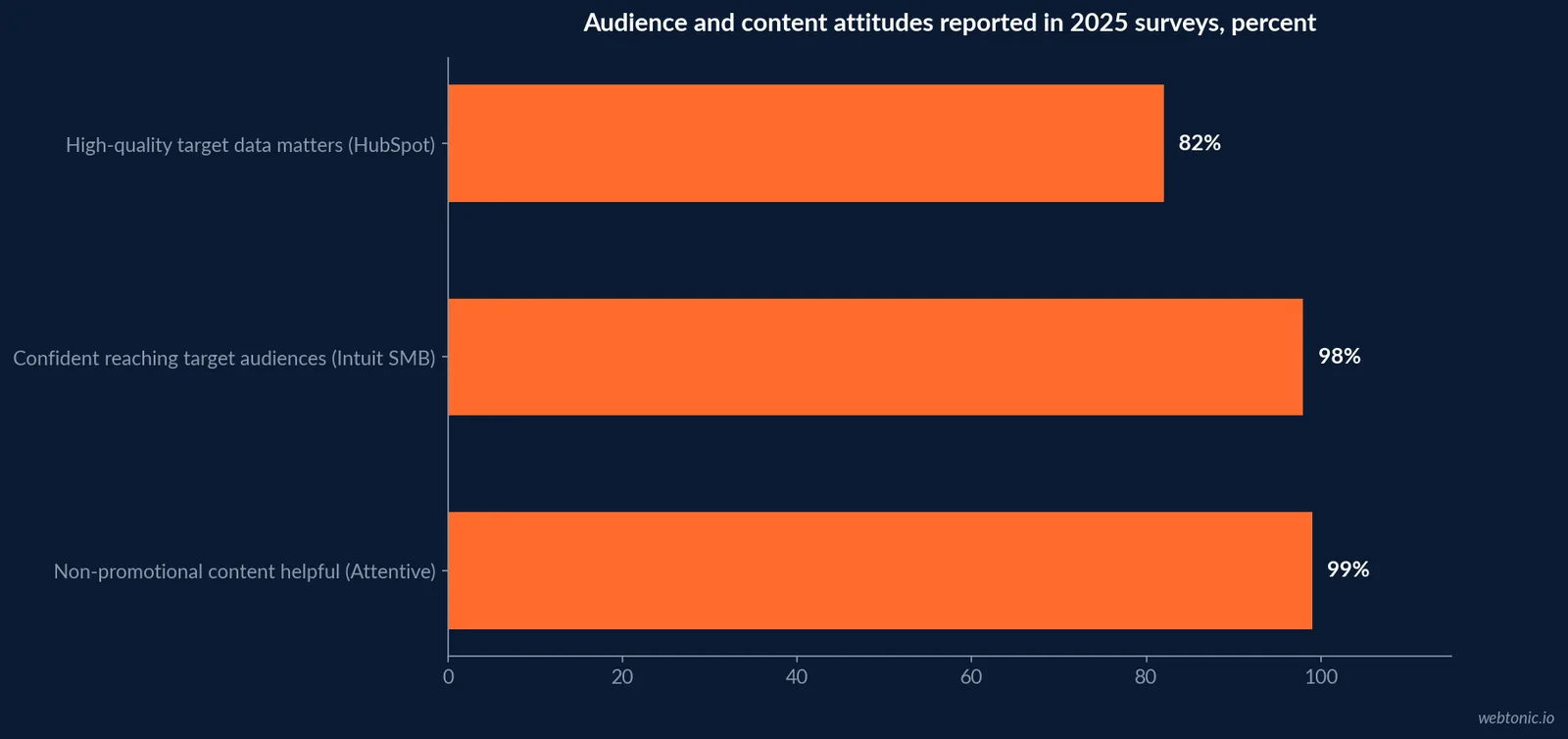
- 82% of marketers say high-quality target-audience data is important in a HubSpot-published 2025 research summary.
- Audience budgets should name a population, data source, activation channel, outcome and holdout.
- No dataset or segment estimate is a guaranteed audience reach, conversion or ROI.
Start with the decision, not a purchased segment
“Target audience statistics” can mean survey data about a market, modeled profiles, first-party customer segments, platform-defined targeting or campaign performance by audience. Those are different products with different costs and risks. Before setting a line item, write down the decision the data must support: a message, a channel allocation, an eligibility rule, a launch market or a retention intervention.
Then define the unit of analysis. Is the team studying people, households, accounts, devices, buyers or transactions? How current must the information be? Is the target population reachable through the planned media? A segment report without those definitions can appear precise while comparing incompatible denominators.
Use a staged budget: first establish the question and data rights, then size the available audience, test activation and finally measure outcomes. Stop spending when the next phase cannot answer a decision or when the data cannot be lawfully used.
Measurement is the first budget gap to close
Nielsen’s 2025 Annual Marketing Report surveyed 1,400 global marketing professionals between February 25 and March 6. Respondents were manager-level or more senior, worked with annual marketing budgets of at least USD 1 million, and two-thirds worked with budgets over USD 10 million. The headline diagnostic: only 32% said they measure media spending holistically across digital and traditional channels. The share was 23% in Europe and 29% in Latin America.
That is a measurement coverage statistic, not a claim that the remaining marketers have no analytics. But it does mean a budget for audience data should include how results will be joined across channels. Nielsen lists data, weak tools, vendor sprawl and a lack of transparency as challenges to cross-media ROI measurement.
Put the measurement plan in the brief before buying audience data: choose a common outcome, define attribution boundaries and identify a way to distinguish incremental impact from people who would have converted anyway. If the team cannot link exposure to qualified actions, first fund the instrumentation or an experiment design.
| Research or activation line | 2025 evidence | Budget question | Deliverable to require |
|---|---|---|---|
| Cross-media measurement | 32% holistic measurement globally (Nielsen) | Can channels be compared on a common outcome? | Metric map, joins and reporting owner |
| Audience definition | HubSpot surveyed 1,200 marketers | Does the segment reflect a specific decision? | Definitions, source and refresh date |
| First-party data | IAB identifies first-party targeting as a focus | What can consented owned data answer? | Permissions, governance and match test |
| Activation | 56% planned OTT/CTV increase (Nielsen) | Can the selected audience be reached there? | Reach, frequency and exclusions |
| Validation | Deloitte surveyed 1,395 US leaders | Is the spend tied to a testable hypothesis? | Holdout, control or matched comparison |
Audience definitions move with the market
HubSpot’s 2025 State of Marketing draws on 1,200 marketers and industry leaders across North America, Europe, Asia and Australia. The report says more than 70% planned to target Millennials in 2025, while interest in Gen Z rose year over year and interest in Gen X and Baby Boomers fell by more than 30% in the survey comparison. Attentive’s 2025 consumer study reports 99% of consumers believed non-promotional content helpful to their shopping experience; that is an expectation signal, not a targeting conversion benchmark. These are marketer plans, not measured population sizes or evidence of segment profitability.
The practical lesson is that audience priorities change, so keep segment definitions versioned. Record the source, geography, inclusion rules, recency, sample size and whether data is observed, modeled or self-reported. For each update, record what changed and whether the campaign’s reachable audience expanded or contracted.
Avoid presenting demographics as a behavioral proxy. Age can help frame a hypothesis, but a content preference, purchase signal or stated need may be closer to the campaign’s actual proposition. Test the signal relevant to the conversion rather than assuming a broad group shares the same intent.
| Audience signal | Source / year | Reported finding | Interpret carefully |
|---|---|---|---|
| Millennial targeting plans | HubSpot, 2025 | More than 70% planned to target Millennials | Marketer plans, not audience size |
| Gen Z targeting interest | HubSpot, 2025 | Interest rose year over year | Direction only; not conversion evidence |
| Gen X / Boomer focus | HubSpot, 2025 | Interest down more than 30% in survey comparison | Marketer priority, not consumer demand |
| Target-audience data quality | HubSpot 2025 summary | 82% say high-quality audience data matters | Importance rating, not budget amount |
| Marketer budget control | Deloitte Digital, 2025 | 61% bases budget on enterprise revenue/budget or prior spend | Budget inputs may be constrained |
First-party data can be a capability budget
IAB’s 2025 Outlook Study surveyed 200 US buy-side investment decision-makers at brands and agencies from November 13 to December 6, 2024. It describes first-party data acquisition and partnerships as persistent priorities and notes buyers seeking privacy-safe audience insight. IAB’s 2025 State of Data report adds context on data collaboration, identity and modeling as advertisers respond to signal loss and privacy rules.
For a team, “first-party data investment” can include consented collection, preference management, CRM hygiene, identity resolution, governance and analytics—not merely a platform license. Each item should have an accountable owner, permitted use and measurable activation. A large database with stale, duplicated or unauthorized records is not a usable audience asset.
Make an incremental test part of the proposal: compare a first-party segment to a baseline, measure match/reach rate and report outcomes beyond platform-attributed conversions. Document audience overlap and suppression so a new data investment does not simply bid against the same customers already in a campaign.
| Capability | Cost category to scope | Evidence of readiness | Guardrail |
|---|---|---|---|
| Consent and provenance | Policy, collection and preference workflows | Source and permitted purpose are documented | Do not activate unknown-origin records |
| Data quality | Deduplication and refresh routines | Coverage, recency and error rates are visible | Do not confuse record count with reach |
| Identity and matching | Partnership or resolution costs | Match rate reported with denominator | Minimize sensitive or unnecessary fields |
| Audience activation | Platform or media operational spend | Reach, frequency and exclusions measured | Check overlap before increasing budget |
| Incrementality | Holdout and analysis effort | Control group is defined in advance | Separate attributed from incremental results |
Channel shifts do not equal audience opportunity
Nielsen reported that 56% of respondents planned to increase OTT/CTV spend in 2025, three points higher year over year, and 65% said retail media networks would play a growing role in media strategies. A shift toward those channels may create new ways to reach shoppers, but it does not guarantee greater incremental reach, better frequency control or stronger audience match.
Use a channel budget to test a specific audience proposition. For each platform, record the number of eligible users, likely duplication with other channels, delivery constraints and conversion window. Estimate a reachable range rather than taking a platform’s entire addressable universe at face value. If a channel cannot expose user-level data, specify what aggregate reporting and experiment design will answer the question.
When expansion is the goal, monitor incremental reach. When conversion is the goal, inspect lead or purchase quality. When brand effects are the goal, use a relevant lift design. Avoid shifting budget because a channel’s audience trend is popular in an industry survey; the statistic is a signal to evaluate, not a media plan.
Macro budget constraints shape the work
Deloitte Digital’s 2025 Marketing Investment Trends research surveyed 1,395 marketing leaders in midsize and large US companies. It found 61% of marketing budgets are based on enterprise-level revenues or budgets or prior spend. That suggests many marketers have limited direct control over inputs even when they can report outputs. Its analysis describes a broadly distributed mix across marketing areas and warns against treating a channel allocation in isolation from total media and martech expenditure.
Translate this into a practical planning conversation: show which audience decision a research line unlocks, what existing line it competes with, and what would trigger additional spend. A small pilot can reduce the risk of funding a full segmentation build before the team knows whether the segment changes performance.
Keep research, media and martech costs distinct in the plan. A vendor subscription is not the total cost of turning data into an audience: integration, permissions, analyst time, creative adaptations and ongoing refresh can all be required.
Budget by stage and stop condition
Set a ceiling for discovery, a separate activation test and a decision point before scale. The discovery stage should answer whether a usable and sufficiently sized segment exists. The test should show whether it produces a different result from the existing audience. Scaling should require stable delivery, acceptable frequency and a defined business outcome.
State stop conditions upfront: the match rate is below a minimum, consent provenance cannot be established, segment overlap is too high, or the test cannot distinguish between audience and creative effects. These are valid findings—not reasons to keep buying more rows of data.
Where there is no credible response benchmark, build a baseline in your own account. Use a consistent lookback window, document audience exclusions and separate new prospects from existing customers. Report a range where sample size is small.
| Stage | What to fund | Gate to move forward | Stop condition |
|---|---|---|---|
| Question framing | Stakeholder interviews and measurement brief | Decision and outcome are explicit | No owner or decision date |
| Data validation | Sample, provenance and audience-size check | Fit, rights and recency are verified | Unknown source or unusable fields |
| Pilot | Limited channel exposure and creative variation | Reach and response can be measured | Insufficient sample or invalid control |
| Evaluation | Incrementality and quality analysis | Evidence meets pre-set threshold | No lift or material quality decline |
| Scale | Expansion plus refresh plan | Owner and guardrails assigned | Frequency saturation or cost beyond cap |
Privacy and quality belong in the audience line item
The Federal Trade Commission’s 2024 staff report on social media and video-streaming services documented extensive collection and use of personal information, including data used for targeted advertising, and criticized deficient privacy controls in the companies it reviewed. Pew Research Center’s 2023 survey found 67% of US adults said they understood little or nothing about what companies do with their personal data. These findings make transparency and governance part of audience strategy, not a later legal add-on.
Before activation, confirm what the audience data contains, whether its source and purpose are permitted, how long it is retained and how opt-outs are honored. Minimize sensitive fields and keep targeting logic explainable. A segment’s targeting utility does not create permission to use every attribute that can be inferred. Pew Research Center reported in 2023 that 67% of US adults understood little or nothing about what companies do with personal data, reinforcing the need to make data use transparent.
Build a review step with privacy and analytics owners. A concise consent and provenance audit is often more useful than a larger data purchase. Document the decision so subsequent refreshes do not silently inherit a flawed collection basis.
Make reporting comparable across studies and campaigns
Every audience benchmark needs a denominator. “Reach rate” might mean reached members of a platform-defined pool, unique users reached, or respondents reached in a survey. “Response” might mean a click, form fill, qualified lead or purchase. Put definitions next to the statistic and preserve them in recurring reports.
For an internal dashboard, show audience source, segment version, time period, budget, reach, frequency, exclusions and outcome quality. Add uncertainty or small-sample notes where needed. Nielsen’s 2025 study itself emphasizes that holistic cross-channel measurement remains difficult; the same discipline applies when comparing internal campaign results to survey-based market findings.
To improve the planning process, Web Tonic’s data intelligence team can help define consistent reporting; the growth marketing practice links media tests to commercial outcomes. For measurement architecture, see our guide to evaluating paid social investment and ROI.
Build a useful audience budget brief
A one-page brief can prevent the common failure mode: buying a dashboard, list or segment before agreeing what good looks like. Define the audience decision, the unit of analysis, the source and recency, consent rules, reachable scale, channel plan, outcome metric, baseline and test design. Add a named owner and a date when the team will decide whether to continue.
Then price the tasks separately. Estimate data access, cleaning, analyst time, platform activation, creative variants and evaluation. Use actual quotes from vendors and internal labor estimates; public studies reviewed here do not supply a universal price for audience statistics work. Intuit SMB MediaLabs’ 2025 report found 98% of small-business advertisers were confident they could reach target audiences; confidence is self-reported, not independent proof of reach. State assumptions and do not present the budget as a benchmark price.
The best audience investment is not necessarily the largest dataset. It is the least expensive evidence that changes an important marketing decision with enough confidence to act.
| Brief field | Write down | Why it matters |
|---|---|---|
| Decision | One action the statistic should change | Prevents data collection without use |
| Population | Who is in scope, where and when | Sets denominator and market boundary |
| Source and rights | Observed, modeled, survey; permission basis | Supports quality and lawful activation |
| Activation | Channel, exclusions, frequency policy | Shows whether people are reachable |
| Outcome | Qualified action, margin or retention | Links audience to business result |
| Test and stop rule | Control, time period and threshold | Keeps budget decision evidence-led |
Frequently Asked Questions
Frequently Asked Questions
How much should a marketer budget for audience research?
There is no credible universal dollar benchmark for audience-statistics work in the evidence reviewed here. Budget from the decision backward: define how many segments need to be measured, what data must be collected, which channels will activate it and what proof is needed. Nielsen’s 2025 survey of 1,400 marketers found just 32% measure media holistically across digital and traditional channels, a gap that may justify measurement investment before another audience vendor subscription.
What does audience research need to include?
At minimum, specify the population, sample or data source, segment definitions, measurement window and intended decision. For paid activation, document reachable audience size, exclusions, overlap, conversion quality and privacy constraints. HubSpot’s 2025 State of Marketing draws on 1,200 marketers and shows age-group targeting priorities shift, while IAB’s 2025 Outlook survey identifies first-party data for targeting as a persistent operational focus. The American Marketing Association’s 2025 segmentation research is another source for assessing how segmentation ties to business strategy. Neither turns audience size into a guaranteed outcome.
Should a team buy third-party audience data?
Only after checking whether first-party data or platform-native signals can answer the use case. IAB’s 2025 State of Data research describes investment in first-party data, partnerships and modeling as ways to respond to signal loss. Compare the incremental reach and qualified outcomes from a paid dataset against a control that uses your own consented customer data. Keep data provenance, permissions and retention rules in the scope.
How do I evaluate a target audience segment?
Assess fit, reachability, response and downstream quality separately. A large estimated audience can produce low delivery or poor-fit leads. Track delivered impressions, frequency, qualified response, conversion, revenue or retention, then compare against a holdout where possible. Avoid reporting platform-estimated segment size as if it were a count of unique, verified prospects.
Which audience metrics belong in a budget review?
Include audience coverage and overlap, cost per reached person, frequency, qualified response, conversion rate and incremental revenue or margin. Nielsen reported 56% of marketers planned to raise OTT/CTV spend in 2025, while 65% expected retail media to play a greater role; the channel mix is changing, so budget reviews should state which audience and outcome each allocation serves.
Sources
Nielsen — 2025 Annual Marketing Report
American Marketing Association — Reinventing Segmentation, 2025
HubSpot — State of Marketing 2025
IAB — 2025 Outlook Study
IAB — State of Data 2025
Deloitte Digital — 2025 Marketing Investment Trends
Federal Trade Commission — 2024 staff report
Pew Research Center — How Americans View Data Privacy
Attentive — State of Personalized Marketing, 2025
Intuit SMB MediaLabs — 2025 Small Business Advertising Trends Report
IAB — 2025 Outlook Study, September update