Table of contents
LinkedIn will never recruit a surrogate for you. It is, however, the only channel where you can reach the three professionals who decide whether a journey is affordable at all: the benefits leader who funds it, the physician who refers it, and the senior professional writing the check.
Key Takeaways
- Healthcare and pharma LinkedIn CPC runs $6.00 to $10.50, with some 2026 datasets reporting $12 to $22 for narrow senior audiences.
- Healthcare LinkedIn click-through rates sit at 0.45% to 0.58%.
- Healthcare cost per lead on LinkedIn runs $80 to $120.
- Lead Gen Forms convert at 10% to 18% (median 13%) against 2% to 6% for landing pages.
- But Lead Gen Form leads qualify at 25% to 40%, versus 40% to 55% for landing-page leads.
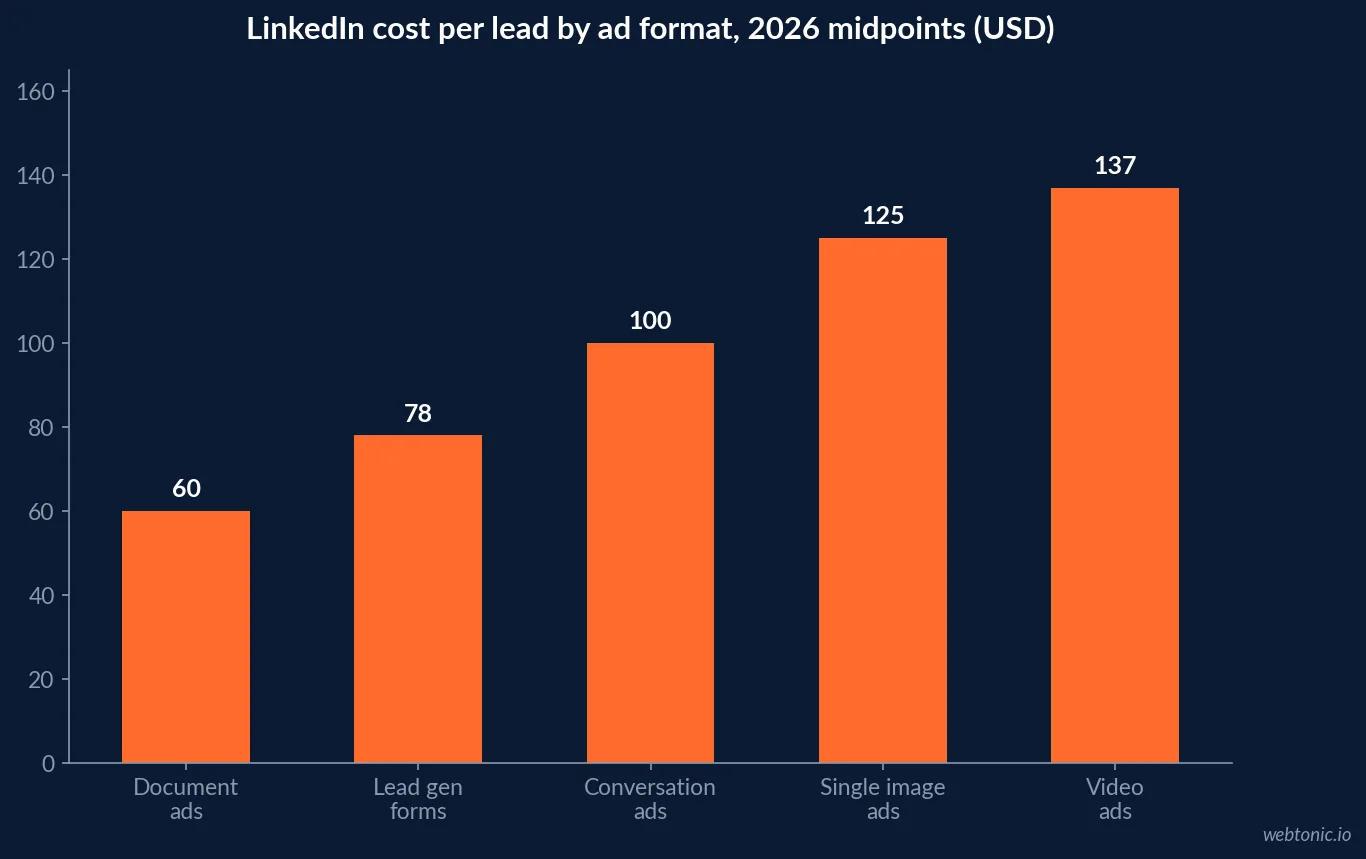
- Document ads deliver leads at $38 to $82; single-image lead gen at $100 to $150; video at $100 to $175.
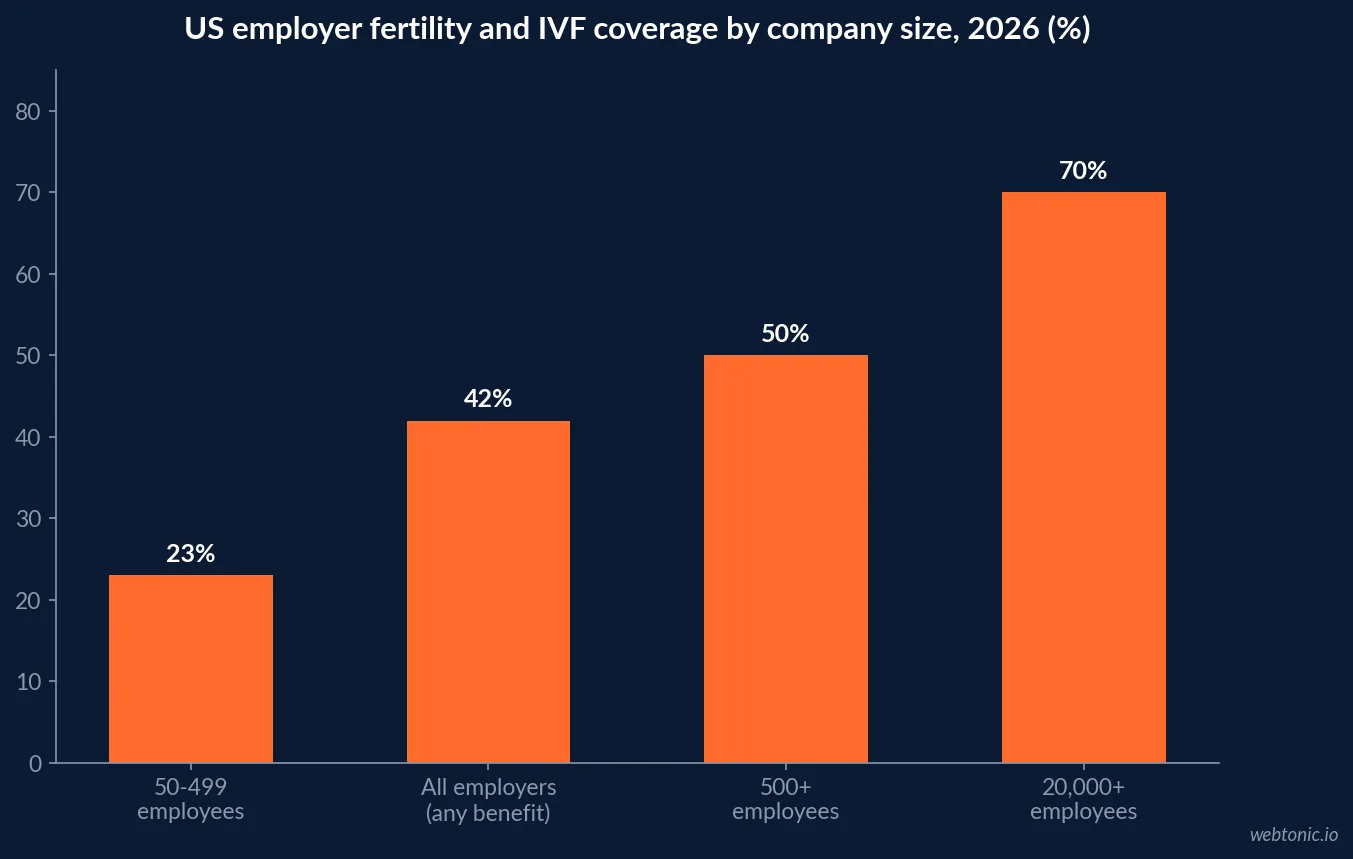
- About half of US employers with 500 or more workers now cover IVF, up from 27% in 2020 and 36% in 2021.
- Among employers with 20,000 or more workers, 70% cover IVF.
- Among smaller employers (50 to 499 employees), only 23% cover IVF.
- The median employer benefit cap is $25,000 lifetime or three cycles.
- 42% of employers surveyed by IFEBP offer some fertility benefit; 76% of those cover IVF.
- Progyny reported 595 fertility and family-building clients in Q1 2026, up from 532 a year earlier, covering an estimated 7.2 million lives.
- Progyny Q1 2026 fertility benefits revenue was $209.4 million of $328.5 million total.
- LGBTQ+ employees and single parents by choice are the fastest-growing driver of inclusive surrogacy and donor coverage.
- 70% of intended parents call inclusive infertility benefits very or extremely important to job satisfaction, against 15% of the general public.
- Employer infertility benefits average about $11,000 in coverage where offered.
- 60% of reproductive endocrinology patients arrive by physician referral.
- 21% of REI patients say the physician referral was the single most influential factor.
- An OB-GYN referral to an IVF clinic converts to consultation at 80% to 90%, 5 to 10 times typical paid-media rates.
- US surrogacy journeys cost $140,000 to $180,000, so a $100 lead is rational; a $100 surrogate applicant is not, at 2% to 3% qualification.
- The global surrogacy market reached $28.91 billion in 2026 at a 22.19% CAGR.
- Fertility paid search averages $9.84 CPC and $112 cost per action - the benchmark LinkedIn must beat on lead quality, not price.
Three audiences, and only three
Most surrogacy agencies test LinkedIn once, target nothing in particular, pay $9 a click and conclude the platform does not work. The platform works fine; the audience choice was wrong. There are exactly three defensible LinkedIn audiences in this category, and each has a different objective and a different acceptable cost per lead.
| Audience | Objective | Acceptable CPL | Why LinkedIn beats other channels |
|---|---|---|---|
| HR, benefits and total-rewards leaders | Get surrogacy reimbursement into the plan | $150-$400 | Job title and company size targeting exists nowhere else |
| Referring REI and OB-GYN physicians | Relationship, not a form fill | $200-$600 per engaged contact | Verified professional identity and specialty |
| Senior professionals in protective states | Consideration, not diagnosis targeting | $80-$200 | Seniority plus geography without health targeting |
| Prospective surrogates | Do not attempt here | Not viable | Demographic mismatch and 2%-3% qualification rate |
| General consumer intended parents | Better served by search | Not competitive | Search captures active intent at $9.84 CPC |
The fourth row is the one agencies get wrong. With cost per qualified surrogate already at $1,500 to $8,000 and cost per matched surrogate at $3,000 to $15,000, paying LinkedIn healthcare CPCs to reach a population that is largely not on LinkedIn is the most expensive possible way to fail. That volume belongs on the channels covered in our surrogacy social media benchmarks.
What LinkedIn actually costs in this category
Healthcare is one of the most expensive verticals on LinkedIn, and surrogacy sits inside it. 2026 LinkedIn benchmarks put healthcare and pharma at $6.00 to $10.50 CPC with 0.45% to 0.58% CTR and $80 to $120 CPL; other 2026 aggregations report healthcare CPCs as high as $12 to $22 once targeting narrows to senior benefits titles.
| Metric | Healthcare and pharma on LinkedIn | Fertility paid search | Read |
|---|---|---|---|
| Cost per click | $6.00-$10.50 (to $22 narrow) | $9.84 | Comparable price, colder audience |
| Click-through rate | 0.45%-0.58% | 5.28% | Interruption versus active intent |
| Cost per lead | $80-$120 | $120-$300 agency-side | LinkedIn can be cheaper per lead |
| Cost per action | Varies by offer | $112 | Only journey revenue justifies either |
| Landing page conversion | 2%-6% | 6.2% | Fertility pages convert well; use them |
| Lead Gen Form conversion | 10%-18% (median 13%) | Not applicable | Volume at the cost of qualification |
The format decision is a qualification decision
LinkedIn format economics are well documented, and the trap is obvious once you see the two numbers side by side: Lead Gen Forms convert at 10% to 18% but their leads qualify at only 25% to 40%, while landing-page leads convert at 2% to 6% and qualify at 40% to 55%. In a category where a lead is either a $160,000 journey or a complete waste of a case manager hour, qualification wins.
| Format | Typical cost per lead | Best use in surrogacy | Qualification risk |
|---|---|---|---|
| Document ad | $38-$82 | Benefits cost-and-coverage explainer for HR | Low - the download self-selects |
| Lead Gen Form | Under $78 | Physician-facing referral kit | High - pre-filled means low intent |
| Single image | $100-$150 | Credibility and outcome messaging | Medium |
| Conversation or message | $80-$120 | Referring physician outreach | Low but slow |
| Video | $100-$175 | Founder and clinical credibility | Medium |
| Thought leader ad | Varies | Named clinical or legal expert content | Low |
Send the high-value clicks to a purpose-built page rather than the homepage; the conversion difference is the whole argument in our surrogacy landing page statistics.
The employer benefits opportunity, quantified
This is the strongest reason for a surrogacy agency to be on LinkedIn at all. Employer coverage of family-building has moved from a perk to a norm in large organisations, and every plan that adds surrogacy reimbursement converts a fully self-funded decision into a partially funded one. Mercer benefits research tracks the climb.
| Employer segment or metric | IVF or fertility coverage | Source year | Marketing implication |
|---|---|---|---|
| 500+ employees | About 50% | 2026 | Half of the large-employer market is addressable |
| 500+ employees | 27% in 2020, 36% in 2021 | Trend | Adoption nearly doubled in five years |
| 20,000+ employees | 70% | 2026 | Enterprise HR is the highest-value target |
| 50-499 employees | 23% | 2026 | Mid-market is the open frontier |
| All IFEBP respondents | 42% offer some fertility benefit | 2026 survey | Coverage is mainstream |
| Of those offering | 76% cover IVF | 2026 survey | IVF first, surrogacy later |
| Median benefit cap | $25,000 lifetime or 3 cycles | 2026 | Caps leave a large funding gap |
| Average coverage where offered | About $11,000 | 2025 survey | Still a fraction of a $160,000 journey |
The demand signal is just as clear. 2026 employer-sponsored fertility benefit analysis identifies LGBTQ+ employees and single parents by choice as the fastest-growing source of demand for coverage that includes surrogacy and donor-assisted reproduction - exactly the categories traditional plans exclude - while SurrogateFirst survey data found 70% of intended parents rating inclusive infertility benefits very or extremely important to job satisfaction, against 15% of the general public. That gap is the entire pitch to a benefits leader.
Who is already selling into that budget
Agencies pitching employers are not entering an empty room. Fertility benefits managers are the incumbents, and their scale sets the vocabulary HR expects. Progyny Q1 2026 results show what a mature version of this channel looks like.
| Metric | Value | Period |
|---|---|---|
| Fertility and family-building clients | 595 | Q1 2026 |
| Clients a year earlier | 532 | Q1 2025 |
| Anticipated clients once all launches complete | About 600 | 2026 |
| Estimated covered lives | About 7.2 million | 2026 |
| Fertility benefits services revenue | $209.4 million | Q1 2026 |
| Total revenue | $328.5 million | Q1 2026 |
| Member utilisation | 0.48% | Q1 2026 |
The practical read for an agency: do not pitch HR on surrogacy. Pitch on being the in-network agency partner behind a benefit the employer has already decided to offer, and let the benefits manager keep the plan design. That is a partnership conversation LinkedIn is uniquely good at starting.
Physician referral is the highest-converting audience on the platform
The most underused LinkedIn play in reproductive health is not an ad at all - it is systematic outreach to the physicians who route patients. Survey work reported by Fertility Bridge found 60% of reproductive endocrinology patients arrive by physician referral and 21% name that referral the single most influential factor in choosing a provider.
| Referral metric | Benchmark | Comparison |
|---|---|---|
| REI patients arriving by physician referral | 60% | Larger than any paid channel |
| Patients naming referral most influential | 21% | Beats advertising recall |
| OB-GYN to IVF referral to consultation | 80%-90% | 5-10x paid rates |
| Primary care to aesthetic practice conversion | 60%-70% | Same mechanism, adjacent category |
| Ancillary-service patients who progress | About 30% | Referral relationships compound |
| Fertility clinic paid CPA for comparison | $112 | Referrals cost time, not media |
Targeting rules you cannot break
LinkedIn prohibits targeting or implying knowledge of sensitive personal characteristics, health status included. Surrogacy also sits inside a patchwork of state law, so geography is a compliance setting rather than an optimisation lever.
| Do not | Why | Do instead |
|---|---|---|
| Imply the viewer is infertile | Sensitive-characteristic policy violation | Speak to family-building planning generally |
| Target by inferred health condition | Prohibited targeting basis | Target seniority, function, industry, company size |
| Run surrogate recruitment creative | Audience mismatch and restricted-category exposure | Keep recruitment on consumer channels |
| Advertise into surrogacy-restrictive states | Contracts cannot be performed cleanly | Bound geography to protective jurisdictions |
| Lead with compensation figures | Reads as predatory and risks disapproval | Lead with process, protection and outcomes |
| Use Lead Gen Forms for high-value asks | 25%-40% qualification rate | Route serious intent to a real page |
Budget model for a first serious test
At $6.00 to $10.50 a click and 0.45% to 0.58% click-through, LinkedIn punishes small budgets and vague audiences. This is the minimum structure that produces a readable result inside one quarter.
| Phase | Monthly budget | Audience | Primary KPI | Decision point |
|---|---|---|---|---|
| Month 1 | $3,000-$5,000 | HR and total-rewards leaders, 500+ employee firms | Cost per document-ad lead | Under $120 to continue |
| Month 2 | $4,000-$6,000 | Add REI and OB-GYN specialties | Engaged physician conversations | Any warm referral relationship pays for the month |
| Month 3 | $5,000-$8,000 | Add senior professionals in protective states | Consultation-qualified leads | CPL under $200 with 40%+ qualification |
| Quarter close | Reallocate | Winner only | Cost per signed journey | Compare against $800-$3,000 blended target |
| Ongoing | 20%-30% of paid budget | Benefits plus referral | Share of journeys with employer funding | Track as a revenue line, not a lead line |
Measure it against the rest of the mix rather than in isolation - a benefits partnership that closes eight months later will never look good in a last-click report. Our data intelligence team builds the reporting that catches it, and the paid-search side of the same funnel is quantified in our surrogacy Google Ads statistics.
How this fits the wider surrogacy market
Context matters when justifying a $9 click. The global surrogacy market reached $28.91 billion in 2026 with a projected 22.19% CAGR through 2031, North America holds 45% of it, and gestational arrangements are now over 95% of the total, per 2026 surrogacy statistics. Against journey revenue of $120,000 to $200,000-plus and an intended-parent acquisition cost of $800 to $3,000 reported by intended-parent marketing benchmarks, LinkedIn is affordable. It is simply not a volume channel, and no amount of budget will make it one.
Frequently Asked Questions
Do LinkedIn Ads work for surrogacy agencies?
Not as a direct consumer acquisition channel, and not for surrogate recruitment. LinkedIn works for surrogacy agencies in three narrow B2B and B2B2C plays: reaching HR and total-rewards leaders who add family-building and surrogacy reimbursement to employer plans, reaching referring physicians such as reproductive endocrinologists and OB-GYNs, and reaching senior professionals in protective states who self-fund a $140,000 to $180,000 journey. Healthcare and pharma cost per click on LinkedIn runs about $6.00 to $10.50 with cost per lead of $80 to $120, which only works against journey revenue of $120,000 to $200,000-plus, never against a cost per qualified surrogate of $1,500 to $8,000.
How much do LinkedIn Ads cost in the fertility and surrogacy category in 2026?
Healthcare and pharma sits at the expensive end of LinkedIn: roughly $6.00 to $10.50 CPC, click-through rates of 0.45% to 0.58%, and cost per lead in the $80 to $120 range, with some 2026 datasets putting healthcare CPC as high as $12 to $22 for tightly targeted senior audiences. Lead Gen Forms convert at 10% to 18% against 2% to 6% for landing pages, but form leads qualify at only 25% to 40% versus 40% to 55% for landing-page leads, so the cheaper lead is not automatically the better one.
Can you target intended parents directly on LinkedIn?
Only indirectly and carefully. LinkedIn prohibits targeting or implying knowledge of sensitive personal characteristics including health conditions, so ad copy cannot address infertility status. What you can target is professional reality: seniority, company size, industry, function and geography inside surrogacy-protective jurisdictions. The workable creative angle is family-building benefits and financial planning, not a diagnosis. That constraint is why LinkedIn is a benefits-and-referral channel for this category rather than a demand capture channel.
Why is the employer benefits angle so important in surrogacy marketing?
Because employers increasingly pay part of the bill. Mercer reporting shows about half of US employers with 500 or more workers covering IVF, up from 27% in 2020 and 36% in 2021, with 70% coverage among employers with 20,000 or more workers, and a median lifetime maximum of $25,000 or three covered cycles. The International Foundation of Employee Benefit Plans found 42% of surveyed employers offering some fertility benefit, 76% of those covering IVF. Progyny alone reported 595 fertility and family-building clients in Q1 2026 covering an estimated 7.2 million lives. Every added plan converts a self-funded decision into a partially funded one.
What LinkedIn ad formats perform best for this category?
Document and single-image ads for benefits decision-makers, where a cost-and-coverage explainer earns the lead at roughly $38 to $82 per document-ad lead versus $100 to $150 for general single-image lead gen. Conversation and message-style formats work for physician referral outreach, where a warm relationship rather than a form is the objective. Video should support credibility, not compensation claims. Avoid any format that requires the viewer to self-identify as infertile in order to respond.
Sources
Foundry CRO - LinkedIn Ads Benchmarks by Industry 2026
42 Agency - B2B LinkedIn Ads Benchmarks 2026
Mercer - Family-Friendly Benefits Take Off
Mercer - Fertility Treatment Benefit Options
IFEBP - Family-Building Benefits, A Ten-Year Look
Taylor Benefits - Employer-Sponsored Fertility Benefits 2026
Progyny - Q1 2026 Results
SurrogateFirst - Infertility Benefits in the Job Market
Fertility Bridge - Referring Provider System
Medical Referral Engineering - IVF Referral Conversion
ACRC Global - Surrogacy Statistics 2026
Tandem - Intended Parent Marketing Benchmarks