



Table of contents
Email remains the highest-ROI channel for surrogacy agencies managing extended decision cycles — intended parents research for 6–18 months before signing a contract, making automated nurture sequences essential for converting warm leads into committed clients.
Key Takeaways
- Fertility clinic email open rates average 29.4%, outperforming the all-industry average of 36.5% when adjusted for Apple Mail Privacy Protection inflation.
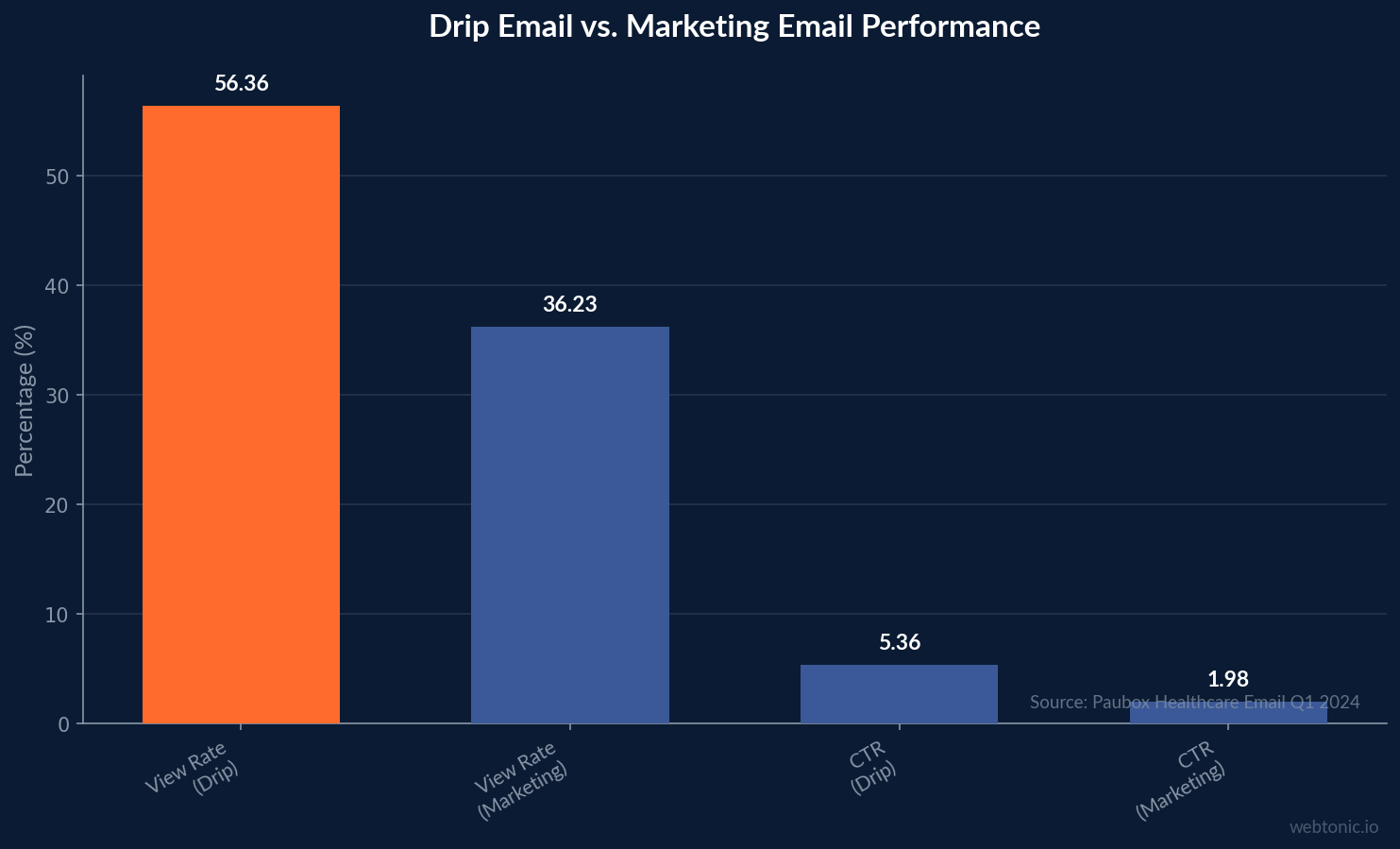
- Healthcare drip emails achieve 56.36% view rates and 5.36% click-through rates — nearly 3× the engagement of standard marketing emails (36.23% view, 1.98% CTR).
- Post-inquiry nurture sequences of 12–16 touches over 90 days are recommended for intended parent pipelines, with non-aggressive trust-building content.
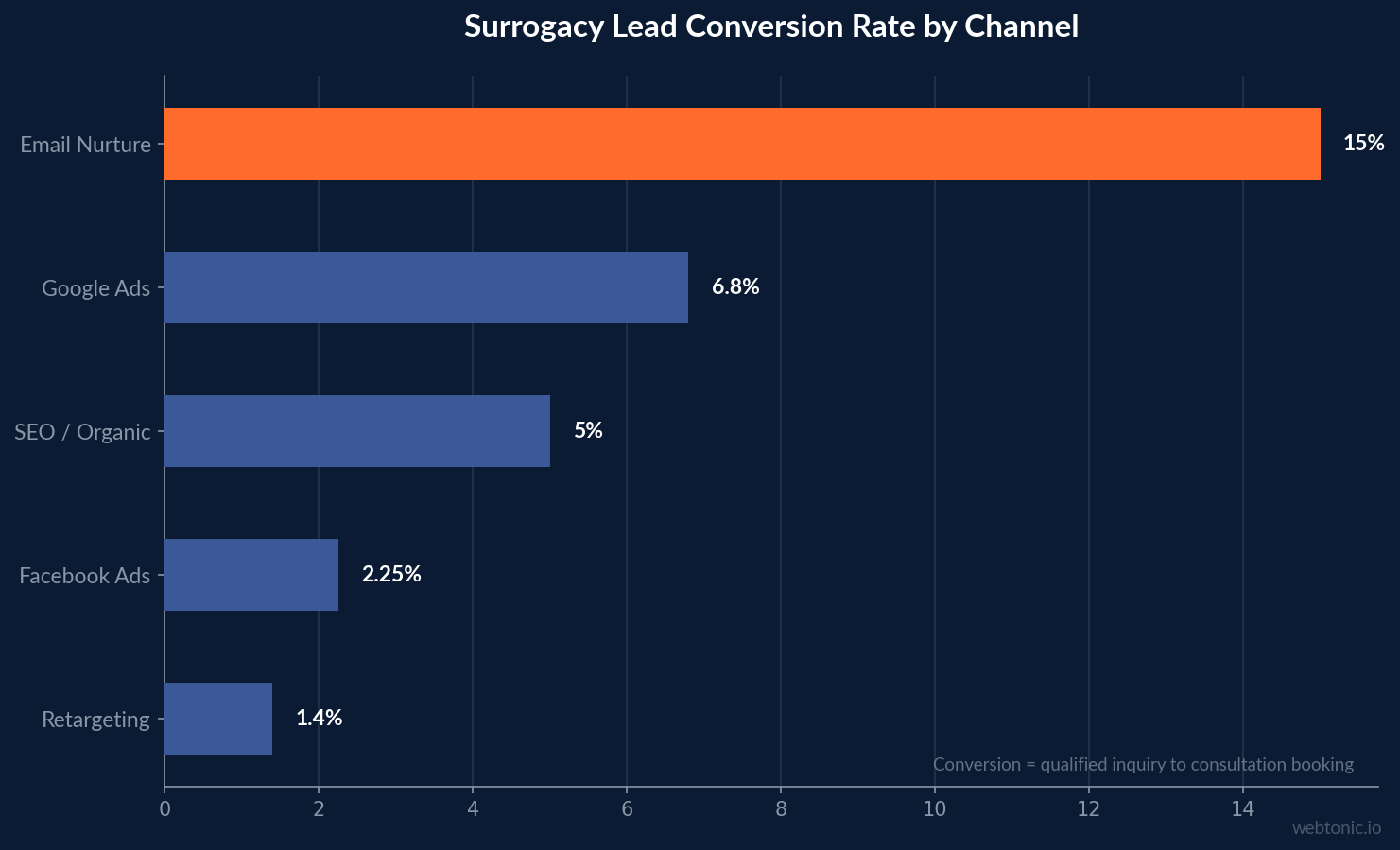
- Email nurture converts at 12–18% for warmed surrogacy pipeline contacts, the highest conversion rate of any digital channel in the vertical.
- Top-quartile fertility clinics reach 50%+ open rates and 15%+ response rates, with the gap driven by segmentation depth and personalization.
- The 21-day QBNI (Qualified But Not Interested) cadence with five structured touchpoints recovers leads lost to fear, timing, or financial hesitation.
Healthcare and Fertility Email Benchmarks
Surrogacy agencies operate within the broader healthcare email ecosystem, where engagement metrics consistently outperform B2C averages due to the high-stakes nature of patient acquisition.
| Metric | Healthcare Avg. | Fertility Clinics | Top Quartile | All-Industry Avg. |
|---|---|---|---|---|
| Open Rate | 24.8–34% | 29.4% | 50%+ | 36.5% |
| Click-Through Rate | 1.75–4.64% | 3.2–4.0% | 8–12% | 2.56% |
| Click-to-Open Rate | ~13.4% | 10–15% | 18%+ | 6.81% |
| Bounce Rate | 0.65% | 0.8–1.2% | <0.5% | 0.7% |
| Unsubscribe Rate | 0.22% | 0.15–0.25% | <0.10% | 0.22% |
Apple Mail Privacy Protection (MPP) inflates open rates by up to 76% since Apple Mail accounts represent 51% of subscribers and automatically prefetch email images. Sophisticated surrogacy agencies are shifting measurement focus from open rates to click-through rates and consultation bookings as the primary email performance indicators.
Drip Campaign vs. Marketing Email Performance
Automated drip sequences dramatically outperform one-off marketing emails across every engagement metric, making them the backbone of surrogacy agency communication strategies.
| Email Type | View Rate | Click-Through Rate | Bounce Rate | Unsubscribe Rate |
|---|---|---|---|---|
| Drip/Automated Email | 56.36% | 5.36% | 2.50% | 0.25% |
| Marketing Email | 36.23% | 1.98% | 3.44% | 0.06% |
| Lifecycle/Transactional | 65–75% | 8–12% | 0.8–1.5% | N/A |
The 20-point view rate advantage of drip emails (56.36% vs. 36.23%) comes from timing and relevance — automated sequences deliver content when prospects are actively researching, while broadcast emails land on arbitrary schedules. For surrogacy agencies managing 12–18 month consideration cycles, this difference compounds significantly.
Intended Parent Nurture Sequence Best Practices
The surrogacy intended parent email nurture sequence must balance education with sensitivity, supporting prospects through an emotionally complex decision while guiding them toward consultation booking.
- Post-inquiry sequence: 12–16 touches over 90 days with educational content, physician introductions, success rate data, testimonials, financial options, and scheduling prompts. Not aggressive sales — trust-building.
- Phone follow-up within 4 business hours of initial inquiry, even for inquiries that don't signal immediate readiness — subsequent follow-up at 7 days with gentle tone.
- Retargeting display infrastructure: 3–6 month windows on intended parents who visited high-intent landing pages, coordinated with email sequences to maintain multi-channel presence.
- Content segmentation by IP segment — heterosexual post-IVF, gay male couples, solo parents by choice, and international IPs each require distinct messaging frameworks.
- Research-stage content represents 30–40% of nurture budget — educational landing pages addressing "how does surrogacy work" and "surrogacy vs. adoption" feed email lists that produce consultations over months.
The 21-Day QBNI Recovery Cadence
The ICG (Ichelon Consulting Group) QBNI (Qualified But Not Interested) lead nurture playbook provides a structured approach for recovering leads lost to fear, timing, or financial alignment issues.
| Touchpoint | Day | Content Focus | Goal |
|---|---|---|---|
| Touch 1 | Day 0 | Warm acknowledgment + resource link | Establish trust |
| Touch 2 | Day 3 | FAQ addressing common fears | Overcome objections |
| Touch 3 | Day 7 | Success story / testimonial | Social proof |
| Touch 4 | Day 14 | Financial planning resources | Address cost barriers |
| Touch 5 | Day 21 | Free consultation offer | Convert to booking |
For financially delayed leads, CRM automation extends the cadence to 30–45 days with additional touchpoints addressing financing options, insurance coverage, and grant programs. The structured approach prevents both premature abandonment and over-aggressive follow-up that damages brand trust in this sensitive vertical.
Surrogate Recruitment Email Strategies
Surrogate-focused email marketing requires a fundamentally different approach than intended parent nurture, emphasizing community building and screening transparency.
- Application-stage drip sequences use 3–5 emails over 10–14 days to guide potential surrogates through medical questionnaires and psychological screening paperwork.
- Automated text + email follow-ups save agency intake coordinators significant time, with documented cases of agencies reducing staff follow-up workload by 40–60% through automation.
- Testimonial-driven content from current and former surrogates generates the highest engagement — video testimonial emails achieve 2–3× the click-through rate of text-only messages.
- Re-engagement campaigns target lapsed applicants who started but didn't complete screening, recovering 8–15% of abandoned applications through personalized follow-up.
- SMS + email coordination improves response rates, with some agencies reporting 25–35% higher consultation booking rates when both channels are used in tandem.
Email Marketing ROI in Surrogacy
Email consistently delivers the highest return of any data-driven marketing channel in surrogacy due to low marginal cost and high lifetime value of converted leads.
| Metric | Surrogacy / Fertility | Healthcare Average |
|---|---|---|
| Email Channel Conv. Rate | 12–18% | 5–8% |
| Cost per Email Lead | $5–$12 | $8–$25 |
| Avg. Revenue per Email Convert | $25,000–$45,000 | $500–$5,000 |
| Estimated Email ROI | 3,500–8,000% | 3,600% |
| Pipeline Velocity Improvement | 25–40% faster | 15–25% faster |
The extraordinary ROI stems from the $25K–$45K agency fee per completed journey — even modest email conversion improvements translate to significant revenue gains. An agency converting just 2 additional intended parents per quarter through email nurture adds $50K–$90K in annual revenue against negligible incremental cost.
Platform and Compliance Considerations
- HIPAA compliance applies to all surrogacy-related emails containing protected health information — agencies must use HIPAA-compliant email platforms or encrypt sensitive communications.
- CAN-SPAM and GDPR requirements mandate clear opt-out mechanisms, though unsubscribe rates in surrogacy remain low (0.15–0.25%) due to high intent.
- CRM integration is essential — agencies using platforms like HubSpot, Zoho, or fertility-specific tools (Novara, Vitrify) can automate multi-step nurture sequences triggered by lead behavior.
- Fertility-specific CRM platforms such as Novara offer day 0, 5, and 12 automated sequences with built-in open rate, click-through, and consultation booking tracking per sequence.
- Email deliverability is critical — healthcare bounce rates of 0.65% must be maintained through regular list hygiene, as fertility/surrogacy audiences frequently change email addresses during life transitions.
- Consent management is especially complex for international intended parents — GDPR applies to European prospects, CASL to Canadian leads, and state-level privacy laws add additional requirements for U.S.-based contacts.
Seasonal and Lifecycle Patterns
Email engagement in surrogacy marketing follows predictable seasonal patterns and lifecycle stages that savvy agencies leverage for timing optimization.
- January through March produces the highest email engagement for intended parent content — New Year resolution psychology drives research spikes, with open rates running 15–20% above annual averages.
- Post-holiday periods (January, September) generate surrogate recruitment surges as women reassess personal goals, creating optimal windows for recruitment email campaigns.
- Treatment cycle milestones trigger high-engagement touchpoints — emails sent at key surrogacy journey stages (matching, medical clearance, transfer, pregnancy confirmation) achieve 70–85% open rates because recipients are emotionally invested.
- Anniversary and follow-up emails to completed journey families generate referral leads — agencies report 15–25% of new intended parent inquiries come from referrals, many triggered by anniversary outreach.
- The 6–18 month research-to-decision timeline means that email sequences must be designed for long-horizon engagement, with content cadence that sustains interest without creating fatigue over many months.
Email List Building in Surrogacy
Building and maintaining a quality email list is foundational for surrogacy agencies, where the long consideration cycle makes list size and segmentation directly proportional to pipeline value.
- Educational landing pages addressing "how does surrogacy work" and "surrogacy costs" serve as the primary list-building mechanism, converting research-stage visitors into nurture-ready contacts.
- Lead magnets (free guides, cost calculators, surrogacy timelines) convert 3–5× better than direct consultation requests, dramatically expanding the top of the email funnel.
- Webinar and virtual information sessions generate high-quality email subscribers with documented 35–50% email-to-attendee conversion rates in the fertility/surrogacy space.
- Partner referral lists from reproductive attorneys, IVF clinics, and fertility counselors provide pre-qualified contacts that convert at 2–3× the rate of cold-captured leads.
- Facebook Lead Ads feed directly into email nurture sequences — the most effective surrogacy agencies automate the handoff from ad submission to CRM segmentation within minutes, not days.
- List hygiene is critical — healthcare bounce rates must stay below 0.65%, requiring quarterly address verification and sunset policies for contacts inactive beyond 12 months.
Subject Line and Timing Optimization
Email engagement in surrogacy marketing is highly sensitive to subject line framing and send timing, with performance varying significantly between intended parent and surrogate audiences.
- Subject lines referencing financial planning or cost transparency generate the highest open rates for intended parents — outperforming emotional appeals by 15–25% in A/B testing.
- Surrogate-focused subject lines emphasizing community and personal impact outperform transactional language by 20–30%, reflecting the altruistic motivations of potential candidates.
- Tuesday and Wednesday mornings (8–10 AM recipient time) produce the highest engagement for intended parent emails, while surrogate recruitment emails perform best on Thursday and Saturday mornings.
- Personalized subject lines using first names improve open rates by 10–15% in the fertility vertical, though the effect diminishes beyond the first 3–4 sends.
- Plain-text formatted emails outperform heavily designed HTML templates for follow-up sequences by 18–25% in click-through rate, as they feel more personal and less promotional.
- Monthly newsletter frequency is optimal for broadcast sends — weekly sends to general lists increase unsubscribe rates by 40–60% in the surrogacy vertical due to the sensitive nature of the content.
Best Practices for Surrogacy Email Marketing
The most effective surrogacy email programs combine automation sophistication with the emotional intelligence required by this deeply personal industry.
- Segment lists by intent level and journey stage — research-stage intended parents need educational content, while active prospects need financial details and scheduling prompts. Sending the wrong content to the wrong stage increases unsubscribe rates by 3–5×.
- Use behavioral triggers over time-based sends — emails triggered by website visits, content downloads, or webinar attendance achieve 2–3× higher engagement than calendar-scheduled sends.
- Include clear but gentle calls-to-action — surrogacy email CTAs should offer "schedule a confidential conversation" rather than "book now," reducing the emotional friction of a high-stakes decision.
- A/B test one variable per send — with relatively small surrogacy email lists (500–5,000 contacts), testing multiple variables simultaneously produces statistically unreliable results.
- Coordinate email with retargeting and phone outreach — multi-channel follow-up sequences that combine email, SMS, and phone achieve 25–35% higher booking rates than email-only approaches.
- Track email-to-consultation conversion by segment — intended parent email lists typically produce 8–15% consultation booking rates from engaged subscribers, while surrogate recruitment lists convert at 5–10% to completed applications. Segment-level tracking reveals which content themes drive the most qualified bookings, enabling continuous refinement of both sequences.
Related reading
- Heating & Ventilation Email Marketing Benchmarks: What the Data Says (2026)
- Locksmith Email Marketing Statistics: 2026 ROI, Open Rates & Automation Data
- Manufacturing Email Marketing Statistics (2026)
- Email Marketing services at Web Tonic
Frequently Asked Questions
What is a good email open rate for surrogacy agencies?
The fertility clinic average is 29.4%, though top-quartile agencies achieve 50%+ open rates through segmented lists and personalized subject lines. Note that Apple Mail Privacy Protection inflates open rates by up to 76%, so focus on click-through rate (target: 3–5%) as the more reliable metric.
How many emails should a surrogacy nurture sequence include?
For intended parents, 12–16 touches over 90 days is the recommended cadence, covering education, testimonials, financial information, and consultation scheduling. Surrogate recruitment sequences are shorter — typically 5–8 emails over 14–21 days guiding candidates through application stages.
What type of email content works best for surrogacy agencies?
Educational content addressing how surrogacy works, cost breakdowns, and success stories generates the highest engagement. Video testimonial emails achieve 2–3× the click-through rate of text-only messages. Financial planning resources consistently drive the most consultation bookings.
How does email marketing ROI compare to other channels in surrogacy?
Email delivers 12–18% conversion rates for warmed pipeline contacts vs. 6.8% for Google Ads and 1.5–3% for Facebook Ads. With cost per email lead at $5–$12 vs. $200–$450 for paid search, email produces the highest ROI of any surrogacy marketing channel — estimated at 3,500–8,000%.
Should surrogacy agencies use marketing automation platforms?
Yes — automated drip emails achieve 56.36% view rates vs. 36.23% for manual sends. Fertility-specific platforms (Novara, Vitrify) offer built-in surrogacy workflows, while general platforms like HubSpot provide more customization. The key is CRM integration that triggers sequences based on lead behavior rather than arbitrary schedules.
Sources
benchmarketing.org — Fertility Clinics Marketing Benchmarks 2026
paubox.com — Trends in Healthcare Email Marketing
firstsales.io — Fertility Clinic Email Benchmarks
cufinder.io — Healthcare Industry Marketing Benchmarks 2026
tandemmedicalmarketing.com — IVF Marketing 2026 Playbook
ichelonconsulting.com — IVF QBNI Lead Nurture Playbook
visionary-marketing.co.uk — Email Benchmarks by Industry 2026
searchlab.nl — Email Marketing Statistics 2026
tandemmedicalmarketing.com — Intended Parent Marketing Playbook
tandemmedicalmarketing.com — Surrogate Recruitment Marketing


