Table of contents

A surrogacy agency has to be trusted twice: by intended parents spending $140,000 to $180,000, and by prospective surrogates committing 18 to 24 months. It has to do it while Google restricts the category, Meta suspends accounts and TikTok bans the ads outright. That is why brand is the acquisition engine here, not the wrapper around one.
Key Takeaways
- The global surrogacy market reached $28.91 billion in 2026, with a projected 22.19% CAGR through 2031.
- More than 210,000 surrogacy cycles were completed in 2025.
- North America holds 45% of the global market, and the US accounts for about 40% of all gestational arrangements worldwide.
- Gestational surrogacy is now over 95% of all arrangements globally.
- US journeys average $140,000 to $180,000, with California often exceeding $200,000.
- Agency fees run $25,000 to $50,000; surrogate base compensation runs $60,000 to $110,000-plus.
- First-time surrogates in 2026 see base compensation of $45,000 to $60,000, with premium markets at $65,000 to $75,000.
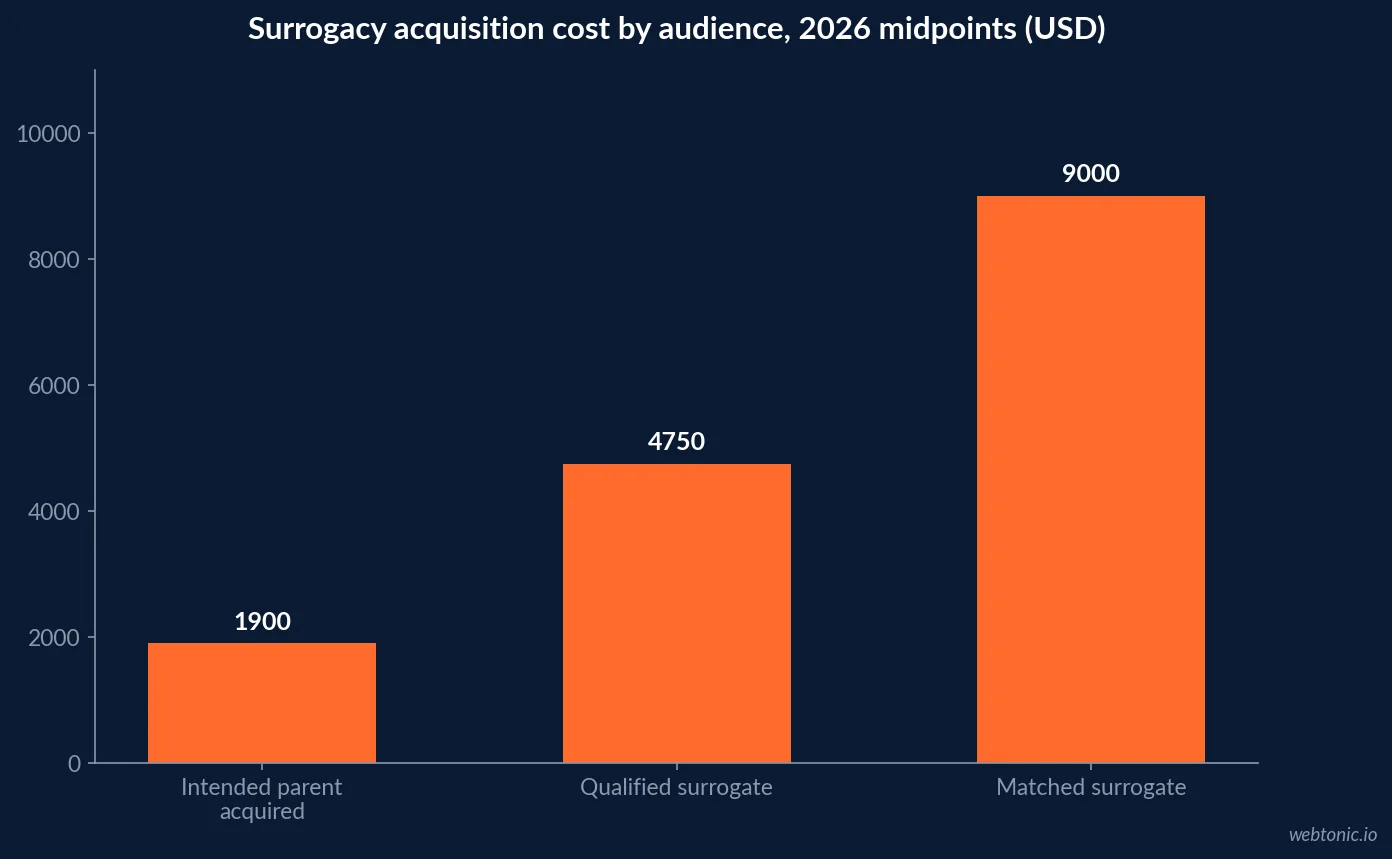
- Intended-parent acquisition cost runs $800 to $3,000 per client.
- Cost per qualified surrogate runs $1,500 to $8,000; cost per matched surrogate $3,000 to $15,000.
- Only 2% to 3% of surrogate inquiries pass full medical, psychological and legal screening.
- Eligibility filters remove 95%-plus of women in any market before screening begins.
- Hitting a matching target requires roughly a 30 to 50 times pipeline ratio.
- Intended-parent decision cycles run 3 to 12 months; surrogate cycles 2 to 6 months.
- TikTok largely prohibits surrogacy advertising; Google requires healthcare-restricted certification; Meta restricts recruitment messaging.
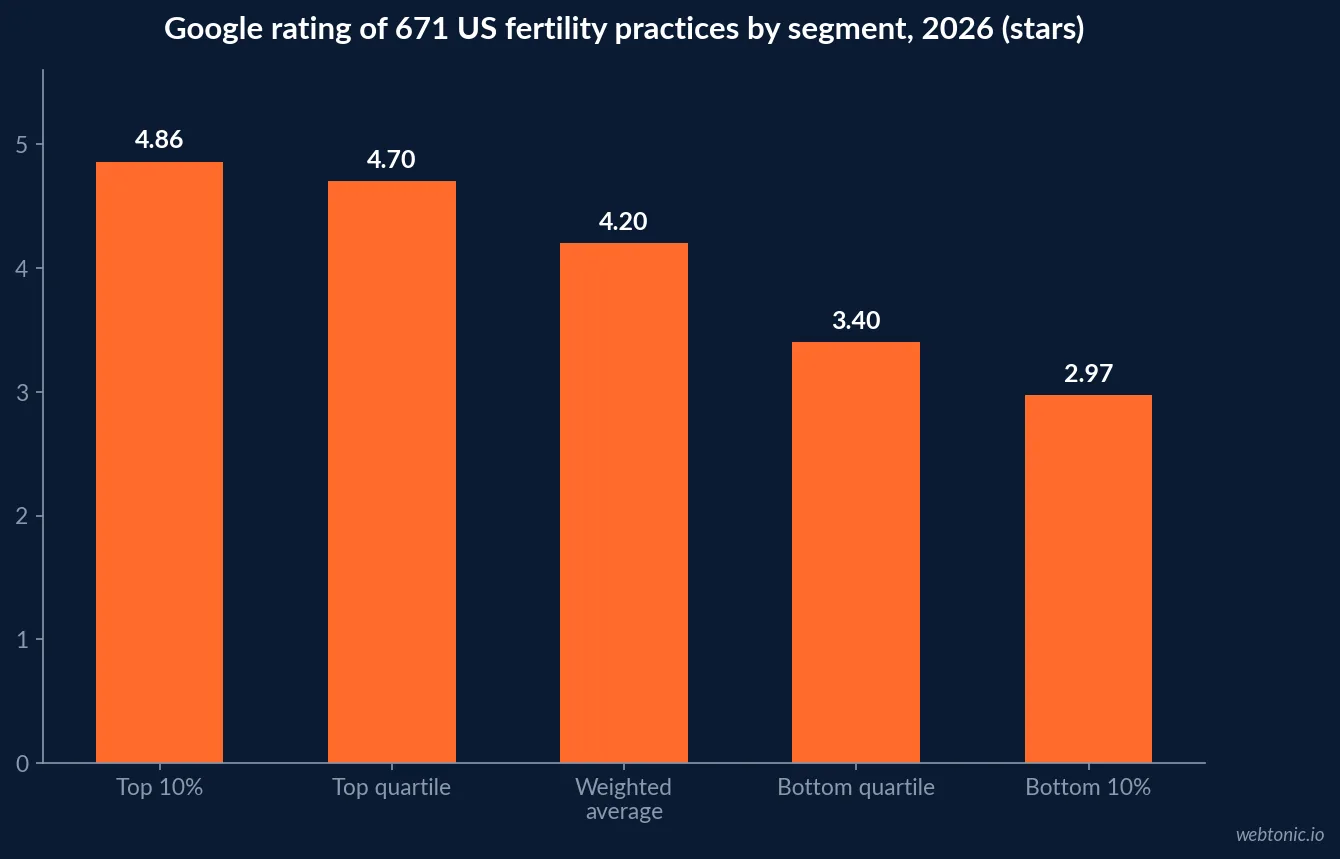
- A 2026 analysis of 671 US fertility practices and 63,513 reviews found a weighted average of 4.20 stars.
- 35.6% of fertility practices sit below 4.0 stars; the top 10% average 4.86 and the bottom quartile 3.40.
- 33.5% of all reviews are concentrated in the top 10% of practices, and 43 practices had five or fewer reviews.
- About 89% of patients check reviews when researching a provider, and 51% read at least six.
- Fertility paid search averages $9.84 CPC, 5.28% CTR and $112 cost per action, with landing pages converting at 6.2%.
- Fertility cost per lead runs $120 to $300, and $200 to $450 in tier-one metros.
- 88% of agency-supported surrogates cited the desire to help a family as very important, against 53% of independents.
The dual-audience problem in numbers
Every branding decision an agency makes is constrained by one structural fact: it runs two acquisition programmes with different economics, different language and different compliance exposure. Surrogacy agency marketing benchmarks put hard numbers on the split.
| Dimension | Intended parents | Prospective surrogates | Brand implication |
|---|---|---|---|
| Acquisition cost | $800-$3,000 per client | $3,000-$15,000 per matched surrogate | Recruitment brand deserves the larger budget |
| Revenue or value | $120,000-$200,000+ per journey | The constraint on all revenue | Neither audience is secondary |
| Qualification rate | Most inquiries are viable | 2%-3% pass full screening | Self-qualification content is a brand asset |
| Decision cycle | 3-12 months | 2-6 months | Brand presence across the whole cycle, not the click |
| Primary question | Can I trust you with this? | Will you protect me for 18-24 months? | Two message architectures, one brand |
| Channel availability | Restricted search and social | More restricted still | Organic and referral carry the volume |
Why restricted advertising makes brand load-bearing
In most service categories a weak brand can be compensated for with budget. Surrogacy is one of the most restricted ad categories on every major platform, so that escape route is partly closed. Google Ads places it under healthcare-restricted policies requiring certification, Meta requires certified accounts and restricts compensation-led recruitment copy, and TikTok largely prohibits the category. State law adds a second filter, since compensated gestational surrogacy is explicitly protected in some states and restricted or unclear in others.
| Channel | 2026 status for surrogacy | Practical consequence |
|---|---|---|
| Google Search | Healthcare-restricted, certification required | Workhorse channel, but copy is constrained |
| Meta | Certification plus restricted-category protocols | Highest recruitment volume, real suspension risk |
| TikTok | Largely prohibited | Organic-only presence |
| Display | Allowed but low intent | Mostly waste |
| Organic search and content | Unrestricted | Where brand compounding happens |
| Referral and community | Unrestricted, state-law bounded | Highest-quality surrogate flow |
The result is an unusual media mix: paid channels are a rationed supplement, and the brand assets - substantive content, reputation, founder credibility, referral programmes - carry the volume. Our surrogacy Google Ads benchmarks cover what the paid side costs when it is available.
Reputation is the measurable part of the brand
The most concrete 2026 dataset in reproductive health is the review benchmark: 671 US fertility and IVF practices and 63,513 patient reviews analysed by Q-Reviews and reported by Inside Reproductive Health. It shows a market where reputation performance is bimodal, not uniformly good.
| Reputation segment | Average Google rating | Share or count | What it means |
|---|---|---|---|
| Top 10% of practices | 4.86 | 33.5% of all reviews | Review velocity compounds visibility |
| Top quartile | 4.70 | - | The competitive standard to beat |
| Weighted industry average | 4.20 | 671 practices | The floor is higher than most owners assume |
| Bottom quartile | 3.40 | - | Below the filter patients apply |
| Bottom 10% | 2.97 | - | Effectively excluded from consideration |
| Below 4.0 stars | - | 35.6% of practices | A third of the market fails the first screen |
| Five or fewer reviews | - | 43 practices | Invisible rather than badly rated |
Patient behaviour research adds the demand side: roughly 89% of patients check reviews when researching a provider and 51% read at least six before booking, per 2026 patient review research. For an agency, that means review volume is not vanity - six recent, specific reviews are the minimum viable trust asset.
Trust signals ranked by what they cost to build
Not all trust assets are equally expensive, and the cheap ones are usually the ones agencies skip. This is the practical order for a brand programme.
| Trust signal | Cost to build | Time to effect | Effect on which audience |
|---|---|---|---|
| Sustained Google review velocity | Low | 3-6 months | Both |
| Published match-timeline and outcome data | Low | Immediate | Intended parents |
| Transparent all-in cost breakdown | Low | Immediate | Intended parents |
| Eligibility self-qualification content | Low | 1-3 months | Surrogates |
| Named founder and clinical leadership | Medium | 3-12 months | Both |
| Former-surrogate testimonial library | Medium | 6-12 months | Surrogates |
| Structured referral programme | Medium | 6-18 months | Both |
| Third-party accreditation and licensure display | Varies | Immediate once held | Both |
Cost transparency as a brand position
Surrogacy pricing is confusing by nature, and the confusion is a brand opportunity. Published breakdowns from 2026 cost analyses and industry statistics converge on similar ranges, yet most agency websites still gate the number behind a consultation.
| Cost component | 2026 range | Share of a $160,000 journey |
|---|---|---|
| Surrogate base compensation | $60,000-$110,000+ | About 45% |
| Agency and matching fees | $25,000-$50,000 | About 22% |
| IVF and embryo creation | $20,000-$50,000 | About 20% |
| Legal representation (both sides) | $8,000-$18,000 | About 8% |
| Escrow and insurance | $12,000-$25,000 | About 10% |
| Monthly allowance and expenses | $200-$500 per month | Variable |
An agency that publishes this table with its own numbers wins the comparison stage before a call happens. The same logic applies to the surrogate side: compensation transparency data shows first-timers earning $45,000 to $60,000 base, rising to $65,000 to $75,000 in premium markets. Vague "generous compensation" language reads as evasion to a candidate who has already read the numbers elsewhere.
Brand economics against the paid benchmarks
Reproductive-health paid media is efficient by healthcare standards - fertility clinic benchmarks report $9.84 CPC, 5.28% CTR, $112 cost per action, 1.72% Meta CTR and 2.8x Meta ROAS, with landing pages at 6.2%. Agency-side cost per lead is higher, at $120 to $300 and $200 to $450 in tier-one metros. Brand work is what moves those numbers without adding budget.
| Brand investment | Mechanism | Measured effect |
|---|---|---|
| Review volume and rating | Higher click-through and call rate from the same impressions | Below-4.0 practices fail a filter 35.6% of the market falls into |
| Published pricing | Pre-qualifies and shortens the cycle | Fewer consultations per signed client |
| Eligibility content | Self-screening before inquiry | Improves the 2%-3% inquiry-to-qualified rate |
| Former-surrogate referrals | Lowest-cost recruitment channel | Avoids $3,000-$15,000 per match |
| Founder and outcome credibility | Reduces perceived risk on a $160,000 decision | Higher close rate |
| Consistent visual and verbal identity | Recognition across a 3-12 month cycle | More return visits |
Design execution still matters at the point of contact - see our surrogacy landing page benchmarks - and the social side of the brand is covered in our surrogacy social media data.
What a surrogacy brand should never do
Category-specific failure modes, all of them common and all of them avoidable.
| Do not | Why it fails | Do instead |
|---|---|---|
| Lead recruitment ads with compensation figures | Triggers restricted-category disapproval and reads as predatory | Invite candidates to learn about the process |
| Use one message for both audiences | Different criteria and cycle lengths | Two architectures, one identity |
| Use stock imagery of babies and families | Indistinguishable from every competitor | Consented, real journey photography |
| Hide total cost | Buyers compare four to six agencies | Publish an itemised range |
| Advertise into surrogacy-restrictive states | Contracts cannot be performed cleanly | Bound targeting to protective jurisdictions |
| Let screening pace lag the marketing | Qualified candidates cool off during delays | Match brand promises to operational capacity |
A 90-day brand programme for an agency
Sequenced so the cheapest compounding assets start first, because review velocity and content indexation both take months to mature.
| Days | Focus | Deliverables | Metric to watch |
|---|---|---|---|
| 1-15 | Reputation baseline | Rating audit against the 4.20 average, review request workflow | New reviews per month |
| 16-40 | Transparency assets | Itemised cost page, match-timeline data, outcome reporting | Consultations per signed client |
| 41-60 | Surrogate self-qualification | Eligibility, screening and timeline content | Inquiry-to-qualified rate |
| 61-75 | Credibility layer | Founder and clinical bios, licensure display, testimonial capture | Branded search volume |
| 76-90 | Referral engine | Compliant former-surrogate and former-parent referral programme | Share of matches from referral |
Run the creative production behind it as a system rather than a one-off refresh; that is what our performance creative team is built for.
Frequently Asked Questions
Why does branding matter more for surrogacy agencies than for other healthcare services?
Because the paid channels are restricted and the purchase is enormous. Google Ads places surrogacy under healthcare-restricted categories requiring certification, Meta restricts surrogate-recruitment messaging and routinely suspends accounts, and TikTok largely prohibits surrogacy advertising altogether. At the same time intended parents commit $140,000 to $180,000 nationally and surrogates commit 18 to 24 months of their lives. When you cannot buy your way to volume, the brand - reputation, founder credibility, transparent reporting and authentic testimonials - is the acquisition engine rather than a decoration on top of one.
What does it cost to acquire an intended parent versus a surrogate in 2026?
Intended parent acquisition typically runs $800 to $3,000 per signed client, tolerable against $120,000 to $200,000-plus of journey revenue. Surrogate acquisition is harder: $1,500 to $8,000 per qualified candidate and $3,000 to $15,000 per matched, contract-ready surrogate, because only 2% to 3% of inquiries pass full medical, psychological and legal screening. Agencies need roughly a 30 to 50 times pipeline ratio to hit a matching target, which is why brand-driven referral flow is worth so much more here than in adjacent specialties.
How much do online reviews affect surrogacy and fertility brand performance?
Substantially. A 2026 analysis of 671 US fertility and IVF practices covering 63,513 reviews found a weighted average rating of 4.20 stars, with 35.6% of practices sitting below the 4.0-star threshold patients use as a filter. The top 10% averaged 4.86 stars while the bottom quartile averaged 3.40, and 33.5% of all reviews were concentrated in the top 10% of practices. Separately, about 89% of patients check reviews when researching a new provider and 51% read at least six before booking.
Should a surrogacy agency use one brand for both audiences or two?
One brand, two distinct message architectures. Intended parents and prospective surrogates evaluate completely different things - success rates, cost transparency and case management versus eligibility, compensation, screening pace and legal protection - and their decision cycles differ (3 to 12 months against 2 to 6 months). Splitting into two unrelated brands destroys the referral and reputation compounding that makes the whole model work, but running one undifferentiated message for both audiences underperforms on both sides.
What brand assets produce the most measurable return for a surrogacy agency?
In order: sustained review velocity on Google, published outcome and match-timeline data, named founder and clinical leadership credibility, and authentic testimonial content from both former intended parents and former surrogates. Referral flow from former surrogates is the highest-quality and lowest-cost recruitment channel there is, and it exists only where the brand experience was genuinely good - 88% of agency-supported surrogates cited the desire to help a family as very important, against 53% of independents.
Sources
Tandem - Marketing for Surrogacy Agencies
Tandem - Surrogate Recruitment Marketing Playbook
ACRC Global - Surrogacy Statistics 2026
Inside Reproductive Health - Fertility Center Google Ratings
RepuGen - Patient Review Behaviour Study
Benchmarketing - Fertility Clinic Marketing Benchmarks
Egg Donor and Surrogacy Institute - 2026 Cost Breakdown
SurroScore - Surrogate Compensation 2026
SurrogateFirst - Agency vs Independent Survey
WifiTalents - Gestational Surrogacy Statistics