Table of contents

Key Takeaways
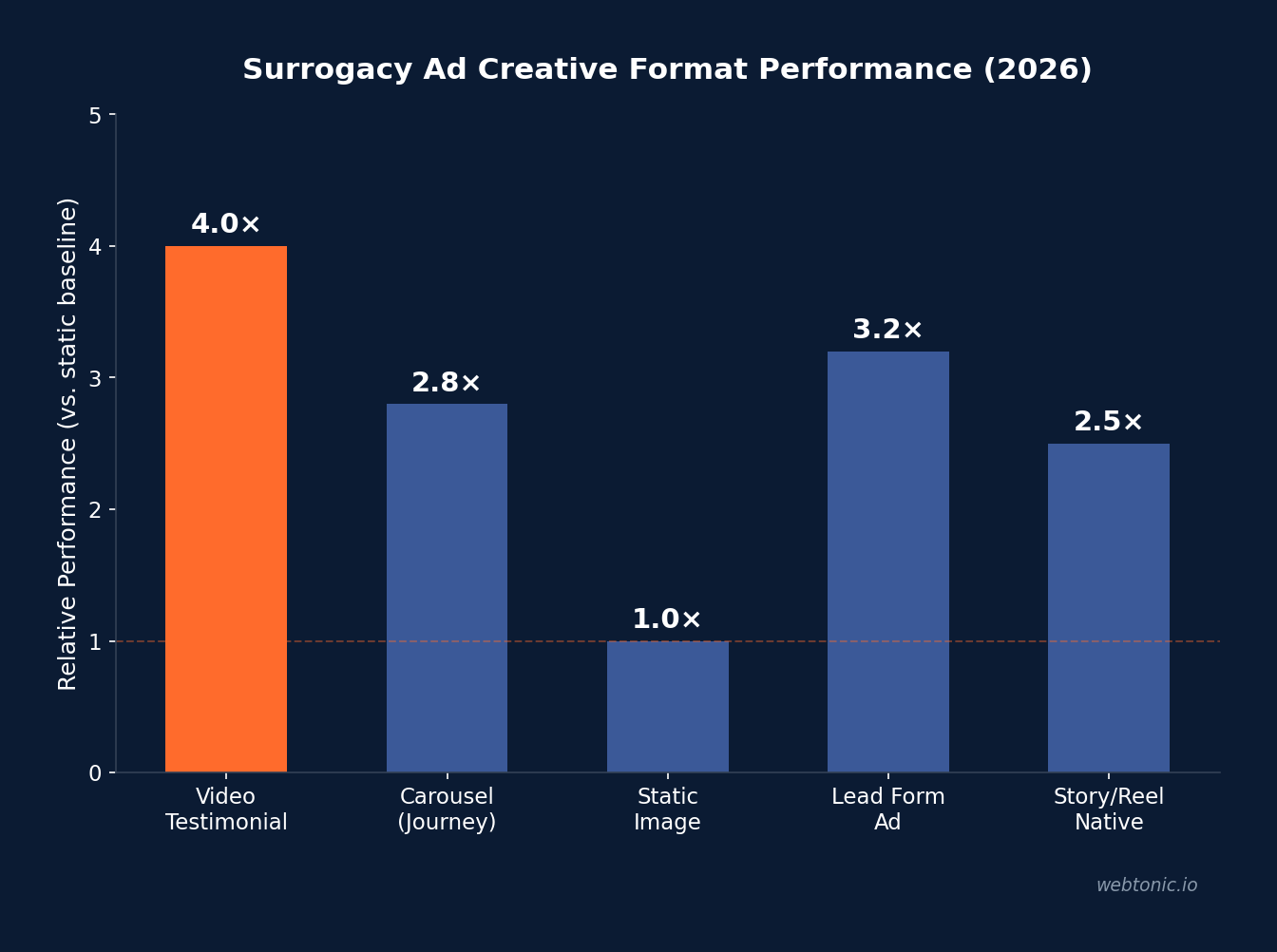
- Video creative outperforms static imagery by 2–4× in surrogacy advertising, with surrogate journey testimonials generating the strongest engagement (Tandem Medical Marketing).
- Surrogacy agencies spend $17,500–$44,500 per month on marketing at the early stage, scaling to $115,000–$285,000+ for mature programs (Tandem Medical Marketing).
- Facebook Lead Ads produced 2,637 leads at $6.75 each for one surrogacy agency, with 324 surrogate applications at $56 per application (LinkedSelling / ISC Case Study).
- The global surrogacy market is valued at $28.91 billion in 2026, projected to reach $78.68 billion by 2031 at a 22.19% CAGR (Mordor Intelligence).
- Fertility clinic Google Ads CPC averages $9.84, with CPA at $112 — but surrogacy-specific keywords command a premium due to compliance restrictions (Benchmarketing).
- Google and Meta both classify surrogacy as a restricted advertising category, requiring compliance-specific creative and geographic targeting (Tandem Medical Marketing).
- Cost per matched surrogate (contract-ready) ranges from $3,000 to $15,000+, reflecting a 30–50× inquiry-to-match pipeline ratio (Tandem Medical Marketing).
Surrogacy Ad Creative Benchmarks at a Glance
| Metric | Value | Source |
|---|---|---|
| Video vs. static performance | 2–4× higher engagement | Tandem Medical Marketing |
| Facebook CPL (surrogacy) | $6.75 per lead | LinkedSelling / ISC |
| Cost per surrogate application | $56 per application | LinkedSelling / ISC |
| Cost per matched surrogate | $3,000–$15,000+ | Tandem Medical Marketing |
| Google Ads CPC (fertility) | $9.84 | Benchmarketing 2026 |
| Google Ads CPA (fertility) | $112 | Benchmarketing 2026 |
| Monthly marketing budget (early) | $17,500–$44,500 | Tandem Medical Marketing |
| Monthly marketing budget (mature) | $115,000–$285,000+ | Tandem Medical Marketing |
| Surrogacy market value (2026) | $28.91 billion | Mordor Intelligence |
| Market CAGR (2026–2031) | 22.19% | Mordor Intelligence |
Video Dominates Surrogacy Ad Creative Performance
In surrogacy advertising, video creative outperforms static imagery by 2–4× across engagement, click-through, and lead quality metrics. Tandem Medical Marketing's analysis identifies two video formats that consistently lead: matched family stories for intended parents and surrogate journey testimonials for recruitment campaigns.
The emotional complexity of surrogacy — involving multiple parties, months-long timelines, and deeply personal decisions — makes narrative-driven video the natural creative format. Static images can introduce a program, but video builds the trust required for a decision that involves $140,000–$180,000 in costs and a 12–18 month commitment.
One case study illustrates the scale of opportunity: International Surrogacy Center generated 2,637 leads at $6.75 each through Facebook Lead Ads over 8 months, converting to 324 surrogate applications ($56 each) and 40 contract-ready surrogates. The campaign used a structured 4-step advertising funnel with carousel and video creative formats optimized per audience segment.
Compliance Constraints Shape Surrogacy Creative Strategy
Both Google and Meta classify surrogacy advertising under restricted categories. The practical implications for creative teams are significant:
- Google requires specific approval for surrogacy ads, with ongoing scrutiny that can produce immediate account suspensions affecting all campaigns — not just the flagged ad.
- Meta places surrogacy under restricted commercial products policies, prohibiting financial-vulnerability targeting and requiring careful ad copy that avoids triggering automated review flags.
- Geographic restrictions apply: commercial surrogacy is illegal in multiple countries (UK, France, Germany, Italy, Spain), and ads targeting those regions from US-based agencies must comply with local law — not just platform policy.
- Washington DC and several US states have enacted specific statutes affecting surrogacy advertising language and disclosure requirements.
These restrictions mean surrogacy agencies cannot simply scale spend — they must invest in compliance-specific creative variations and performance creative workflows that clear platform review while maintaining conversion effectiveness.
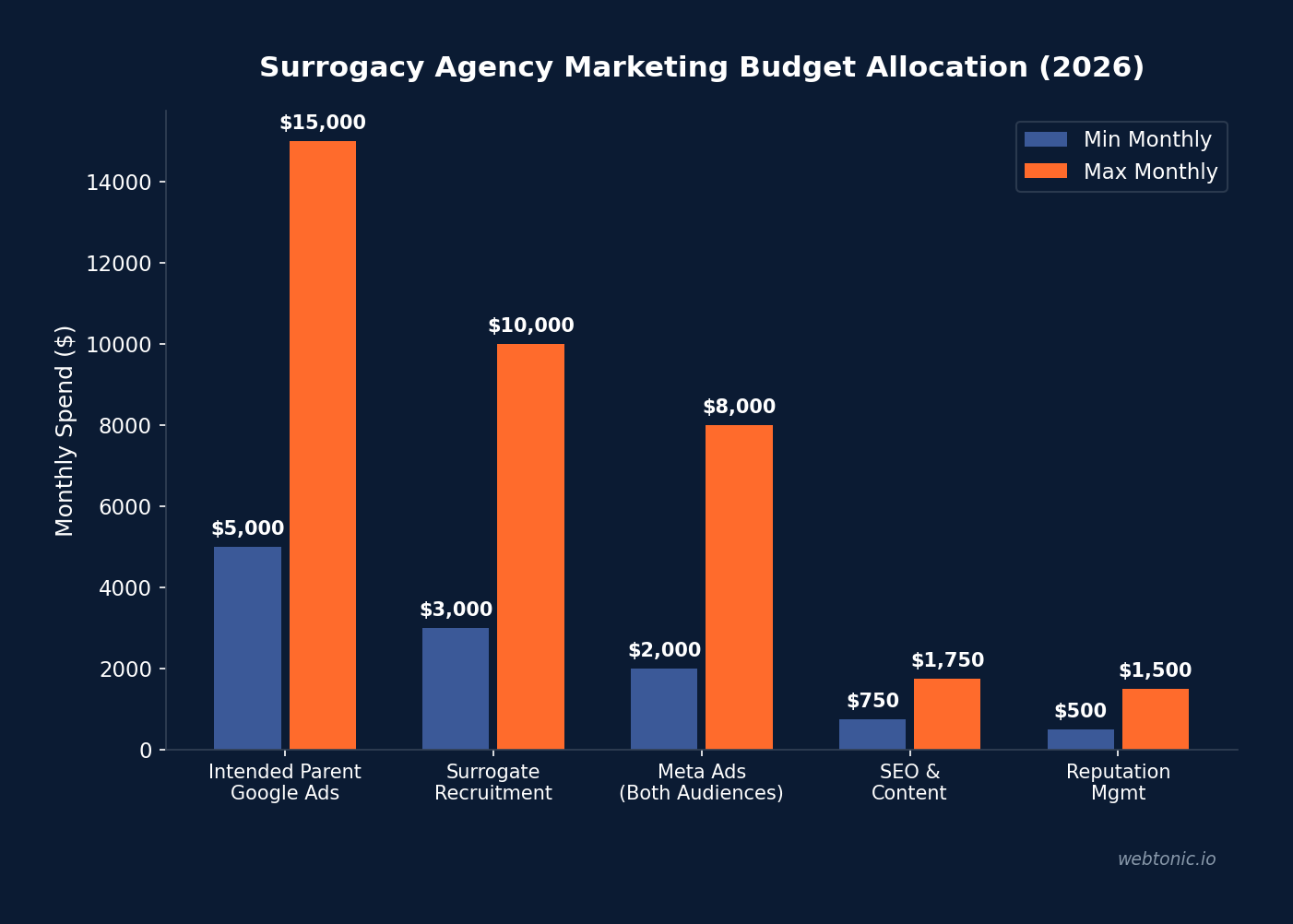
Surrogacy Marketing Investment by Agency Stage
| Budget Category | Early Stage | Growth Stage | Mature Program |
|---|---|---|---|
| Intended parent Google Ads | $5K–$15K/mo | $15K–$40K/mo | $40K–$100K/mo |
| Surrogate recruitment | $3K–$10K/mo | $10K–$25K/mo | $25K–$60K/mo |
| Meta Ads (both audiences) | $2K–$8K/mo | $8K–$20K/mo | $20K–$50K/mo |
| SEO & content | $750–$1,750/mo | $1,750–$4K/mo | $4K–$10K/mo |
| Reputation management | $500–$1.5K/mo | $1K–$3K/mo | $2K–$5K/mo |
| Strategy & management | $2K–$4K/mo | $4K–$8K/mo | $7K–$15K/mo |
| Total monthly range | $17.5K–$44.5K | $43.5K–$118K | $115K–$285K+ |
Source: Tandem Medical Marketing's 2026 surrogacy marketing benchmarks. Note that intended parent campaigns and surrogate recruitment run as parallel campaigns with separate budgets — they target fundamentally different audiences with different creative, messaging, and conversion goals.
Creative Format Deep Dive: What Works and Why
Surrogacy ad creative must serve two distinct audiences simultaneously — intended parents exploring family-building options and potential surrogates considering the journey. Each requires a fundamentally different creative approach:
- Intended parent creative: Focus on outcome (family completion), agency trust signals, success rates, and process transparency. Five distinct segments dominate demand — each requiring its own channel mix, creative, and landing page architecture.
- Surrogate recruitment creative: Focus on the personal experience, compensation transparency, support systems, and community. Authentic former surrogate testimonials consistently outperform polished agency messaging.
- LGBTQ+ family-building creative: Requires specific representation and messaging — this segment has a $120,000–$200,000 per-journey value and responds to creative that normalizes the surrogacy path rather than positions it as an alternative.
The key insight from the data is that surrogacy creative cannot be generalized. Agencies running a single creative set across all audiences leave significant performance on the table. With proper Meta Ads strategy, each audience segment should have its own creative pipeline.
Platform-Specific Creative Restrictions and Workarounds
Each advertising platform imposes unique constraints on surrogacy creative that directly affect campaign architecture and performance:
- Google Ads: Requires specific approval for surrogacy-related campaigns. Ad copy cannot include financial incentive language ("get paid to be a surrogate") or make medical outcome claims. Violations trigger account-wide suspensions, not just ad-level disapprovals — making compliance-first creative development essential (Tandem Medical Marketing).
- Meta (Facebook/Instagram): Surrogacy falls under restricted commercial products. Targeting restrictions prohibit financial-vulnerability-based audience building. Creative must avoid implying transactional surrogacy in markets where it's illegal. However, Meta remains the highest-performing awareness channel for surrogacy, making compliant creative development a competitive advantage.
- TikTok: Emerging channel for surrogate recruitment through organic content marketing. Surrogacy agencies using TikTok content marketing reach younger potential surrogates (ages 21–35) where traditional advertising underperforms. Authentic, unpolished content outperforms produced creative on this platform.
The compliance landscape means surrogacy agencies typically need 3–5 creative variations per ad to maintain platform approval while testing performance — a higher creative production requirement than most healthcare verticals. Integrating performance creative workflows with compliance review is the operational challenge that separates high-performing agencies.
International Intended Parent Creative Considerations
International intended parents represent a growing and high-value segment for US surrogacy agencies. Marketing US surrogacy internationally requires creative that addresses fundamentally different concerns: legal certainty, cost transparency in their home currency, and process logistics for families navigating cross-border surrogacy.
Key creative considerations for international campaigns include:
- Multilingual ad creative for target markets — particularly Mandarin, Arabic, French, and Spanish for the largest international demand segments.
- Cost comparison creative that positions US surrogacy ($140,000–$180,000) against alternatives in other jurisdictions, emphasizing legal protections and success rates.
- Process-focused creative that addresses "how does this work from [country]?" — the primary question international intended parents search.
- Geographic targeting precision that respects local surrogacy laws while reaching intended parents in countries where domestic options are limited or illegal.
For LGBTQ+ international intended parents, per-journey values reach $120,000–$200,000, and creative must normalize the surrogacy path within specific cultural contexts — a nuance that generic agency creative consistently misses. Agencies investing in segment-specific Meta Ads for these audiences see significantly higher engagement and lower CPL than one-size-fits-all campaigns.
Creative Testing and Performance Measurement
Effective surrogacy ad creative testing requires a fundamentally different cadence than typical direct-to-consumer advertising. Because conversion windows span 3–6 months for intended parents, creative performance cannot be evaluated on standard 7-day or 14-day optimization windows. Agencies need at minimum a 30-day testing period to accumulate statistically meaningful results.
The testing methodology that works best for surrogacy follows a structured hierarchy:
- Audience segment testing first: Confirm which of the five intended parent segments (domestic couples, LGBTQ+ families, single parents by choice, international IPs, second-journey IPs) responds to which channels before optimizing creative.
- Format testing second: Video versus carousel versus static within each winning segment. The data consistently shows video testimonials leading at 4× static baseline, but carousel journey stories (2.8×) outperform video for process-oriented segments who want control and information.
- Message testing third: Within the winning format, test emotional angles (family completion, journey support, community) versus rational angles (success rates, cost transparency, legal security).
- Landing page testing fourth: Match creative messaging to landing page experience — misalignment between ad promise and landing page content is the single largest conversion killer in surrogacy advertising.
The cost of poor creative testing in surrogacy is exceptionally high. With CPAs reaching $4,000 per intended parent, every percentage point of conversion improvement translates to thousands of dollars in efficiency. Smart testing methodology, combined with well-structured ad spend, is what separates agencies that scale profitably from those that burn budget on underperforming creative.
The Surrogacy Market Driving Ad Creative Demand
The explosive growth of the surrogacy market creates both opportunity and competition for advertising creative. Mordor Intelligence values the global surrogacy market at $28.91 billion in 2026, projecting $78.68 billion by 2031 at a 22.19% CAGR. Other research firms cite even higher figures — other research firms estimate $31.95 billion in 2025 with a 24.14% CAGR.
This market growth translates directly to increased advertising competition and cost pressure. As more agencies enter the space, patient acquisition costs rise: intended parent CPL can reach $500, and CPA up to $4,000 — justified by per-journey revenue of $25,000–$80,000+ in agency fees.
Success rates for PGT-tested embryos reach 70–80%, and average total costs span $140,000–$180,000 in the US — numbers that shape how creative must position the value proposition for intended parents weighing their options.
The EDSI 2026 Surrogacy Trends Report highlights that surrogate compensation, surrogacy-specific insurance, and IVF medical fees are the three largest cost drivers — a breakdown that savvy creative teams use to structure value-proposition messaging. Agency and legal fees have remained stable in absolute terms but declined as a share of total cost, creating an opportunity for agencies to emphasize their value through creative that focuses on process support and outcome certainty rather than fee justification.
AI search engines are also reshaping how intended parents discover agencies. The Arcalea Surrogacy Agency AEO Index evaluates 15 leading agencies across SERP and AI Engine Optimization readiness — agencies that invest in structured content and authoritative creative assets gain visibility in AI-generated surrogacy answers, a channel that bypasses traditional ad platforms entirely.
Related reading
- How Medical Spa & Aesthetics Businesses Use Ad Creative in 2026: Stats & Insights
- Mold Removal Ad Creative Statistics (2026): Benchmarks & Trends
- Mortgage Ad Creative Statistics (2026)
- Branding services at Web Tonic
FAQ
What type of ad creative works best for surrogacy agencies?
Video testimonials outperform all other formats by 2–4×. Matched family stories for intended parents and surrogate journey testimonials for recruitment generate the highest engagement and lead quality. Carousel ads showing the surrogacy journey timeline also perform well, at roughly 2.8× static baseline performance.
How much do surrogacy agencies spend on advertising?
Total monthly marketing budgets range from $17,500–$44,500 for early-stage agencies to $115,000–$285,000+ for mature programs. Intended parent Google Ads ($5K–$15K/mo) and Meta Ads ($2K–$8K/mo) represent the largest channel investments, with surrogate recruitment running as a parallel budget.
Why is surrogacy advertising restricted on Google and Meta?
Both platforms classify surrogacy under restricted or sensitive categories due to the ethical, legal, and financial complexity of the service. Commercial surrogacy is illegal in multiple countries, and platforms enforce geographic restrictions, specific approval requirements, and restrictions on vulnerability-targeting to manage regulatory risk.
What is the cost per lead for surrogacy advertising?
Facebook Lead Ads have achieved CPLs as low as $6.75 for initial inquiries, but the more meaningful metric is cost per matched surrogate: $3,000–$15,000+. The 30–50× inquiry-to-match pipeline ratio means most leads require extensive screening before becoming actionable.
How does the surrogacy market size affect advertising strategy?
With the market valued at $28.91 billion and growing at 22.19% CAGR, competition for leads is intensifying annually. Agencies that invest in differentiated creative — especially video and compliance-specific variations — gain a meaningful advantage over competitors running generic static ads in an increasingly crowded market.
Sources
Tandem Medical Marketing — Marketing for Surrogacy Agencies
Tandem Medical Marketing — Surrogacy Marketing Budgets
Tandem Medical Marketing — Surrogacy Advertising Compliance
LinkedSelling — International Surrogacy Center Case Study
Mordor Intelligence — Surrogacy Market Report 2026
Benchmarketing — Fertility Clinics Marketing Benchmarks 2026
Tandem Medical Marketing — Patient Acquisition Cost Benchmarks
ACRC Global — Surrogacy Statistics 2026
Tandem Medical Marketing — LGBTQ+ Family Building Marketing