Table of contents
Whitespark's 2026 Local Search Ranking Factors survey weights Google Business Profile signals at roughly 32% and review signals at 16-20% of the local-ranking formula for home-service categories like solar. That matters more now because SEIA reports the second-largest national installer went bankrupt and the federal 30% purchase tax credit expired for systems installed after December 31, 2025 - a smaller, more price-sensitive buyer pool with fewer installers left standing.
Key Takeaways
- 87% of "solar installer near me" searches surface a Google map pack first.
- The top map-pack position takes 47.2% of clicks; position two takes 24.8%, position three 16.4%.
- Local search drives 60-70% of solar leads overall.
- Google Business Profile calls convert at 40-60% versus 2-8% for a site visitor.
- Whitespark's 2026 panel weights GBP signals around 32% and review signals 16-20% of local ranking.
- Cross-industry: 47% of consumers won't hire below 20 reviews; 31% require 4.5+ stars (BrightLocal 2026).
- 74% only trust reviews from the last three months (BrightLocal 2026).
- The US passed 6 million cumulative solar installations in Q1 2026 (SEIA).
- New Q2 2026 capacity alone can power 50 million homes (SEIA).
- SEIA's Q2 2026 report names the bankruptcy of the #2 national installer among the drivers of an "overall market contraction."
- The 30% federal residential solar purchase credit expired for systems installed after December 31, 2025 (OBBBA, via EnergySage).
- Trustpilot removed 4.5 million fake reviews in 2024, 7% of everything posted, 90% caught automatically.
- Yelp filtered roughly half a million suspected AI-generated reviews in 2025 and flagged review-extortion scams targeting businesses.
- The FTC's 16 CFR Part 465 rule (final August 2024) makes buying or faking reviews a civil-penalty offense.
The click gap the review count creates
Local-search tracking of the residential solar category finds 87% of "solar installer near me" style searches return a Google map pack, and inside that map pack the top position takes 47.2% of clicks, the second 24.8%, the third 16.4% - a steep drop-off that makes ranking position, not just review count, the real prize. Review volume is one of the inputs that decides which installer holds that top spot, alongside the Google Business Profile itself: Whitespark's panel weights GBP signals at roughly 32% of the local-ranking formula versus 16-20% for review signals.
| Local-search metric (solar category) | Figure | What it means |
|---|---|---|
| Searches that surface a map pack | 87% | Ranking position beats a standalone site for most buyers |
| Click share, map-pack position 1 | 47.2% | Losing the top three spots loses most of the clicks |
| Click share, map-pack position 2 | 24.8% | Still meaningful, but under half of position 1 |
| Click share, map-pack position 3 | 16.4% | The last position most buyers will scroll to |
| Local search's share of solar leads overall | 60-70% | The channel a review profile has to win |
A shrinking installer market raises the cost of picking wrong
SEIA's Q2 2026 Solar Market Insight Report, produced with Wood Mackenzie, cites the bankruptcy of the second-largest national installer among the factors behind an expected overall residential market contraction. That follows the expiration of the federal 30% purchase tax credit for systems installed after December 31, 2025 under the One Big Beautiful Bill Act, which EnergySage's own marketplace reporting says triggered a "historic shift" toward leases and power-purchase agreements as buyers lost the direct-ownership incentive.
None of that changes what a home buyer needs from a 20-plus-year piece of roof equipment: a contractor who will still answer the phone in year 12. A thin, unresponsive review profile is a weaker signal of that in a shrinking field than it was in a crowded one, because there are fewer competitors left to absorb an installer's failure.
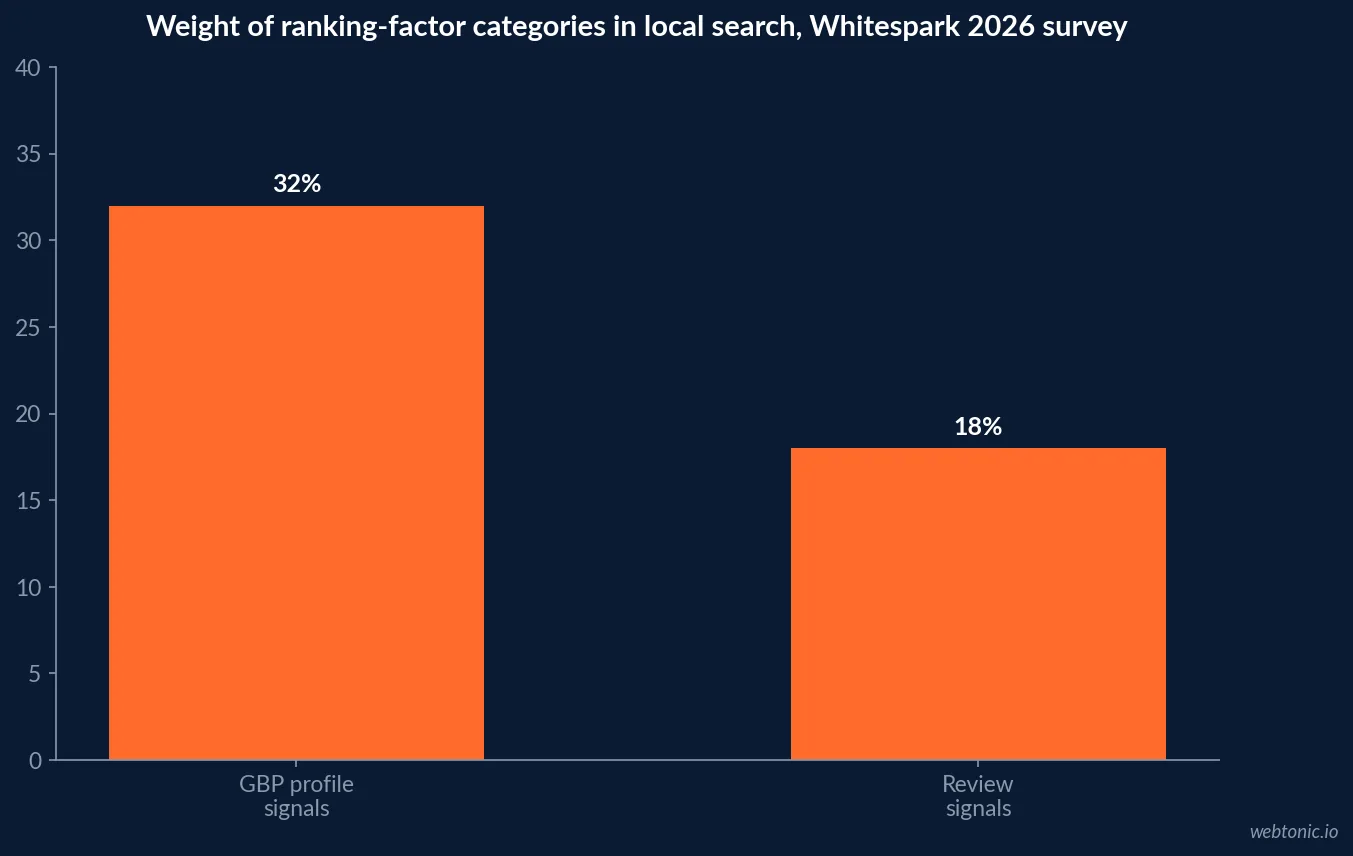
| US residential solar scale (SEIA, 2026) | Figure |
|---|---|
| Cumulative US solar installations | 6 million (surpassed Q1 2026) |
| Homes powered by new capacity added, single quarter | 50 million |
| Time from 5 million to 6 million installations | ~2 years |
| Federal 30% purchase credit | Expired for installs after Dec 31, 2025 |
| Named market event, Q2 2026 | Bankruptcy of the #2 national installer |
The consumer thresholds a solar quote has to clear
BrightLocal's 2026 Local Consumer Review Survey is a cross-industry benchmark - it was not fielded on solar buyers specifically - but the thresholds it measures are the same ones a homeowner brings into any large home-improvement decision. 47% won't use a business with fewer than 20 reviews, 31% require 4.5 stars or higher, and 74% only trust reviews written in the last three months. An installer sitting on 40 reviews from three years ago is closer to failing all three tests than passing any of them.
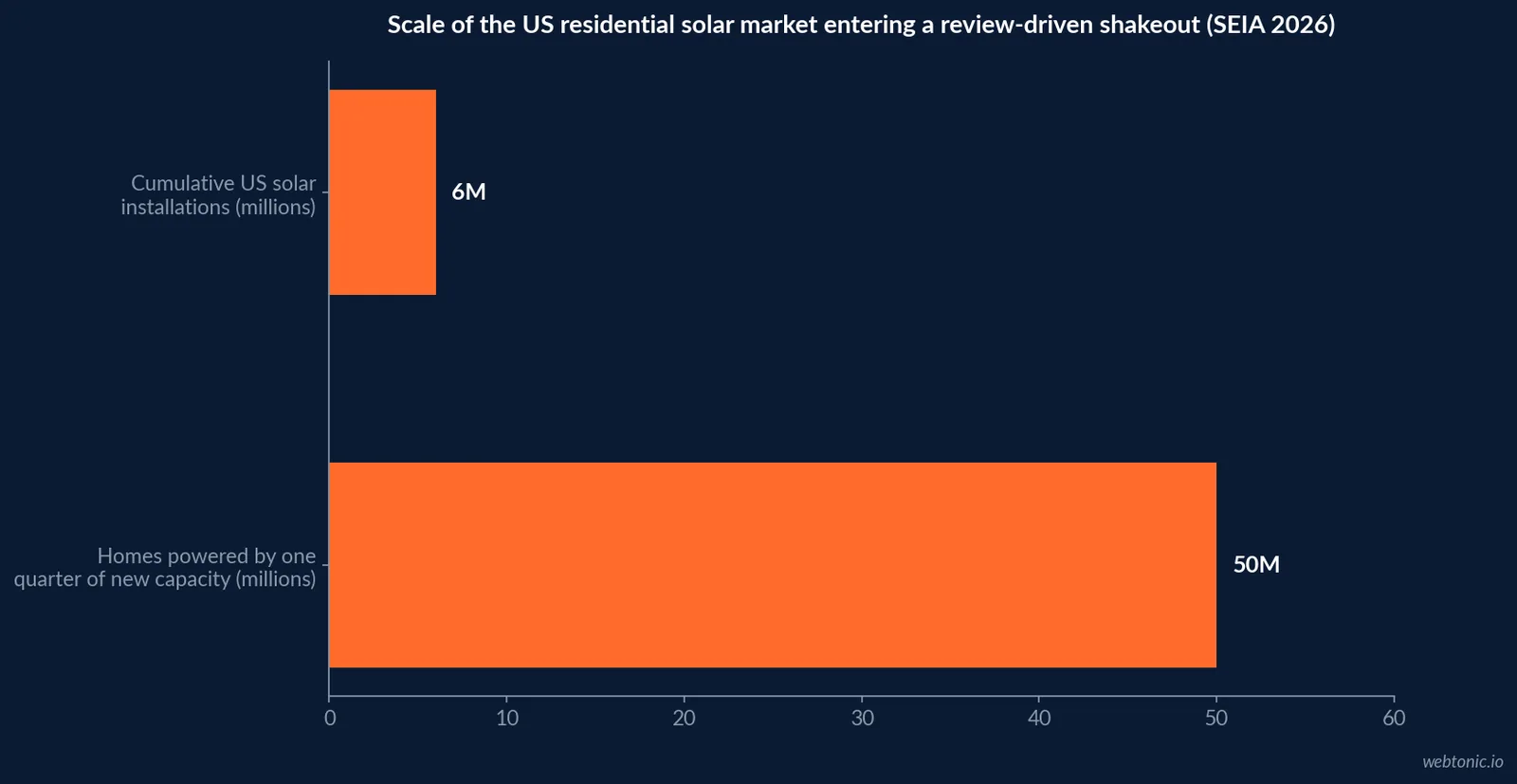
Whitespark's 2026 Local Search Ranking Factors survey, drawn from 47 local-search practitioners scoring 187 individual factors, puts Google Business Profile signals at roughly 32% of local ranking weight and review signals at 16-20% - reviews matter, but a complete, correctly categorized profile still outweighs them.
| Consumer trust threshold (cross-industry, 2026) | Figure | Source |
|---|---|---|
| Minimum review count to be considered | 20+ | BrightLocal LCRS 2026 |
| Minimum star rating to be considered | 4.5+ | BrightLocal LCRS 2026 |
| Review recency window still trusted | Last 3 months | BrightLocal LCRS 2026 |
| Weight of GBP profile signals in ranking | ~32% | Whitespark 2026 |
| Weight of review signals in ranking | 16-20% | Whitespark 2026 |
| GBP-sourced call conversion rate | 40-60% | Local-search benchmark, 2026 |
Where solar reviews actually live
| Platform | Trust model | 2026 note |
|---|---|---|
| Google Business Profile | Open - anyone with a Google account can post | Subject to Fake Engagement restrictions on violation |
| EnergySage marketplace | Screened - installers vetted before joining the platform | Review count and rating shown on each listed installer's profile |
| Yelp | Open, moderated - written review required with every rating | Filtered ~500,000 suspected AI-generated reviews in 2025 |
| Trustpilot | Open, AI-assisted moderation | Removed 4.5 million fake reviews in 2024, 7% of all posted |
| Better Business Bureau | Complaint-and-response ledger, not a star-review feed | Tracks resolution, not just sentiment |
The fake-review rules that apply to a solar sales cycle
The FTC's 16 CFR Part 465 rule (final August 2024) prohibits buying or selling fake reviews, prohibits compensating a customer conditioned on posting a specific sentiment, and prohibits undisclosed insider reviews - all live risks in a sales model that often puts a commissioned rep in the room at the point of signature, exactly when a review ask is easiest to make and easiest to make improperly. Google's parallel Fake Engagement policy can suspend a profile's ability to receive new reviews, unpublish existing ones, and post a public warning - a serious cost for an installer that depends on the map-pack click share above.
Building a compliant review-request cadence
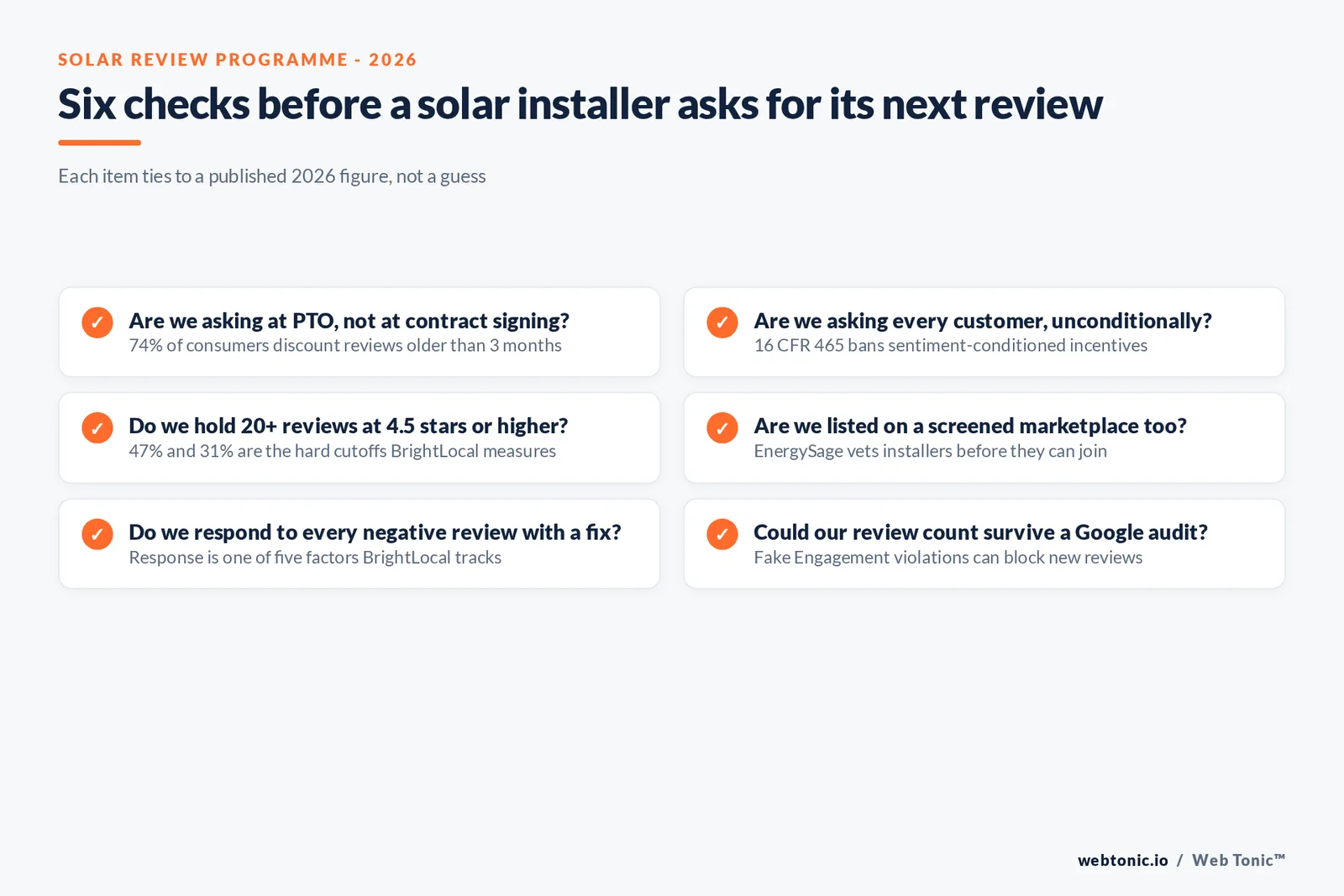
- Ask at system activation (PTO), not at contract signature - the customer has an actual result to describe, and 74% of consumers discount anything older than three months, so activation timing keeps the review current when the next prospect is searching.
- Ask every customer, unconditionally - the FTC rule targets sentiment-conditioned incentives, and selective asking produces the same inflated-then-collapsing rating pattern reviewers are specifically trained to discount.
- Diversify beyond Google - an EnergySage marketplace listing carries a pre-screening step Google does not, which matters more as buyers get pickier in a consolidating market.
- Respond to every negative review with the specific fix, not a generic apology - it is one of the five factors BrightLocal's panel says consumers weigh directly.
- Never offer a discount, referral bonus, or free upgrade in exchange for a star rating - that is the incentive structure 16 CFR 465 prohibits outright.
What review-management tools cost
Review-management platforms for home-services contractors are typically priced per location per month, scaling with request-automation volume and multi-crew reporting. Because list prices move and a solar installer's crew count varies widely, treat any specific number as a starting quote to verify on the vendor's own current pricing page rather than a fixed industry rate - and weigh it against the click multiplier above, not against a flat marketing budget line.
Where reputation work fits a broader acquisition plan
Review count and rating do not operate in isolation from the rest of an installer's acquisition stack. Installers running paid social campaigns for lead generation should expect creative built around a real review count to out-convert generic offer creative, since the same trust threshold buyers apply to a map-pack listing carries into an ad click. Installers investing in performance creative production should treat a current review screenshot as a standard creative asset, not an afterthought. This site's own conversion-rate benchmark data shows the same pattern across categories: trust signals move the rate a click turns into a lead more reliably than headline copy alone. Installers wanting help building that stack can start here.
| Self-audit question | Why it matters | 2026 benchmark |
|---|---|---|
| Do we hold 20+ reviews at 4.5 stars or higher? | 47% and 31% are the BrightLocal cutoffs | BrightLocal LCRS 2026 |
| Was our latest review within the last quarter? | 74% discount anything older | BrightLocal LCRS 2026 |
| Are we listed on a screened marketplace, not just Google? | Marketplace listings carry a vetting step Google lacks | EnergySage 2026 |
| Do we respond to every negative review with the fix applied? | Response is one of five weighted factors | BrightLocal LCRS 2026 |
| Could our review history survive a policy audit? | Fake Engagement violations can freeze new reviews | Google Business Profile Help |
Frequently Asked Questions
Do solar installers with more reviews actually get more business?
The clearest evidence is a ranking-weight study, not a close-rate study: Whitespark's 2026 Local Search Ranking Factors survey weights Google Business Profile signals at roughly 32% of the local-ranking formula versus 16-20% for review signals. In a category where 87% of “solar installer near me” searches surface a map pack first, losing rank on either input means never reaching the quote stage at all.
Why do reviews matter more for solar in 2026 specifically?
The installer base is consolidating. SEIA's Q2 2026 Solar Market Insight Report notes the bankruptcy of the second-largest national installer and an overall market contraction, following the loss of the 30% federal residential purchase tax credit for systems installed after December 31, 2025 (per the One Big Beautiful Bill Act, tracked by EnergySage). Fewer installers competing for a more price-sensitive buyer raises the cost of picking wrong, which is exactly the risk a review profile is supposed to reduce.
How many reviews and what star rating does a solar installer need?
BrightLocal's 2026 Local Consumer Review Survey - a cross-industry benchmark, not a solar-specific study - found 47% of consumers won't use a business with fewer than 20 reviews and 31% require 4.5 stars or higher. Those are the general floors a prospect brings into any home-improvement purchase, solar included, before your installer-specific numbers are even in view.
Can an installer be penalized by Google for fake or incentivized reviews?
Yes. Google's Fake Engagement policy allows the company to block a Business Profile from receiving new reviews for a set period, unpublish existing reviews found to violate the policy, and display a public warning that fake reviews were removed. The FTC's 16 CFR Part 465 rule adds civil-penalty exposure on top of that for buying, selling or incentivizing reviews with a required sentiment.
What do EnergySage and other marketplaces actually verify before publishing a review?
EnergySage operates as a quote marketplace that screens installers before allowing them to join the platform, and displays a review count and rating on each listed company's profile. That is a different trust model from an open platform like Google, where anyone can post: a marketplace review sits behind an installer-screening step the open platforms do not perform.
Sources
BrightLocal - Local Consumer Review Survey 2026
Whitespark - 2026 Local Search Ranking Factors
SEIA/Wood Mackenzie - Solar Market Insight Report Q2 2026
SEIA - 6 Million Solar Installations
EnergySage - Home Electrification Marketplace Report
EnergySage - screened installer marketplace listing example
FTC - Final rule banning fake reviews and testimonials (16 CFR 465)
Google Business Profile Help - Fake Engagement policy restrictions
Trustpilot - Trust Report 2025
Yelp - 2025 Trust & Safety Report