Table of contents
No named study prices a "solar marketing automation CPL" as its own metric - automation is sold as software priced by contact volume, and lead cost is decided by the media budget sitting on top of it. This page benchmarks what the platforms actually charge, how fast a routed lead needs a human, and what click-through rate an automated nurture sequence can realistically expect.
Key Takeaways
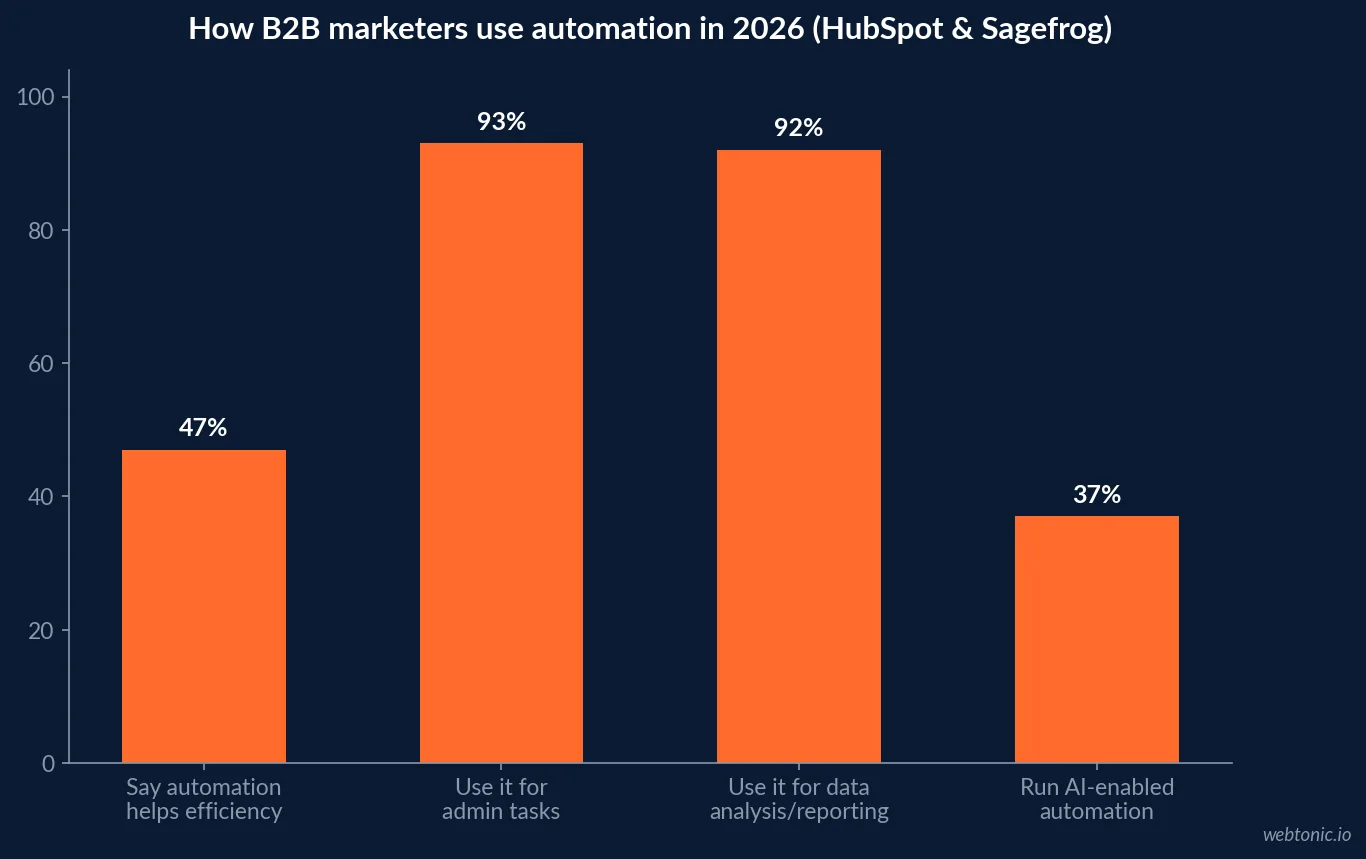
- 47% of marketers say automation makes their processes more efficient.
- 93% use automation for administrative tasks like scheduling and documentation.
- 92% use automation for data analysis and reporting.
- HubSpot Marketing Hub Starter runs USD 9 to 15 a month per seat for 1,000 contacts.
- HubSpot Professional is USD 800 a month for 2,000 contacts, plus a USD 3,000 setup fee.
- HubSpot Enterprise is USD 3,600 a month for 10,000 contacts, plus a USD 7,000 setup fee.
- Klaviyo's entry email plan is USD 20 a month for 251 to 500 profiles.
- Brevo's Starter tier is USD 9 a month, Standard USD 18, Professional USD 499.
- Zoho Marketing Automation leads B2B platform adoption at 44%.
- Salesforce Marketing Cloud follows at 42%, Pardot at 38%.
- HubSpot and Constant Contact tie at 29% adoption in the same survey.
- Marketing technology takes 15% of the average 2026 B2B budget increase.
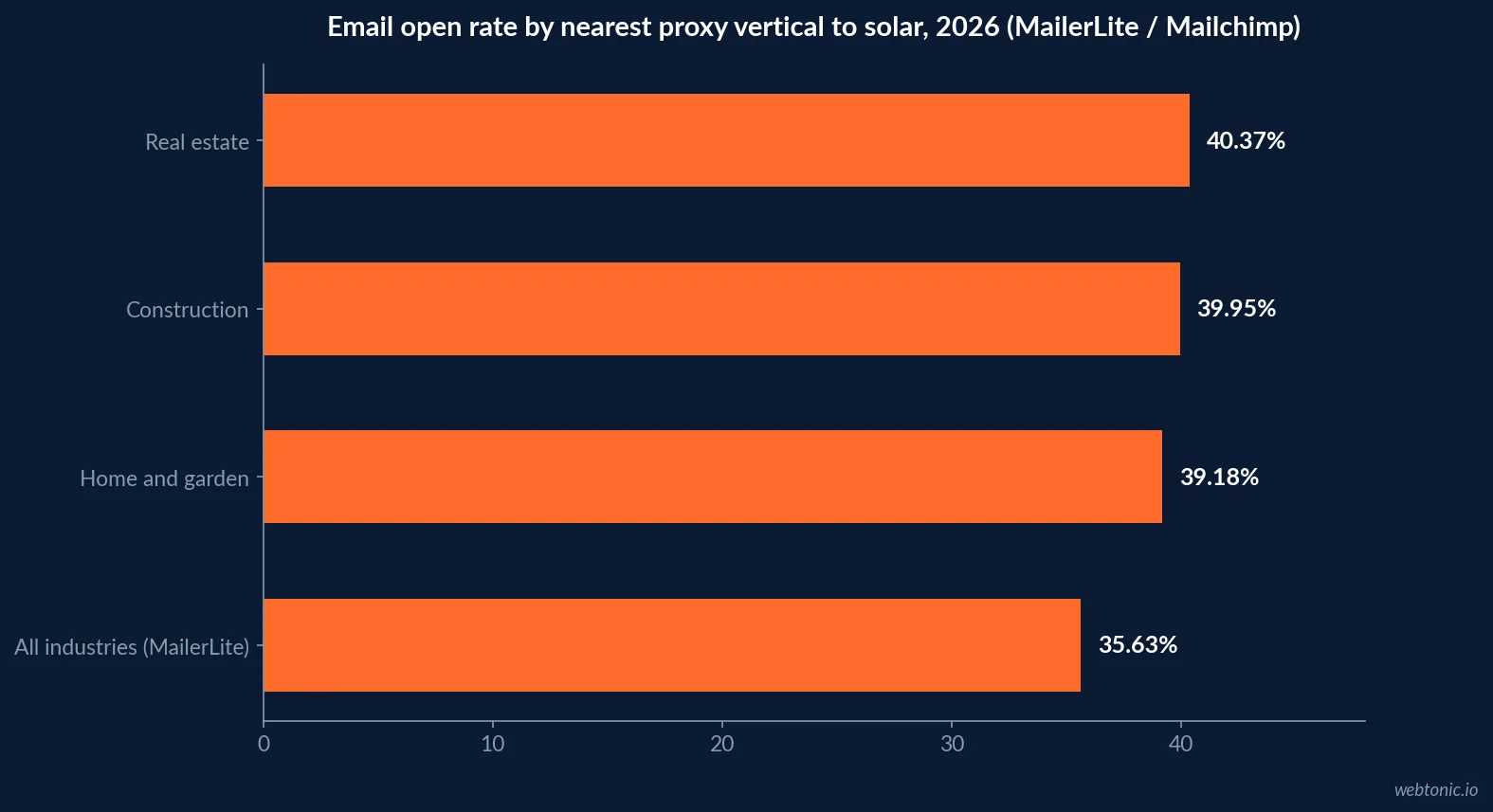
- Home and garden email carries a 39.18% open rate, the closest labelled proxy for solar.
- Its click rate sits at 1.75%, against a 2.09% all-industry average.
- Construction email opens at 39.95% with a 3.53% click rate.
- The cross-industry average email CTR is 2.5% per HubSpot's own 2025 figure.
- Contact odds on a sales lead fall fastest in the first hour (HBR, 2011 study).
- 37% of B2B marketers now run AI-enabled automation inside their stack.
Why there is no solar automation CPL to quote
Marketing automation platforms are priced as software: a monthly fee scaled to contacts or profiles, not to outcomes. HubSpot's own State of Marketing data reports that 47% of marketers say leveraging automation makes marketing processes more efficient, 93% use it for administrative tasks such as scheduling and documentation, and 92% use it for data analysis and reporting - none of that is a lead-cost claim.
What decides a solar lead's actual cost is the paid media sitting on top of the automation, which is a separate line item covered on our marketing automation statistics hub. Any single dollar figure quoted for "automation CPL" without naming the study behind it should be treated as unsourced.
| What automation is priced on (2026) | Published figure | Source | What it does NOT tell you |
|---|---|---|---|
| Efficiency perception | 47% say it helps | HubSpot State of Marketing | Not a cost or lead figure |
| Admin-task usage | 93% of marketers | HubSpot State of Marketing | Task share, not spend |
| Reporting/analysis usage | 92% of marketers | HubSpot State of Marketing | Task share, not spend |
| AI-enabled automation adoption | 37% of B2B marketers | Sagefrog 2026 | Feature adoption, not a rate card |
| Marketing technology budget share | 15% of 2026 increase | Sagefrog 2026 | Category share, not per-lead price |
What a routing workflow is actually built to solve
The reason installers buy automation is speed, not the software itself. The most-cited data point on lead response is still Harvard Business Review's 2011 analysis of roughly 15,000 sales leads, which found that contact odds drop sharply once follow-up passes the first hour and that the first five minutes carry the best odds of all. It is a 2011, cross-industry finding - not a solar study - but it is the argument every routing workflow is built on: remove the human delay, not the human.
| Response window | What HBR's 2011 data implies | Automation's role | Manual equivalent |
|---|---|---|---|
| Under 5 minutes | Highest recorded contact odds | Instant routing + auto-reply | A rep watching an inbox live |
| 5 to 60 minutes | Odds falling quickly | Queue + escalation rules | A callback list worked in order |
| 1 to 24 hours | Odds fall further still | Drip nurture takes over | A next-day callback sheet |
| Beyond 24 hours | Lowest recorded contact odds | Long-cycle nurture sequence | A lead going cold in a spreadsheet |
What the platforms actually charge
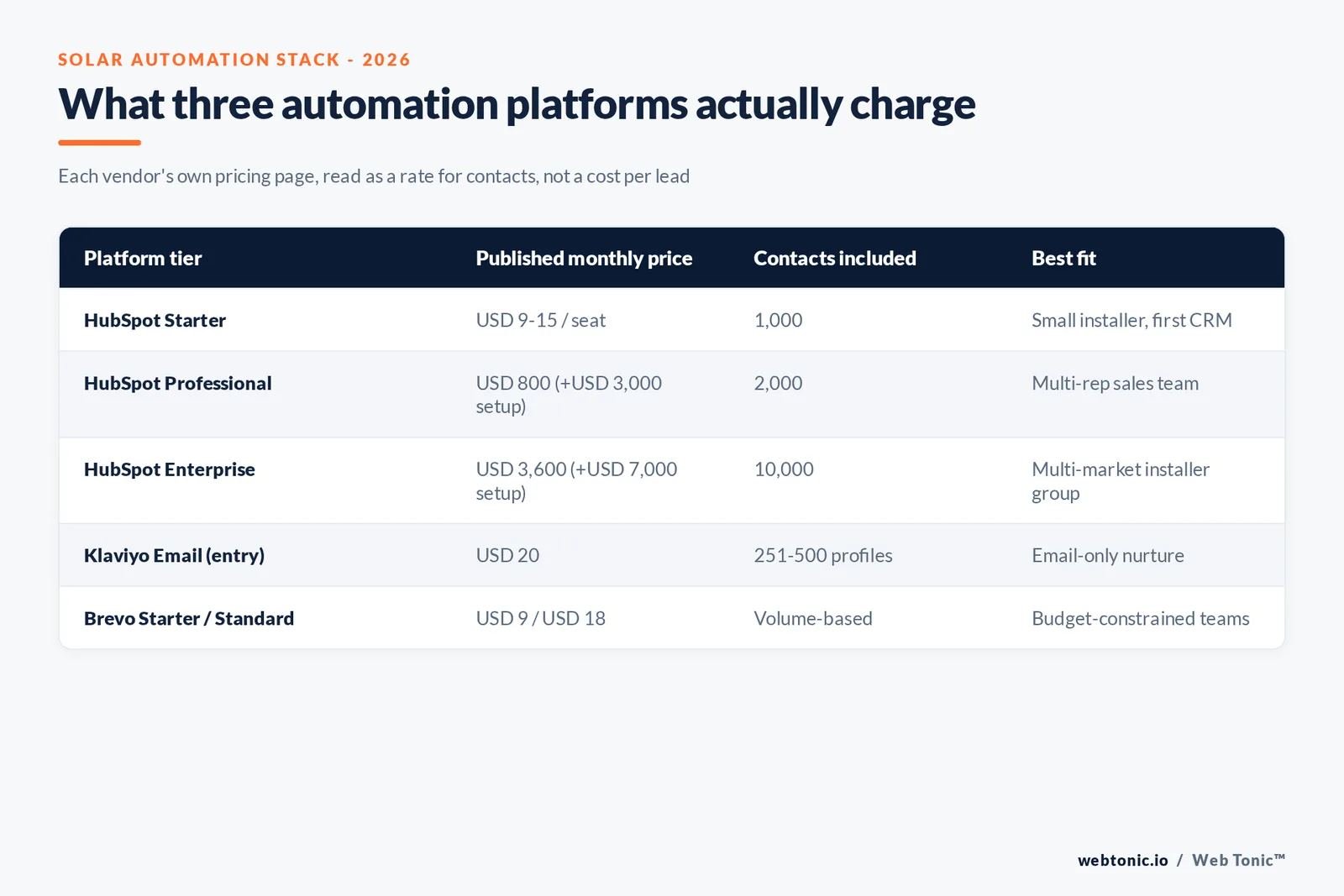
Three vendors publish their own tiers in enough detail to compare directly. HubSpot's own Marketing Hub pricing guide lists Starter at USD 9 to 15 a month per seat for 1,000 marketing contacts, Professional at USD 800 a month for 2,000 contacts (3 seats included) plus a USD 3,000 one-time onboarding fee, and Enterprise at USD 3,600 a month for 10,000 contacts (5 seats) plus a USD 7,000 onboarding fee. Klaviyo's own pricing page lists a free plan (250 profiles, 500 email sends and 150 SMS credits a month) and an entry email plan at USD 20 a month for 251 to 500 profiles. Brevo's own pricing page lists Starter at USD 9 a month, Standard at USD 18 a month and Professional at USD 499 a month.
| Platform tier | Published monthly price | Contacts/profiles included | Source |
|---|---|---|---|
| HubSpot Marketing Hub Starter | USD 9-15 per seat | 1,000 | HubSpot pricing guide |
| HubSpot Marketing Hub Professional | USD 800 (+USD 3,000 setup) | 2,000 | HubSpot pricing guide |
| HubSpot Marketing Hub Enterprise | USD 3,600 (+USD 7,000 setup) | 10,000 | HubSpot pricing guide |
| Klaviyo Email plan (entry) | USD 20 | 251-500 profiles | Klaviyo pricing page |
| Brevo Starter / Standard / Professional | USD 9 / USD 18 / USD 499 | Varies by send volume | Brevo pricing page |
Who is actually running which platform
No single platform owns this market. Sagefrog's 2026 B2B Marketing Mix Report - its 19th annual edition, surveying B2B marketers across healthcare, industrial, financial services and technology - found Zoho Marketing Automation leading adoption at 44%, Salesforce Marketing Cloud at 42%, Pardot (Account Engagement) at 38%, Mailchimp at 37%, Marketo at 33%, and HubSpot and Constant Contact tied at 29%. Most respondents run more than one tool at once, which is the honest state of most installers' stacks too.
| Platform | 2026 B2B adoption share | Note |
|---|---|---|
| Zoho Marketing Automation | 44% | Leads adoption, no dominant platform overall |
| Salesforce Marketing Cloud | 42% | Common where sales already runs Salesforce |
| Pardot (Account Engagement) | 38% | Tied to the Salesforce ecosystem |
| Mailchimp | 37% | Frequently a secondary tool, not primary CRM |
| Marketo (Adobe) | 33% | More common at enterprise contact volumes |
| HubSpot | 29% | Tied with Constant Contact in this survey |
What CTR to actually expect from a nurture sequence
Neither Mailchimp nor MailerLite publish a dedicated Solar or Energy category, so the honest read is the nearest labelled vertical, not the cross-industry average. MailerLite's 2026 benchmarks, built from 3.6 million campaigns, put Home and garden at a 39.18% open rate and a 1.75% click rate and Construction at 39.95% open and 3.53% click - both a meaningfully different read than the 2.09% all-industry click average in the same dataset. HubSpot's own cross-industry figure puts average email CTR at 2.5% (HubSpot, 2025 data).
| Vertical (closest proxy) | Open rate | Click rate | Source |
|---|---|---|---|
| Home and garden | 39.18% | 1.75% | MailerLite 2026 |
| Construction | 39.95% | 3.53% | MailerLite 2026 |
| Real estate | 40.37% | 1.72% | MailerLite 2026 |
| All industries (MailerLite) | n/a | 2.09% | MailerLite 2026 |
| All industries (HubSpot) | n/a | 2.5% | HubSpot 2025 |
Where the budget for this actually comes from
Sagefrog's same 2026 survey found marketing technology taking 15% of the average marketer's planned 2026 budget increase, behind content marketing at 30% and AI tools at 28%, and ahead of email marketing platforms specifically at 11%. That ordering matters for an installer deciding what to fund first: the platform line is real money, but it is rarely the largest line in the plan.
| 2026 budget-increase priority | Share of respondents | Source |
|---|---|---|
| Content marketing | 30% | Sagefrog 2026 |
| AI tools and applications | 28% | Sagefrog 2026 |
| Customer experience / journey optimization | 26% | Sagefrog 2026 |
| Marketing technology | 15% | Sagefrog 2026 |
| Email marketing platforms and campaigns | 11% | Sagefrog 2026 |
What installers should actually be measuring
HubSpot's own 2026 data reports the five metrics marketers say matter most this year: lead quality and MQLs at 39%, lead-to-customer conversion rate at 34%, return on investment at 31%, customer acquisition cost at 30%, and lead generation volume at 29%. Notice that raw lead volume ranks last of the five - the industry's own attention has already shifted away from "more leads" and toward "better leads that close," which is the argument for nurture quality over nurture speed once initial routing is solved.
| What marketers track most in 2026 | Share ranking it top-5 | Source |
|---|---|---|
| Lead quality / MQLs | 39% | HubSpot State of Marketing 2026 |
| Lead-to-customer conversion rate | 34% | HubSpot State of Marketing 2026 |
| Return on investment | 31% | HubSpot State of Marketing 2026 |
| Customer acquisition cost | 30% | HubSpot State of Marketing 2026 |
| Lead generation volume | 29% | HubSpot State of Marketing 2026 |
Why deliverability decides whether any of this works
A cheap platform that lands in spam is not cheap. ActiveCampaign's own customer data reports that its users see a 93.4% deliverability rate, against an industry average of 83.1% - a ten-point gap that changes every open-rate and click-rate figure quoted above before a single automation rule even runs. Ask any vendor for their deliverability number before comparing their CTR claims to anyone else's.
Why half of buyers are not getting their money's worth
Buying the platform is not the same as running it well. Ascend2's own State of Marketing Automation research found that 54% of marketers say they are not using their automation tools to their fullest potential, and that two-thirds report their tools are only somewhat or not at all integrated with the rest of their stack. A solar installer paying for HubSpot Professional or Klaviyo's Email+SMS tier and running only broadcast blasts through it is paying enterprise software prices for a basic newsletter tool.
| Underutilization signal (Ascend2) | Share of marketers | What it costs a solar installer |
|---|---|---|
| Not using automation to its fullest potential | 54% | Paying for workflows never built |
| Tools only somewhat or not integrated | 66% (two-thirds) | Manual re-entry between CRM and ad platforms |
| Say quality data would amplify automation's success | Over half | Bad contact data caps any platform's ceiling |
How to read a CPL claim in this category
Treat any quoted "solar automation cost per lead" the same way you would treat an unverified testimonial: ask which platform, which media channel, which market and which month it was measured in. The vendors above price contacts and message volume, not results, and the closest thing to a published outcome benchmark is the CTR-by-vertical data shown here - which is still a proxy, not a solar-specific study. If a number cannot be traced to a named, dated source, it is a guess wearing a decimal point.
For a workflow build that actually routes and nurtures solar leads on your own numbers, our growth marketing practice or our data and analytics practice can model it against your CRM; or read our breakdown of what the paid media side actually costs before you size the stack.
Frequently Asked Questions
What does solar marketing automation actually cost per month?
It is priced by contacts, not by lead. HubSpot's own Marketing Hub pricing runs Starter at USD 9 to 15 a month per seat for 1,000 contacts, Professional at USD 800 a month for 2,000 contacts plus a USD 3,000 onboarding fee, and Enterprise at USD 3,600 a month for 10,000 contacts plus a USD 7,000 onboarding fee (HubSpot's own pricing guide, 2026). Klaviyo's entry email plan is USD 20 a month for 251 to 500 profiles, and Brevo's Starter tier is USD 9 a month (both vendors' own pricing pages, 2026). None of these vendors publish a cost-per-solar-lead figure, because the tool prices contacts, not outcomes.
Is there a real cost-per-lead benchmark for solar automation specifically?
No. No vendor or association study we could verify prices a 'marketing automation CPL' as its own metric, for solar or any other industry - automation is priced as software, and lead cost is a function of the media buy sitting on top of it. Treat any single CPL number quoted for solar automation as unsourced until the study behind it is named and dated.
How fast does a solar lead actually need a response?
The most-cited study is still Harvard Business Review's 2011 analysis of 15,000 sales leads, which found contact odds fall sharply once a call passes the first hour, with the first five minutes the highest-odds window. It is a 2011 finding on a b2c/b2b sales-lead sample, not a solar-specific study, but it is the reason routing workflows exist at all - automation's job is to remove the humans from that clock.
What email click-through rate should a solar installer expect from automated nurture?
There is no published Solar or Energy vertical in the major benchmark sets, so installers should read the closest labelled category rather than the cross-industry average. MailerLite's 2026 benchmarks (3.6 million campaigns) put Home and garden at a 39.18% open rate and 1.75% click rate, and Construction at 39.95% open and 3.53% click - both closer proxies than the 2.09% all-industry click average from the same dataset.
Which automation platform do most B2B marketers actually run?
Sagefrog's 2026 B2B Marketing Mix Report (19th edition survey across healthcare, industrial, financial and technology respondents) found no single platform dominant: Zoho Marketing Automation led at 44%, Salesforce Marketing Cloud at 42%, Pardot at 38%, Mailchimp at 37%, Marketo at 33%, and HubSpot and Constant Contact tied at 29%. Most companies run more than one.
Sources
HubSpot - Marketing statistics (State of Marketing 2026)
HubSpot - Marketing Hub pricing guide
Klaviyo - Pricing
Brevo - Pricing
Sagefrog - 2026 B2B Marketing Mix Report
MailerLite - Email marketing benchmarks by industry and region, 2026
Mailchimp - Email marketing benchmarks
Harvard Business Review - The Short Life of Online Sales Leads (2011)
Web Tonic - Marketing automation statistics hub